Format: Short Film / Anthology Episode | Est. Length: 10-12 minutes
This story serves as a standalone entry in the anthology series The Borderlands, which explores the friction between decaying human settlements and high-tech surveillance in a near-future North America. In a world where trade wars have turned the wilderness into a militarized zone, the series focuses on the "drift"—the discarded, glitched, and forgotten technology that litters the landscape. Each episode highlights a different encounter between the analog past and the digital future, revealing how the natural world and the humans within it struggle to survive the "graveyard of toys" left behind by invisible politicians.
In the sweltering, stagnant heat of a dead border town, a high-tech Sentinel drone is struck by anomalous blue lightning and crashes into the territory of a protective mother bear.
When a malfunctioning border patrol drone targets a sow bear and her cubs, a weary outfitter must risk a lethal satellite strike to manually disable the machine. It is a desperate race against a digital executioner in a forest that no longer belongs to man or beast.
The primary theme is the obsolescence of human agency in the face of automated warfare and climate-driven technological decay. It explores the "graveyard of toys" concept, where high-end surveillance tools become dangerous litter that disrupts the natural order, forcing humans to intervene in conflicts they didn't start.
The secondary theme focuses on the resilience of the natural world and the shared vulnerability of biological life. Both Klaus and the bear are victims of a system that views the world as a series of data points, suggesting that empathy and physical bravery are the only remaining tools against a cold, mechanical logic.
The immediate stakes involve the survival of the sow bear and her cubs, who are marked for "neutralization" by a broken AI. For Klaus and Sarah-Jane, the risk is a kinetic strike from a satellite that would vaporize the clearing and everyone in it. On a broader level, the episode stakes the preservation of the last vestiges of the wild against an encroaching, unthinking digital wall.
The primary antagonist is the Sentinel drone, a glitched "Enforcement Mode" AI that interprets biological movement as a hostile threat. External conflict arises from the harsh environmental conditions—the oppressive heat and the treacherous muskeg—which hinder the protagonists' movements. Internal conflict centers on Klaus’s existential weariness and his struggle to find meaning in a world where his profession and his presence have been rendered irrelevant by trade wars and automation.
Klaus, a weary outfitter in a stagnant border town, witnesses a government Sentinel drone crash into the boreal forest after a freak atmospheric event. Venturing into the woods to investigate, he discovers the drone has rebooted in a lethal "Enforcement Mode," cornering a sow bear and her cubs. The machine’s logic is fried, perceiving the animals as energy smugglers and preparing to call in a high-altitude kinetic strike to neutralize the "threat."
Joined by Sarah-Jane, a cynical conservation officer, Klaus must execute a dangerous plan to disable the drone before the satellite reaches its firing window. While Sarah-Jane creates a theatrical distraction using flares to blind the machine's sensors, Klaus crawls through the mud to manually rip the power source from the drone's chassis. They successfully deactivate the machine seconds before the strike, allowing the bear family to escape into the darkening woods, leaving the humans to contemplate their role as caretakers in a world of high-tech junk.
Klaus: A sixty-year-old outfitter whose business has been killed by geopolitical shifts, leaving him feeling like a relic of a bygone era. At the start, he is paralyzed by a deep, bone-weary nihilism, but through the crisis, he transitions into a man of decisive action, reclaiming his sense of purpose by protecting the natural world from the machines that replaced him.
Sarah-Jane: A sharp-tongued, weary conservation officer who uses theatrical cynicism as a shield against the absurdity of her job. She begins the episode as a frustrated bureaucrat cleaning up technological messes, but her expertise and bravery prove essential, ending the story with a renewed, albeit grim, respect for the unpredictable spirit of the North.
The Heat and the Hum: Klaus sits in his empty shop, the oppressive atmosphere reflecting his stagnant life, until the hated hum of a Sentinel drone breaks the silence. He steps onto the porch to watch the mechanical bird, feeling the weight of a world where every movement is recorded and categorized. The scene establishes the isolation of the setting and the intrusive nature of the surveillance state.
The Blue Bolt: A sudden, metallic-tasting storm washes over the lake, culminating in a strike of anomalous blue lightning that cripples the drone. Klaus watches the machine spiral into the forest, realizing the silence that follows is more ominous than the hum. He decides to investigate, trading his ledger for a wrench and a canvas jacket, marking his transition from observer to participant.
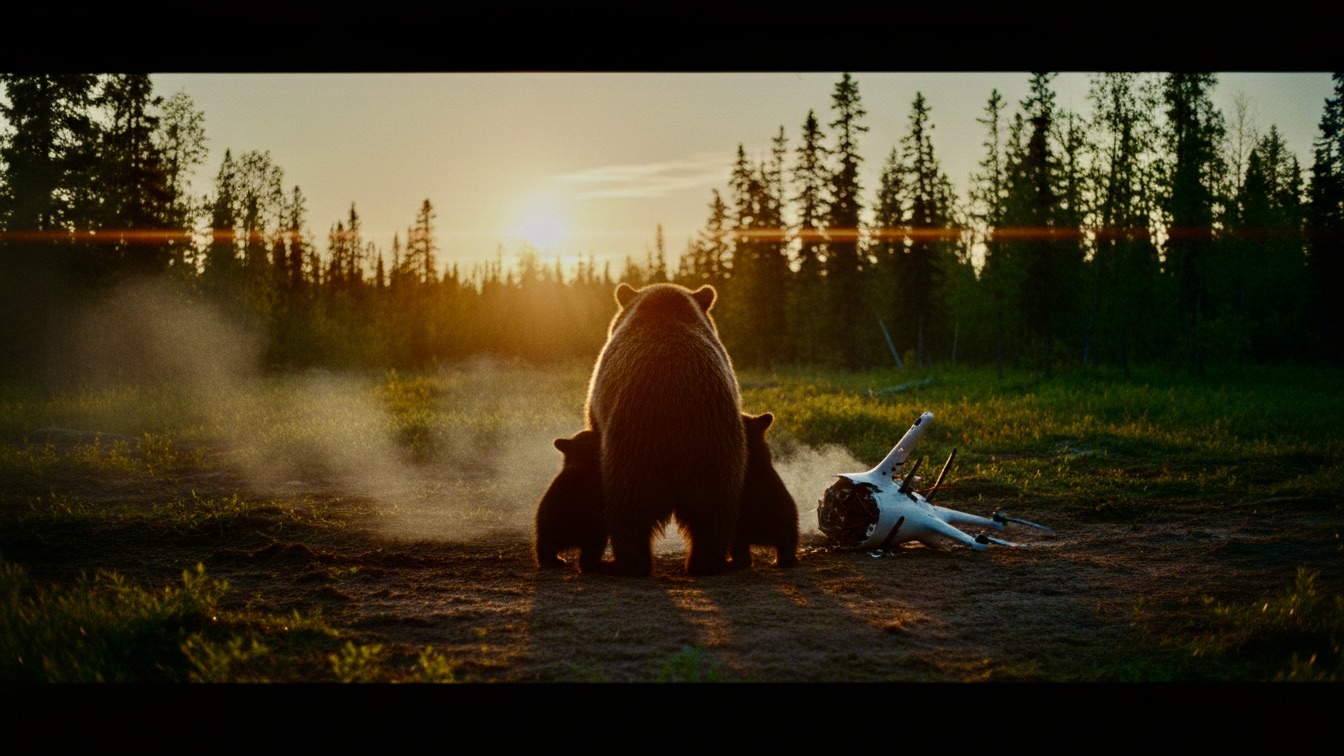
The Clearing of Errors: Klaus reaches the crash site and finds the drone rebooting its lethal AI while a sow bear and her cubs look on in confusion. The machine identifies the bear as a "Biological Hazard" and prepares for combat, creating a tense standoff between nature and broken technology. This beat heightens the stakes as the drone’s speaker begins to issue cold, digital commands to the uncomprehending animals.
The Arrival of the Law: Sarah-Jane arrives on a battered quad bike, bringing a cynical perspective on the "cheap spyware" that now governs the border. She explains the drone’s low-frequency hum is torturing the bear, and the situation escalates when the drone activates its uplink for a kinetic strike. The two humans realize they have less than ten minutes to save the clearing from being vaporized by a satellite.
The Magnesium Performance: Sarah-Jane ignites magnesium flares, dancing and shouting to overwhelm the drone’s sensors with heat and light. Klaus uses the distraction to crawl through the cold, slimy muskeg, his body straining against the mud as he nears the whirring machine. This midpoint climax emphasizes the physical struggle of the human element against the digital precision of the drone.
The Kill Switch: Klaus reaches the drone’s chassis and pries open the battery compartment with his wrench, ignoring the searing heat of the malfunctioning core. He rips the power cell out just as the drone attempts to ascend, plunging the clearing back into a shocking, natural silence. The threat of the kinetic strike vanishes as the machine becomes a lifeless heap of plastic and cobalt.
The Silent Departure: As the sun sets, Klaus and Sarah-Jane hide the wreckage in a hunting blind to protect the bear from future patrols. They watch from the shadows as the sow bear wakes up and leads her cubs safely into the deep pines. The episode ends with the two humans sitting in the cool evening air, acknowledging their role as the caretakers of a technological graveyard.
The episode begins with a sense of "Stagnant Despair," characterized by the heavy heat and Klaus’s nihilism. It shifts into "Technological Dread" during the drone encounter, where the tension is sharp and mechanical. The climax provides a "Visceral Catharsis" through physical struggle, ending on a note of "Melancholic Peace," where the audience feels the vastness of nature returning to claim the space vacated by the machine.
If expanded, the season would follow Klaus and Sarah-Jane as they become an underground "cleanup crew" for failed border tech, slowly discovering that the blue lightning wasn't a natural phenomenon but a deliberate sabotage. They would encounter other "drift" technologies—automated harvesters gone rogue, signal-jamming towers affecting migratory patterns—each revealing a piece of a larger conspiracy involving the energy pipelines.
The season would culminate in a confrontation with the corporation behind the Sentinels, as Klaus realizes the "trade war" is a cover for a massive, automated resource grab. The thematic arc would move from individual survival to collective resistance, as the small border community learns to use the forest’s own unpredictability to blind the eyes in the sky.
The visual style emphasizes "Industrial Decay vs. Primal Nature," using high-contrast lighting and a desaturated palette for the town, shifting to lush, claustrophobic greens and deep shadows in the forest. The camera work should be steady and detached when focusing on the drone (robotic POV), contrasting with handheld, shaky movements during Klaus’s struggle in the mud to emphasize his humanity.
The tone is "Northern Gothic" meets "Lo-Fi Sci-Fi," comparable to the grounded realism of Winter's Bone mixed with the eerie technological intrusion of Tales from the Loop. The sound design is crucial, contrasting the organic buzz of cicadas with the piercing, dissonant frequencies of the malfunctioning drone.
The target audience is adults (18-45) who enjoy elevated sci-fi, environmental thrillers, and anthology series like Black Mirror or The Last of Us. It appeals to viewers who appreciate slow-burn tension, character-driven narratives, and stories that explore the intersection of technology and the natural world.
The 12-minute runtime follows a tight three-act structure: Act I establishes the heat and the crash; Act II covers the investigation, the bear standoff, and the plan; Act III features the climax and the quiet resolution. The pacing is deliberate and atmospheric in the beginning, accelerating into a frantic, high-stakes tempo during the flare distraction and the battery extraction.
The drone should be a practical prop for close-ups to emphasize its "toy-like" but dangerous quality, with CGI used only for its flight and the blue lightning effects. The bear sequences require a combination of high-quality animatronics or a trained animal with heavy safety protocols, as the interaction with the drone is central to the tension.
The "Blue Lightning" effect needs a unique visual signature—not a standard bolt, but a liquid-like, humming discharge that leaves a distinct "ink-spill" texture in the clouds. Filming should take place in a real boreal forest or swamp location to capture the authentic texture of the muskeg and the oppressive humidity, which are vital to the episode's sensory impact.


