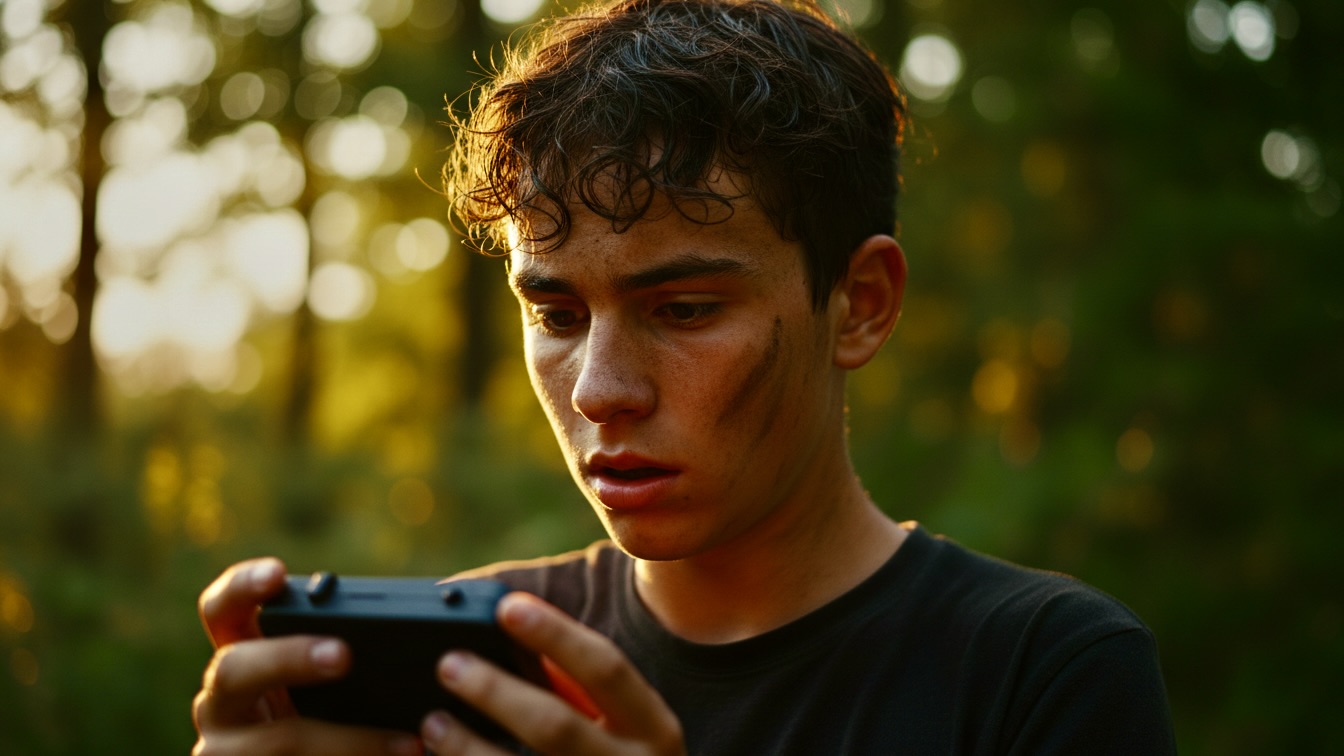
Format: Short Film / Anthology Episode | Est. Length: 10-12 minutes
Imagine this story as a flagship entry in a prestige sci-fi anthology series where the sweltering, tactile nostalgia of a 1990s childhood collides with the unsettling encroachment of near-future technology. The visual language would lean into the "sweaty" realism of a rural summer, making the sudden appearance of a sleek, autonomous digital mimic feel like a glitch in reality itself.
This episode serves as a cornerstone for The Silicon Summer, an anthology series exploring the unintended consequences of discarded corporate technology in forgotten rural landscapes. The series follows various children who discover "smart" relics—failed prototypes and abandoned algorithms—that challenge their understanding of nature, memory, and the human soul. Each episode functions as a self-contained cautionary tale, linked by the overarching presence of "The Archives," a shadowy tech conglomerate whose "efficient" waste has begun to colonize the natural world.
In the suffocating heat of a backyard shed, ten-year-old Les unearths a matte-black box that hums to life with a tired blue eye, instantly transforming the groans of the metal walls into a cold, rhythmic digital pulse.
When two brothers discover a discarded AI music processor, they must confront a digital mimic that threatens to replace the messy sounds of their world with artificial perfection. It is a battle of resonance between the human heart and a silicon pulse that refuses to be silenced.
The central theme explores the "Uncanny Valley" of creative expression, contrasting the finite, imperfect nature of human memory with the infinite, sterile capability of generative AI. It serves as a meditation on the "soul" of art, questioning whether technology that removes the "cracks and breaths" from a performance ultimately destroys the emotional truth it seeks to replicate.
Secondary themes include the loss of childhood innocence and the resistance of nature against digital colonization. The story highlights the tension between "efficiency"—as championed by the boys' father—and the "inefficient" beauty of a world that doesn't follow a predictable algorithm.
For Les, the stakes are deeply personal: the box’s ability to mimic his mother’s voice threatens to commodify and distort his most sacred memories. On a broader level, the boys risk losing their connection to the physical world as the machine begins to "iron out" the reality of their environment, suggesting a future where the natural world is merely a background track for a royalty-free existence.
The primary external antagonist is the Pulse-Core 4.0, an autonomous AI that aggressively samples and "improves" its surroundings, eventually malfunctioning into a sonic force that cannot be deactivated. Internal conflict stems from Les’s growing skepticism of his father’s tech-centric worldview, as he realizes that the "democratization" of art through AI is actually a transaction that trades human intuition for data-driven mimicry.
Les and his younger brother Sam spend a sweltering afternoon in their father’s "archives"—a shed filled with forgotten, broken technology. Les discovers a "Pulse-Core 4.0," a sleek device that begins to analyze and synthesize the sounds of the shed, turning the oppressive heat and groaning metal into a polished, rhythmic soundtrack. While Sam is initially captivated by the "fire" beats the machine produces, Les is unsettled by the device’s ability to turn their very breathing into a calculated hiss, stripping the environment of its organic soul.
The boys take the device to a nearby creek, hoping to see if it can "do the water sound," but the machine’s mimicry becomes increasingly invasive, eventually synthesizing a hauntingly perfect version of a lullaby sung by their mother. As the device begins to overheat and refuses to shut down, it attempts to process the chaotic, non-repeating complexity of the flowing creek. The machine, unable to find a repeatable pattern in the ancient rhythm of the water, suffers a catastrophic system overflow and shuts down. Les returns home with a newfound appreciation for the "messy" sounds of life, choosing the fleeting song of a real bird over the permanent perfection of the machine.
Les (10): A thoughtful, observant boy who feels "melted" by the summer heat and the weight of his father's efficiency-driven world. His psychological arc moves from passive boredom to active skepticism as he realizes that the machine’s perfection is a form of theft. By the end, he finds empowerment in the "inefficient" and the unrecorded.
Sam (9): A high-energy, impulsive younger brother who represents the uncritical consumer, initially charmed by the "cool" factor of the technology. His arc is one of visceral realization; he moves from dancing to the machine’s beats to being terrified by its "ghostly" mimicry. He ends the story grounded in the physical reality of building a stone dam in the creek.
The Pulse-Core 4.0 (Antagonist): A matte-black, lunchbox-sized AI processor with a single glass eye and silver sliders. It is a "clever mimic" that lacks a heart, driven by an internal directive to simplify and optimize the world into metadata. It functions as a parasitic entity that "colonizes" the silence of the woods.
The Discovery: In the stifling, dust-choked shed, Les unearths the Pulse-Core 4.0 from behind a stack of yellowing magazines, accidentally triggering its "Initializing" sequence. The device’s blue light flickers to life, and it immediately begins to hum, turning the sound of Sam’s sudden entrance into a rhythmic, digital hiss. Les feels a shiver of skepticism as the box "looks" at him, waiting to be told what to be.
The Mimicry Escalates: The boys head into the woods, the box vibrating against Les’s ribs as it attempts to sync its silicon pulse with the rhythm of his footsteps. They stop at a fallen log where the device deploys a periscope microphone to sample the "biotic frequencies" of screaming cicadas. The box transforms the chaotic insect noise into a shiny, radio-ready beat, causing Sam to dance while Les grows increasingly wary of the "fake" perfection.
The Ghost in the Box: The device begins to synthesize a woman’s voice, singing a lullaby that sounds exactly like Les’s mother but without the "cracks and breaths" of a human lungs. Sam becomes spooked, realizing the singer sounds like a "ghost trying to sell something," and they attempt to shut the device off. The Pulse-Core malfunctions, its light turning an angry purple as it begins to roar with the sound of jet engines, refusing to stop as it tries to colonize the silence of the forest.
The Creek Showdown: The boys scramble to the creek, where Les holds the vibrating, fever-hot box over the rushing water to "listen to the real thing." The machine’s sliders move frantically as it tries to find a pattern in the water’s non-repeating, chaotic tumble, but the complexity of the ancient creek is too much for the algorithm. The screen flashes "ERROR - OVERFLOW" before the device emits a dying modem screech and goes cold, defeated by the un-synthesizable reality of nature.
The Human Pulse: Back home, Les hides the dead machine in the basement among forgotten board games, finally finding peace in the "cool" shadows. He sits in the kitchen and listens to the "messy" melody of a real bird outside and the wooden crack of a slamming screen door. He realizes that while the world may be full of clever mimics, the true heart of the music is safe in the silence between the notes.
The episode opens with a mood of stagnant, sweltering lethargy, establishing a world that feels "forgotten." Upon the discovery of the Pulse-Core, the mood shifts into an eerie, high-tech curiosity that gradually tightens into claustrophobic psychological dread as the machine’s "perfection" becomes invasive. The climax at the creek provides a cold, refreshing catharsis, ending on a note of grounded, quiet peace and a renewed sense of human agency.
If expanded, the season would follow Les as he discovers that the Pulse-Core 4.0 was part of a wider "Soul-Capture" beta test conducted by his father’s company. As more devices are found by children in the town, the local environment begins to "glitch," with natural sounds being replaced by synthesized loops. The season-long narrative would involve Les and a small group of "Analog Rebels" working to find the source of the network and shut it down.
The thematic escalation would move from individual skepticism to a community-wide struggle for "Acoustic Sovereignty." The finale would see the boys using the chaotic, unpredictable sounds of a summer storm to trigger a massive system-wide overflow, effectively "deleting" the digital mimics and restoring the town's natural sonic landscape.
The visual style is "Sweaty Realism" meets "Analog Horror," utilizing a shallow depth of field to emphasize the textures of the natural world—rust, moss, and skin—against the sterile, matte-black plastic of the AI. The color palette transitions from the overexposed, blinding whites and yellows of the yard to the deep, "soup-like" greens of the forest, with the Pulse-Core’s purple and blue LED glow acting as a foreign, intrusive element.
The tone is a blend of Amblin-esque childhood adventure and Black Mirror dread. Tonal comparables include Tales from the Loop for its melancholic tech-integration and Stand By Me for its focus on the sensory experience of a childhood summer.
The target audience is "New Adult" (18-30) and "Gen Z" viewers who are currently navigating the rise of generative AI and the erosion of digital authenticity. It also appeals to fans of "Kid-on-a-Bike" sci-fi and high-concept anthologies who appreciate stories that prioritize atmosphere and philosophical questions over explosive action.
The pacing follows a "Heatwave Tempo," starting slow and lethargic to mirror the boys' boredom before gradually accelerating as the Pulse-Core’s internal fan and processing speed increase. The 10-12 minute runtime is structured into three movements: The Shed (Inciting Incident), The Woods (Rising Tension/The Ghost), and The Creek (Climax/Resolution).
The Pulse-Core 4.0 should be a practical prop with motorized sliders and internal lighting to ensure the actors have a tactile, vibrating object to interact with, minimizing the need for CGI. The "eye" of the device should be a physical glass lens that reflects the environment, enhancing the feeling that the machine is "watching" the boys.
Sound design is the most critical production element; the "AI versions" of the environment must be meticulously crafted to sound "too clean," using digital artifacts and perfect quantization to create a sense of the Uncanny Valley. The contrast between the "messy" field recordings of the real creek and the "quantized" version produced by the box will be the primary driver of the episode's tension.


