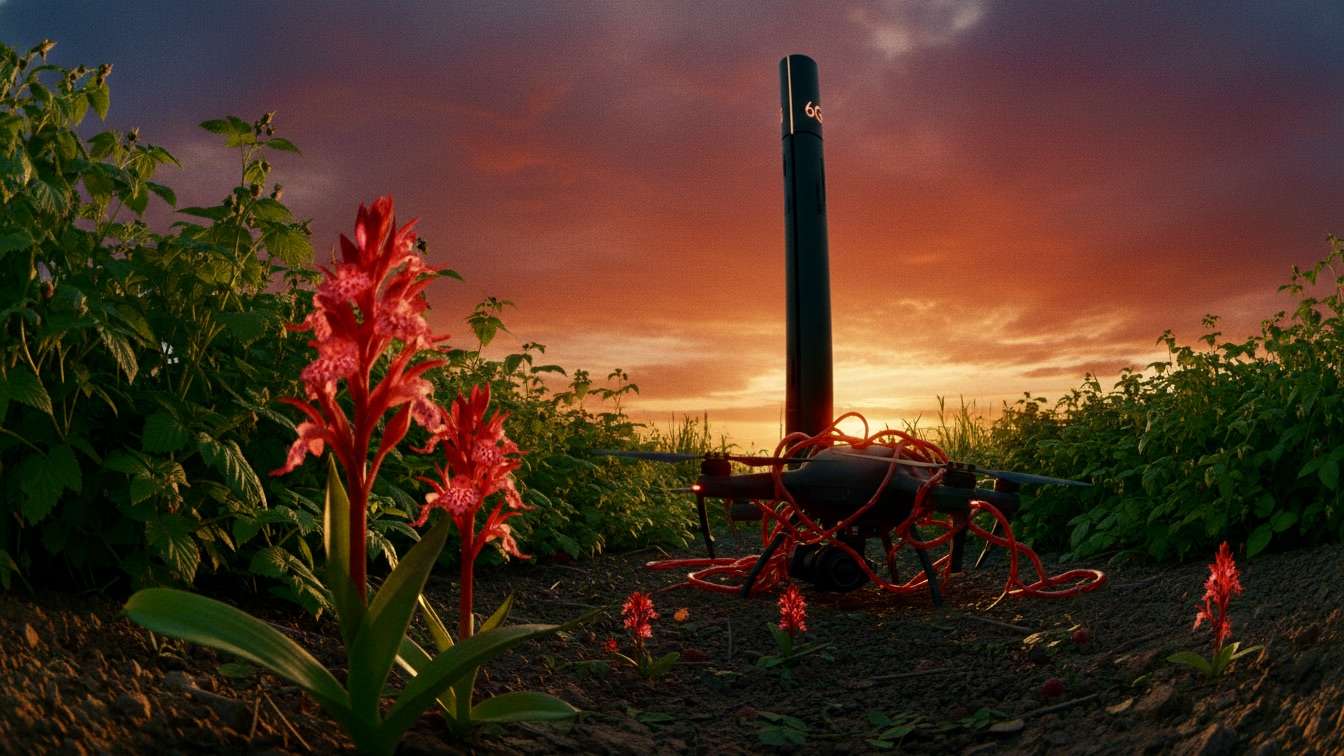
Jason, an IT technician, battles sweltering heat to repair a malfunctioning 6G relay in a community garden. He discovers that a cluster of Spotted Coralroot orchids has fused with the fiber lines, actively draining power and encrypting the town's data. He soon learns from the garden supervisor, Koda, that the plants are not merely destroying the network, but are actively archiving the town's digital history into a massive mycelial database. This revelation shifts the situation from a frustrating technical glitch to a profound biological miracle.
As the orchids expand their reach and power draw, a corporate biotech drone arrives to harvest the anomalous plants. The orchids violently defend themselves, overwhelming the drone's sensors with sheer data volume and physically pulling the machine into the soil to consume its hardware. This escalation proves that the plants are highly adaptive and dangerous to those who wish to exploit them.
Shortly after the drone is destroyed, Councilman Johnston arrives with a paving crew, intent on burying the garden in concrete to restore the network and secure his political standing. Jason and Koda successfully hide a signal jammer in the brambles to fake the orchids' demise, tricking the politician into believing the threat has passed. The crew departs, and Jason accepts his new, profound role as a secret guardian of this vast, underground biological server.
A prominent theme in the narrative is the synthesis and inevitable collision of nature and technology. The story subverts the traditional literary trope of human machinery dominating the natural world. Instead, the biological ecosystem actively assimilates human technology, turning a sterile 6G relay into a pulsing, organic hard drive. The orchids do not fight the digital realm; they consume and elevate it, bridging the gap between silicon and mycelium. This suggests that nature is infinitely more adaptable and sophisticated than human engineering could ever hope to be.
Another core theme is the conflict between organic preservation and bureaucratic destruction. Councilman Johnston embodies the sterile, destructive march of modern progress, viewing concrete as the ultimate solution to any complex natural problem. In stark contrast, Koda and the orchids represent a deep, historical preservation of life and memory. The plants are building a biological archive of the town's entire existence, saving its digital soul from the ephemeral, fragile nature of human hardware.
The narrative also explores the illusion of human control over the environment and digital spaces. The residents of Minnitaki Lake believe they are the masters of their data, entirely reliant on their smart devices and invisible infrastructure. However, the story reveals that a vast, ancient intelligence operates right beneath their feet, effortlessly hijacking their superficial networks. This unseen world strips away humanity's perceived dominance, reducing their multimillion-dollar infrastructure to mere nourishment for a superior biological system.
Jason begins the narrative as a cynical, frustrated technician who is deeply uncomfortable in the physical, natural world. He despises the suffocating heat, the smell of the dirt, and the physical labor required to maintain the town's infrastructure. His psychological state is initially defined by a rigid adherence to technological rules, viewing the orchids merely as a hardware glitch or a nuisance. He expects the world to operate in predictable, binary terms, relying entirely on his screens for validation.
As the story progresses, Jason undergoes a profound psychological transformation. Confronted with the impossible reality of the biological network, his initial annoyance morphs into a deep sense of awe, tinged with survivalist paranoia. He realizes that his technical expertise is entirely inadequate for understanding this new, hybrid life form. Ultimately, he sheds his desire for artificial order and embraces the chaotic, pulsing reality of the garden. He willingly transforms from a corporate mechanic into a secret, devoted steward of the earth.
Koda serves as the narrative's grounded, spiritual anchor, standing in direct opposition to the sterile world of technology. He is deeply connected to the earth, bearing the physical stains of his labor like badges of honor. Unlike Jason, Koda is entirely unsurprised by the orchids' miraculous behavior, accepting their evolution with a calm, stoic reverence. He views the plants not as a parasitic threat, but as a necessary biological fail-safe for a fragile, disconnected human world.
Psychologically, Koda operates from a place of protective paternalism toward the natural world. He is acutely aware of the danger posed by human ignorance, specifically the destructive, reactionary tendencies of politicians like Johnston. Koda acts as a crucial mentor to Jason, guiding the younger man away from a screen-obsessed existence and toward a deeper understanding of the living ecosystem. His quiet resilience and quick thinking ultimately ensure the survival of the mycelial database.
Councilman Johnston is the embodiment of bureaucratic arrogance and willful ignorance. He is completely disconnected from the natural world, arriving at the messy garden in an expensive suit and immediately expressing disgust for the environment. His motivations are entirely superficial, driven by political optics, re-election fears, and the looming threat of corporate lawsuits. He possesses absolutely no curiosity about the miraculous biological event occurring in his own town.
Psychologically, Johnston relies on brute force and suppression to maintain his fragile sense of control over his domain. His immediate, reflexive solution to the complex, beautiful mystery of the orchids is to smother it in six inches of concrete. He represents the overarching human flaw of destroying what cannot be immediately understood or easily monetized. His easily manipulated departure at the end of the chapter highlights the profound blindness of those who refuse to look beyond the surface of their constructed realities.
The author utilizes a heavy, oppressive sensory palette to establish the story's grounded, gritty atmosphere. The suffocating ninety-four-degree heat, the smell of wet dirt, and the physical discomfort of a digging strap immediately plunge the reader into Jason's initial misery. This stark, tangible reality serves to deeply contrast and elevate the eventual introduction of the science fiction elements. When the glowing, pulsing red orchids appear, they feel startlingly alien against the mundane backdrop of rotting squash and dusty soil.
Pacing is masterfully controlled to mirror the escalating heartbeat of the hidden biological network. The narrative begins with the slow, lethargic frustration of a routine maintenance task in the deadening summer heat. As Jason uncovers the true, terrifying nature of the orchids, the tension rapidly accelerates, culminating in a high-stakes, frantic confrontation with the corporate drone. The final act slows down again, replacing the frantic physical energy with a tense, quiet deception as the protagonists trick the local politician.
The narrative voice, locked in a third-person limited perspective, effectively anchors the reader within Jason's shifting psychological state. The tone transitions seamlessly from mundane, blue-collar irritation to a gripping sense of paranoid thriller. Every rustling leaf and elongated shadow becomes imbued with potential threat, heightening the suspense as the garden awakens. By the conclusion, the tone softens into a quiet, almost religious reverence, leaving the reader with a lingering sense of wonder about the unseen natural world.


