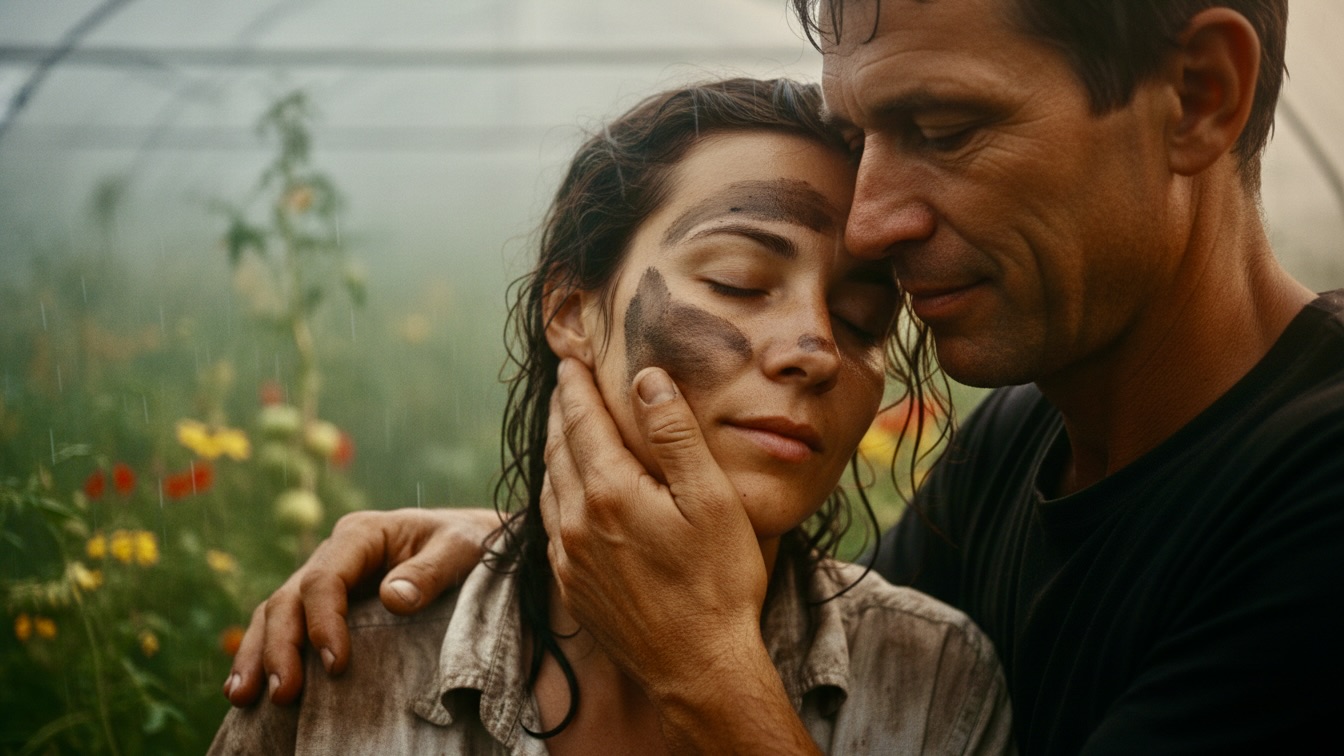
The story follows Helen and Steve, two rival gardeners in the town of Kenora who manage adjacent plots in a community garden. Helen is a meticulous traditionalist who relies on a rigid grid and scientific measurements, while Steve embraces a chaotic, organic approach focused on abundance and microbial health. Their personal conflict is forced to a head when the city council threatens to shut off the garden's water supply unless they can prove its value by producing a massive one-thousand-pound harvest for the local food bank.
To save the garden, the two must merge their plots and reconcile their vastly different philosophies. They face a series of escalating challenges, including an unseasonal frost, a persistent raccoon thief, and a violent microburst storm that threatens to destroy their entire crop. Through these trials, they reveal their shared history of childhood poverty and food insecurity, which drives their obsession with cultivation. In the end, they rally the community to salvage the harvest, successfully hitting their goal and finding a romantic connection amidst the mud and ruined vines.
The central theme of the narrative is the conflict between order and chaos as methods of survival. Helen’s "grid" represents a psychological need for control, an attempt to impose human logic on the unpredictable natural world to ensure safety. Conversely, Steve’s "abundance" philosophy suggests that true resilience comes from diversity and allowing nature to fight for its own survival. The story posits that neither extreme is entirely sufficient; Helen’s rigidity lacks the volume needed for the grant, while Steve’s chaos risks disease and mismanagement.
Another significant theme is the long-term psychological impact of food insecurity. Both protagonists are driven by "food trauma," though they express it in diametrically opposed ways. For Helen, the lack of food in her youth led to a desire for a "sterile" and predictable environment where every ounce of produce is accounted for. For Steve, the same lack led to a hatred of "rationing," causing him to prefer a garden so overflowing that it defies organization. Their work in the community garden is not just a hobby, but a recursive attempt to heal their younger selves by ensuring no other child has to experience the same deprivation.
Finally, the story explores the power of collective action over individual competition. The "pink mason line" serves as a literal and metaphorical barrier that limits the productivity of the garden. When the storm destroys their individual efforts, it is only through the mobilization of the "isolated seniors" and hobbyists that the harvest is saved. The transition from "individual hobby plots" to a "unified plan" reflects a broader social commentary on the necessity of community interdependence in the face of systemic threats like municipal budget cuts and climate instability.
Helen is a character defined by her defensive rigidity and an almost clinical need for precision. As a psychologist might observe, her obsession with the soil's pH and the "perfectly spaced rows" is a compensatory mechanism for the lack of agency she felt as a child. She views the garden as a laboratory where success can be guaranteed through strict adherence to protocol. This personality trait makes her highly effective at planning but leaves her vulnerable to the emotional distress caused by the inherent unpredictability of nature.
Her internal conflict is centered on her fear of vulnerability, which she masks with professional coldness and technical jargon. When she grips Steve’s wrist or snaps orders during the frost, she is struggling to maintain her composure in a world that feels increasingly out of her control. Her journey involves the painful process of dismantling her own "grid" to allow for a more messy, collaborative reality. By the end of the story, her willingness to touch the mud with her bare hands and accept Steve’s "uncalibrated" kiss signals a breakthrough in her emotional development.
Steve acts as the narrative’s agent of chaos, challenging Helen’s structured world with his "localized organic breakdown." He is portrayed as a man who values the spirit of growth over the mechanics of it, often prioritizing the "microbial network" over aesthetic or organizational standards. While he appears laid-back, his motivations are just as intense as Helen’s. His refusal to weed or follow a grid is a deliberate rebellion against the "rationing" of his youth, suggesting a man who equates order with the scarcity of his past.
Psychologically, Steve uses humor and provocation as tools to bridge the gap between himself and others. He recognizes Helen’s pain because it mirrors his own, and he uses the garden as a medium to force her into a more present, sensory state. His decision to harvest wild sorrel shows a lateral thinking ability that Helen lacks, highlighting his role as a provider who looks beyond conventional boundaries. Despite his rough exterior and "steel-toed boots," he possesses a deep empathy that allows him to support Helen during her moments of physical and emotional exhaustion.
The author employs a visceral, sensory-driven prose style that emphasizes the physical toll of gardening. The text is thick with descriptions of "dirt-caked fingernails," "steaming piles of manure," and the "sharp pain" of a throbbing lumbar spine. These details serve to ground the high-stakes emotional drama in a gritty, tangible reality. The heavy humidity of the Kenora summer is used as a metaphorical weight, mirroring the pressure the characters feel to perform under the city council’s scrutiny.
Pacing is used effectively to transition from the slow, simmering tension of the early bickering to the frantic energy of the storm sequence. The initial dialogue is sharp and rhythmic, reflecting the barrier between the two characters. As the environmental threats escalate, the sentences become more urgent and action-oriented. The climax of the storm is particularly effective, using the "deafening" sound of rain and the "whipping" of the pink line to create a sense of total atmospheric collapse, which sets the stage for the quiet, communal resolution that follows.
The narrative voice maintains a balance between the clinical observations of Helen and the more expansive, naturalistic perspective of Steve. This duality is reflected in the imagery, which shifts from "brass probes" and "metrics" to "bruised purple" skies and "wild garlic." The recurring symbol of the "pink mason line" is handled with subtlety; its eventual washing away in the mud provides a silent but powerful conclusion to the conflict. The final scene in the greenhouse serves as a stylistic "thaw," replacing the cold, wet exterior with a warm, "damp" intimacy that resolves the story's tension.


