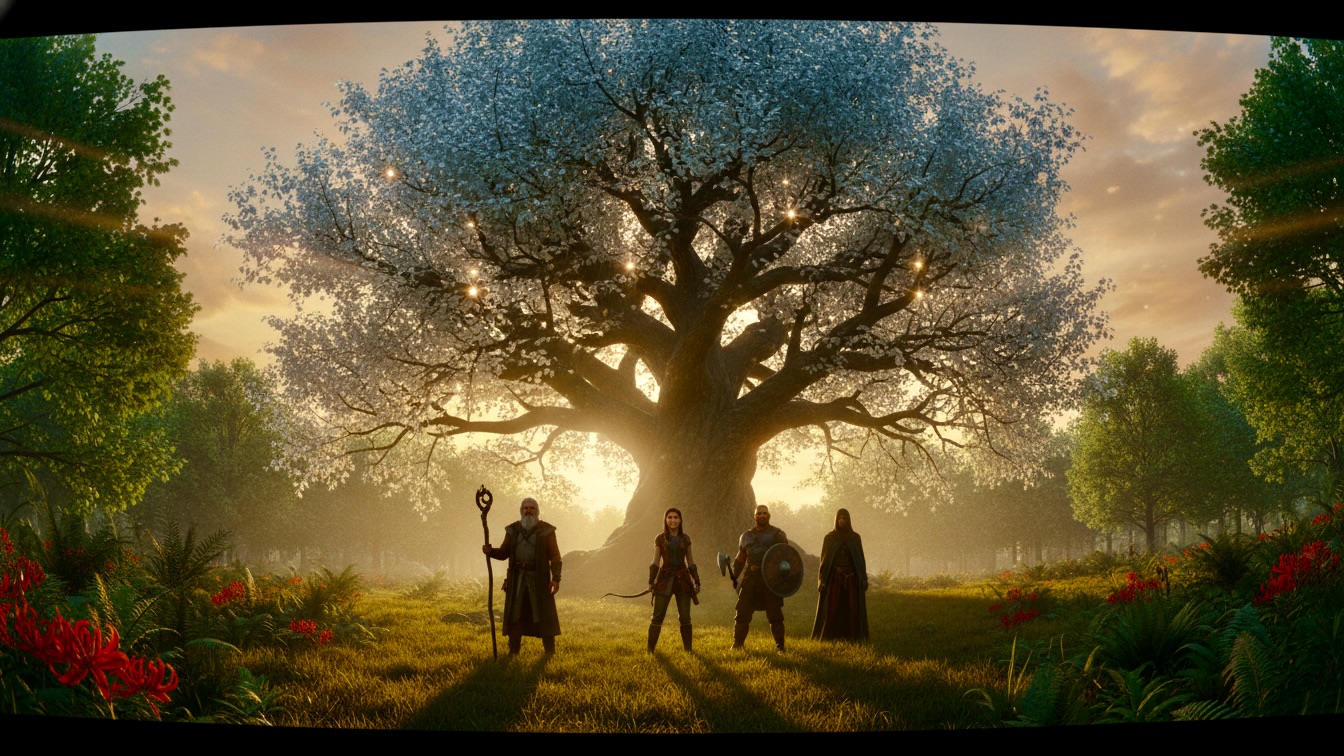
The chapter follows Silas, the aging leader of the Wardens of the Verdant Reach, as he struggles to maintain a dying grove during a catastrophic mid-summer drought. Facing a lack of support from the High Council and the physical exhaustion of his small team, Silas realizes that the psychological weight of their failure is as dangerous as the heat itself. He initiates a cultural shift within the guild by creating a "Win Board" to document small, incremental successes, effectively reframing their struggle from a losing battle to a series of manageable victories. This change in perspective revitalizes the team, leading to the discovery of a resilient bloom on a silver-leaf tree grafted by Julian, a discouraged young warden. The chapter concludes with the team reclaiming their sense of agency, choosing to implement new conservation strategies despite the unrelenting sun.
The central theme of the narrative is the psychology of resilience in the face of systemic and environmental collapse. Silas recognizes that his team is suffering from a "grey sludge" of fatigue, which is a metaphor for the emotional burnout that occurs when effort is decoupled from visible results. By introducing the "Standing Vines" slate, he utilizes a cognitive reframing technique that forces the characters to acknowledge their efficacy. This shift suggests that while the environment may be beyond their immediate control, their internal narrative remains a domain where they can exercise power.
Another prominent theme is the disconnect between bureaucratic governance and ecological reality. The High Council prioritizes the aesthetic and political value of city fountains for a festival while the essential "lungs" of the world are left to wither. This creates a tension between the "urban expansion" and the natural world, highlighting a society that has forgotten its fundamental dependence on the environment. The story posits that the preservation of nature requires a "vocation" rather than just a job, demanding a level of sacrifice that the distant Council cannot comprehend.
The narrative also explores the concept of legacy and the generational transmission of hope. Silas, as an elder, views the forest as a "slow conversation" and understands the cyclical nature of death and rebirth. He acts as a bridge for Julian, who represents the younger generation’s struggle with immediate gratification and the lure of easier, air-conditioned paths. The story suggests that survival is not merely a physical act but a cultural one, requiring the elders to teach the youth how to carry the weight of the world without being crushed by it.
Silas serves as the narrative’s moral and psychological anchor, embodying the archetype of the Wise Old Man who is beginning to feel the frailty of his own "unreliable hinges." His internal conflict stems from the fear that his identity is inextricably tied to a dying mission, making the potential collapse of the guild a personal annihilation. He demonstrates a sophisticated understanding of human motivation, recognizing that he must act as a shepherd for his team's spirits before he can save the trees. His decision to lie about having "told people worse things" reveals a leader willing to carry a heavy emotional burden to protect the morale of his subordinates.
Mara functions as the pragmatic realist of the group, her "spine like a steel rod" providing the necessary structure to Silas’s more visionary leadership. She is the keeper of ledgers and the tracker of water, representing the logical and grounded aspects of the guild’s operations. Her initial skepticism toward Silas’s "Win Board" highlights her focus on tangible, material outcomes over psychological states. However, her eventual participation and her rare laugh during the honey-water celebration show a woman who is deeply loyal and capable of adapting her rigid standards when the survival of the team is at stake.
Julian represents the vulnerability and potential of the next generation of wardens. He is characterized by his "blistered hands" and a sense of impending doom, reflecting the acute anxiety of a young man who feels he is failing a dying world. His struggle is a classic conflict between the desire for a comfortable, modern life and the grueling demands of a meaningful calling. When his silver-leaf graft blooms, he undergoes a transformation from a man looking for an exit to a "shaper" who recognizes his own unique contribution to the world’s survival.
Stefi is the quiet, observant specialist whose connection to the "dormant spirits" of the seed-vaults provides a more mystical or intuitive counterpoint to Mara’s ledgers. She is modest to a fault, initially dismissing her discovery of the fire-lilies as a simple observation of temperature. Her character arc, though subtle, illustrates the importance of specialized knowledge and the quiet persistence required in ecological work. Silas’s validation of her "eye for the subtle shifts" helps her move from the shadows of the workshop into a more confident role within the team’s new proactive phase.
The author employs a heavy, sensory-driven prose style that effectively mirrors the oppressive environment of the story. The opening metaphor of the heat sitting like a "wet wool blanket" establishes a visceral sense of physical burden that persists throughout the chapter. References to "copper" suns, "grey sludge" in the veins, and the "metallic tang" of mana-pumps create a world that feels both organic and dangerously close to mechanical failure. These details serve to ground the psychological drama in a harsh, tangible reality, making the characters' eventual hope feel earned rather than sentimental.
The pacing of the narrative is deliberate, slowing down significantly during the scenes in the workshop to emphasize the importance of the team's internal shift. The transition from the "bone dry" irrigation channels to the "cool and sharp" honey-water marks a pivotal moment where the atmosphere of the story begins to breathe again. This rhythmic change mirrors Silas’s philosophy that the "mulch can wait" while the people cannot. By focusing on these quiet, interpersonal moments, the author creates a contrast with the "brutal, uncaring cycle" of the sun, highlighting the human element as the story's true heart.
The first-person narrative voice of Silas provides a deeply personal and reflective tone to the analysis of the guild’s struggle. His observations are colored by his age and his long history with the forest, giving the text a sense of gravitas and wisdom. The use of charcoal on stone as a recurring motif for recording "The Standing Vines" and "HOPE" symbolizes a return to primal, foundational truths in the face of a complex, indifferent bureaucracy. This stylistic choice reinforces the theme that survival in a changing world requires a firm grasp on the small, essential victories that define a life’s work.


