A heatwave kills the grid, forcing two rivals to paddle life-saving insulin through forty kilometers of burning wilderness.
The phone was a brick. A sleek, titanium-edged, six-hundred-dollar brick that currently served no purpose other than reflecting Devon’s own sweaty, panicked face. He stared at the screen, waiting for the little bars to reappear, for the spinning wheel of death to stop, for a single notification to pop up and tell him the world wasn't actually ending. Nothing. The 5G signal had vanished three hours ago, right around the time the air conditioning in the main lodge had let out a final, rattling wheeze and died. Now, the heat was a physical weight, pressing down on the back of his neck like a hot iron. It was 42 degrees in the shade, and the shade was disappearing as the sun climbed toward its midday peak.
"It’s not coming back, Dev," Stan said. He was standing by the window, peering out at the heat haze shimmering off the lake. He looked annoyingly calm, his face a mask of rural stoicism that Devon found deeply offensive. Stan was wearing a sweat-stained trucker hat and a shirt that had probably been white in the nineties. He looked like he belonged here. Devon, in his tech-fabric hiking gear and designer sunglasses, felt like a glitch in the simulation.
"You don't know that," Devon snapped, his thumbs still twitching over the black screen. "The grid probably just tripped because everyone in Toronto is running their AC at max. It’s a localized brownout. It happens."
"A localized brownout doesn't knock out the satellite relays," Stan replied, turning around. His eyes were hard. "The generator is dead too. The fuel pump is fried. We’re out of juice, and it’s getting hotter."
Dr. Burton came into the room then, looking older than he had that morning. He was carrying a small, plastic medical cooler that looked tragically flimsy. He set it down on the heavy oak table with a soft click. The room was silent for a second, save for the sound of a fly buzzing against the windowpane, desperate to get back into the furnace outside.
"The insulin," Burton said. His voice was thin. "It’s in the fridge in the kitchen, but without the generator, that fridge is basically an oven. The kids at the north camp... they have maybe twelve hours before what they have on-site spoils. If we don't get this stash to them, they’re going to go into DKA. Out here, with no way to airlift them out? That’s it. Game over."
Devon felt a cold spike of genuine fear pierce through his annoyance. He looked at the cooler. Then he looked at Stan. Stan was the only one who knew the waterways well enough to navigate the back routes. The main roads were already choked with stalled cars and people fleeing the heat. The lake was the only way.
"We have the blue barrel," Stan said, his voice dropping an octave. "The one with the thermal gel lining. If we pack it right, and we move fast, we can make it. But I can't paddle a loaded canoe forty clicks through the Shield alone in this heat. I need a second set of shoulders."
He looked directly at Devon. It wasn't an invitation. It was a challenge. Devon remembered high school—how he’d mocked Stan for being a 'bush kid,' how he’d made fun of his muddy boots and his lack of interest in anything that required a charging cable. Now, the bush kid was the only thing standing between three kids and a very ugly death.
"I’m not a paddler, Stan," Devon said, his voice cracking slightly. "I do Pilates. I go to the gym in Liberty Village. I don't... I don't do the Great Outdoors."
"Well, the Great Outdoors is currently doing you," Stan said, grabbing his keys from the counter. "So either you get in the boat, or you sit here and watch your phone die while those kids run out of time. Your choice, influencer."
Devon looked at his dead phone one last time. He thought about his Instagram feed, his brand deals, his carefully curated life. It all felt like a fever dream. The reality was the heat, the smell of pine needles baking in the sun, and the heavy blue barrel sitting on the floor. He stood up, his legs feeling heavy. "Fine. But if I die of heatstroke, I’m haunting your shitty lodge forever."
"Better get moving then," Stan said, already heading for the door. "The water is starting to cook."
They hauled the barrel down to the dock. The sun felt like a physical blow. The lake, usually a deep, inviting green, looked flat and oily. The air didn't move. It just sat there, thick with humidity and the smell of drying mud. Devon felt the sweat start to pour down his back instantly, his high-tech shirt already failing him. He watched Stan slide the cedar-strip canoe into the water with practiced ease. It looked fragile. Too small for the task.
"In the front," Stan commanded. "Keep your center of gravity low. Don't try to be a hero. Just keep the rhythm."
Devon climbed in, the boat rocking dangerously under his weight. He gripped the gunwales, his knuckles white. He looked back at the lodge, seeing Dr. Burton standing on the porch, a small, shrinking figure in the haze. The weight of the mission settled into his gut, heavier than the barrel tucked between them. This wasn't a content trip. There was no 'behind the scenes.' This was just survival.
"Ready?" Stan asked, his paddle already dipping into the water.
"No," Devon said, reaching for his own paddle. "Let's go."
They pushed off, the dock sliding away. The water was unnervingly warm against the hull. As they rounded the first point, the lodge disappeared behind a wall of granite and scorched spruce. There was no one else on the water. No motorboats, no jet skis. Just the silence of a world that had suddenly run out of power.
Devon’s arms already felt like lead. He looked at the blue barrel, the only thing that mattered now. It sat there, stubbornly cold in a world that was rapidly turning into an oven. He focused on the back of Stan’s neck, the rhythmic dip of the paddle, and the terrifying realization that he had no idea what he was doing. But he kept paddling. He had to. The alternative was unthinkable.
Every stroke was a struggle. The water felt thick, like paddling through syrup. Devon’s breath came in short, ragged gasps. He tried to remember his breathing exercises from yoga, but they felt ridiculous now. His brain was a chaotic mess of thoughts—his unpaid bills, his fake followers, the way the light was hitting the water. He tried to shut it all down, to focus on the one-two-three rhythm Stan was setting.
"Drink water," Stan called out, not breaking his stride. "Small sips. Don't wait until you're thirsty. If you stop sweating, tell me immediately."
"I think I've already sweated out my entire soul," Devon muttered, but he reached for his Nalgene. The water inside was lukewarm and tasted like plastic. He drank it anyway. It was the only fuel he had left.
They were two kilometers in. Thirty-eight to go. The sun was a white-hot eye in the sky, watching them. Devon closed his eyes for a second, feeling the heat bake into his skin. He opened them and saw a dead fish floating on the surface, its eyes cloudy. The world was changing, and he was right in the middle of it, holding a plastic paddle and praying for a breeze that wasn't coming.
The stench hit them before they saw the extent of the carnage. It wasn't the usual lake smell—that mix of lily pads and wet rocks. This was something heavier, a thick, cloying odor of rot that seemed to hang in the stagnant air. As they paddled into a shallow bay that served as a shortcut to the main channel, Devon gagged, his paddle faltering. The surface of the water was littered with silver bellies. Hundreds of them. Perch, pike, and even a few large muskie, all floating motionless in the dead water.
"What is that?" Devon hissed, covering his nose with the collar of his shirt. "Did something leak into the lake?"
"The heat," Stan said, his voice grim. "The water in these shallows is too shallow and the sun is too hot. The oxygen levels just cratered. They’re basically being boiled alive. Dead water, Dev. It’s a sign."
"A sign of what? The apocalypse?" Devon tried to inject some irony into his voice, but it came out as a tremor. He looked down at his phone, which he’d tucked into a waterproof pouch on his chest. It was still black. A useless slab of glass. He felt a sudden, sharp pang of loss, not for the device itself, but for the connection it represented. Without it, he felt invisible. If a tree falls in the forest and nobody posts a reel about it, does it even make a sound?
"It’s a sign that the system is broken," Stan said, his paddle cutting through the water with a wet, rhythmic slap. "We’ve been living on borrowed time up here, relying on the grid to keep the fish alive and the cabins cool. Now the bill is due."
Devon looked at the dead fish. He thought about his life in Toronto—the tiny apartment he couldn't afford, the credit card debt he was hiding under layers of aesthetic photos, the constant pressure to look like he was winning. It was all a grift. He was a professional pretender, and out here, the pretense was melting away along with the thermal gel in the barrel.
"My life is a total grift, Stan," Devon said, the words slipping out before he could stop them. He didn't look back. He just kept his eyes on the silver-scaled graveyard they were navigating. "I’m broke. My phone is dead, and my bank account is probably empty. I spent my last three hundred bucks on this shirt because the brand told me it was 'expedition-ready.' Look at it. It’s a rag."
Stan didn't laugh. He didn't even mock him. He just kept paddling. "Most things are rags when they actually have to work, Dev. People included. You just haven't had to work in a long time."
"Screw you," Devon said, but there was no heat in it. The humidity was doing something to his brain, making everything feel fuzzy and slow. He felt the skin on his forearms beginning to burn, a deep, angry red that promised a long night of pain. He watched a black bear cub emerge from the brush on the shoreline, sniffing at the dead fish. It looked skinny, its fur matted. It ignored them, focused entirely on the easy meal.
"The bears are going to be a problem," Stan noted, his tone conversational. "The smell is calling them in from miles away. We need to stay in the middle of the channel. Don't drift toward the banks."
"Great. Boiling fish and hungry bears. This is exactly how I imagined my summer vacation," Devon muttered. He felt a drop of sweat roll into his eye, stinging like acid. He wiped it away with the back of a shaking hand. The blue barrel was sitting right behind him, a silent reminder of why they were doing this. He reached back and touched the plastic. It was still cool to the touch, but for how much longer?
They hit the main channel, and the wind—if you could call it that—picked up slightly. It was a hot, dry breath that offered no relief, but it pushed the smell of rot away. Devon found a rhythm, his muscles screaming in a way that felt strangely honest. For the first time in years, he wasn't thinking about his engagement metrics or his follower count. He was thinking about his core, his grip, and the way the water resisted his every move.
"You're doing okay," Stan said after an hour of silence. It was the highest praise Devon had ever received from him. "Keep that pace. We're about fifteen clicks in. If we can get through the narrows before the sun starts to drop, we might have a chance."
"The narrows?" Devon asked. "Is that where the 'ghost portage' is? You mentioned it earlier."
"Yeah. It’s an old trapper route. It’s not on the GPS, and the brush has mostly reclaimed it, but it cuts four hours off the trip. If we stay on the main lake, we’ll be out here all night. The gel won't last that long."
Devon nodded, though the thought of carrying the canoe through the woods made his stomach flip. He looked at the sky. It was a weird, bruised color—a mix of hazy white and a dull, sickly yellow. The sun was a blurred circle behind a veil of smoke. The world felt muffled, as if the volume had been turned down on everything except the sound of their own breathing.
"Do you think it's happening everywhere?" Devon asked softly. "The grid collapse?"
"Probably," Stan said. "It’s been a long time coming. The infrastructure is old, and the heat is unprecedented. People don't know how to live without the hum, Dev. When the hum stops, they panic."
Devon thought about the 'hum.' The constant background noise of the city, the vibration of the subway, the glow of the streetlights. He realized he’d never known true silence until today. Even now, the silence was heavy, filled with the unspoken fear of what came next. He felt a strange sense of clarity, a stripping away of all the noise he’d been carrying in his head. There was just the boat, the water, and the mission.
They paddled on, the silence occasionally broken by the distant, booming crack of a tree limb snapping in the heat. It sounded like a gunshot. Each time, Devon jumped, his heart rate spiking. He was waiting for something to happen, for the world to resume its normal programming, but the screen remained black. The heat stayed at 42 degrees. The fish stayed dead. And they kept moving, two small shadows on a vast, unblinking eye of water.
The narrows were a nightmare. The water slowed down to a trickle, and the canoe began to scrape against the bottom, the sound of cedar on stone like a scream in the stillness. They had to get out and wade, their boots sinking into the thick, black muck of the lakebed. The mud felt hot between Devon’s toes, and the leeches were a constant threat he tried not to think about. He gripped the bow of the boat, hauling it forward while Stan pushed from the back.
"Just a little further," Stan grunted, his face red and slick with sweat. "The trail starts by that split cedar."
As they neared the bank, a movement in the brush caught Devon’s eye. He froze. Three figures stepped out from the trees. They weren't bears. They were people—a man and two teenagers, looking ragged and desperate. They were carrying heavy packs and looked like they’d been walking for days. Their eyes were wide, fixed on the canoe, and more specifically, on the blue barrel.
"Hey!" the man called out, his voice hoarse. "You got food in there? Water?"
Devon felt his pulse quicken. This was the panic Stan had talked about. "It’s medicine," Devon said, trying to keep his voice steady. "Insulin. For the kids at the north camp."
The man didn't look like he believed him. He took a step forward, his hand resting on a heavy walking stick. "We’ve been out here since the power went. My kids haven't had a real meal in forty-eight hours. We need whatever you’ve got in that barrel."
Stan stepped around the back of the canoe, his paddle held low like a staff. "I told you, it’s medicine. If you take it, kids die. You want that on your head?"
There was a tense silence. The heat seemed to amplify the standoff, the air vibrating between them. Devon looked at the teenagers. They looked exhausted, their skin lobster-red from the sun. He felt a surge of pity, but he also felt the weight of the barrel. He couldn't let them have it.
"Look," Devon said, reaching into his own pack and pulling out a handful of protein bars. "Take these. It’s all we have. But the barrel stays. It’s not food. It’s life."
He tossed the bars onto the muddy bank. The man stared at them for a long moment, then slowly reached down and picked them up. He looked at Devon, then at Stan, and finally at the blue barrel. He gave a sharp, jerky nod and stepped back into the shadows of the trees. The teenagers followed him, disappearing like ghosts.
"Let's move," Stan said, his voice low. "Before they change their minds."
They hauled the canoe onto the bank and began the portage. The 'ghost trail' was barely a suggestion of a path, choked with overgrown raspberry bushes and fallen logs. They had to carry the canoe over their heads, the weight of the cedar pressing down on their shoulders. Devon felt like his spine was being compressed into his boots. Every step was a battle against the undergrowth. The heat under the forest canopy was even worse—stagnant and buzzing with black flies that bit at their exposed skin.
"This is... hell," Devon panted, his vision blurring. "Tell me... we’re almost... there."
"Halfway," Stan said, his breath coming in rhythmic huffs. "Watch your footing. The rocks are slippery."
Suddenly, the sky darkened. It wasn't the relief of a cloud; it was something more ominous. A low, rolling rumble shook the ground, but there was no rain. Then, a flash of white-hot light illuminated the woods, followed instantly by a deafening crack.
"Dry lightning," Stan yelled over the noise. "Keep moving! If a strike hits these dry needles, we’re toast!"
Devon’s adrenaline kicked in, a frantic, buzzing energy that pushed aside the exhaustion. He scrambled over a mossy log, the canoe tilting dangerously. Above them, the sky had turned a terrifying shade of orange. Smoke began to drift through the trees, thin and acrid. A ridge a few kilometers away had caught fire, the flames licking at the dry timber.
"The wind is shifting!" Stan shouted. "It’s pushing the smoke toward us. We have to get back to the water!"
They practically ran the last few hundred meters of the portage, the canoe bouncing on their shoulders. They burst out of the trees and onto the shore of the next lake, the air thick with falling ash. It looked like a grey snowstorm in the middle of a furnace. They shoved the boat into the water and scrambled inside, the heat from the distant fire radiating off the granite cliffs.
"Paddle!" Stan roared. "Don't look back!"
Devon dug his paddle into the water, his arms moving on pure instinct. The lake was a chaotic mess of whitecaps and ash. The orange haze was so thick he could barely see the bow of the boat. He felt the sting of the smoke in his lungs, each breath a struggle. He focused on the blue barrel, now dusted with grey ash. It looked like a relic from another world.
They paddled through the haze for what felt like hours. The world had become a two-tone nightmare of orange and grey. Devon’s mind began to wander, drifting back to the 'noise' of his old life. He realized how much of it was just static—the endless scrolling, the empty validation, the constant need to be 'on.' Out here, in the middle of a literal firestorm, none of it mattered. The only thing that was real was the weight of the paddle and the coldness of the insulin.
"The fire is staying on the ridge," Stan called out, his voice sounding distant through the haze. "The wind is dying down. We’re through the worst of it."
As the smoke cleared, Devon saw the far shore. It was still miles away, but it was there. He felt a sudden, overwhelming wave of emotion—a mix of relief, exhaustion, and a strange, new kind of pride. He hadn't broken. He was still here. He looked at his hands, which were blistered and bloody, and felt a sense of connection to them he’d never felt before. They weren't just for typing; they were for surviving.
"We’re going to make it, aren't we?" Devon asked, his voice a whisper.
"We’re not there yet," Stan said, but his tone was softer. "But yeah. We might just make it."
They paddled on into the darkening evening, the sun finally dipping below the horizon and leaving a bruised, purple sky in its wake. The heat began to ebb, replaced by a cooling dampness that felt like a miracle. But the silence remained, deep and absolute, as they moved toward the flickering light of a single campfire on the distant shore.
The final five kilometers were the hardest. The adrenaline had long since evaporated, leaving Devon’s body a hollow shell of pain. His shoulders felt like they had been fused together with hot glue, and his legs were cramped into stiff, useless pillars. Every stroke of the paddle required a conscious effort of will, a mental argument with his own muscles. Stan wasn't faring much better; his breathing was a ragged, wet sound in the twilight, and his movements had lost their crisp, mechanical precision.
"Almost... there," Stan wheezed. The camp was visible now, a cluster of dark cabins silhouetted against the fading light of the sky. A small, battery-operated lantern flickered on the dock, a tiny beacon in the vast dark of the Shield.
They reached the dock and the canoe drifted in with a soft, hollow thud against the wood. Devon didn't move. He just sat there, his head hanging, his arms dangling over the sides. He felt like if he tried to stand, he would simply shatter into a thousand pieces of sun-baked plastic and tech-fabric.
"Devon? Stan?" A figure hurried down the dock. It was a young woman, her face etched with worry. She looked at the blue barrel and let out a sob of pure relief. "Oh thank god. We were down to the last two units. The kids... they’re starting to get sick."
Stan grunted, hauling himself out of the boat with a groan that sounded like shifting tectonic plates. He reached down and helped Devon lift the barrel onto the dock. "Get it inside. The gel is about done. You need to use it now."
She grabbed the barrel and ran toward the main cabin. Devon watched her go, his mind finally allowing the magnitude of what they’d done to sink in. They’d made it. Forty kilometers. A heatwave. A fire. A near-hijacking. And the insulin was safe. The kids were safe.
He climbed onto the dock, his legs shaking so violently he had to sit down immediately. Stan sat down next to him, his back against a piling. They didn't speak for a long time. They just watched the darkness settle over the lake. The silence was different here—not the heavy, expectant silence of the forest, but a peaceful, exhausted quiet.
"Why did you stay?" Devon asked suddenly, the question he’d been wanting to ask since high school finally coming out. "Up here. You could have gone to the city. You were smart enough. You could have had a career, a life that didn't involve hauling canoes through mosquito-infested swamps."
Stan looked out at the water, his face unreadable in the gloom. "I tried the city, Dev. I spent a year in Toronto after graduation. I hated it. Every second of it. The noise... it never stops. Not just the literal noise, but the mental noise. Everyone wanting something, everyone performing, everyone trying to be louder than the person next to them. I couldn't breathe. I felt like I was being erased."
He paused, taking a long, slow breath of the cooling air. "Up here, the noise stops. You can hear yourself think. You can see the world for what it actually is, not what someone tells you it should be. Today... today was real. That's why I stay."
Devon looked at his dead phone, still tucked into his chest pouch. He pulled it out and looked at it. It was a beautiful piece of engineering, but in this moment, it felt like a shackle. He thought about his apartment, his 'friends' who only liked him when his lighting was right, the endless treadmill of his own making. Stan was right. The noise was deafening.
"I think I’m done with the noise," Devon said. He felt a strange, light sensation in his chest, as if a weight he’d been carrying for a decade had finally been lifted. He stood up, walked to the edge of the dock, and dropped the phone into the dark water. There was a small, satisfying splash, and then it was gone.
"That was expensive," Stan noted, a ghost of a smile playing on his lips.
"It was a brick," Devon replied, sitting back down. "I don't need a brick."
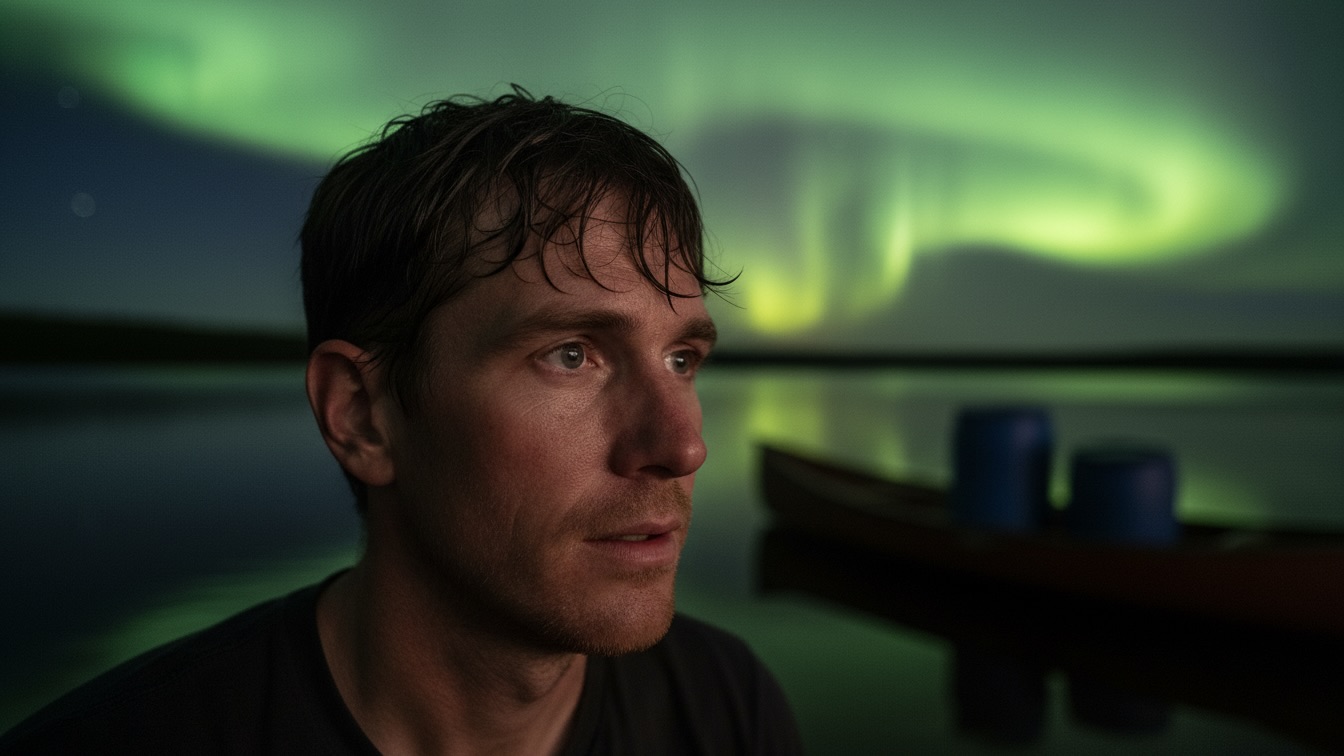
As the last of the light faded, a shimmering curtain of green began to ripple across the sky. The aurora borealis, magnified by the total lack of light pollution from the dead cities to the south, danced over the lake. It was beautiful in a way that no screen could ever capture—vibrant, ethereal, and completely indifferent to human struggle.
"Look at that," Devon whispered.
"The world is resetting," Stan said. "It’s going to be a long time before the lights come back on, Dev. If they ever do."
Devon nodded. He thought about the lodge, the broken generator, and the sustainable systems Stan had been trying to build for years. He thought about the kids in the cabin, and the world that was waiting for them when they woke up tomorrow. It wouldn't be the same world they’d known, but maybe that wasn't a bad thing.
"I’m staying," Devon said, the decision feeling as solid as the granite beneath them. "I don't know how to fix a fuel pump, and I’m a terrible paddler, but I can learn. You’re going to need help rebuilding the lodge's infrastructure if we're going to survive the rest of the summer."
Stan looked at him, his eyes reflecting the green glow of the sky. He reached out a hand, and Devon took it. A firm, calloused grip. A mutual respect forged in sweat and ash.
"First lesson is at dawn," Stan said. "And don't expect any influencer breaks."
"Deal," Devon said.
They sat there in the dark, two men in a world that had suddenly become very small and very quiet. The heat was gone, replaced by a cool breeze that smelled of pine and the promise of a new day. They watched the lights dance until their eyes grew heavy, knowing that the journey was far from over, but for the first time in a long time, they knew exactly where they were going.
“Devon looked at the empty space where his phone used to be, then at the vast, dark horizon, and wondered what else was about to disappear.”


