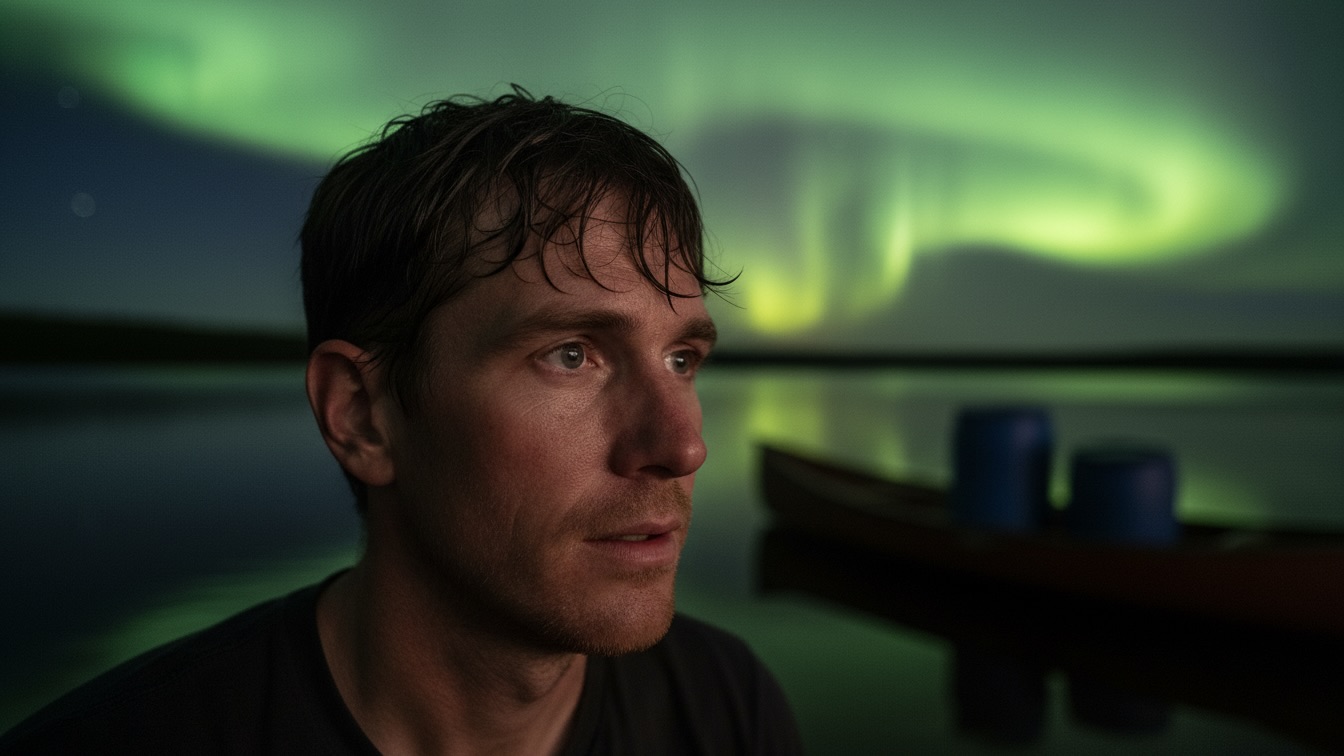
The story follows Devon, a tech-dependent social media influencer, and Stan, a rugged outdoorsman, as they navigate a catastrophic grid collapse during a record-breaking heatwave in the Canadian Shield. When the power fails and the cooling systems at a remote lodge die, a critical supply of insulin is at risk of spoiling. Dr. Burton tasks the two men with transporting the medicine across forty kilometers of wilderness to a camp where children are in desperate need. This journey serves as the crucible for Devon’s internal transformation.
Throughout the trek, the pair faces escalating environmental and human threats, including a massive fish die-off caused by oxygen depletion and a tense encounter with a desperate family. They are forced to traverse a "ghost portage" while a dry lightning storm ignites a nearby forest fire, pushing their physical and mental limits. Despite his initial resistance and lack of survival skills, Devon finds a rhythmic competence in the grueling labor of paddling and hauling.
The mission concludes successfully as they reach the north camp just in time to save the children. In the aftermath, Devon experiences a profound psychological shift, realizing the vacuity of his former urban existence. He chooses to discard his useless smartphone into the lake and commits to staying in the wilderness to help Stan rebuild. The story ends with the two men watching the aurora borealis, signifying a new, albeit harsh, beginning for humanity.
A primary theme of the narrative is the fragility of modern civilization and the "noise" of digital existence. The story posits that the technological comforts of the city are a thin veneer that can be stripped away by the raw power of nature. Devon’s phone, initially described as a "six-hundred-dollar brick," symbolizes the uselessness of digital status when faced with biological necessity. The "hum" that Stan describes represents the constant, distracting performance of modern life that prevents individuals from connecting with reality.
The conflict between performative identity and functional competence is also central to the text. Devon begins the journey as a "glitch in the simulation," defined by his expensive gear and his social media metrics. However, the extreme heat and physical labor act as a purifying force, melting away his pretenses. By the end of the story, his value is no longer measured by engagement but by his ability to hold a paddle and endure suffering for the sake of others.
Environmental collapse serves as the backdrop and catalyst for the characters' development. The "dead water" filled with boiled fish and the "dry lightning" are visceral reminders that the ecological bill has come due. The story suggests that humanity has been living on "borrowed time," and the collapse of the grid is not just a technical failure but a systemic rejection of an unsustainable lifestyle. Survival, therefore, requires a return to foundational skills and a respect for the natural world's limits.
Finally, the story explores the theme of redemption through shared struggle. Devon and Stan begin as antagonists, divided by class and lifestyle choices from their high school years. The blue barrel of insulin acts as a shared burden that bridges this gap, forcing them into a state of mutual reliance. Through this ordeal, Devon earns Stan’s respect not by being "smart" or "successful," but by refusing to break when the world around him is quite literally on fire.
Devon serves as the protagonist whose psychological journey mirrors the physical journey across the lake. Initially, he is defined by profound anxiety and a sense of displacement, clutching his dead phone as if it were a talisman of his lost identity. He is acutely aware of the "grift" of his life, recognizing that his influencer persona is a mask for debt and insecurity. This self-awareness makes his initial resistance to the journey a defense mechanism against the terrifying reality of his own uselessness in a survival scenario.
As the physical toll of the journey increases, Devon undergoes a process of "stripping away." The psychological weight of his unpaid bills and fake followers is replaced by the literal weight of the paddle and the heat of the sun. He moves from a state of panicked distraction to a focused, rhythmic mindfulness. This shift is a classic psychological transition from an external locus of control—where his value is determined by others' likes—to an internal one grounded in his own physical agency.
His decision to throw his phone into the water is the climax of his character arc. It represents a ritualistic shedding of his former ego and an acceptance of a world without "the hum." By choosing to stay and learn from Stan, he seeks a life that is "real," even if it is significantly harder and more dangerous. He moves from being a consumer of experiences to a participant in survival, finding a new sense of pride in his blistered hands and aching muscles.
Stan functions as the archetypal mentor and the "stoic survivor" who provides the necessary contrast to Devon’s initial hysteria. He is a man who has already rejected the "noise" of the city, having found it suffocating and performative years prior. His competence is not a source of vanity but a tool for survival, and his "rural stoicism" is a psychological armor that allows him to remain calm in the face of a boiling world. He views the grid collapse not as a tragedy, but as an inevitable correction.
While he appears hard and judgmental at first, Stan’s motivations are rooted in a deep sense of communal responsibility. He doesn't just want to save the insulin; he wants to test Devon to see if the man beneath the "tech-fabric" is worth saving as well. His "challenge" to Devon is an invitation into a more authentic way of being. He recognizes that the coming world will require more than just his own skills; it will require a community of people who have learned to stop performing and start working.
The author utilizes a gritty, sensory-heavy prose style to emphasize the oppressive nature of the environment. The heat is described not just as a temperature, but as a "physical weight" and a "hot iron," making the setting an active antagonist in the story. Sensory details like the "stench of rot" from the dead fish and the "acrid smoke" of the forest fire create a visceral experience for the reader. This focus on the physical world mirrors the characters' own shift away from the abstract digital realm.
The pacing of the narrative is relentless, matching the ticking clock of the spoiling insulin. The transition from the "dead water" to the "ghost portage" and finally the "dry lightning" ensures that the tension never dissipates. Even the moments of silence are described as "heavy" or "expectant," maintaining a sense of atmospheric dread. This high-stakes pacing forces the character development to happen rapidly, as there is no time for slow reflection amidst the immediate threats of fire and heatstroke.
The narrative voice is third-person limited, staying close to Devon’s internal state to highlight the contrast between his inner turmoil and the external silence of the wilderness. This perspective allows the reader to feel the sting of his sweat and the "lead" in his arms, grounding the thematic exploration of "reality" in physical sensation. The use of the aurora borealis at the end provides a stark, beautiful contrast to the "orange haze" of the fire, offering a moment of aesthetic relief that underscores the story's final note of somber hope.


