Format: Short Film / Anthology Episode | Est. Length: 10-12 minutes
This story serves as a standalone entry in a speculative anthology series titled Static Echoes, which explores the intersection of hyper-capitalist technology and the erosion of human intimacy in a near-future urban landscape. The series focuses on how individuals navigate a world where genetic optimization, constant digital surveillance, and algorithmic labor markets have commodified every facet of existence, leaving human connection as the only remaining form of rebellion.
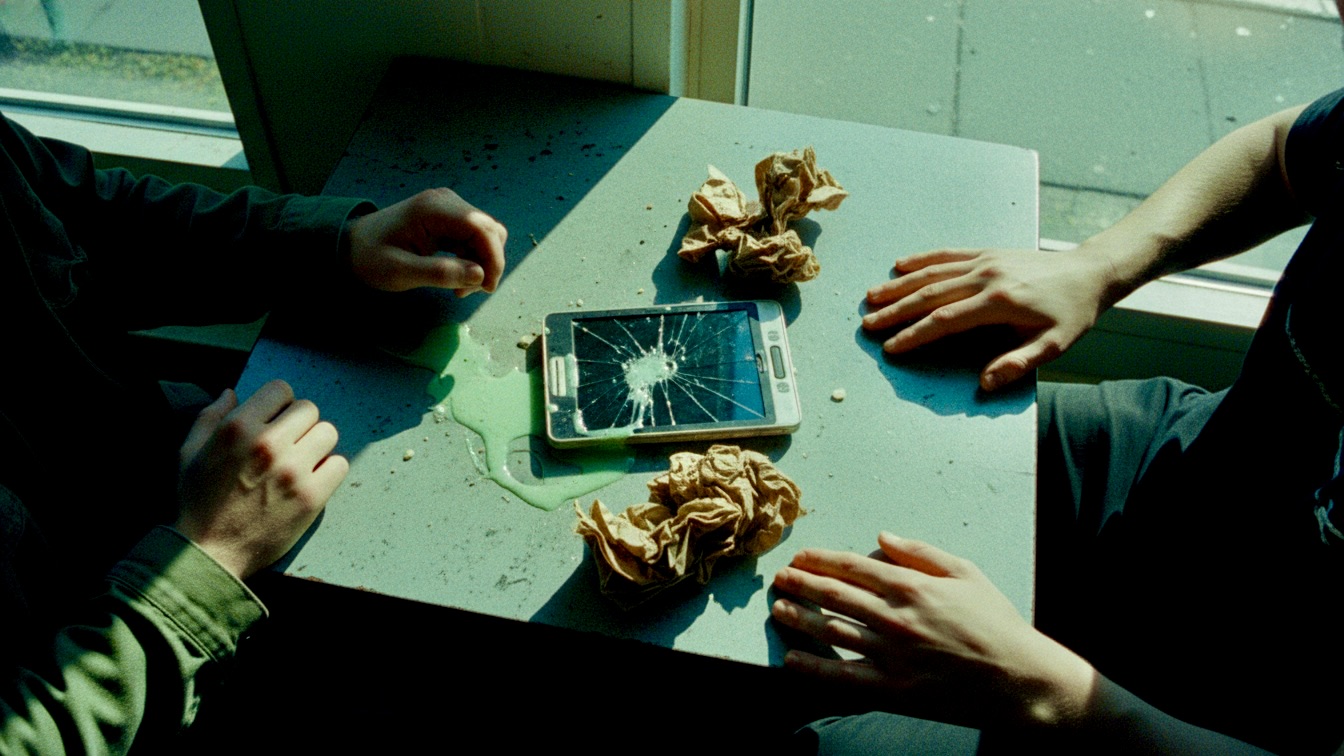
Deb sits in a dimly lit, algae-filled cafe, her cracked datapad—a shield against intrusive advertisements—suddenly flooded by a stranger’s spilled "vat-grown soy-fungus" beverage. The device shorts out, forcing an immediate, involuntary disconnection from the digital noise that defines her daily survival.
In a hyper-optimized city where human worth is measured by genetic perfection and algorithmic efficiency, two strangers find a fleeting, forbidden sanctuary by choosing to disconnect. Their chance encounter forces them to weigh the safety of their digital chains against the terrifying freedom of authentic human connection.
The episode explores the theme of "biological and digital determinism," questioning whether individuals can escape the paths laid out for them by prenatal genetic editing and predictive market algorithms. It highlights the tension between the curated, optimized self and the "rough draft" of natural, flawed humanity.
Furthermore, the narrative delves into the theme of "radical presence." In a world where attention is the most valuable currency, the act of simply sitting with another person without the mediation of a screen becomes a subversive, revolutionary gesture of defiance against a system that demands constant engagement.
For Deb, the stakes involve the crushing weight of familial expectation and the fear of being deemed obsolete in a world that values her sister’s CRISPR-enhanced perfection over her own flawed existence. For Jason, the stakes are survival; he risks his livelihood, his housing, and his social reliability score by choosing to ignore the digital mandates that keep him afloat in a predatory gig economy.
The primary antagonist is the "Omniscient System"—the invisible, pervasive network of AR feeds, predictive algorithms, and social credit scores that exert constant pressure on the characters to optimize their behavior. Internally, both characters struggle with the deep-seated societal conditioning that equates disconnection with failure, making the choice to "go dark" a psychological battle against their own ingrained habits.
Deb and Jason, two exhausted urbanites, find themselves trapped in a sensory-overloading cafe after Jason accidentally destroys Deb’s datapad. Initially hostile, they quickly bond over their shared misery, moving past social scripts to share intimate, raw confessions about their lives: Deb’s resentment toward her genetically "perfected" sister and Jason’s family history of disastrous, low-budget cybernetic augmentation.
As the city’s digital demands attempt to pull them back into the fold, they reach a breaking point where they must choose between compliance and true, albeit risky, isolation. They decide to disable their devices, experiencing a moment of profound, quiet clarity that allows them to forge a genuine, non-digital pact to meet again in the physical world.
Deb is a "rough draft" human, defined by her exhaustion and a deep-seated inferiority complex stemming from her mother’s investment in her sister’s genetic success. By the end of the episode, she shifts from a state of cynical, passive-aggressive compliance to a state of quiet, empowered defiance.
Jason is a jittery, anxious gig-worker who has spent his life trying to keep pace with an impossible algorithmic workload. His arc moves from a state of frantic, performative apology to a state of calm, deliberate agency as he realizes that his own survival is less important than the connection he has made with Deb.
The opening beat establishes the claustrophobic, high-tech misery of the Lumen cafe, culminating in the destruction of the datapad and the initial friction between the two strangers. The midpoint occurs when the characters move past superficial apologies and share their personal traumas, effectively creating a "digital vacuum" where the city’s noise ceases to matter. The climax arrives when both characters receive urgent, life-altering notifications and must decide, in a single, synchronized moment, to override their devices and embrace the silence.
The episode begins with a tone of frantic, high-frequency anxiety, mirroring the buzzing digital noise of the city. As the characters disconnect, the mood shifts toward a melancholic but hopeful intimacy, characterized by a sense of "sudden oxygen" and relief. The final moments leave the audience with a lingering, bittersweet feeling of peace, acknowledging that while the world remains broken, the human connection they’ve found is a temporary, vital victory.
If expanded, the series would follow a loose network of "disconnected" individuals who are slowly forming an underground movement of people opting out of the grid. Each episode would introduce new characters struggling with different facets of the system, gradually building toward a season finale where the "offline" community faces a direct, systemic crackdown.
The thematic escalation would move from personal rebellion to collective resistance, as the characters realize that their individual acts of disconnection are being tracked and labeled as a new kind of "deviant" behavior by the governing algorithms. The character evolution would focus on the transition from fearing the system to actively outsmarting it.
The visual style is defined by a harsh, high-contrast palette: the sickly, pulsing blue light of algae tanks and the aggressive, saturated red of digital warning icons. The camera work should be handheld and claustrophobic during the opening, becoming steadier and more focused on tight, intimate close-ups as the characters begin to connect. Tonal comparables include the bleak, grounded futurism of Children of Men mixed with the intimate, dialogue-driven tension of Before Sunrise.
The target audience is young adults and adults (18-40) who are familiar with the anxieties of the gig economy, the prevalence of social media surveillance, and the rapid advancement of biotechnology. It is designed for viewers who enjoy character-driven speculative fiction that prioritizes emotional resonance over high-concept action.
The pacing is rapid and erratic in the first act to reflect the characters' overwhelmed mental states, then slows down significantly once the devices are muted. The second act is a deliberate, slow-burn dialogue that allows the audience to settle into the silence alongside the characters. The final act returns to a steady, rhythmic tempo that emphasizes the weight of their decision to meet again.
The production should emphasize practical, tactile elements to contrast with the digital world—the sticky texture of the table, the physical decay of the cafe, and the tangible, worn-out clothing of the characters. The "digital noise" should be represented through subtle, low-frequency sound design that is abruptly cut off, creating a jarring, effective transition to the "silent" world of the characters' connection.
Special attention should be paid to the lighting design to ensure the algae tanks feel like an oppressive, artificial presence rather than a decorative element. The use of practical, in-camera effects for the AR overlays will help ground the futuristic elements in a gritty, believable reality.


