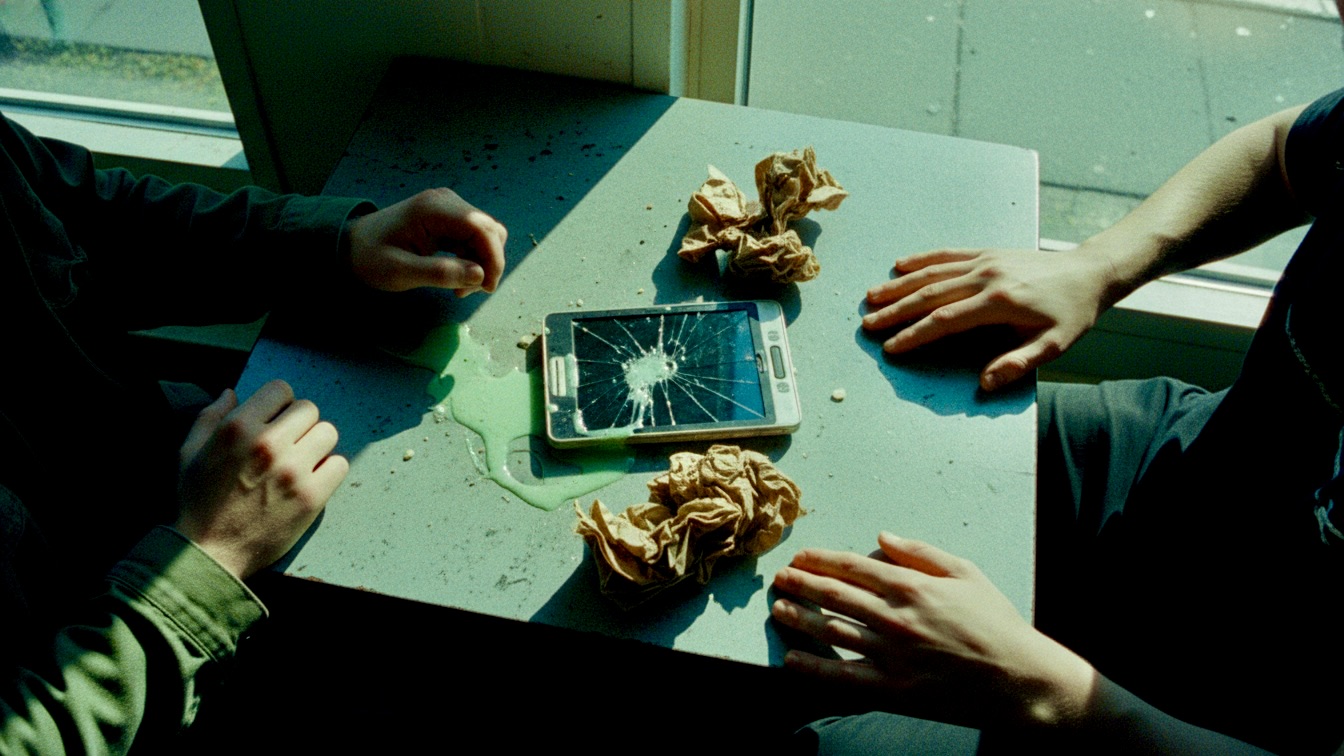
The story follows two strangers, Deb and Jason, who meet in a claustrophobic cafe called Lumen after Jason accidentally spills a synthetic drink onto Deb’s datapad. Initially framed by the transactional friction of the modern gig economy, the interaction shifts when the two realize they share a profound exhaustion with their hyper-connected, technologically invasive world. As they discard their digital tethers and disconnect from the surveillance-heavy city, they form an authentic human connection rooted in shared trauma and the absurdity of their respective family burdens. The chapter concludes with a fragile, hopeful agreement to meet again in a physical space devoid of digital oversight.
The central theme of this narrative is the erosion of human authenticity under the weight of hyper-capitalism and technological surveillance. The city functions as a character itself, a suffocating environment where every interaction is mediated by algorithms, heart-rate monitors, and the constant threat of productivity penalties. The green oat-sludge beverage serves as a perfect metaphor for this existence: a synthetic, expensive, and ultimately toxic substitute for natural nourishment that physically infiltrates and destroys the tools of the characters' digital subjugation.
Another pervasive theme is the commodification of the human biological experience. Through the backstory of Deb’s sister, Chloe, the author illustrates a terrifying future where genetic modification is a tool for social climbing rather than medical necessity. This creates a sharp divide between the "modded" elite and the "un-modded" masses, leaving individuals like Deb to feel like obsolete prototypes. Jason’s uncle provides the inverse of this struggle, showing how the attempt to bridge the gap between human limitation and machine speed leads only to further dysfunction and absurdity, such as the accidental ordering of industrial cat food.
Ultimately, the story explores the radical act of opting out. The "sudden oxygen" felt by the characters when they disconnect from their devices highlights how much of their daily anxiety is self-imposed by the machines they carry. By choosing to ignore the pinging notifications and the demands of their employers, they reclaim a sense of agency. This act of civil disobedience against the culture of constant connectivity is presented not as a grand political revolution, but as a small, necessary breath of air in a world that is slowly asphyxiating its inhabitants.
Deb is a woman defined by her deep-seated resentment toward the pressure of perfection. She carries the weight of being the "rough draft" in a family that values genetic optimization over intrinsic human worth. Her cynicism serves as a protective shell, a way to navigate a world that constantly reminds her of her flaws, such as her astigmatism and poor posture. When she reveals her sister’s background, she displays a raw vulnerability that suggests she is starving for a connection that does not judge her against an engineered standard.
Her internal state is one of profound depletion, yet she possesses a hidden reservoir of defiance. By choosing to disable her hardware and ignore her mother’s pings, she demonstrates that she is capable of rejecting the societal scripts that dictate her life. She is not merely a victim of her environment; she is a person actively searching for a space where she can exist as a flawed human being without the constant, critical gaze of an algorithm or a parent.
Jason presents himself as a jittery, anxious man, constantly reacting to the stimuli of a city designed to keep him in a state of perpetual flight. His reliance on cheap, ill-fitting AR glasses and his employment in a logistics warehouse categorize him as a cog in the machine who is beginning to realize the gears are grinding him down. His initial interaction with Deb is characterized by social anxiety and an adherence to scripts, yet he possesses enough residual humanity to abandon those scripts in favor of genuine curiosity.
His motivation for connecting with Deb stems from a shared recognition of their mutual absurdity. By sharing the story of his uncle, he demonstrates a dry, coping humor that serves as a bridge to intimacy. Jason is the one who initiates the final act of disconnection, showing a latent desire to be more than just a data point in a warehouse ledger. He is seeking a partner in his rebellion, someone with whom he can share the burden of existing in a reality that feels increasingly like a "badly written joke."
The narrative voice is sharp, observational, and deeply cynical, perfectly mirroring the sensory overload of the setting. The author makes effective use of visceral imagery, such as the "spiderweb of shattered glass" on the datapad or the "low-frequency hum" of the algae tubes, to ground the story in a physical reality that feels hostile to the human body. The pacing is frantic in the beginning, mimicking the rhythm of the city's digital notifications, before slowing down significantly once the characters choose to disconnect.
The tone shifts masterfully from the flat, deadpan delivery of the opening lines to the intimate, breathy cadence of the final conversation. This transition reinforces the story's message: that true communication only becomes possible when the digital noise is stripped away. The use of the "omniscient narrator" perspective adds a layer of irony, highlighting how the characters are often unaware of how their biological responses—such as adrenaline spikes or heart rate changes—are inextricably linked to the technological environment.
Finally, the sensory details are curated to emphasize the claustrophobia of the setting. The description of the air as a "wet wool blanket" and the "corpse-like" lighting of the algae tanks create a pervasive sense of physical discomfort that makes the characters' eventual relief feel earned and profound. By focusing on the "sticky" and "gritty" aspects of their reality, the author creates a tactile experience that contrasts sharply with the smooth, frictionless, and ultimately hollow world of the digital feeds.


