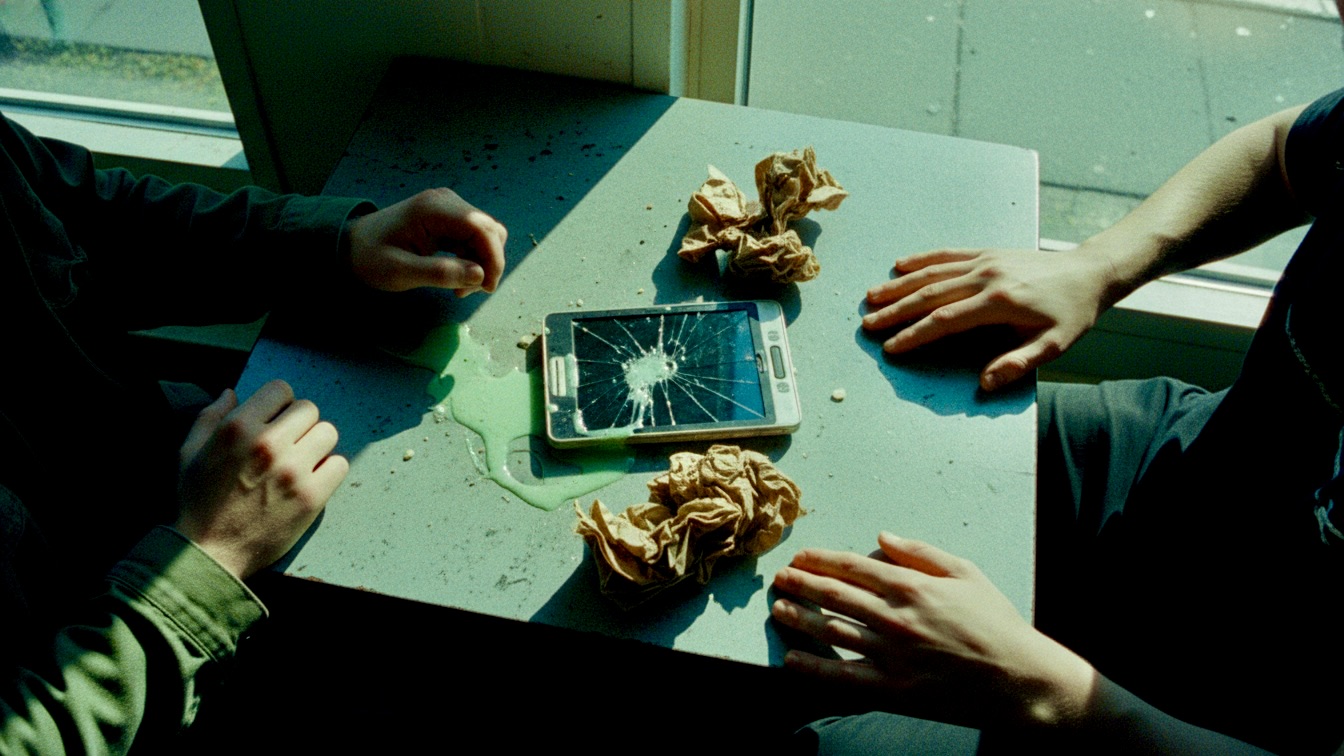
A spilled drink breaks the digital static, forcing two burned-out strangers to breathe the same heavy air.
"You are actively destroying my life."
Deb did not yell. She said it with the flat, theatrical deadpan of someone who had already accepted that the universe was a badly written joke. She stared down at her datapad. The screen was cracked in the upper left corner, a spiderweb of shattered glass that she used specifically to distort the retinal-scanning advertisements that plagued the city. Now, that crack was rapidly filling with a thick, pale green liquid.
"A tragedy. Truly. I am the destroyer of screens," Jason said. His voice was equally flat, but his hands were moving fast. Too fast. He grabbed a stack of recycled brown napkins from the dispenser on the tiny, sticky table and slapped them down on the device.
"Don't rub it," Deb said. "You're just pushing the oat sludge into the motherboard."
"It's not oat," Jason corrected, his thumbs pressing hard into the cheap paper. The green liquid soaked through instantly, staining his skin. "It's vat-grown soy-fungus isolate. With synthetic matcha. It cost me fourteen dollars and now it is part of your hardware."
"Fascinating. I'm thrilled to host it."
They stood on opposite sides of a table the size of a pizza box. The cafe, Lumen, was a narrow hallway of a place tucked between a defunct crypto-bank and a bio-hacking clinic. The walls were lined with vertical glass tubes filled with engineered algae. The algae was supposed to photosynthesize carbon dioxide and emit a calming blue glow. Instead, it just made everyone look like a corpse and gave off a low-frequency hum that vibrated directly in the molars.
It was late April outside. Spring in the city meant the air was a thick soup of aggressive pollen, heat waves bouncing off concrete, and the smell of melting trash. The cafe's HVAC system struggled to filter it all out, resulting in an atmosphere that felt like breathing through a wet wool blanket. Claustrophobia was the baseline human condition here.
Jason lifted the soggy napkin. The datapad's screen flickered, flashed a bright, angry yellow, and then went completely black.
"Well," Jason said. He dropped the wet napkin onto the table. "It's dead. I murdered it."
"Good," Deb said. She slumped back into the hard plastic booth. "I hated that thing anyway. It's been tracking my heart rate to sell me anxiety meds."
Jason looked at her. Really looked at her. The omniscient static of the room—the pinging of a dozen different augmented reality feeds, the lo-fi algorithmic beats designed to optimize chewing speed, the hiss of the espresso machine—seemed to dial back a fraction of a decibel.
Deb looked exhausted. Not just tired, but fundamentally depleted. She wore an oversized canvas jacket that had frayed cuffs and a grease stain near the pocket. Her dark hair was pulled back in a severe clip, and her eyes had the hollow, bruised look of someone who slept exclusively in four-hour shifts.
Jason wasn't doing much better. He was jittery. His left knee bounced under the table, striking the metal pedestal with a rhythmic clink, clink, clink. He wore a faded black t-shirt and had a distinct groove on the bridge of his nose from wearing cheap AR glasses that didn't fit right.
He didn't walk away. Social protocol dictated that he should apologize, transfer her the funds for a new pad, and vanish into the crowd. That was the script.
Instead, he slid into the booth opposite her.
"I'm Jason," he said.
"Deb."
"I owe you a new screen, Deb. Or a new life, depending on what was on that hard drive."
"Mostly just passive-aggressive text threads from my mother and a highly curated collection of memes about the impending collapse of the global water supply," Deb said. She picked up a dry napkin and began wiping the green residue off her own fingers. The physical sensation of the rough paper on her skin grounded her. "Nothing I can't live without."
Jason leaned back against the plastic booth. The blue light from the algae tank behind him cast sharp shadows across his face. He felt a strange lack of urgency. His own feed was vibrating in his pocket—three missed messages from his shift manager, a notification that his rent was due in four days, an alert that the air quality outside had dropped to 'Moderate Risk'. He ignored it all. The physical reality of the sticky table and the ruined device felt more real than the digital noise.
"Why are you even here?" Jason asked. "This place is a sensory nightmare."
"I needed the dark," Deb said. She gestured vaguely at the pulsing blue tubes. "And the UV radiation. It's supposed to trick your brain into thinking you've seen the sun today."
"Does it work?"
"No. It just makes me want to punch a wall."
Jason laughed. It was a short, sharp sound. "Yeah. I come here because the Wi-Fi blocker in the walls stops my landlord from tracking my location."
Deb stopped wiping her hands. She looked across the table. Her gaze was narrow, assessing. She was trying to figure out if he was a creep, a scammer, or just another broken piece of the city's machinery. The omniscient view of the moment hung in the air: two dots of human static trapped inside a glowing blue box, surrounded by millions of other dots, all vibrating at frequencies of pure panic.
She decided he was harmless. Or, at least, his harm was currently contained.
"You want to know why I actually don't care about the datapad?" Deb asked, her voice dropping a register. It was a sudden shift into intimacy. The kind of confession you only give to a stranger because the stakes are zero.
"Enlighten me."
"My mom literally CRISPR'd my sister to be a perfect cellist," Deb said. The words came out in a rush, a bitter burst of syllables. "It is fucking exhausting."
Jason blinked. The bouncing of his knee stopped. The clink faded into the background noise.
"Wait. What?"
"You heard me," Deb said. She crossed her arms over her chest, burying her hands in the rough canvas of her jacket. "Chloe. That's my sister. When my mom was pregnant with her, she took out a second mortgage to pay a clinic in Geneva. They tweaked the muscle memory pathways. They altered her bone density so she could sit straight for twelve hours a day without back pain. They elongated her fingers by exactly four millimeters. She is a biological machine designed specifically to play Bach."
Jason stared. He tried to process the sheer, terrifying economics of it. "For a cello?"
"For a cello," Deb repeated flatly. "Not to cure a disease. Not to make her immune to the smog. Just so she could get first chair in the youth symphony. Which she did. Because, obviously, she's genetically rigged to win."
"Jesus."
"Right? And I'm the older one. The rough draft. Un-modded. Un-tweaked. I have astigmatism, bad posture, and I'm allergic to soy-fungus isolate, which is why I'm glad you spilled that toxic waste before I took a sip."
Jason looked down at the green puddle. "I am a hero."
"You're a public menace," Deb countered, but the corner of her mouth twitched upward. It was a microscopic movement, but in the harsh blue light, it was massive. "But seriously. It's a nightmare. Every time I drop a plate, or forget a birthday, or, I don't know, exist as a flawed human being, my mom gets this look. This look of profound regret that she didn't have the Geneva money when she had me."
She stopped. Her breathing was shallow. The physical toll of the rant was visible in the tight cords of her neck. The omniscient narrator could see the adrenaline spiking in her bloodstream, the defensive walls going up. She had shared too much. She waited for him to minimize it. To tell her it wasn't that bad. To spout some algorithmic platitude about self-love.
Jason didn't do that. He leaned forward, resting his elbows on the sticky table, completely ignoring the green sludge that soaked into his sleeves.
"My uncle Rick," Jason said, his voice quiet, intense. "He wanted to be a day trader. Thought he was the Wolf of Wall Street. But his APM—actions per minute—was too slow for the new trading bots."
Deb uncrossed her arms. She was listening.
"So," Jason continued, "he didn't go to Geneva. He went to a strip mall in the Valley. Paid a guy named 'Doc Byte' to install a neural implant. Direct hardline from his visual cortex to the market feeds. Cut out the middleman of his hands and eyes. Pure thought-to-screen interface."
Deb winced. "Oh no."
"Oh yes," Jason said. A grim, theatrical smile spread across his face. "It was pirated Russian military hardware running on cracked open-source software. The installation was done by a robotic arm that usually assembled cheap electric scooters."
"Did it work?"
"For about three days. He made eighty grand. Thought he was a god." Jason's smile vanished. The reality of the memory hardened his features. "Then a firmware update pushed through. The implant confused the market feed with the smart-home network. Now, whenever a Wi-Fi router resets in his apartment building, his left eye twitches uncontrollably, and he accidentally orders twenty pounds of industrial cat food."
Deb let out a sound that was half-gasp, half-laugh.
"He doesn't even own a cat," Jason added deadpan.
Deb broke. She threw her head back and laughed. It was a harsh, ugly, authentic sound that cut through the lo-fi beats of the cafe. It was the sound of pure, unadulterated relief.
Jason watched her. His chest felt lighter. The knot of anxiety behind his ribs, the one that had been tight since he woke up to a smog-alert sky, began to loosen. He laughed with her. They sat there in the oppressive blue gloom, two broken people laughing at the absolute absurdity of their broken families and their broken world.
For a moment, the omniscient view shifted. The digital noise of the city seemed to hit a glass wall around their table and bounce off. The algorithmic pressure to optimize, to upgrade, to be perfect, dissolved into the messy, green-stained reality of the moment.
"He just sits there," Jason wheezed, wiping a tear from his eye. "Staring at the microwave. Speaking in binary. 'Zero one one zero, pass the salt, please.'"
"Stop," Deb begged, holding her ribs. "My un-modded lungs can't take it."
They slowly caught their breath. The silence that followed wasn't the heavy, loaded silence of strangers. It was the comfortable, exhausted silence of soldiers in a trench during a ceasefire.
Then, the physical world intruded.
Deb's wrist buzzed. A heavy, aggressive haptic vibration. A notification from her mother. Then another. Then a calendar alert. Her AR contacts—cheap, slightly scratched lenses—flashed a sequence of red warning icons in the periphery of her vision.
Jason's pocket vibrated. His phone was demanding attention. A new shift had opened up at the warehouse. If he didn't claim it in thirty seconds, the algorithm would penalize his reliability score.
The claustrophobia rushed back in. The air in the cafe felt suddenly thick again. The blue algae glowed brighter, pulsing like a warning siren. The cognitive static of 2026 was demanding its toll.
Deb looked down at her wrist. Her face tightened. The hollow look returned to her eyes. She was slipping back under the surface.
Jason felt the vibration in his pocket. He needed the money. He needed the score.
He looked at Deb. He looked at the ruined datapad on the table.
"Hey," Jason said.
Deb looked up.
"Don't answer it," he said.
"It's my mom. If I don't answer, she'll initiate a location ping."
"Let her ping. The walls block the signal, remember?"
Deb hesitated. The societal conditioning was deep. To ignore a notification was a minor act of treason against the modern age. It meant you were inefficient. Unoptimized.
"Turn it off," Jason said. He reached into his pocket. He didn't look at the screen. He just felt for the physical power button on the side of the device. He pressed it. Held it. Felt the long, dying vibration as the phone shut down completely.
He pulled his empty hand out of his pocket and placed it flat on the table, palm up.
Deb stared at his hand. Then she looked at his face. He wasn't smiling playfully anymore. He was entirely serious. It was a challenge, but also an invitation. An invitation to step off the treadmill for five minutes.
Deb swallowed hard. Her throat felt dry. She raised her left hand, tapped the node behind her ear.
"Command," she whispered. "Mute all incoming. Hardware disable. Override."
The node clicked softly.
The red icons in her peripheral vision vanished. The buzzing on her wrist stopped.
It was instantaneous.
SUDDEN OXYGEN.
That was the only way to describe it. It was a physical sensation of a massive, crushing weight being lifted off their chests. The atmosphere in the narrow booth fundamentally changed. The air felt thinner, cooler, easier to drag into the lungs. The oppressive blue light of the algae tanks stopped feeling like a prison and just became... light.
The background noise of the cafe—the hiss of steam, the clinking of ceramic mugs, the muffled sound of a siren out on the street—suddenly sounded real. It wasn't just data to be processed; it was the actual texture of the world.
Deb exhaled. A long, shuddering breath. Her shoulders dropped two inches. The tight cords in her neck relaxed. She leaned forward, resting her arms on the table, careless of the sticky residue.
"Oh my god," she breathed.
"Right?" Jason said softly.
"I haven't gone dark in... I don't even know. Months."
"It feels illegal," Jason said.
"It probably is. Some user agreement we signed when we were twelve says we have to remain perceptible to the market at all times."
They were close now. The pizza-box sized table forced a physical proximity that they had been avoiding, but now leaned into. Their knees bumped under the table. Neither pulled away. The contact was grounding. It was real, messy, un-crispr'd human contact.
"So," Deb said, her voice barely above a whisper. "What do we do now? We have no screens. No data. We are practically cavemen."
"We could talk about the weather," Jason suggested.
"The smog is very thick today."
"Indeed. A fine vintage of industrial runoff."
Deb smiled. A real one this time. It reached her eyes, crinkling the corners where the dark circles lived.
"You owe me a new datapad, Jason."
"I do. I am fully legally and morally responsible for the destruction of your property."
"I'm going to hold you to that. I expect a replacement. Top of the line. No cracked glass."
"I work at a logistics warehouse and drink synthetic fungus," Jason said. "You're getting a refurbished brick from a pawn shop."
"I'll accept it. On one condition."
"Name your terms."
"You have to hand-deliver it," Deb said. She held his gaze. There was no irony now. No theatrical defense mechanism. Just a blunt, desperate request for human connection. "In meatspace. Not a drone drop. Not a locker code. You bring it to me."
Jason felt his heart kick against his ribs. Not the frantic, panicked beat of a missed notification, but a steady, solid rhythm.
"Deal," he said.
"When?"
"Tomorrow. Same time. But maybe not here. Maybe somewhere that doesn't smell like fake vanilla and desperation."
"There's a park down by the old water treatment plant," Deb said. "The city forgot to install surveillance cameras there. It's just dirt and some dead grass. It's perfect."
"Dirt and dead grass. Sounds like paradise."
They sat there in the sudden, beautiful quiet. The world outside the cafe was still burning. The pollen was still choking the streets. The genetic arms race was still churning out perfect, soulless cellists. The gig economy was still grinding bones into dust.
But inside the booth, the air was clear.
Jason looked down at the table. A single drop of the pale green latte had stubbornly clung to the edge of the shattered screen. It trembled there, caught in the micro-gravity of the shattered glass, right on the precipice. He watched the light catch inside the droplet, refracting a tiny, distorted image of the room, waiting to see if it would hold, or if it would finally fall.
“He watched the light catch inside the droplet, refracting a tiny, distorted image of the room, waiting to see if it would hold, or if it would finally fall.”


