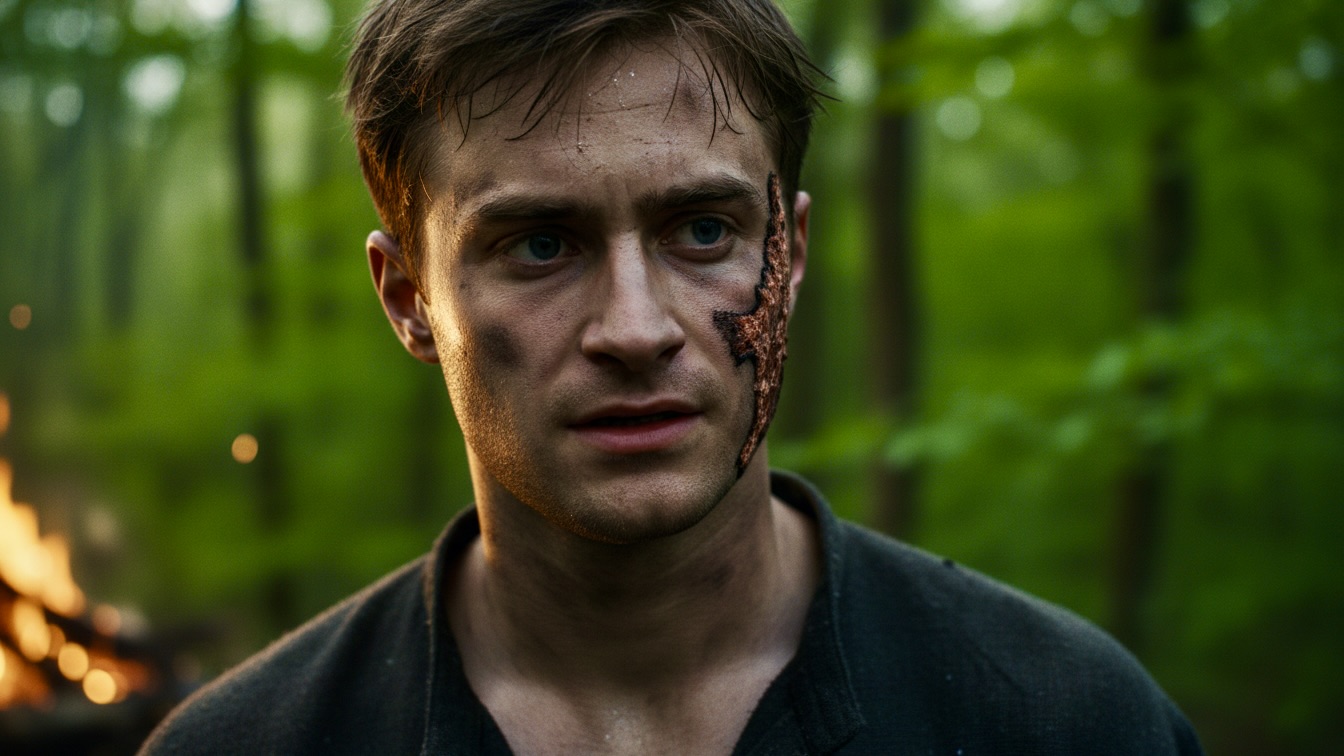
Harry wakes to find his body turning into wood while his town prepares for a violent, ancient ritual.
I woke up feeling like a cheap Ikea desk that had been left out in the rain. My back didn't just hurt; it felt like it was being structurally reinforced by something that shouldn't be inside a human body. I rolled over, and my spine made a sound like a dry branch snapping. It wasn't the satisfying pop of a chiropractor visit. It was heavy. It was dense. It was the sound of something structural failing. I pushed myself up and looked at my forearms. The skin was peeling back in long, dry strips, but there wasn't blood underneath. There was bark. Hard, grey-brown, deeply ridged bark. I rubbed my thumb against my wrist, and a flake of it fell onto the bedsheet. It didn't hurt. That was the scariest part. It just felt numb, like my nerves were being replaced by cellulose.
"Great," I muttered. "Just what I needed for my twenty-first birthday. A career in landscaping from the inside out." I stood up and felt the 'scoliosis' flare. That’s what the school nurse had called it last year. She’d told me to stand straighter. She didn’t mention that the curve in my spine was actually a sapling competing for space with my lungs. I reached back, my hand trembling, and felt the base of my neck. There was a hard, pointed knot of wood pushing through the skin. It felt like a thumb-sized branch. If I moved my head too fast, I could feel it scraping against my vertebrae. I was becoming a tree. In any other town, this would be a medical emergency. In Oakhaven, it was just a rite of passage. I just didn't think it would happen to me this fast.
I looked out the window. The town was already setting up for the Jubilee. They had the streamers out—bright, neon-green ribbons that looked like plastic vines. It was Spring, or at least Oakhaven's version of it. Here, the flowers didn't just bloom; they erupted. The grass grew so fast you could hear it hiss against the fence posts. Everything was too green, too vibrant, like someone had turned the saturation up to a level that made your eyes ache. It was beautiful if you didn't know that the soil was mostly made of our ancestors.
There was a knock on the door. It wasn't a polite tap. It was a rhythmic, aggressive pounding. "Harry? You dead in there, or just turning into a coat rack?"
I pulled on a thick hoodie to hide the bark on my arms. "Go away, Paula. I’m busy having a mid-life crisis."
"It’s noon, Harry. The Jubilee starts in an hour. Elder Unti is already asking about you. He says you’re 'ripe.'" Paula pushed the door open before I could lock it. She was wearing her usual gear: grease-stained cargo pants and a t-shirt that said 'Everything is Fine' over a picture of a burning dumpster. She stopped dead when she saw me. Her eyes went to my hands, then to the weird bulge in my hoodie. "Oh, hell. You’re really doing it, aren't you?"
"Doing what? Growing? It’s a growth spurt, Paula. Totally normal for a guy my age."
"Harry, you have a leaf sticking out of your ear," she said, her voice dropping the sarcasm for a second. She reached out and plucked a small, perfectly formed oak leaf from my hairline. It was bright green and tipped with a drop of clear, sticky sap. "That’s not scoliosis, dude. That’s a structural support beam. You’re turning into timber."
"I know," I snapped, pulling the hoodie tighter. "I can feel it. It’s in my legs too. Every time I walk, it feels like my bones are rooting into the floor. What am I supposed to do? Go to the Jubilee so Unti can prune me?"
Paula looked toward the window. The town square was filling up. I could see the Ancient Oak in the center, its branches reaching out like greedy fingers. It was the biggest thing in the valley, a massive, gnarled heart that pumped the life through the woods. But it was hungry. It hadn't been fed in a decade, and the 'eternal spring' was starting to look a little yellow around the edges. "Unti isn't going to prune you, Harry. He’s going to plant you. You’re the legacy. Your family has been the fertilizer for this town since 1850. You think they built those nice colonial houses on hard work? No. They built them on the mulch of your great-uncles."
"I’m not becoming a lawn ornament," I said. I grabbed my keys from the dresser. My fingers were stiff, the joints feeling like they were being glued shut with resin. "We’re leaving. Now."
"The roads are already blocked," Paula said. "The forest knows when it’s Jubilee day. The trees move, Harry. You know they do. The 101 is probably a wall of thorns by now."
"Then we go off-road," I said. I felt a sharp, stabbing pain in my lower back. The branch was growing. I could feel it lengthening, pushing through the muscle. I let out a choked sound and slumped against the wall. "God, it hurts. It’s like my skin is too small for what’s inside."
"Stay with me," Paula said, grabbing my shoulders. "We need to get to the garage. If we’re going to do this, we need more than a dirt bike. We need an edge."
We moved through the house like ghosts. My parents were already at the square, probably drinking spiked cider and waiting for the 'blessing.' They wouldn't even be sad. They’d be proud. To them, having a son join the Oak was like getting a kid into Harvard. It was a status symbol. I hated them for it. I hated the way they looked at me lately—like I was a crop they were waiting to harvest.
We hit the garage, and the smell of gasoline and old oil hit me like a shot of adrenaline. It was the only thing that didn't smell like mulch and damp earth. My dirt bike, a battered Husqvarna, sat in the corner. Next to it was the workbench where my dad kept the heavy-duty gear.
"Take this," Paula said, handing me the Stihl chainsaw. It was heavy, the metal cold and honest. "If the forest tries to grab you, you don't talk to it. You don't negotiate. You just cut."
I gripped the handle. My bark-covered hands felt a weird affinity for the plastic grip. "I can't believe I’m about to fight a tree with a chainsaw. This is peak irony."
"Welcome to Oakhaven," Paula said, kicking her own bike to life. "Where the green thumb is a literal terminal diagnosis."
We heard the bells then. The Jubilee was starting. A deep, resonant tolling that seemed to vibrate in the very marrow of my bones. It wasn't just a sound; it was a command. My legs twitched, wanting to turn toward the square, wanting to walk into the center of the town and lie down in the dirt. My roots wanted home. I fought it, biting my lip until I tasted blood—real, salty human blood.
"Harry!" Paula yelled over the roar of her engine. "Focus! Don't let the hum get to you!"
"I'm fine!" I shouted back, though I wasn't. I felt the branch in my spine shift, a sharp spike of agony that made my vision blur. I cranked the chainsaw. It roared to life, a beautiful, screaming mechanical protest against the natural order. We tore out of the driveway, the tires kicking up gravel.
We didn't make it two blocks before we saw them. The 'Greens.' That’s what we called the kids who had turned early. They weren't people anymore. They were shambling, vertical logs with human faces stretched thin over the bark. Some of them were my former classmates. There was Tyler, who used to be the point guard for the varsity team. Now, he was seven feet tall, his arms ending in long, whip-like willow branches. He stood in the middle of the road, his eyes clouded over with green moss.
"Tyler, move!" I screamed, but there was no Tyler left. He hissed, a sound like wind through dry leaves, and lunged. His wooden arm whipped out, catching my shoulder. The fabric of my hoodie tore, and the wood-on-wood impact sounded like a baseball bat hitting a fence.
I didn't think. I couldn't afford to. I swung the chainsaw in a wide, horizontal arc. The blade bit into Tyler’s chest—or where his chest used to be. It didn't spray blood. It sprayed sawdust and thick, amber sap. The vibration traveled up my arms, shaking the bark on my skin. Tyler didn't scream. He just sagged, his wooden heart carved in two.
"Keep going!" Paula yelled, swerving around a girl who was sprouting rose thorns from her eye sockets. "Don't look back!"
We hit the edge of town, where the paved road ended and the forest began. Usually, the woods were a few hundred yards back from the treeline. Not today. The forest had moved in. The oaks and maples had stepped forward, their roots humped up through the dirt like the backs of giant buried animals. The trail we usually took was gone, replaced by a wall of dense, interlocking briars.
"It’s shifting!" I yelled. I watched a birch tree literally slide ten feet to the left to block our path. The ground was heaving, the soil turning over as the roots rearranged themselves. It was like riding a bike on the back of a living thing.
I leaned into the turns, my body feeling heavier by the second. The branch in my spine was heavy, pulling my center of gravity off. I felt a leaf sprout from my collarbone. I ripped it off, the pain grounding me. We were flying through the underbrush, the bikes screaming as we jumped over logs that hadn't been there five seconds ago.
"Left! Harry, go left!" Paula screamed.
I pulled the handlebars hard, the bike skidding on a patch of slick, wet moss. A branch whipped across my face, stinging my cheek. I looked back and saw the trees closing in behind us. They weren't just growing; they were reaching. The forest was a giant mouth, and we were the appetizers.
Suddenly, the ground ahead of us exploded. A massive root, thick as a tractor tire, burst through the dirt, sending a shower of earth into the air. Paula hit it head-on. Her bike flipped, tossing her into a thicket of ferns.
"Paula!" I braked, the bike sliding to a halt. I jumped off, my legs stiffening as soon as my feet hit the ground. The earth felt like a magnet. It wanted me to stay. It wanted to pull me down and wrap me in the dark.
Paula was struggling to get up, her arm pinned under the bike. "Go, Harry! Get out of here!"
"Not happening," I said. I ran toward her, the chainsaw idling in my hand. The trees around us were leaning in, their shadows long and jagged in the spring sun. I could hear them whispering. Not words, but a low, rhythmic vibration that suggested hunger.
I reached Paula and shoved the bike off her. She groaned, clutching her shoulder. "It’s broken. My arm is definitely broken."
"Get on my bike," I said. I helped her up, my movements jerky and mechanical. The bark on my arms was thicker now, the ridges deep enough to catch the light. I felt a weird strength in my grip—the strength of an oak. I lifted her onto the back of my Husqvarna like she weighed nothing.
"What about you?" she asked, her face pale.
"I’m going to give us some room," I said. I turned toward the wall of trees blocking the exit path. I revved the chainsaw until it screamed. I didn't feel like a victim anymore. I felt like an invasive species.
I charged the wall of wood. I hacked and carved, the sawdust blinding me. The trees groaned, a deep, tectonic sound of protest. I felt a branch wrap around my waist, pulling me back. I spun and saw a face in the bark—Elder Unti. Not the real Unti, but a projection of him, his features formed by the knots and burls of a massive elm.
"Harry," the tree-voice echoed. "Accept the sap. Accept the cycle. The town needs the green. Your blood is the rain. Your bones are the soil."
"My blood is mostly caffeine and spite, Unti!" I yelled. I jammed the chainsaw into the center of the elm-face. The chain caught on something hard—a core of dense, ancient wood. The saw kicked back, nearly breaking my wrists, but I held on. I leaned into it, using the weight of my own changing body to push the blade through. The elm split with a sound like a lightning strike.
I ran back to the bike and jumped on. "Hold on!"
I pinned the throttle. We shot through the gap I’d carved, the bike jumping over the remains of the elm. The forest behind us was a riot of motion, the trees thrashing in anger. But we were hitting the clearing. We were reaching the old sawmill—the source of the rot.
This was where it had all started. The sawmill sat on the edge of the Ancient Oak’s primary root system. My family had owned this land for generations. My grandfather hadn't just milled timber; he’d been the one who brokered the deal with the woods. He’d traded the town’s humanity for a never-ending spring, and my family was the currency.
I pulled up to the old, rusted structure. The air here was thick with the smell of decay and sweet, cloying pollen. In the center of the mill, where the great saw blade used to sit, the Ancient Oak’s heart-root emerged from the ground. It was a pulsing, translucent mass of wood and veins, glowing with a sickly green light.
"This is it," Paula said, sliding off the bike. She looked exhausted, her face covered in dirt. "The heart. If you destroy this, the Jubilee ends. The forest goes back to being just... trees."
"And what happens to me?" I asked. I looked at my hands. They were almost entirely wood now. I could barely wiggle my fingers. The branch in my spine felt like it was about to burst through my skull.
"I don't know," Paula said softly. "But you won't be a statue."
I walked toward the heart-root. It felt warm, radiating a heat that made the air shimmer. I could see things inside the translucent wood—faces, hands, the ghosts of everyone Oakhaven had consumed. My grandfather was in there. My uncles. They were all part of the weave now.
I raised the chainsaw, but my arms wouldn't move. My muscles were locking up. The 'blessing' was taking hold. I fell to my knees, the chainsaw clattering to the floor.
"Harry!" Paula ran toward me, but she was stopped by a tangle of roots that sprang from the floorboards.
"It’s okay," I whispered. My voice sounded like sandpaper. I looked at the heart-root. It was beautiful in a terrifying way. It offered peace. It offered a life without pain, a life of just existing, of drinking the sun and the rain. All I had to do was let go.
But then I thought about the 'Greens' in the street. I thought about Tyler. I thought about a town that fed its children to a tree so they could have nice lawns.
"No," I said. I reached into my pocket with my one hand that still had some feeling. I pulled out my lighter—a Zippo my dad had given me for my eighteenth. It was engraved with the family crest: an oak tree.
I flicked it. The flame was small, fragile in the face of all that green power.
"Harry, don't!" Unti’s voice came from everywhere and nowhere. "You’ll burn the whole valley! You’ll destroy the legacy!"
"Good," I said. "It’s a shitty legacy."
I didn't use the chainsaw. I used the gasoline. I kicked over the Husqvarna, let the fuel spill out across the floorboards, soaking the roots, soaking the heart of the woods. I felt the forest scream. The building shook. Dust fell from the rafters like grey snow.
I looked at Paula. "Get to the road. The bike’s gone, so you’re going to have to run."
"I’m not leaving you!"
"Go!" I roared. The bark on my chest cracked as I spoke. I was tearing myself apart to stay human for one more minute.
She looked at me, eyes wet, and then she ran. She didn't look back. She was smart. She knew a funeral when she saw one.
I stood in the center of the gasoline pool. I felt the heart-root try to pull me in, its sticky tendrils wrapping around my ankles. I felt the branch in my spine pulse with a final, desperate surge of growth. I could feel the leaves unfurling in my lungs.
I looked at the lighter. The flame was steady.
"Happy birthday to me," I said.
I dropped the Zippo.
The gasoline ignited instantly. A wall of orange flame erupted, climbing the walls, devouring the dry sawdust, and biting into the heart-root. The scream that came from the forest wasn't human. It was the sound of a thousand years of hunger being silenced. The green light of the root turned to a violent, angry red.
I stood in the heat, and for the first time in months, I felt warm. Not the fake, humid heat of the Oakhaven spring, but the real, burning heat of fire. The bark on my arms began to char and peel. The branch in my spine felt the flame and shriveled. It hurt—god, it hurt like nothing else—but it was a human pain.
I watched my family’s legacy turn to ash. The Ancient Oak was dying, and as it died, the grip it had on the town began to slip. Outside, the trees would be retreating. The 'Greens' would be falling still. The eternal spring was over.
I collapsed as the roof began to cave in. I was covered in soot and sap, my skin a map of burns and bark. I crawled toward the door, my limbs heavy but finally, finally mine again. I could feel the cold air of a real March evening blowing in through the smoke. It wasn't sweet. It didn't smell like flowers. It smelled like wet dirt and upcoming rain.
It smelled like the truth.
I made it to the edge of the clearing before the mill collapsed in a final, thunderous heap of burning timber. I lay in the dirt, breathing in the ash. My back was a mess, and I’d probably never walk right again, but the branch was gone. I could feel my spine settling back into its natural, crooked shape.
I looked up at the sky. The stars were coming out. They weren't blocked by the canopy of the Ancient Oak anymore. They were just points of light in a cold, indifferent universe.
I heard footsteps. Paula. She was limping, her arm tied in a makeshift sling made from her 'Everything is Fine' shirt. She sat down next to me in the dirt.
"You look like hell," she said, her voice shaking.
"I feel like a charcoal briquette," I rasped. "Did it work?"
She looked back at the town. The neon-green ribbons of the Jubilee were melting in the heat of the distant fire. The woods looked smaller, thinner. "Yeah. The spring is over, Harry. It’s actually going to be winter for a while."
"Good," I said, closing my eyes. "I’m tired of everything being so damn green."
We sat there for a long time, watching the fire burn itself out. I felt a weird sensation in my hand. I looked down. My skin was red and blistered, but it was skin. No bark. No rings. Just me.
"What now?" Paula asked.
I looked at the road leading out of the valley. It was clear now. The thorns had withered, and the trees had pulled back, leaving the asphalt bare and open.
"Now," I said, pushing myself up with a groan, "we find a doctor who doesn't know anything about gardening."
I looked at my reflection in a puddle of rainwater. I looked older. I looked broken. But as I stood up, I didn't hear the sound of a branch snapping. I just heard the sound of my own breath, ragged and real, in the quiet of the night. The forest was just a forest again. And I was just a guy with a very long road ahead of him.
I picked up a piece of charred wood from the ground—a remnant of the heart-root. It was cold now. I tossed it into the bushes and started walking.
"Hey, Paula?"
"Yeah?"
"If I ever ask to go for a hike, just shoot me."
"Deal," she said, and for the first time in Oakhaven, the laughter didn't sound like it was being muffled by the leaves. It sounded like it could go on forever.
We walked toward the treeline, leaving the burning remains of the legacy behind us. The air was crisp, the kind of cold that reminded you that you were alive because it bit at your skin. I liked it. I liked the sting. I liked the way the shadows didn't move when I wasn't looking.
As we passed the town limits, I saw a single sprout pushing through the asphalt. It was small, innocent, and bright green. I didn't think about its beauty. I didn't think about the cycle of life.
I just stepped on it and kept walking.
We reached the highway as the first hint of dawn started to grey the horizon. It wasn't a 'blooming' sunrise. It was just the sun, coming up because it had to. The world felt bigger than the valley. It felt wide and terrifying and completely unrooted.
"We need a car," I said, looking at the empty road.
"I think I saw an old truck back at the gas station," Paula said. "Keys were probably in it. Nobody leaves Oakhaven, right?"
"They do now," I said.
We started down the asphalt, two kids covered in ash and sap, heading toward a world that didn't know the difference between a growth spurt and a death sentence. My back ached with every step, a constant reminder of what I’d carried, but the weight was gone. I was light. I was hollowed out and empty, and for the first time in my life, I was ready to grow into whatever I wanted to be, as long as it wasn't an oak.
I looked back one last time. The smoke from the sawmill was a thin, black ribbon against the morning sky. The Ancient Oak was a skeleton, its branches white and brittle in the cold light. It looked like a graveyard.
"Rest in peace, Grandpa," I whispered.
Then I turned my back on the woods and didn't look back again. The road was long, and the spring was finally, mercifully dead.
I felt a twitch in my shoulder. Just a muscle spasm. I hoped. I reached up and rubbed the spot where the bark had been thickest. It was smooth. Scarred, but smooth. I took a deep breath, filling my lungs with the scent of smoke and cold air. It didn't taste like pollen. It tasted like gasoline.
It was the best thing I’d ever smelled.
"You coming?" Paula called from a few yards ahead.
"Yeah," I said. "I'm coming."
I caught up to her, and together we walked out of the valley, leaving the emerald nightmare to rot in the sun. The world was waiting, and for once, I wasn't part of the scenery.
“As we reached the highway, I felt a familiar, sharp itch deep inside my hip bone, right where the fire hadn't reached.”


