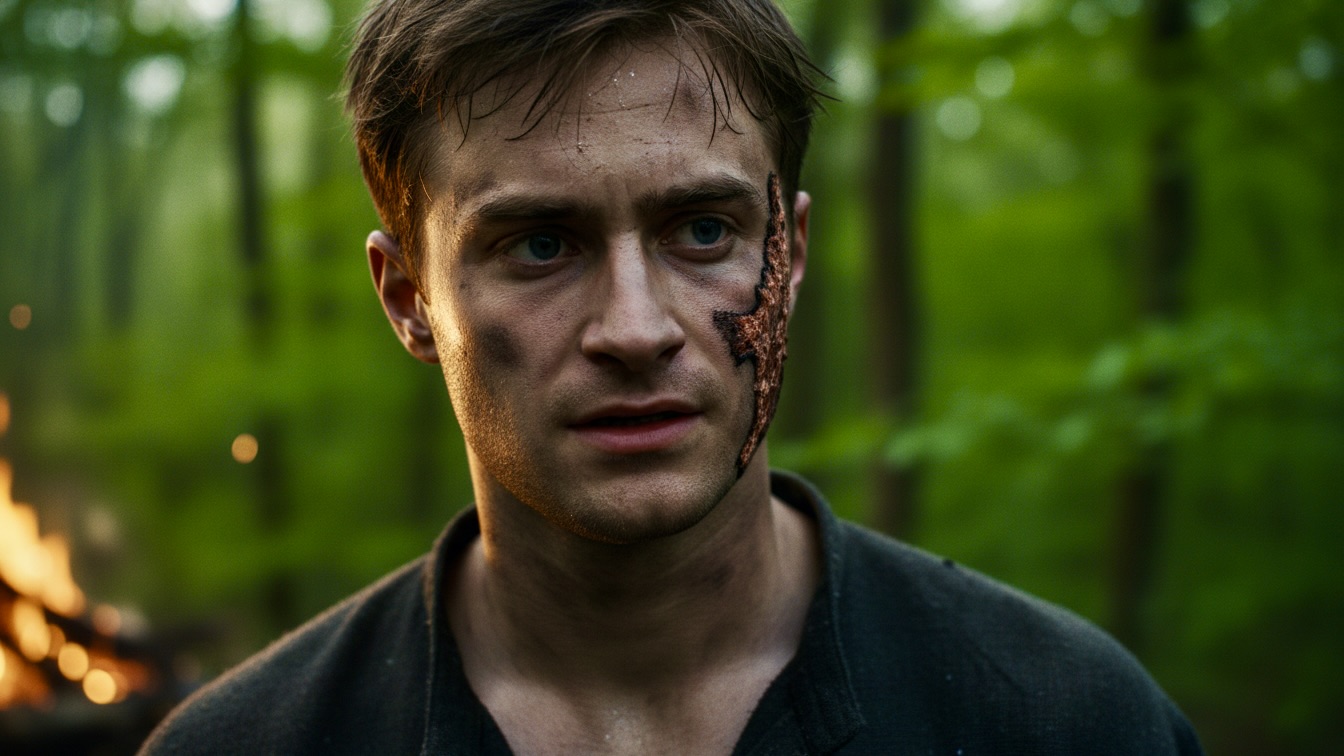
The narrative begins with Harry, a young man in the town of Oakhaven, discovering that his body is undergoing a grotesque metamorphosis into an oak tree. What was previously dismissed as scoliosis reveals itself to be a literal sapling growing along his spine, while his skin begins to harden into grey-brown bark. This transformation is not a medical anomaly but a localized rite of passage in a town where the "eternal spring" is fueled by the bodies of its inhabitants. Harry’s friend Paula arrives to find him in the midst of this change, warning him that the town elders intend to "plant" him during the upcoming Jubilee celebration.
Refusing to succumb to his family’s legacy as "fertilizer" for the town, Harry and Paula attempt a desperate escape on a dirt bike. They are forced to navigate a sentient, aggressive forest that physically shifts to block their path, and they encounter "Greens," former classmates who have already fully transformed into mindless wooden husks. Harry is forced to use a chainsaw to cut through Tyler, a former friend, marking a definitive break from his connection to the natural world of Oakhaven. The journey culminates at an old sawmill, the site of a generational pact between Harry’s ancestors and the Ancient Oak that dominates the valley.
At the sawmill, Harry confronts the heart-root of the forest, a pulsing, translucent mass that represents the collective consciousness of those the town has consumed. Despite the forest's seductive promises of peace and a life without pain, Harry chooses to destroy the heart-root using gasoline and his grandfather’s Zippo lighter. The resulting inferno kills the Ancient Oak and severs the supernatural grip it held over the town and Harry’s own body. The story concludes with Harry and Paula walking out of the valley toward the highway, battered and scarred but finally free from their predetermined botanical fate.
The central theme of the story is the struggle for autonomy against the crushing weight of ancestral legacy. In Oakhaven, legacy is not merely a set of values or a name but a biological imperative that consumes the individual for the sake of the collective's prosperity. Harry’s family has literally been the mulch for the town’s success, and his rebellion is a rejection of the idea that he owes his life to the traditions of his forebears. By burning the heart-root, he destroys the "shitty legacy" that would have seen him sacrificed to maintain a false, hyper-vibrant status quo.
Another prominent theme is the subversion of the "natural" as a source of horror rather than peace. The forest in Oakhaven is depicted as a predatory, parasitic entity that masquerades as a beautiful spring. The vivid green ribbons and the hissing grass create an atmosphere of "unnatural nature," where growth is synonymous with death and the loss of the self. This theme highlights the psychological terror of being consumed by something that is supposed to be life-giving, transforming the pastoral ideal into a claustrophobic nightmare of roots and resin.
The narrative also explores the theme of human identity through the lens of pain and imperfection. Harry initially views his human body as a "cheap Ikea desk," but by the end of the story, he embraces his "crooked" spine and charred skin. The forest offers a painless, eternal existence as a tree, but Harry chooses the "human pain" of fire and struggle. This suggests that identity is forged through the ability to feel, suffer, and resist, rather than through the passive acceptance of a comfortable, predetermined role within a larger system.
Harry functions as a cynical and defiant protagonist who uses dark humor as a psychological defense mechanism against his horrifying reality. His initial comparison of his body to a broken piece of furniture suggests a sense of detachment, but this quickly shifts to a fierce protectiveness of his own humanity. He is acutely aware of the parasitic nature of his community, expressing deep resentment toward his parents who view his impending transformation as a "status symbol." This resentment fuels his drive to survive, as he refuses to be another "lawn ornament" in the service of a town that does not value his individuality.
Psychologically, Harry undergoes a transition from a victim of biology to an "invasive species" who takes active control of his environment. His use of the chainsaw and gasoline represents a psychological embrace of the industrial and the artificial as weapons against the overwhelming organic force of the forest. He displays significant mental fortitude when he rejects the "peace" offered by the heart-root, recognizing it as a form of spiritual and physical annihilation. By the end of the chapter, he is physically broken but psychologically whole, having reclaimed his right to grow in his own way, even if that growth is scarred and difficult.
Paula serves as the pragmatic and grounded foil to Harry’s internal struggle, acting as the catalyst for his escape. She is characterized by her lack of sentimentality, evidenced by her "Everything is Fine" shirt and her immediate recognition of the leaf in Harry’s ear as a "structural support beam." Her role is that of a realist who understands the mechanics of the town's curse better than Harry does. She provides the necessary "edge"—both the mechanical chainsaw and the emotional push—to ensure that Harry does not succumb to the "hum" of the forest.
Despite her cynical exterior, Paula demonstrates profound loyalty and bravery, refusing to leave Harry even when her own arm is broken. She represents the possibility of human connection outside the parasitic collective of the town. While Harry fights the internal battle against the sap and bark, Paula manages the external logistics of their flight. Her presence at the end of the story provides Harry with a witness to his humanity, and her laughter signals a return to a world where emotions are not muffled by the oppressive silence of the leaves.
The tone of the narrative is a blend of gritty body horror and cynical noir, which effectively heightens the stakes of Harry’s transformation. The author uses mechanical and industrial metaphors to describe biological processes, such as the "Ikea desk" and the "structural support beam," creating a sense of cognitive dissonance. This stylistic choice emphasizes Harry’s alienation from his own body, framing his metamorphosis as an invasive construction project rather than a natural occurrence. The pacing is expertly handled, moving from the slow, heavy dread of the bedroom to the frantic, high-octane violence of the escape.
Sensory details are used to create a sharp contrast between the "green" world of Oakhaven and the "grey" world of reality. The scent of mulch, damp earth, and sweet pollen is depicted as cloying and dangerous, while the smell of gasoline and smoke is presented as "honest" and liberating. The visual imagery of the "Greens" with human faces stretched over bark provides a visceral anchor for the horror, ensuring the reader understands the stakes of Harry’s failure. The "neon-green" saturation of the town serves as a visual metaphor for the artificiality of the life the elders are trying to preserve.
The narrative voice is deeply rooted in Harry’s perspective, allowing for a personal exploration of the trauma of losing one's physical self. His internal monologue is filled with "caffeine and spite," which gives the story an energetic, rebellious edge that prevents it from becoming purely tragic. The final shift in the atmosphere—from the humid, airless spring to the crisp, biting cold of a real March evening—mirrors Harry’s internal liberation. This sensory transition underscores the story’s conclusion, where the "truth" of a cold, indifferent universe is portrayed as far more desirable than the suffocating "blessing" of the Ancient Oak.


