The hose kicked in my hands like a wild snake. Water blasted the dirt into heavy black soup.
The light was wrong. It was spring, and the sun was supposed to be bright and clean, but it wasn't. It looked dirty. It pushed through the smog and hit the campus concrete like a spilled yellow drink.
I walked fast. My backpack hit my shoulder blades. Thump. Thump. Thump. The straps were too tight. My chest felt squeezed.
I had a pink paper slip in my hand. It was folded into a tiny, hard square. The paper felt damp because my palms were sweating. The paper said I had to do community service. It said I had to go to the agriculture building.
The campus was huge. The buildings looked like giant gray blocks left by a giant baby. Everything was too big. The walkways were too wide. The trees were too tall. It made me feel like a bug.
Spring was loud. The birds were screaming in the trees. The bugs were buzzing in the weeds. The weeds were everywhere. They pushed up through the cracks in the sidewalks. They were bright, angry green. The world was ending, but the weeds didn't care. They just kept growing.
My phone buzzed in my pocket. It was hot. The battery was dying. It was always dying. I didn't look at the screen. I knew what it was. Bad news. The news was always bad. The water is gone. The air is bad. The money is gone. The bulldozers are coming.
I reached the edge of the campus. The greenhouse was at the end of a dirt path.
It looked like a skeleton.
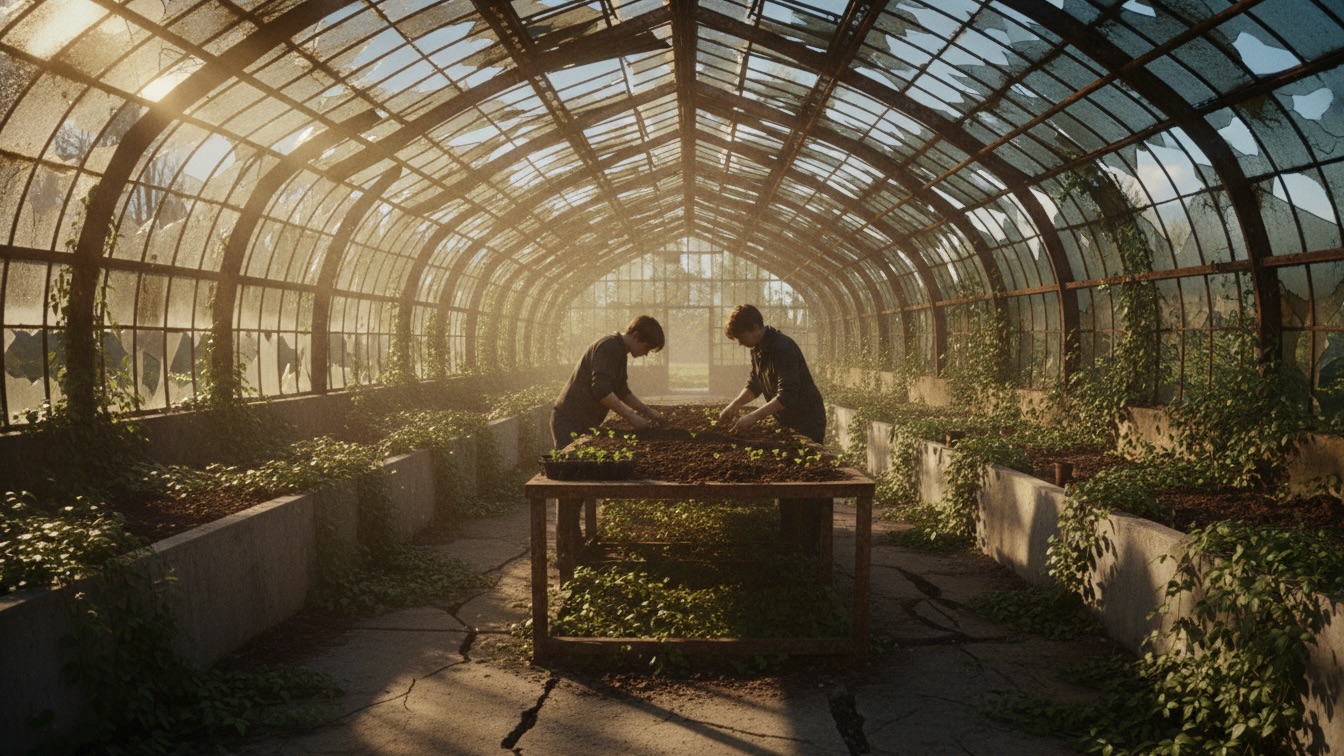
It was a long building made of metal and glass. But half the glass was missing. The metal was covered in brown rust. The roof sagged in the middle. It looked tired.
I looked at the ground. There were square marks in the dirt. Empty spots. That was where the big outdoor planters used to be. Now they were gone. Just flat dirt. Someone took them. Things were always going missing on campus. Bicycles. Benches. Trash cans. Now the planters.
I walked up to the door. The handle was heavy iron. It felt cold. I pulled it. It stuck.
I pulled harder. The metal groaned. The door popped open.
I stepped inside.
The air hit me first. It was thick. It smelled like wet dirt and old plastic. It smelled like a basement after a flood.
It was quiet in here. The screaming birds were muffled.
I looked around. The room was massive. Long metal tables stretched all the way to the back. But the tables were empty.
There used to be plants here. I could tell. There were round dirt stains on the metal grates. Thousands of them. Circles where pots used to sit. Now it was just empty metal.
Above me, a giant metal fan hung from the ceiling. It was missing three blades. It was perfectly still.
The light inside was fading. The sun was going down behind the chemistry building. The shadows in the greenhouse were long and sharp.
I walked down the main aisle. My shoes scuffed the concrete. Scuff. Scuff.
"Don't step on the hose."
The voice came from the back.
I stopped. I looked down. A thick green hose lay across the floor. It was covered in gray dust. I stepped over it.
I kept walking.
I saw her at the very last table.
She was standing under a broken glass pane. The dirty yellow light hit her shoulders. She wore a faded green shirt. Her hair was pulled back. She was hunched over a black plastic tray.
I walked up to her table.
She didn't look up. Her hands were covered in black dirt. She was using a wooden stick to poke holes in the dirt. Poke. Poke. Poke.
"Are you Cleo?" I asked.
"Yes," she said.
"I have this," I said. I held out the pink square of paper.
She stopped poking. She looked at the paper. Then she looked at me. Her eyes were tired. Her face was smudged with dirt.
"Put it in your pocket," she said. "I'm not a teacher. I don't care about your slip."
I put the paper in my pocket.
"You need hours?" she asked.
"Yes," I said.
"Grab the big bag," she said. She pointed with her dirty hand.
I looked. There was a massive plastic bag on the floor. It was white with a torn label. It looked like a bag of concrete.
"Lift it," she said. "Put it in the blue tub."
I walked over to the bag. I grabbed the plastic. It was slippery. I pulled. It was heavy. My stomach muscles tightened. I dragged it across the concrete floor. It made a loud scraping noise.
I got it to the blue plastic tub. I tried to lift it. My arms shook. I heaved it over the edge.
The plastic tore.
Dirt exploded out. A huge cloud of gray dust hit my face.
I closed my eyes. I coughed. The dust tasted like dry leaves and old chemicals. It coated my tongue.
"Don't breathe it," Cleo said.
I wiped my face. My eyes watered.
"Now water," she said.
She pointed to the green hose on the floor.
I picked up the hose. The metal end was heavy. It had a brass nozzle. The nozzle looked bent.
"Turn the red wheel on the wall," she said.
I walked to the wall. The pipe was rusty. The wheel was bright red metal. I grabbed it. The metal cut into my hand. I twisted it.
It was stuck.
I used both hands. I pushed hard. My boots slipped on the floor. The wheel gave a loud squeak. It turned.
I heard the water. It hissed inside the pipes in the wall. It rushed through the green hose. The hose swelled up. It jumped on the floor like a live snake.
I held the nozzle over the blue tub.
"Just a little," Cleo said.
I squeezed the brass handle.
It didn't move.
I squeezed harder. My knuckles went white.
Snap.
The handle broke inward.
The water didn't spray. It exploded.
A solid, high-pressure beam of water blasted out of the broken nozzle. It hit the dry dirt in the blue tub.
The dirt blew up.
A geyser of black mud shot into the air. It hit my chest. It hit my face. It splashed across the metal table.
I dropped the hose.
The hose whipped wildly on the floor. It sprayed water everywhere. It hit the walls. It hit the empty metal racks.
The tub was overflowing. The dirt turned into black soup. It spilled over the plastic edge. It poured onto my shoes.
Thick, cold mud soaked right through my canvas sneakers. My toes went freezing cold.
"Hey!" Cleo yelled.
She ran past me. She didn't slip. She grabbed the red wheel on the wall. She yanked it hard.
The hissing stopped. The hose went limp. The water stopped flying.
The greenhouse was completely quiet again.
Except for the dripping. Drip. Drip. Mud dripped off the edge of the metal table and hit the concrete.
I stood there. My hands hung at my sides. My shirt was soaked. The water was cold. It chilled my chest. My shoes were heavy blocks of wet dirt.
My stomach did a slow, painful flip. I wanted to run away. I wanted to walk out the heavy iron door and go back to my dorm room and pull my blanket over my head and look at the cracked screen of my phone until my eyes burned.
I ruined it. I ruined the dirt. I ruined the table.
Cleo walked back to the table. She looked at the blue tub. It was a swamp.
She looked at my shoes.
"Your shoes are wrecked," she said.
"I know," I said. My voice sounded small.
She wiped a splash of mud off her cheek. It just smeared the dirt.
"The nozzle was broken," I said. I felt my face get hot. I was making an excuse.
"Everything here is broken," she said.
She didn't yell. She didn't sound angry. She just sounded tired.
She reached into the blue tub. She sank her hands into the black soup. She pulled up a handful of dripping mud.
"Too wet," she said.
She threw the mud back into the tub. Splat.
"I'm sorry," I said.
"Get a dry bucket," she said.
She pointed under the table. There was a stack of orange plastic buckets. They looked like the buckets from a hardware store.
I walked over. My shoes squelched. Squelch. Squelch. The cold mud sloshed between my toes. It felt gross. It made my skin crawl.
I pulled an orange bucket from the stack. I set it on the table.
Cleo walked over to a different plastic bag. A smaller one. She ripped the top open.
"Scoop," she said.
I reached into the bag. The dirt inside was light brown. It felt fluffy. It felt like dry sponge. I scooped out a handful. I put it in the orange bucket.
I did it again. Scoop. Drop. Scoop. Drop.
My hands got covered in brown dust.
"Stop," she said.
I stopped. The bucket was half full.
She reached into the swampy blue tub. She grabbed a handful of the wet black mud. She dropped it into the orange bucket with the dry brown dirt.
"Mix," she said.
I shoved my hands into the orange bucket.
I squeezed the mud and the dry dirt together. It felt weird. The mud was freezing cold. The dry dirt was room temperature. I mashed them. It felt like mixing bread dough, but grittier. The little rocks scratched my palms.
I mixed until my wrists ached.
"Show me," she said.
I grabbed a handful of the mixed dirt. I squeezed it in my fist.
"Open," she said.
I opened my hand. The dirt held its shape. It looked like a dark brown baseball. It didn't drip water. It didn't crumble into dust.
"Good," she said.
She pushed a black plastic tray toward me. It had fifty little square holes in it.
"Fill them," she said.
I grabbed clumps of the mixed dirt. I pressed the dirt into the little square holes. I pressed hard. I wanted to do it right.
"Not so hard," she said. "You'll choke them. Just let it sit."
I stopped pressing. I lightly sprinkled the dirt into the holes. I leveled it off with the side of my hand.
The tray was full. Fifty little squares of perfectly damp dirt.
Cleo walked to the back of the table. She came back carrying a different tray.
This tray was full of plants.
But they didn't look right. They were tiny. Just green stalks with two little leaves on top. And they were dying. The stalks were bent over. The leaves were yellow at the edges. They looked sad. They looked like they were giving up.
"What are these?" I asked.
"Tomatoes," she said.
"They look sick," I said.
"The heater broke," she said. She looked up at the ceiling. I followed her eyes. There was a big metal box hanging from a pipe. It had scorch marks on it.
"It got to freezing in here last night," she said. "They got cold. And their dirt is bad. No nutrients."
She set the tray of dying sprouts next to my tray of fresh dirt.
She picked up a small wooden stick. It looked like a popsicle stick.
"Watch," she said.
She slid the wooden stick down the inside edge of one of the square plastic cells holding a dying sprout. She pushed down. Then she pulled up.
The whole block of dirt popped out. It sat in the palm of her hand.
She gently broke the dirt apart.
I leaned in. I looked close.
Inside the dirt, there were tiny white strings. They wrapped around the dirt in circles.
"Roots," she said.
"They look like thread," I said.
"They are trapped," she said. "The pot is too small. They are spinning in circles looking for food."
She used her thumb to gently massage the bottom of the dirt block. The white threads uncoiled. They dangled down.
She took the wooden stick. She poked a deep hole in one of the squares of fresh dirt I had made.
She lowered the sprout into the hole. She tucked the white roots in carefully. Then she pinched the fresh dirt around the green stalk.
The little plant stood up straight.
"Now you," she said.
She handed me a wooden stick.
I picked up the tray of dying sprouts. I picked a square. I pushed the stick down the side. I popped the dirt block out.
I caught it in my hand. It weighed almost nothing.
My hands are big. My fingers are thick. I felt clumsy.
I tried to break the dirt apart.
Snap.
The dirt broke in half. The tiny white roots ripped.
My chest seized up. I stopped breathing. I killed it.
I looked at Cleo.
She looked at the ripped roots.
"It happens," she said. "Put it in the bucket."
I dropped the broken dirt and the torn plant into a gray trash bucket on the floor. It felt terrible. I threw away a life.
"Try again," she said. "Slower."
I popped another block out.
I didn't break it this time. I used the very tips of my thumbs. I rubbed the dirt. It crumbled away. The white roots fell loose. They were so fragile. They felt like wet cobwebs.
I poked a hole in the new dirt. I lowered the plant in. I pinched the dirt around it.
It stood up.
I let out a breath.
"Good," she said.
We worked.
The greenhouse was quiet again. The only sound was the scuffing of the wooden sticks against the plastic. Scrape. Pop. Crumble. Pinch.
The light in the room changed. The dirty yellow sun went down. The sky outside the broken windows turned purple. Then it turned dark blue.
The shadows in the greenhouse got thicker. The corners of the giant room faded into black.
My back started to hurt. The metal table was a little too low for me. I had to hunch over.
My feet were still freezing. The mud inside my shoes had turned into a cold, hard crust. My toes felt numb.
But I didn't stop.
Scrape. Pop. Crumble. Pinch.
I looked at the sprout I just planted.
"Why are we doing this?" I asked.
Cleo didn't stop working. "They need bigger pots."
"No," I said. "I mean... why?"
I stood up straight. I stretched my back. My spine cracked.
"The bulldozer is coming," I said.
Cleo stopped. She looked at her dirty hands.
"I saw the email," I said. I pulled my phone out of my pocket. The screen was covered in spiderweb cracks. I tapped it. The screen stayed black. It was dead. I put it back in my pocket.
"The university sold this lot," I said. "They are tearing the greenhouse down. They are pouring concrete over the dirt. They are building a server farm for the AI science department."
I looked at the endless rows of empty metal tables.
"They took all the big plants already," I said. "The botany professors packed up. The place is dead."
I pointed at the fifty tiny sprouts.
"So why are we putting these in new dirt?" I asked. "The machines are coming next week. Maybe tomorrow. They will crush this whole table. They will crush the sprouts. It doesn't matter."
My throat felt tight. The doomer feeling was back. The heavy, dark blanket in my brain. Nothing matters. The world is burning. The water is poison. The machines are taking over. Why plant a seed?
Cleo wiped her hands on her green shirt. She left two black handprints on the fabric.
She picked up a tiny seed packet from the table. It was made of brown paper. It was wrinkled and water-stained.
"Read this," she said. She handed it to me.
I held it up to the fading light.
The text was stamped in faded black ink.
'Cherokee Purple. Harvested 1998.'
"1998?" I said. "That's old."
"They are heirlooms," she said. "They belong to my grandmother. She saved them in a jar in her basement. For thirty years. Through the heatwaves. Through the blackouts. She kept the jar sealed."
Cleo looked at the tiny green sprouts in the black tray.
"The seeds are tired," she said. "They are old. Only fifty of them sprouted. The rest stayed dead in the dirt."
She picked up a wooden stick. She poked at a clump of dry dirt on the metal table.
"The world is awful," she said. Her voice was flat. "You're right. The bulldozers are coming. The air is toxic. The rent is too high. Everyone is angry on their screens."
She looked up at me. Her eyes caught the faint glow of the orange streetlamps turning on outside the broken windows.
"But the seed doesn't know that," she said.
I looked at the little green stalk.
"The seed just knows it got wet," she said. "It knows it felt the warmth. So it woke up. It did its job. It pushed a root down. It pushed a leaf up. That's all it knows how to do. It tries to live."
She pointed at the tray.
"They are trying to live right now," she said. "They don't know about the server farm. They just know they need iron and nitrogen from the dirt."
She picked up another dying sprout. She popped the dirt block out.
"If I leave them in the bad dirt, they die tonight," she said. "If I put them in the new dirt, they live tomorrow."
She crumbled the dirt. She freed the white roots. She planted it in the new tray.
"I can only control today," she said.
I watched her hands. They were fast. They were careful.
I swallowed hard. The tight feeling in my chest loosened a tiny bit. Just a fraction.
I picked up my wooden stick.
I went back to work.
Scrape. Pop. Crumble. Pinch.
We didn't talk anymore. The silence was heavy, but it wasn't bad. It felt like a shared secret.
The greenhouse went completely dark. The only light came from the orange streetlamps shining through the missing roof panels. The light cast strange, long shadows across the empty metal tables.
We finished the last one.
Fifty tiny green stalks stood straight up in fifty tiny squares of fresh, damp dirt.
They looked like a tiny army.
My back was locked up. I groaned when I stood straight. My hands were stained black. The dirt was jammed deep under my fingernails.
Cleo grabbed a plastic spray bottle. She pumped the handle. She misted the fifty sprouts with water.
The water droplets caught the orange light. They sparkled for a second.
"Done," she said.
She dropped the spray bottle on the table.
We stood there in the dark.
I heard a heavy engine rumble in the distance.
It came from the edge of campus. It was a low, deep vibration. It made the rusty metal pipes in the greenhouse rattle.
I looked at Cleo.
She was looking at the door.
"Construction crew," she said. "They are moving the heavy equipment to the perimeter fence. Getting ready for morning."
The rattle stopped. But the feeling stayed in the air.
I looked down at the tray of tomatoes.
Fifty lives.
I looked at Cleo.
"We can't leave them here," I said.
She looked at me. Her face was hidden in the shadows.
"I know," she said.
"If we leave them, the machines will crush the table at dawn," I said.
"I know," she said again.
"Where do we take them?" I asked.
She looked around the massive, empty greenhouse.
"I live in a van," she said. "It's too cold at night. They will freeze."
I thought about my dorm room. It was tiny. It smelled like dirty laundry and cheap noodles. It had one tiny window that faced a brick wall. It got zero sunlight.
But it had a heater. It was warm.
"My dorm," I said.
"You have a grow light?" she asked.
"No," I said. "But I have a desk lamp. And my roommate has a bright reading light. And we can steal the LED strip from the hallway."
She was quiet for a second.
"Okay," she said.
She grabbed one side of the black plastic tray.
"Grab the other side," she said.
I grabbed the plastic lip. My dirty fingers gripped it tight.
"Keep it level," she said. "Don't shake them. The roots are in shock."
We lifted the tray together.
It was heavy with the wet dirt.
We walked down the long, dark aisle of the greenhouse. We walked past the empty tables. We walked past the broken fan. We stepped over the green hose on the floor.
We reached the heavy iron door.
I turned backward. I pushed my shoulder against the cold metal. I shoved the door open.
The spring night air hit us. It was loud. The bugs were buzzing. The heavy machinery was humming in the distance.
I picked up the tray of tomatoes, pushed the heavy door open, and stepped out into the dark.
“I picked up the tray of tomatoes, pushed the heavy door open, and stepped out into the dark.”


