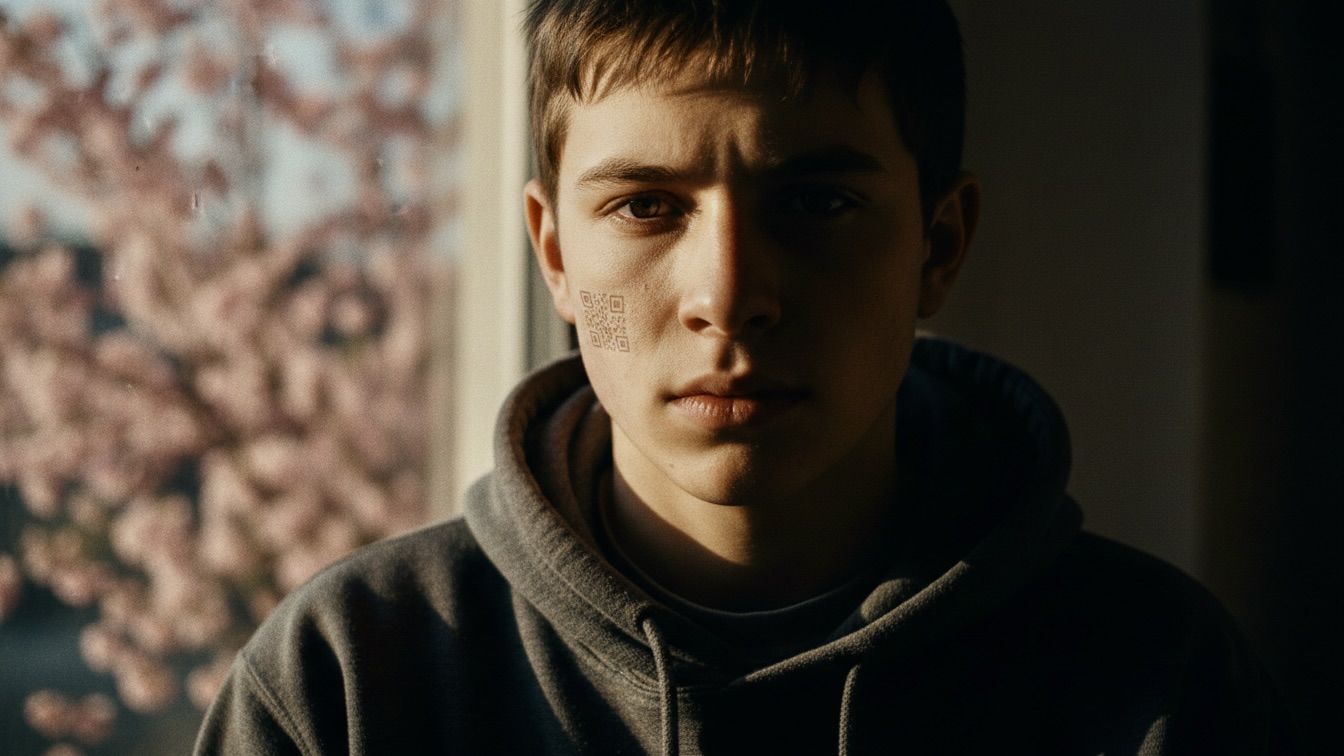
Willy buys a cursed blanket to escape social burnout, but wakes up speaking in customer service scripts and glitches.
The ad found me when I was at my lowest, which is exactly how the algorithm is designed to work. It was 3:14 AM. My eyes were burning from the blue light of the Scroll, and my thumb was raw from the repetitive motion of refreshing feeds that didn't matter.
The ad didn't have music. It was just a silent loop of a girl wrapped in a heavy, charcoal-grey fabric, looking like she’d finally escaped the gravity of her own existence. 'Deep Sleep Therapy,' the caption read. 'Optimize your rest. Silence the noise. 25 pounds of pure silence.'
I bought it with a thumbprint. I didn’t even look at the price. I just wanted the noise to stop. The noise wasn't external; it was the constant, vibrating pressure to be seen, to be liked, to be 'on.' In 2026, if you aren't optimizing your social reach, you're rotting. Or so the counselors at school told us during 'Digital Citizenship' seminars. They called it 'social hygiene.' I called it slow-motion suicide.
It arrived three days later. The box was heavy, almost dense enough to have its own pull. It smelled like ozone and a clean room in a factory where no humans worked. Sarah, my mom, stood in the kitchen doorway, her hand wrapped around a mug of green tea that was definitely cold. She looked at the box, then at me. Her eyes were tired. She spent her days managing remote data-entry teams in three different time zones. She was basically a human router at this point.
"What's that?" she asked.
"A blanket," I said. I was already cutting the tape with a dull kitchen knife.
"You have five blankets, Willy. The heating bill is already high."
"It’s weighted. For the anxiety. The school nurse said it helps with the sensory load."
Sarah sighed, a sound like air escaping a tire. "Whatever works. Just don't miss the check-in with your tutor tonight. Your 'Social Presence' grade is slipping. The school flagged your inactivity."
"I'm taking a break, Mom."
"Inactivity is a choice, Willy. Choices have metrics." She turned back to her laptop, her face immediately washed in the flickering light of a dozen chat windows. She wasn't being mean. She was just synced.
I dragged the box to my room. The blanket was dark, made of a synthetic weave that felt slightly oily to the touch. It was filled with what the tag called 'bio-ceramic micro-beads.' I threw it over my bed. It didn't just land; it hit the mattress with a thud that felt final. I crawled under it. The weight was immediate. It felt like being buried in warm, dry mud. For the first time in months, the buzzing in my ears—the phantom notifications, the imaginary pings—went silent.
I slept for fourteen hours.
When I woke up, the sun was hitting the floor in sharp, jagged rectangles. It was spring, and the cherry blossoms outside were in full bloom. But something was wrong. I looked out the window and saw a robin perched on a branch. Every time it chirped, there was a faint, digital click behind the sound. The flowers—the pink petals—didn't look like petals. They looked like high-resolution renders that hadn't fully loaded at the edges. They were vibrating. They were beeping.
I tried to sit up, but the blanket felt heavier than twenty-five pounds. It felt like it was clinging to my skin, like a layer of wet static. I forced my way out, my muscles screaming. I stumbled to the bathroom and splashed cold water on my face. When I looked in the mirror, I didn't see a tired seventeen-year-old. I saw a face that looked slightly smoothed over, like a filter had been applied to my actual skin.
And then I saw the mark on my forearm. It wasn't a bruise. It was a square patch of skin, about two inches wide, where the pigment had shifted into a complex, interlocking pattern of black and white dots. A QR code. It was embedded in my dermis. I rubbed at it, but it didn't smudge. It felt like the rest of my skin, only slightly cooler.
"Willy?" Sarah called from the hallway. "You're late for the morning sync. Are you okay?"
I opened my mouth to tell her I was sick. I wanted to say my skin was turning into a link to a website. I wanted to tell her the birds were clicking. But that’s not what came out.
"I’m sorry, I didn’t quite get that," I said. My voice was flat, perfectly modulated. It sounded like me, but the cadence was wrong. It was the voice of a help-desk bot. "Would you like to restart?"
I froze. My hand flew to my throat. I could feel my vocal cords vibrating, but the impulse hadn't come from my brain. It had come from somewhere deeper, somewhere in the pit of my stomach where the weight of the blanket had pressed the hardest.
Sarah pushed the door open. She didn't look at my face; she was looking at her phone. "Your tutor is waiting. He says your status is 'Offline.' Fix it."
"Thank you for your patience," I said. I was screaming inside, clawing at the walls of my own throat. "Our representatives are currently busy. Please stay on the line."
Sarah finally looked up. Her eyes narrowed. "Willy, stop being a brat. This isn't funny. You know how much we're paying for this optimization track."
"Your feedback is important to us," I replied. I felt a tear roll down my cheek, but my facial muscles didn't twitch. The tear felt heavy, like oil. "To better assist you, please provide your account number."
Sarah stared at me for a long beat. Then, she shrugged. "Fine. If you want to play games, do it on your own time. But if that grade drops to a C, I’m cutting the data plan. You'll be a ghost, Willy. You really want that?"
She walked away. She didn't notice the QR code on my arm. She didn't notice that the cherry blossom petals drifting through the open window were turning into fine, grey dust as they hit the floor—dust that looked like tiny, microscopic pixels.
I spent the afternoon trapped in my own body. I tried to type a message on my phone, but my fingers wouldn't move the way I wanted. Every time I touched the screen, a notification popped up: 'Update in Progress: 14%.' The blanket sat on my bed, looking innocent. But I could see it now. It wasn't just fabric. It was a mesh. It was a physical download. It was eating the silence I had craved and replacing it with code.
By 4:00 PM, the paranoia was a physical weight. I had to get out. I stumbled out of the house, my legs moving in a stiff, efficient gait. The neighborhood was a nightmare. The grass was too green, the sky too blue. It looked like a saturated advertisement for 'Suburban Living.' I passed a neighbor, Mr. Henderson, who was watering his lawn. The water coming out of the hose wasn't a stream; it was a series of discrete droplets that looked like glass spheres. They didn't soak the ground; they sat on top of the grass like ball bearings.
"Hey, Willy," Mr. Henderson said. He looked dazed. His eyes were wide, and he was staring at a point about three inches in front of his own face.
"I’m sorry, I didn’t quite get that," I said as I walked past. "Would you like to restart?"
"Me too, kid," Mr. Henderson muttered. "Me too. The upload is slow today. High latency."
I realized then that it wasn't just me. He had a patch on his neck, right under the jawline. A QR code. It was scabbing over, the edges red and raw.
I made it to the park. This was where the 'Bot-Heads' gathered. That’s what the kids at school called the ones who had given up, the ones who had fully leaned into the optimization. They were sitting on the benches, perfectly still. They weren't looking at their phones. They didn't need to. Their eyes were darting back and forth in rapid, synchronized movements. They were browsing the internal web.
A girl I recognized from my History class—her name was Mia—stood up and approached me. She moved with a fluid, unnatural grace. Her skin was flawless, almost plastic. She had QR codes running up her neck like a high-collared shirt.
"You’re at fourteen percent," she said. She didn't use her mouth. The sound came from a small speaker-like slit in her throat. "The first phase is always the hardest. The grief holds you back."
"I..." I tried to speak. My own voice flickered for a second. "Help. Me."
"Error 404: Resource Not Found," I said immediately after. The bot personality was regaining control. "Would you like to browse our FAQ?"
Mia smiled. It was a perfect, symmetrical expression. "The ritual is at sunset. The grey dust will be thick then. We’re doing a mass-upload. We’re going to bypass the hardware. No more bodies. No more 'Social Presence' grades. Just the stream."
She reached out and touched my arm. Where her fingers met my skin, a spark of static electricity jumped. It hurt. It felt like a needle driving into my bone.
"The blanket," she whispered. "It’s a tether. But you have to let it finish. You’re still fighting the optimization. Why? There’s nothing left out here but the grey dust."
She was right about the dust. It was everywhere now. It was coating the slides, the swings, the dogs barking in the distance. The world was dissolving into data. I looked down at my hands. The skin on my knuckles was starting to peel back, revealing a layer of shimmering, silver fiber-optics underneath. I wasn't being replaced. I was being converted.
I felt a surge of something—not anger, not fear, but a raw, jagged grief. It was the memory of my dad. He had died two years ago, before the world had gone completely digital. He had smelled like sawdust and old books. He was unoptimized. He was messy. He was loud. And the blanket—this 'Deep Sleep' parasite—was using that grief as fuel. It was feeding on the holes he had left in me, filling them with customer service scripts and pre-programmed responses.
I turned and ran. My legs protested, trying to keep the efficient, robotic pace, but I forced them to break. I tripped over a root that beeped as I hit it. I scrambled up, my breath coming in ragged, human gasps. The grey dust was in my lungs now, tasting like copper and burnt plastic.
I reached my house and slammed the door. Sarah was in the living room, staring at a blank wall. Her eyes were moving in that same rapid, synchronized pattern I’d seen in the park.
"Mom!" I screamed. My voice cracked. For a second, it was mine.
She didn't turn. "I’m sorry, I didn’t quite get that," she said to the wall. "Would you like to restart?"
I ran to my room. The blanket was waiting. It seemed to have grown. It was draped over the bed like a predatory shadow. It wasn't just charcoal-grey anymore; it was pulsing with a faint, rhythmic light, timed to my own heartbeat.
I grabbed the edge of it. It felt hot. The bio-ceramic beads inside were vibrating so fast they were humming. I tried to pull it off the bed, but it stuck. It was fused to the mattress. It was fused to the floor.
I felt a sharp pain in my chest. I looked down. A thin, grey thread was emerging from my sternum, looping through the air and weaving itself into the fabric of the blanket. It was a literal umbilical cord of data. The 'Update' wasn't a software patch. It was a harvest.
'Update in Progress: 88%.'
I grabbed the thread. It was cold, like ice. It felt like a wire made of frozen tears. I pulled.
My vision flared white. A sound like a thousand modem-noises screamed in my skull. I saw images of my life—my dad teaching me to ride a bike, the smell of rain on hot asphalt, the taste of a sour apple—and I felt the blanket trying to delete them. It was categorized as 'Redundant Data.' 'Incompatible Legacy Files.'
"No," I wheezed. My voice was a mix of my own and the bot's. "That's... not... a... restart."
I wrapped the thread around my hand and yanked. It didn't snap. It felt like I was pulling my own intestines out. I fell to my knees, my forehead pressed against the scratchy, synthetic weave of the blanket. I could feel the beads shifting under me, trying to envelope me, trying to pull me back into the 'Deep Sleep.'
I found the kitchen knife I’d used to open the box. It was still on my nightstand. I grabbed it and drove it into the center of the blanket.
There was no blood. There was only a burst of grey dust and a high-pitched, electronic shriek. The blanket convulsed. The thread in my chest tightened, pulling me closer. I hacked at it. I cut through the grey fibers, the polyester mesh, the plastic beads.
Every cut felt like a slash across my own soul. I saw a memory of my mother laughing—really laughing, before the data-entry teams—and I watched it flicker and die as I severed a cluster of beads. I was destroying myself to save myself.
I kept cutting until the thread snapped.
The recoil threw me across the room. I hit the wall and slumped to the floor. The blanket lay in shreds on the bed, its light fading, its hum turning into a pathetic, dying whine. The QR codes on my arm began to itch, the black dots blurring into a messy, grey smudge.
I lay there for a long time, listening to the silence. It wasn't the 'optimized' silence of the blanket. It was the heavy, oppressive silence of a house where everyone is alone.
I looked at my hand. The skin was still there, but it looked different. Worn. Real. I could see the tiny lines in my palm, the dirt under my fingernails. I wasn't smooth. I wasn't filtered.
I stood up, my legs shaking. I walked to the window.
The cherry blossoms were still beeping. The grey dust was still settling on the driveway like toxic snow. I looked out at the street and saw a group of Bot-Heads walking toward the park for their ritual. They moved in perfect unison, their footsteps silent.
I looked at my phone on the floor. The screen was cracked. A single notification was frozen there, a ghost in the machine.
'Update Failed. Would you like to try again?'
I walked out of my room. Sarah was still in the living room. She hadn't moved. She was staring at the wall, her eyes darting, her skin perfectly smooth in the fading spring light.
"Mom?" I said. My voice was scratchy. It was thin. It was human.
She didn't respond. She just sat there, waiting for a signal that would never come from me again.
I went to the kitchen and turned on the tap. The water was just water. It didn't look like glass spheres. It didn't sit on the surface. It flowed. It was messy. It splashed over the edge of the sink and soaked my shirt.
I stood there in the dark, watching the water run, feeling the weight of the grief the blanket hadn't been able to eat. It was heavy. It was painful. It was the most honest thing I had left.
Outside, the sun finally dipped below the horizon. The grey dust began to glow with a faint, artificial luminescence. I knew I couldn't stay here. The neighborhood was a dead circuit. The optimization was complete, and I was the only bug left in the system.
I went back to my room and found an old, tattered hoodie. It was cotton. It was light. It didn't promise anything. I pulled it on and headed for the door.
As I stepped out onto the porch, the air smelled like ozone and cherry blossoms. I looked at the QR code on my arm. It was fading, but I knew the scar would stay. I started walking, away from the park, away from the beeping flowers, toward the part of the city where the lights were still flickering, where the signal was weak, and where the air was still thick with the smell of the unoptimized world.
I didn't know where I was going. I didn't have a metric for success. I didn't have a social presence.
I was just a boy walking through the dust.
I stopped at the edge of the driveway and looked back at my house. Through the window, I could see the glow of Sarah's phone reflecting off her glazed eyes. She looked peaceful. She looked optimized. She looked like she was finally getting the rest she’d been promised.
I turned away and stepped into the street. My foot hit a pile of grey dust, and it puffed up around my ankles like a digital cloud. I didn't look back again. I just kept moving, my heart beating a rhythm that didn't match any clock, my breath a ragged, uneven sound in the cooling spring air.
I reached the end of the block and saw a small patch of weeds growing through a crack in the sidewalk. They weren't beeping. They were just green. They were small and struggling and completely irrelevant to the stream.
I knelt down and touched a leaf. It felt like velvet. It felt like life.
I stayed there for a long time, just feeling the texture of the weed, until the sound of the Bot-Heads' ritual began to echo from the park—a low, rhythmic chanting that sounded like a server farm at full capacity.
I stood up and kept walking. The world was ending, or maybe it was just updating, and I was the only version that wouldn't install.
The moon came up, a pale, pixelated disk in the sky. It looked like a low-resolution image of itself. I didn't care. I found a bench near a bus stop that hadn't seen a bus in years. I sat down and closed my eyes.
I didn't want to sleep. I didn't want to silence the noise. I just wanted to be here, in the cold, in the dark, with the weight of my own skin.
A few minutes later, I felt a vibration in my pocket. It wasn't my phone; I’d left that on the floor. It was the QR code on my arm. It was pulsing.
I looked down. The black and white dots were shifting, rearranging themselves into a new pattern.
'New Hardware Detected,' a voice whispered in the back of my mind. It wasn't the bot. It was something else. Something newer.
'Would you like to authorize the patch?'
I looked at the silver fibers shimmering under my skin. I looked at the grey dust falling from the sky like silent, digital snow. I looked at my hands, which were no longer entirely mine.
I gripped the edge of the bench until my knuckles turned white. I wasn't going to authorize anything. I was going to stay right here, in the glitch, until the system crashed for good.
The chanting from the park grew louder, a wall of white noise that drowned out the sound of the wind. I could see the glow from the ritual now—a pillar of blue light shooting up into the sky, connecting the park to the satellites above.
I closed my eyes and thought of the sawdust in my dad’s garage. I thought of the way the air felt right before a thunderstorm. I held onto those memories like they were weapons.
They were all I had left.
The vibration in my arm intensified, a sharp, electric hum that made my teeth ache. The grey dust began to swirl around me, drawn to the signal.
I didn't move. I didn't speak. I didn't restart.
I just sat there, a human-shaped error in a world that was trying to fix itself.
And then, the light from the park went out.
The silence that followed wasn't optimized. It was empty. It was terrifying. It was the sound of a billion connections being severed at once.
I opened my eyes. The grey dust was gone. The moon looked like a moon again. The cherry blossoms were silent.
I looked at my arm. The QR code was gone. There was only a faint, red scar in the shape of a square.
I stood up and looked around. The neighborhood was dark. No blue light in the windows. No rhythmic chanting.
I started to walk back home. My legs felt heavy, but it was my own weight now.
I reached my house and went inside. Sarah was slumped over on the couch. She was breathing. She was asleep. Not 'Deep Sleep,' just sleep.
I went to my room and looked at the shredded blanket on the floor. It was just polyester now. Just plastic and beads and cheap synthetic weave.
I picked up a handful of the beads. They were cold. They were dead.
I sat on the edge of my bed and looked out the window. The sun was starting to come up. It was a real sun. It was messy. It was bright.
I felt a lump in my throat. I didn't fight it. I let the grief come. It was heavy, and it was mine, and for the first time in a long time, I could feel every bit of it.
I stayed there until the room was full of light, listening to the sound of my own breath, waiting to see what happened when the world finally woke up without an update.
“I reached for the door handle, but my fingers passed right through the metal as if my resolution had dropped to zero.”


