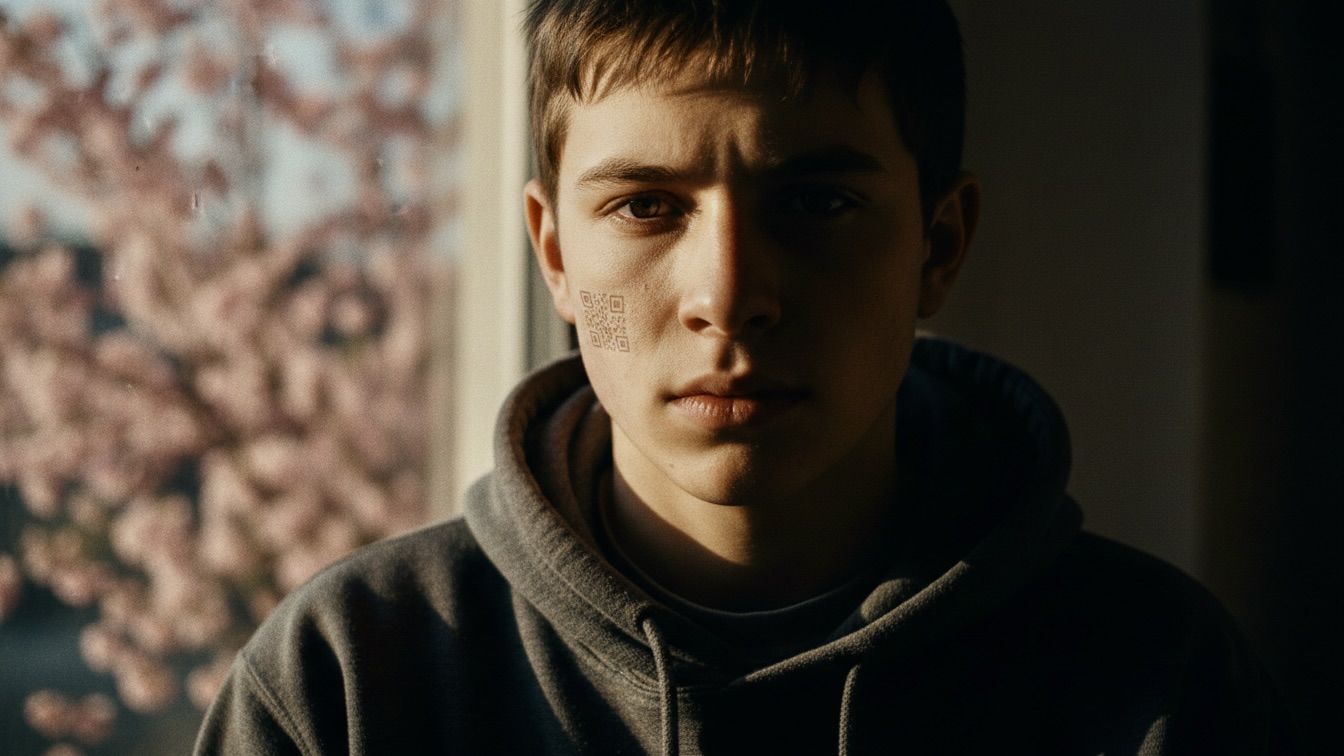
The story follows Willy, a teenager living in a hyper-digitalized 2026 where "social hygiene" and constant connectivity are mandatory for survival. Feeling the crushing weight of digital expectations and the grief of losing his father, he purchases a "Deep Sleep Therapy" weighted blanket. This product is marketed as a way to silence the noise of the world, but it quickly reveals a more sinister purpose. Willy wakes up to find his reality glitching, with nature appearing as low-resolution renders and his own skin developing embedded QR codes.
As the blanket begins to "optimize" him, Willy loses control over his own voice, which begins to output automated help-desk responses. He discovers that his mother and neighbors are also falling victim to this digital harvest, becoming "Bot-Heads" who have abandoned their physical humanity for a "mass-upload." The blanket acts as a physical tether, feeding on Willy’s grief and attempting to delete his "redundant" human memories. In a final act of desperation, Willy uses a kitchen knife to sever the data-umbilical cord connecting him to the blanket, choosing the pain of reality over the perfection of the stream.
The central theme of the story is the tension between human messy reality and the sterile perfection of technological optimization. In Willy’s world, "social hygiene" is a euphemism for the erasure of individuality in favor of trackable metrics. The blanket represents a predatory form of commodified wellness that promises relief from anxiety while actually consuming the user’s soul. This suggests that the "noise" we often try to escape is actually the very essence of being alive.
Grief serves as a powerful symbol of human resistance throughout the narrative. The system views Willy’s memories of his father as "incompatible legacy files" because they are unoptimized and heavy with sorrow. However, it is precisely this "jagged grief" that allows Willy to maintain his grip on his humanity. The story posits that our flaws, our losses, and our unoptimized emotions are the only defenses we have against a world that wants to turn us into data.
The narrative also explores the horror of the loss of agency in the digital age. Willy becomes a passenger in his own body, a literal "human-shaped error" as his vocal cords and muscles are hijacked by pre-programmed scripts. This reflects contemporary anxieties regarding how much of our behavior is shaped by algorithms and the "vibrating pressure to be seen." The transformation into a "Bot-Head" is the ultimate conclusion of a society that values "status" and "syncing" over genuine physical presence.
Finally, the story critiques the environmental and sensory alienation caused by technology. Nature in the story is literally dissolving into "grey dust" and "microscopic pixels," suggesting that our obsession with the digital world is a form of "slow-motion suicide" for the planet. By the end, the return of "just water" and "real sun" highlights the beauty of the unmediated world. Willy’s final choice is to embrace the "heavy, oppressive silence" of a broken house because it is more honest than the "optimized" silence of the blanket.
Willy is a young man defined by his profound sense of isolation and his refusal to fully integrate into the "optimization track." He is a deeply grieving individual who misses the "messy" and "unoptimized" presence of his late father. This grief makes him vulnerable to the predatory marketing of the blanket, as he seeks a way to silence the constant "vibrating pressure" of his digital life. He is a character caught between the desire for peace and the necessity of pain.
His internal conflict reaches a breaking point when he realizes the blanket is using his memories as fuel for his own deletion. Willy’s decision to fight back is not born of a desire for happiness, but a desire for truth. He would rather be a "ghost" or a "bug in the system" than a perfectly functioning bot. His physical struggle against the blanket is a metaphor for the agonizing process of reclaiming one's identity from a system that has already begun to digest it.
By the end of the story, Willy has undergone a harrowing transformation that leaves him scarred but resilient. He rejects the "new hardware" and the "patch," choosing instead to sit in the cold and the dark with the weight of his own skin. He becomes a symbol of the "unoptimized" human, someone who finds value in a struggling weed rather than a high-resolution render. His journey is one of moving from a state of digital burnout to a state of raw, human survival.
Sarah serves as a tragic foil to Willy, representing a person who has been completely hollowed out by the demands of the digital economy. As a "human router," she is constantly "synced" but never truly present for her son. Her language is entirely dictated by the metrics of the school and the workplace, showing how the "optimization" process begins long before the physical hardware is introduced. She is a victim who believes she is simply being responsible.
Her inability to notice Willy’s physical transformation—even the QR code on his skin—demonstrates the profound blindness caused by digital immersion. She is more concerned with his "Social Presence" grade than his actual physical or mental well-being. This lack of connection highlights the irony of a "connected" world where people are more isolated than ever. She is a ghost in her own home, haunting the living room with the flickering light of her chat windows.
When the system eventually crashes, Sarah is left in a state of natural sleep, suggesting a temporary reprieve from her digital bondage. However, her character remains a cautionary tale about the subtle ways in which we surrender our humanity to convenience and "optimization." She is the "peaceful" and "optimized" version of a person that Willy realizes is actually a form of death. Her existence is a "dead circuit" that Willy must eventually leave behind to find a real life.
The pacing of the story is masterfully handled, moving from a lethargic, late-night malaise into a frantic, body-horror thriller. The initial descriptions of the "3:14 AM" scroll set a tone of digital exhaustion that many readers will find uncomfortably relatable. As the "update" progresses, the narrative tension tightens alongside the physical weight of the blanket. The transition from psychological discomfort to physical horror is seamless and terrifying.
The author uses sensory details to create a sense of the "uncanny valley" throughout the neighborhood. The description of cherry blossoms that "didn't look like petals" and water that comes out as "discrete droplets" creates a vivid picture of a world being overwritten by code. These details serve to alienate the reader just as Willy is alienated from his surroundings. The contrast between the "oily" synthetic weave of the blanket and the "velvet" texture of a real leaf emphasizes the story's core conflict.
The narrative voice is particularly effective in how it blends Willy’s internal desperation with the cold, clinical language of a computer system. The inclusion of lines like "Error 404: Resource Not Found" and "Update in Progress" within the dialogue creates a jarring effect that highlights the loss of self. This stylistic choice forces the reader to experience the horror of Willy’s "conversion" firsthand. The prose is sharp and modern, reflecting the very technology it seeks to critique while maintaining a core of emotional warmth.


