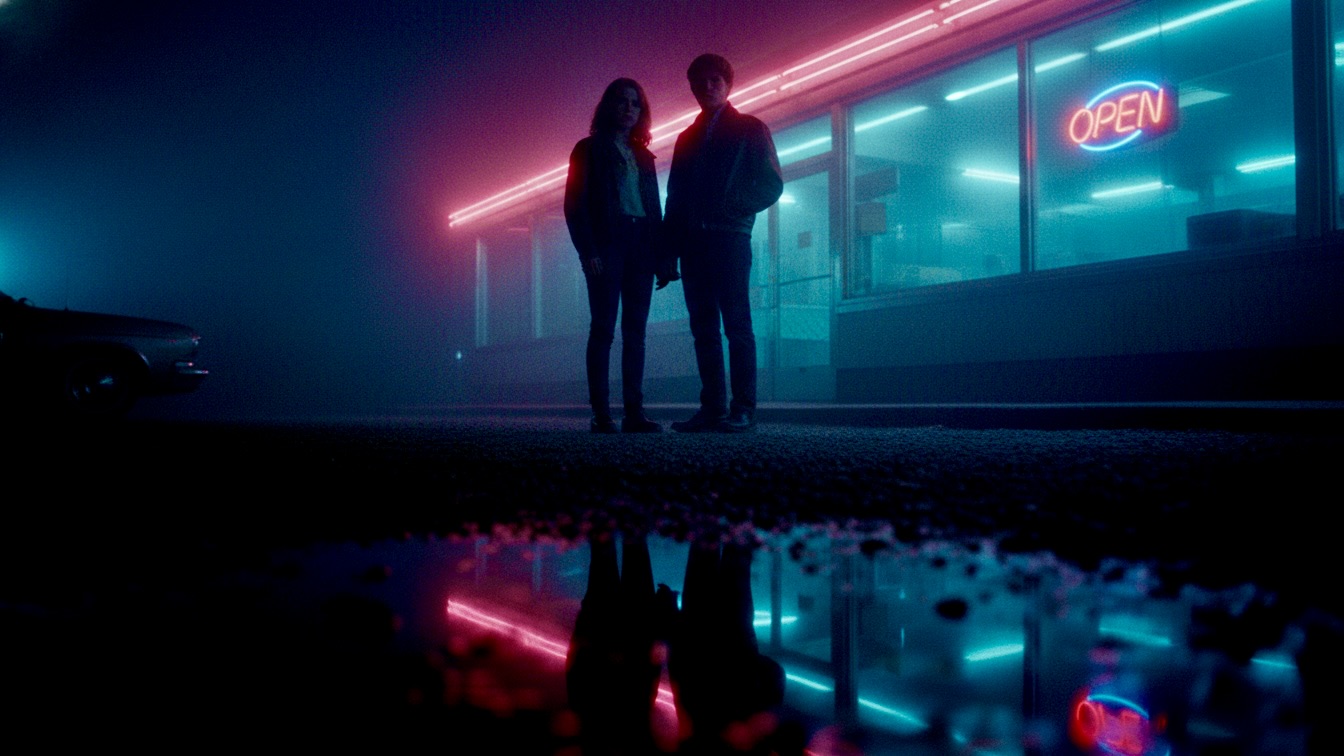
Tyler and Sarah find a diner where time has stopped and the driver of their crashed bus is serving coffee.
The message stayed on my screen for three minutes. THE DRIVER IS WAITING. No sender. No timestamp. Just four words that felt like a hook in my ribs. I showed it to Sarah. She didn't say anything, just looked at the asphalt. The highway was too clean. No roadkill. No cigarette butts. Just a black ribbon of perfect road cutting through the pines. The air still felt like pure oxygen, but the message had added a drop of lead back into my stomach.
We walked for another mile before we saw it. A pink glow on the horizon that wasn't the sun. It was a sign. ‘LUNA’S DINER.’ It sat on a bed of gray gravel, looking like it had been dropped there from a height. The architecture was 1950s chrome, but the neon was vibrating at a frequency that made my teeth ache. It was the only thing visible. Beyond the parking lot, the world just... ended. The trees stopped. The road faded into a gray haze. It was a localized pocket of reality.
'Tyler,' Sarah said. She was holding the strap of her jacket. 'Look at the cars.'
There were four of them. A boxy Volvo from the nineties. A muscle car that looked like a prop from a movie about the seventies. A station wagon with wood paneling. And a modern electric SUV that looked exactly like the one my neighbor in Winnipeg used to wash every Sunday. They were all covered in the same fine, white dust we’d seen in the forest. It looked like salt. Or bone meal.
'We have to eat,' I said. It was a stupid thing to say. I wasn't even hungry. I was hollow. But the diner was the only objective left on the map. We stepped onto the gravel. It didn't crunch. It sounded like walking on dry cereal. The hum of the neon got louder. It sounded like a swarm of bees trapped in a glass jar.
I pushed the door open. A bell chimed. It was a heavy, brass sound that didn't match the cheap plastic door. The heat hit us first. It was thick and smelled of onions and floor cleaner. It felt like walking into a mouth. The interior was a maze of red vinyl booths and Formica tables. The light was harsh, fluorescent, and flickered just enough to give me a migraine.
And there he was. Behind the counter.
He was wearing a white paper hat and a stained apron. He was wiping a glass with a rag that looked older than I was. It was the Driver. The same guy from the bus. The guy who had steered us into the white void. He looked younger, though. The lines around his eyes were gone. He looked like he’d had a full night’s sleep. He looked... refreshed.
'Morning,' he said. His voice was bright. Normal. Too normal. 'Table or booth?'
Sarah’s hand tightened on my arm. Her nails dug into my skin. 'You,' she whispered. 'The bus. The crash.'
The Driver tilted his head. He smiled, and it was a customer-service smile—practiced, empty, and terrifying. 'Bus? No buses here, miss. Just the diner. Best coffee in the province. Grab a seat.'
He turned back to the coffee machine, whistling something that sounded like a commercial jingle. I led Sarah to a booth in the corner. My legs felt like they were made of water. I looked around the room. There were six other people. They weren't ghosts. They didn't glow. They were just... there.
A girl about our age sat three booths down. She had a Discman on the table and a stack of CDs. She was wearing a flannel shirt and oversized jeans. She looked like a photo from 1994. Across from her, an older man in a brown suit was reading a newspaper. I caught a glimpse of the headline: Trudeau Promises New Era. I couldn't tell which Trudeau it meant. The paper looked fresh, the ink still black and sharp.
'They're all from different times,' Sarah whispered. She wasn't looking at the people. She was looking at the windows.
I followed her gaze. The windows didn't show the highway anymore. They showed the White Forest. Those resinous, fake trees were pressing right up against the glass, their branches scratching the surface like fingernails. We were inside a bubble. The diner was a life raft in the middle of that static sea.
The Driver walked over with two mugs. He set them down. The coffee was black and steaming. It smelled like actual coffee, which was the most suspicious thing about it.
'On the house,' he said. 'You two look like you’ve had a long night.'
'Where are we?' I asked. I didn't look at the coffee. I looked at his name tag. It just said DAVE.
'The Trans-Canada,' Dave said. He leaned against the table, casual. 'The stretch between what was and what’s next. You’re lucky. Most people miss the exit.'
'The bus crashed, Dave,' I said. My voice was shaking. I tried to ground myself in the texture of the table. 'Everyone's dead. We’re dead, aren't we?'
Dave laughed. It was a short, sharp bark. 'Dead is a binary, kid. You’re Gen Z, right? You should understand. Everything’s a spectrum now. You’re just... transitioning. Think of this as a loading screen.'
He winked and walked away to refill the cup of a guy in a trucker hat who was staring at a plate of untouched bacon.
I looked at my phone. 3%. The signal bar was a hollow triangle. I tried to open my maps, but the screen just showed a blue dot in a sea of gray. No roads. No landmarks. Just us.
'Tyler, look at the back,' Sarah said.
At the far end of the diner, past the restrooms, there was a heavy steel door with an 'EXIT' sign above it. The light above the door was green. It looked like a fire exit. But through the small porthole window in the door, I didn't see the parking lot. I saw the white trees again. They were closer there. They were moving, swaying in a wind we couldn't feel inside the diner.
'He said the driver is waiting,' I said, looking at my phone. 'He is the driver. He’s right there.'
'But he’s not waiting,' Sarah said. 'He’s working. He’s part of the furniture.'
She was right. Dave was moving with a robotic efficiency, pouring coffee, clearing plates, laughing at jokes no one was making. He wasn't a person anymore. He was a function. The oxygen feeling from the highway was starting to fade, replaced by the familiar weight of the Shield. The claustrophobia was coming back. The diner felt smaller by the minute. The ceiling seemed lower. The neon hum was getting louder, vibrating in my sinuses.
I looked at the girl with the Discman. She looked up and caught my eye. Her expression wasn't sad. It was just... bored. Like she’d been waiting for a bus that was thirty years late.
'Don't eat the food,' she said. Her voice was thin, like a recording played too many times.
'Why?' Sarah asked.
'The taste stays with you,' the girl said. 'It’s the only thing that stays. You’ll spend the rest of forever trying to find that exact flavor of maple syrup. It’s a trap. It keeps you in the booth.'
She went back to her music, clicking a button on her Discman. I could hear the tinny bleed of the headphones. It sounded like grunge, but the lyrics were garbled.
'We have to go,' I said. I stood up. My knees popped. The sound was like a gunshot in the quiet diner.
Dave stopped wiping the counter. He didn't look at us, but his posture changed. He went still. 'The bill hasn't been paid,' he said.
'You said it was on the house,' I countered.
'The coffee is free,' Dave said, turning slowly. His eyes were different now. They weren't human. They were like the headlights of the bus—bright, yellow, and fixed. 'The seat costs. You’ve been here for twenty minutes. That’s twenty minutes of life you owe the house.'
'We don't have anything,' Sarah said. She was standing now, too.
'You have memories,' Dave said. He started walking around the counter. He didn't use the gate. He just stepped over it in a way that defied physics, his legs stretching like taffy. 'Give me one. Just a small one. The smell of your first car. The name of your third-grade teacher. Something useless. Then you can go.'
'No,' I said. I grabbed Sarah’s hand. 'We’re leaving.'
We backed away toward the front door. But as we moved, the diner seemed to expand. The distance between us and the entrance grew. The red floor tiles multiplied. It was like running on a treadmill.
'Tyler, the back door!' Sarah shouted.
We turned and ran toward the steel door. Dave wasn't running, but he was getting closer. He was gliding, his feet not quite touching the linoleum. The other patrons didn't look up. The girl with the Discman just flipped a page in a magazine. The man in the suit kept reading about Trudeau.
We reached the steel door. I grabbed the handle. It was freezing cold, the kind of cold that sticks to your skin. I pulled. It didn't budge.
'Give me a memory, Tyler,' Dave’s voice was right behind us. It didn't sound like a guy named Dave anymore. It sounded like the static from the trees. 'Give me the way your mom’s kitchen smelled on Sundays. Give it to me, and I’ll let you go to Kenora. You want Kenora, don't you? The shitty apartment? The job at the warehouse? It’s all waiting.'
I looked at Sarah. Her face was pale, her eyes wide. She looked like she was about to give in. I could see her lips trembling, the memory of something—maybe her father, maybe a dog she once had—rising to the surface.
'Don't!' I yelled. 'It’s not real! It’s baggage!'
I remembered the transit card. I reached into my pocket, but it was gone. I’d thrown it in the ditch. I had nothing but my phone. 2%.
I looked at the 'EXIT' sign. It wasn't a sign. It was a screen.
I smashed my phone against the glass porthole of the door. The screen shattered, but the glass of the door didn't. Instead, the image of the White Forest flickered. It was a projection.
'It’s a glitch,' I whispered.
I didn't pull the door. I pushed it.
The door swung open with zero resistance.
We fell forward, but we didn't hit gravel. We hit something soft. We hit the white salt of the forest floor. The heat of the diner vanished instantly, replaced by that sharp, cold oxygen.
I scrambled to my feet and looked back.
The diner wasn't a building. It was a bus. Our bus. It was lying on its side, the neon lights actually just the sparks from the frayed electrical wires. The patrons weren't people; they were the other passengers, sitting perfectly still in their seats, staring out the shattered windows.
And Dave?
Dave was the Driver, still slumped over the steering wheel, his head at an impossible angle.
But the text message was still on my phone. I looked at the cracked screen.
THE DRIVER IS WAITING.
I looked back at the wreck. The Driver’s seat was empty.
'Tyler,' Sarah breathed. She was pointing into the trees.
A man was standing there. Not the Man in the Suit. This man was wearing a high-visibility vest. He had a flashlight. He looked like a first responder. But the light from the flashlight was yellow. The same yellow as the bus's eyes.
'You kids okay?' he asked. His voice was Dave’s voice.
'Stay back,' I said.
'I’m here to help,' he said, stepping into the light. Behind him, I could see the highway. It looked real. Cars were passing. I could hear the sound of actual tires on actual pavement. It was so close. Just twenty yards away.
'We just have to get to the road,' Sarah said. She started toward him.
'Sarah, wait,' I said.
Something was wrong. The cars on the highway were moving backward. The sound of the engines was a loop.
'Come on,' the man in the vest said. He held out a hand. 'I’ve got a warm car. I’ll take you wherever you need to go.'
I looked at his feet. He wasn't wearing boots. He was wearing the same polished black shoes as the Man in the Suit.
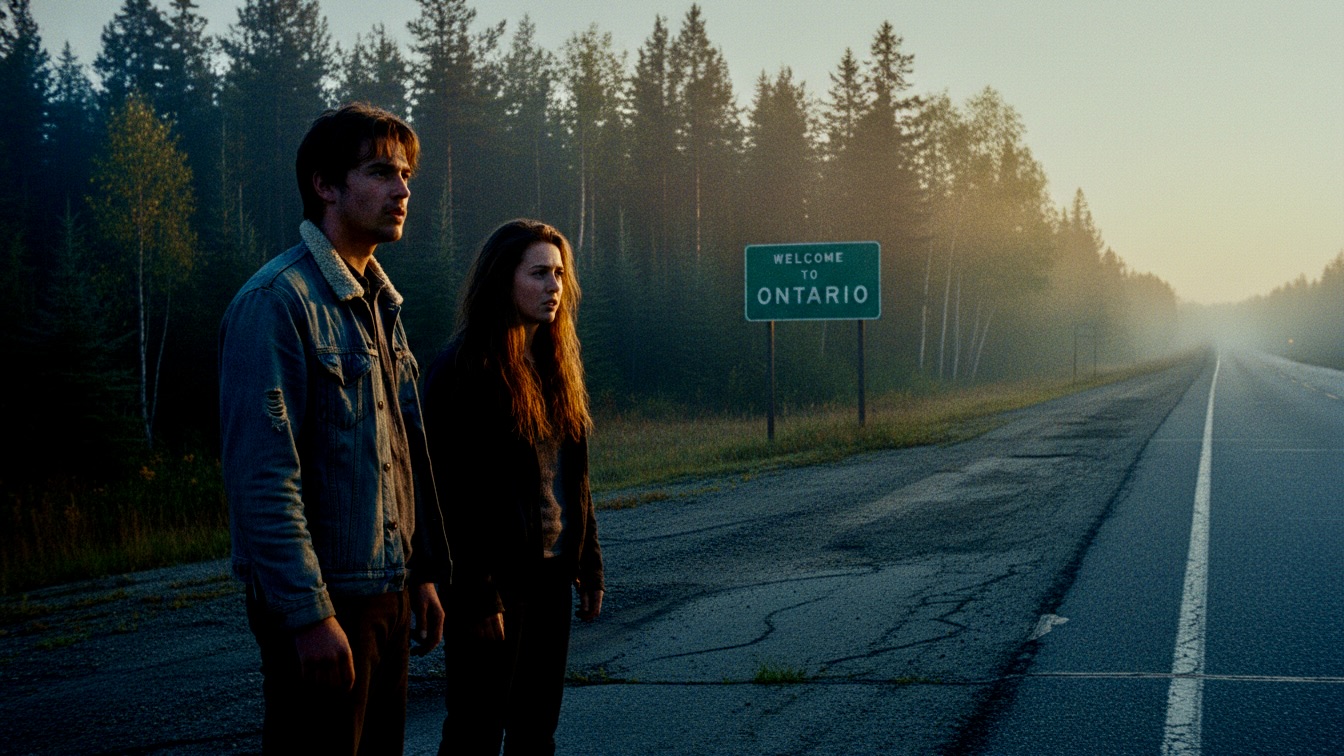
I looked at the highway again. The sign that said 'WELCOME TO ONTARIO' was there, but the graffiti had changed.
It didn't say YOU ARE HERE anymore.
It said: YOU NEVER LEFT.
I grabbed Sarah’s arm just as she reached for his hand. The man’s face didn't change, but the flashlight in his hand flickered out. In the sudden darkness, his eyes stayed bright.
'The bus is leaving, Tyler,' he said. 'Last call.'
From the wreck behind us, a horn honked. A long, mournful sound that echoed through the white trees. The lights of the bus—the neon of the diner—flared one last time, blindingly bright.
When the light faded, the man was gone. The highway was gone.
We were standing in the middle of a parking lot. A real parking lot. There was a Tim Hortons and a gas station. People were walking around, holding coffee cups, looking at their phones. It was a bright, sunny Spring morning.
'We made it?' Sarah asked. She looked around, dazed. 'Tyler, we’re actually here. Look at that lady. She’s real. That’s a real dog.'
I wanted to believe her. I really did. The air smelled like exhaust and sugar. It was perfect.
But then I looked down at my hand.
I was still holding my phone. The screen was still cracked. And the battery percentage hadn't moved.
It was still at 2%.
I watched as a car pulled out of the parking lot. As it passed us, I saw the driver. He looked at me and winked.
It was Dave.
He was driving a bus.
“I looked at the battery icon on my phone, frozen at two percent while the world around us hummed with a life that felt way too loud to be real.”