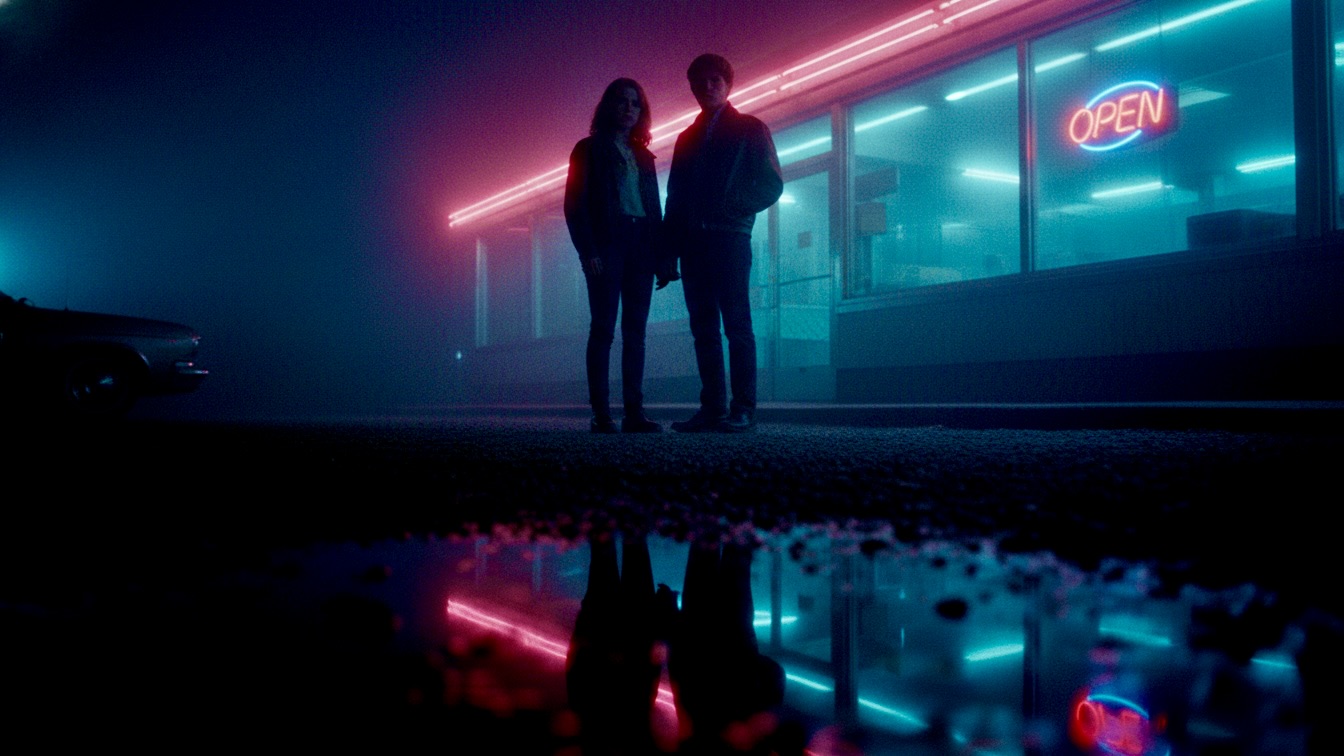
The story follows Tyler and Sarah as they navigate a surreal, liminal landscape after a bus crash. They discover a diner that exists in a localized pocket of reality, populated by individuals plucked from various decades. The proprietor, a man named Dave, reveals himself to be the driver of the bus they arrived on, acting as a predatory entity that consumes memories to maintain his artificial domain. After a harrowing escape through a projection of an exit, the protagonists find themselves in an ordinary, bustling parking lot. However, the lingering presence of the driver and the static nature of Tyler’s phone suggest that their perceived reality remains a loop or a construct, indicating they have not actually escaped the driver’s influence.
The narrative explores the terrifying concept of liminality, presenting the diner as a purgatorial "loading screen" between life and death. By stripping away the familiar markers of reality, the author examines how humans cling to memories as a form of currency or identity. The diner acts as a trap where time is effectively frozen, forcing its inhabitants to trade their pasts for the comfort of an eternal, stagnant present.
The theme of the "binary" versus the "spectrum" serves as a critique of modern, digitized existence. Dave’s assertion that death is no longer a simple state but a transition suggests that the characters are trapped in a simulation of their own grief. The reliance on technology, specifically Tyler’s phone, highlights the fragility of the protagonist’s connection to the "real" world. When the digital tools fail to provide a map or a exit, the characters are left to confront the void, emphasizing that their perception of reality is entirely dependent on the systems they trust.
Tyler functions as the grounded, albeit increasingly desperate, anchor of the narrative. His internal state is defined by a frantic need for objective truth in an environment designed to deceive him. He experiences a profound sense of "hollowness," which acts as a psychological response to the trauma of the crash. His motivation is purely survival-oriented, yet he is constantly undermined by his own skepticism and the realization that his memories are being targeted as a resource.
His conflict is primarily existential, as he struggles to distinguish between genuine escape and the next layer of the trap. Even when he believes they have reached safety, his focus on the 2% battery life reveals his inability to fully let go of his analytical framework. Tyler’s refusal to surrender his memories to Dave demonstrates a stubborn, if futile, assertion of his own humanity against a force that views him as nothing more than a data point.
Sarah represents the vulnerable side of the trauma, acting as a barometer for the supernatural threats surrounding them. She is more sensitive to the shifting reality than Tyler, noticing the subtle anomalies in the diner before he does. Her physical reactions, such as her nails digging into Tyler’s arm, betray a deep-seated fear that she is being slowly erased or consumed.
Her motivation is centered on comfort and the desire to return to a state of normalcy, which makes her susceptible to the siren song of the driver. Sarah’s hopefulness in the final scene is a tragic contrast to Tyler’s cynicism, as she desperately wants to believe in the reality of the dog and the passersby. She serves as the emotional heart of the story, her potential surrender to the driver’s offer highlighting the seductive danger of choosing a comfortable lie over a painful truth.
Dave is the embodiment of the predator hiding in plain sight, masquerading as a service worker to lower the defenses of his victims. He is a shapeshifter of sorts, shifting from a helpful bus driver to a bureaucratic diner proprietor, and finally to a deceptive first responder. His smile, described as "practiced and empty," suggests that he lacks true personhood, acting instead as a cog in an infernal machine.
His motivation is the parasitic extraction of human experience. By demanding memories as payment, he highlights his own lack of essence, as he must consume the lives of others to sustain the diner’s existence. Dave is ultimately a manifestation of the "driver" archetype, a figure who controls the path of those who have lost their way, ensuring they never truly arrive at their destination.
The narrative employs a tense, claustrophobic tone that mirrors the characters' descent into confusion. By utilizing sensory details like the smell of floor cleaner, the hum of neon, and the static of the forest, the author effectively builds a sense of dread that is both visceral and unsettling. The pacing is deliberate, slowing down during the interactions in the diner to mimic the "stuck" feeling of the characters, before accelerating into the frantic escape attempt.
The narrative voice is intimate and first-person, which limits the reader’s knowledge to Tyler’s perspective. This restriction is crucial to the story’s impact, as it forces the reader to share in Tyler’s uncertainty and his eventual, devastating realization. The use of abrupt shifts—from the high-oxygen air of the forest to the stifling heat of the diner—creates a jarring effect that keeps the reader off-balance, reflecting the instability of the characters' reality.


