Format: Short Film / Anthology Episode | Est. Length: 10-12 minutes
Imagine this story as a standalone entry in a "Cli-Fi" (Climate Fiction) anthology series titled The Last Spring, where each episode focuses on a small, quiet act of resistance against an encroaching ecological and technological collapse. The world of the series is one of "slow-motion apocalypse," where infrastructure is failing, resources are privatized, and the human spirit is being crushed by the weight of inevitable obsolescence. This specific episode highlights the intersection of student debt, environmental decay, and the preservation of biological heritage in the face of cold, digital progress.
A student clutching a damp disciplinary slip navigates a decaying, smog-choked campus to find a skeletal greenhouse, only to be met by a woman who treats the end of the world as a mere logistical hurdle. The sound of screaming birds and the sight of "dirty" sunlight set a tone of immediate, oppressive unease.
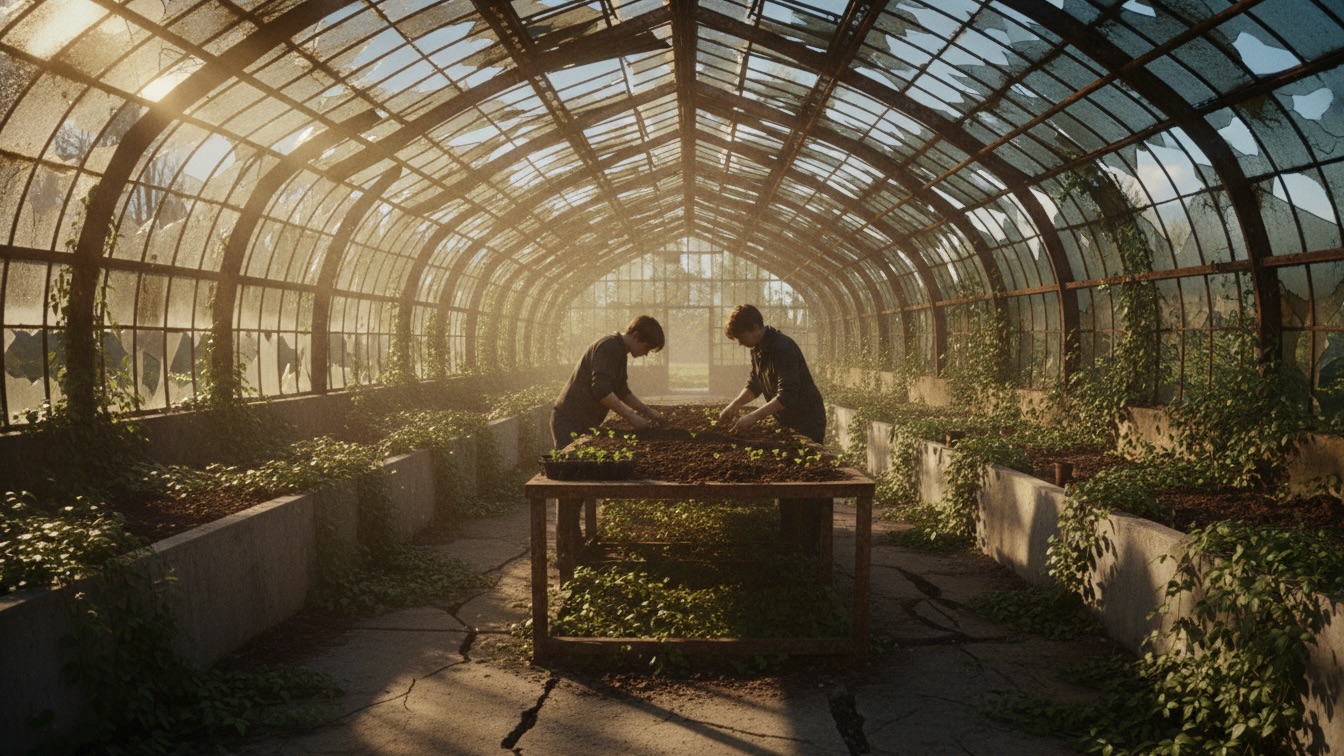
A disillusioned student performing mandatory community service at a condemned university greenhouse must learn to save a dying heirloom crop before bulldozers arrive at dawn. In a world surrendering to AI and concrete, two strangers choose to protect a legacy that the future has already written off.
The primary theme is "Active Hope"—the idea that doing the work is necessary regardless of the guaranteed outcome, contrasting the protagonist's nihilistic "doomerism" with Cleo’s practical stoicism. It explores the tension between the digital future (the server farm) and the biological past (the heirloom seeds), framing the act of gardening as a radical political statement.
The story also touches on the "brokenness" of modern systems, where everything from water nozzles to social contracts is failing, leaving individuals to mend the gaps with their own hands. It posits that while the world may be ending, the responsibility to "today" remains the only manageable moral compass.
For the protagonist, the stake is his soul; if he succumbs to his paralyzing nihilism, he loses his agency and connection to the physical world. For Cleo, the stakes are the survival of the "Cherokee Purple" lineage, representing thirty years of her family’s resilience and a genetic link to a pre-collapse era. If the sprouts are crushed by the bulldozers, a unique piece of history and a potential food source for a starving future are erased forever.
The primary external conflict is the ticking clock of the university’s redevelopment plan, represented by the encroaching rumble of heavy machinery and the cold indifference of the "AI science department." Internal conflict stems from the protagonist’s paralyzing anxiety and his belief that effort is futile in a dying world. The physical environment acts as a secondary antagonist, with broken equipment, toxic dust, and freezing temperatures conspiring to kill the fragile sprouts.
A student arrives at a derelict campus greenhouse to serve community service hours, feeling dwarfed by a world that seems to be ending in smog and noise. He meets Cleo, a weary but determined woman tending to the last of her grandmother's heirloom tomato sprouts in a building marked for demolition. After a disastrous attempt to water the plants results in a burst pipe and a mud-soaked catastrophe, the student is forced to confront his own clumsiness and the "everything is broken" reality of their surroundings.
Cleo teaches him the delicate art of transplanting the root-bound "Cherokee Purple" seedlings into fresh soil, a process that requires a level of care he previously thought pointless. As the sun sets and the rumble of construction equipment signals the greenhouse's imminent destruction, the student realizes these plants won't survive the night without intervention. In a final act of defiance against the university's plan to build a server farm over the site, the two decide to smuggle the tray of fifty lives back to the student's dorm, choosing a warm desk lamp over certain death under the treads of a bulldozer.
The Protagonist (Unnamed): At the start, he is a "doomer" paralyzed by the scale of global collapse, viewing the world through the lens of a cracked phone screen and a tight chest. By the end, he has transitioned from a passive observer of decay to an active participant in preservation, finding purpose in the tactile, muddy reality of the sprouts. His arc is one of shedding nihilism for a difficult, grounded responsibility.
Cleo: A stoic, "dirt-under-the-fingernails" survivor who operates on the edge of the university system and lives in her van. She begins the story as a weary mentor who has no time for bureaucracy, focused entirely on the biological clock of her plants. Her arc is a quiet revelation of her motivation: a deep, ancestral duty to keep her grandmother's "Cherokee Purple" seeds alive through sheer willpower.
The Arrival: The protagonist enters the "skeleton" greenhouse, overwhelmed by the sensory decay of the campus and the weight of his own anxiety. He meets Cleo, who ignores his paperwork and immediately puts him to work dragging heavy bags of soil, establishing a hierarchy of labor over bureaucracy. The atmosphere is thick with the smell of wet dirt and the sound of a dying world outside.
The Mud Geyser: While attempting to water the soil, the protagonist breaks a faulty brass nozzle, triggering a high-pressure blast that turns the greenhouse into a swamp and soaks him in freezing mud. This midpoint represents his lowest point of incompetence and the "everything is broken" realization, but Cleo’s lack of anger forces him to stay and fix the mess. They begin the rhythmic, meditative work of mixing new soil and carefully untangling the "trapped" roots of the dying tomato sprouts.
The Rescue: As night falls and the rumble of bulldozers grows louder, the protagonist challenges the point of their work, only for Cleo to explain the seeds' 30-year history and their simple, biological drive to live. Realizing the greenhouse will be leveled by dawn for an AI server farm, they decide to commit a small act of rebellion. They lift the heavy tray of fifty lives together and step out into the dark, heading toward the warmth of a dorm room to keep the legacy alive.
The episode begins with a feeling of "environmental claustrophobia" and high-functioning anxiety, characterized by tight shots and oppressive ambient noise. As the work begins, the mood shifts into a gritty, tactile "labor-meditation," where the focus narrows to the hands and the dirt, providing a sense of grounding. The finale moves from the "doomer" despair of the encroaching machines to a quiet, defiant hope, ending on a note of solidarity and physical action.
If expanded, the season would follow the protagonist and Cleo as they turn the dorm room into a "guerrilla nursery," eventually seeking out other "broken" spaces on campus to transplant the heirlooms. The overarching narrative would track the escalating tension between the students' underground garden and the university's increasingly automated security and construction drones.
The season would culminate in a "Harvest Festival" during a campus-wide blackout, where the community tastes the Cherokee Purples for the first time, proving that the biological past can still nourish a digital future. Character evolution would see the protagonist becoming a leader in the campus resistance, while Cleo eventually finds a permanent home for her grandmother's seeds in a secret community land trust.
The visual style is "Industrial Naturalism," blending the cold, gray textures of brutalist campus architecture with the vibrant, "angry green" of resilient weeds. Lighting should transition from the "dirty yellow" smog of the day to the high-contrast orange of sodium-vapor streetlamps, creating long, expressionistic shadows inside the glass skeleton of the greenhouse.
The tone is a mix of Children of Men’s grounded grit and the quiet, observational beauty of a nature documentary. Sound design is crucial, contrasting the mechanical, low-frequency hum of the server farms with the wet, organic sounds of "Scrape. Pop. Crumble. Pinch."
This is aimed at the "Gen Z / Millennial" demographic, specifically those experiencing "eco-anxiety" or feeling alienated by the rapid rise of AI and the gig economy. It serves as a "hope-punk" narrative for viewers who enjoy slow-burn, atmospheric dramas that find meaning in small, personal victories against systemic collapse.
The pacing is deliberate and "heavy," mirroring the protagonist’s physical labor and the slow growth of the plants. The first five minutes focus on the sensory overwhelm of the campus, while the final seven minutes tighten the focus to the interaction between the two characters and the ticking clock of the bulldozers. It follows a three-act structure: The Disruption (Arrival/Mud Burst), The Connection (Transplanting/The Seed Packet), and The Choice (The Rescue).
The "Mud Geyser" sequence requires a practical high-pressure water rig and multiple sets of identical costumes for the actors, as the mud soak is a one-way transition. The greenhouse location needs to look authentically derelict, requiring significant "aging" of metal surfaces and the use of breakable glass or acrylic for the missing panels.
The "Cherokee Purple" sprouts should be represented by real tomato seedlings in various stages of health to ensure the "Crumble and Pinch" actions look authentic on camera. Sound recording must capture the specific "squelch" of mud-filled sneakers and the resonant "groan" of the heavy iron greenhouse door to emphasize the physical weight of the environment.


