Arthur fights a malfunctioning shopping cart while grocery prices spike and the Utopian dream begins to fray at the edges.
The wheel didn't just stick. It screamed. A high, metal-on-metal shriek that set Arthur’s teeth on edge and made the muscles in his lower back seize. He shoved the handle of the Smart-Cart.
The plastic was warm, slightly tacky from the palms of a thousand other anxious shoppers. It didn't budge. He kicked the front left wheel. It was locked sideways, the red light on the axle blinking a steady, mocking rhythm. 'Error: Weight Distribution,' the screen on the handlebar read. Arthur looked down at the four bunches of carrots and the single bag of flour. Weight distribution? It was a scam. The whole store was a series of tiny, expensive hurdles.
He shoved again. Harder this time. His hip gave a dull, familiar pop. The cart jerked forward six inches, the wheel dragging across the polished concrete with the sound of a dying animal. He needed to get to the checkout before the 10:00 AM credit-tier shift. In three minutes, the 'Spring Bounty' subsidy would expire, and the price of those carrots would double. That was the 'Utopia' for you. Everything was perfectly balanced, provided you could move faster than the algorithms. Arthur wasn't fast anymore. He was sixty-three, his knees were shot, and he lived in a world designed for people who didn't have to catch their breath.
'Move it or lose it, Artie,' a voice barked from behind him.
Arthur didn't turn. He knew the voice. It was Miller, a man ten years younger who still acted like he was running a drill on the old construction sites. Miller’s cart was piled high with synthetic protein blocks and gallon jugs of grey-water.
'Wheel’s jammed,' Arthur said, his voice grating in his own ears.
'So lift the front. Come on. The tier’s gonna flip. You want to pay twelve credits for dirt-roots?' Miller didn't wait for an answer. He swerved his own cart around Arthur’s, the silent, magnetic casters of the premium model humming with insulting efficiency.
Arthur glared at the carrots. They were beautiful, technically. Long, tapered, covered in actual soil—a luxury in 2026. The Green Equity Initiative had brought back real farming, but they’d forgotten to make it affordable for the people who actually remembered what a farm looked like. He reached out and grabbed the handle again, leaning his entire weight into it. The cart groaned. He felt a bead of sweat roll down the side of his neck, disappearing into the collar of his worn flannel shirt. The air in the market was supposed to be climate-controlled, 'Spring-Fresh' according to the vents, but to Arthur, it just smelled like ozone and wet dirt.
He managed to get the cart into the produce aisle. The overhead misters hissed, a fine spray of recycled water coating the kale in a fake, glistening dew. It was too bright in here. The glass roof allowed the sharp, unapologetic spring sun to pour in, highlighting every scratch on the floor and every wrinkle on the hands of the elderly people huddled over the onion bins.
'Excuse me, sorry, just—' A young woman in a sleek, bioluminescent workout suit tried to squeeze past.
'The cart,' Arthur started.
'Yeah, I see it. Can you just—' She gestured vaguely at the space between him and the leeks.
'I can't. It's locked. The sensors—'
'Just reboot the handle,' she snapped, not looking at him, her eyes fixed on the digital display hovering over the fruit. 'God, it’s not that hard. Some of us have a shift.'
She shoved past, her shoulder clipping his. Arthur stumbled. His hand slipped from the handle, and the cart, freed for a second from his guiding weight, veered sharply to the left and slammed into a display of heirloom tomatoes. The sound of plastic cracking was loud in the quiet hum of the store.
'Security alert,' a flat, synthesized voice announced from the ceiling. 'Aisle Four. Incident detected.'
Arthur’s heart hammered against his ribs. A dull ache started in his chest. 'It was the wheel,' he muttered to no one. He looked at the tomatoes. Three of them had burst, their insides spilling out like wet, red silk on the grey floor. That was probably five credits right there. Ten. He didn't have it. His monthly allocation was already hovering in the red.
He looked around. The other shoppers were ignoring him, their heads down, their fingers dancing over their own cart screens. This was the Utopian peace: a collective agreement to look away from any friction. If you weren't winning, you were invisible.
He tried to lift the front of the cart, just like Miller said. He gripped the cold metal bars near the bottom and pulled. A sharp, lightning-bolt pain shot through his lower back. He hissed, the air whistling through his teeth. He stayed bent over for a moment, waiting for the world to stop spinning. The floor was dusty. He saw a discarded receipt near his shoe. Total: 450 Credits. For a bag of groceries.
'Sir? You okay?'
Arthur looked up. A store monitor was standing there. A kid, maybe twenty, wearing a green vest that was two sizes too big. He had the soft, unformed face of someone who had never seen a world without a 'Resource Managed' label on everything.
'The wheel,' Arthur said, pointing. 'It’s defective. I want a different one.'
'We’re at capacity, sir. All carts are assigned to biometric IDs at entry. I can’t just swap it.' The kid looked at the smashed tomatoes. He sighed, a sound of pure, bureaucratic exhaustion. 'You’re going to have to pay for the shrinkage.'
'Shrinkage? It’s a tomato, kid. It fell because your equipment is garbage.'
'The equipment is optimized for the New Spring standards,' the monitor said, his voice a rehearsed drone. 'If you can’t control the vehicle, you should have requested a motorized assist.'
'Those cost extra. I don’t have the equity for a motorized assist.'
'Then you have to move. You’re blocking the flow.'
'I’m trying!' Arthur shouted. The sound echoed off the glass walls. A few people looked up now, their expressions a mix of pity and irritation. Arthur felt his face flush. He hated this. He hated the light, the misters, the clean, efficient cruelty of it all.
He grabbed the handle again. He didn't push this time; he pulled. He began to drag the cart backward, his heels skidding on the concrete. It was harder, but the wheel didn't scream as much when it was being dragged. He looked like a man trying to pull a dead horse through a swamp. He passed the carrots again. He reached out, grabbed two more bunches, and tossed them into the basket. If he was going to be fined for the tomatoes, he might as well get his money’s worth of Vitamin A.
'Price update in sixty seconds,' the ceiling voice sang.
Arthur’s pace quickened. He dragged the cart toward the checkout line. His breath was coming in short, ragged bursts. His lungs felt tight. He passed an old man sitting on a bench, a man who looked even older than Arthur, staring blankly at a wall of vertical-farmed strawberries.
'Don't bother,' the man said as Arthur passed.
'What?'
'The scanners. They’re slow today. System lag. The price will flip while you're standing there.'
'I’m gonna make it,' Arthur said, more to himself than the man.
He reached the end of the line. There were five people ahead of him. Miller was at the front, his screen flashing green as he tapped his wrist against the sensor.
'Come on, come on,' Arthur whispered. He looked at his own screen. The 'Current Total' was fluctuating. 42.1... 42.8... 43.5... The algorithm was already pricing in the demand. The more people in line, the higher the cost. It was 'Dynamic Equity.' It was a nightmare.
He looked out the massive front windows. Outside, the world was a riot of green. The trees were heavy with new leaves, the grass was a perfect, deep emerald. People were walking dogs, laughing, sitting on benches in the 'Public Harmony' park. It looked like a postcard. It looked like the future they’d been promised back in the teens, before the crashes. But inside the glass, Arthur was suffocating.
'Next,' the automated kiosk chirped.
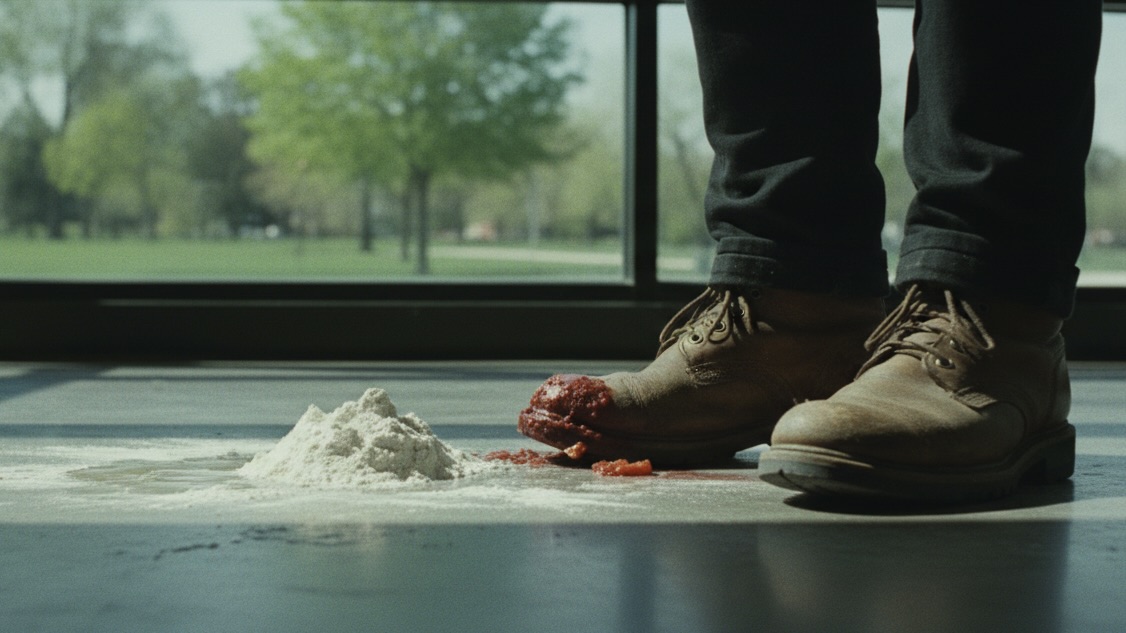
Arthur dragged the cart forward. The wheel caught on a metal strip in the floor and the whole cart tipped. The carrots spilled out. The bag of flour hit the ground and burst, a cloud of white dust billowing up around Arthur’s shins.
'Dammit!' he yelled.
'Sir, please remain calm,' the monitor from earlier said, appearing at his side again. 'You’re creating a hazard.'
'A hazard? Look at this!' Arthur gestured at the white cloud. 'This is my week’s ration! This is it!'
He dropped to his knees, his joints screaming in protest. He started scooping the flour back into the bag with his bare hands. It was pointless. The flour was mixing with the floor dust and the water from the misters, turning into a grey, sticky paste.
'Leave it, Arthur,' a woman behind him said. He didn't know her name, but he’d seen her in the complex. She had gray hair tied back in a tight bun and eyes that looked like they’d seen too many winters. 'Just leave it. It’s gone.'
'I paid for this. Or I’m going to pay for it.'
'The price just flipped,' she said, pointing at the overhead board.
Arthur looked up. The numbers shifted. The carrots went from 4 credits to 9. The flour, even the spilled flour, was now a luxury item.
'I can't—' Arthur started, but the words caught in his throat. He felt a sharp, stabbing pain behind his left eye. He looked at his hands. They were coated in white paste. He looked like a ghost.
He stood up slowly. His back didn't want to straighten. He looked at the monitor, who was already calling for a cleaning drone.
'I’m done,' Arthur said.
'Sir, you still have to settle your cart’s tab. The biometrics—'
'I don’t care. Take it out of my housing credit. Take it out of my funeral fund. I don’t care.'
He turned and walked toward the exit. He didn't look back at the cart, or the carrots, or the white smear on the floor. He pushed through the heavy glass doors, and for a moment, the air was actually sweet. The spring sun was warm on his face, but it didn't feel like a blessing. It felt like a spotlight.
He stood on the sidewalk, his hands still white with flour, watching the happy people in the park. They were smiling. They were part of the balance. He looked down at his shoes. There was a smear of tomato juice on the toe of his left boot.
He started to walk toward the bus stop, but he stopped when he heard a low, rhythmic thumping sound coming from the direction of the city center. It wasn't a car. It wasn't a construction crew. It was something heavy. Something coordinated.
He looked back at the grocery store. Through the glass, he could see the shoppers still moving, still scanning, still fighting their carts. None of them looked up. None of them heard it.
Arthur felt a cold shiver run down his spine, despite the spring heat. The birds in the trees suddenly went silent, all at once, as if someone had flipped a switch. The emerald grass in the park seemed to lose its luster, the shadows stretching out long and jagged across the path.
He wiped his flour-stained hands on his pants, but the white wouldn't come off. It clung to the fabric like bone dust. He looked toward the horizon, where the gleaming spires of the central district caught the light.
The thumping grew louder. It wasn't just a sound; he could feel it in the soles of his feet. The 'Utopia' was built on a very thin floor, and Arthur could hear something underneath it beginning to crack.
“The 'Utopia' was built on a very thin floor, and Arthur could hear something underneath it beginning to crack.”


