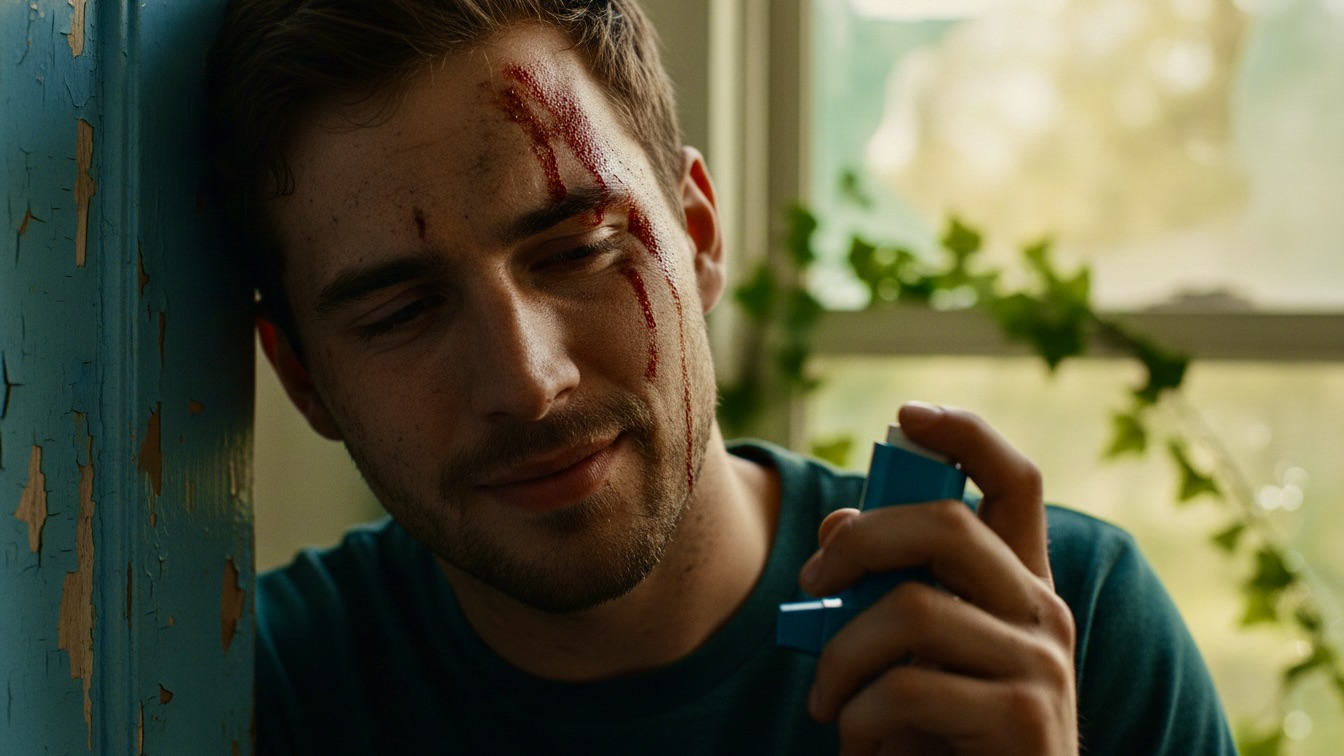
The brick connects with a wet crunch. I do not wait to watch him spit out his teeth.
Spring is a parasite in this city.
Before the world stopped working, people used to write poems about the changing of the seasons. They talked about rebirth. They talked about the green shoots pushing through the dark earth. But when the city services die, when the garbage trucks stop running and the street sweepers rust in their depots, spring is just a different kind of rot. It is the season of overgrowth. Weeds the size of small trees tear apart the asphalt on 4th Street. Vines choke the power lines that have not carried a current in five years. And the pollen. The yellow, suffocating dust coats every burnt-out sedan and shattered storefront in a thick, sickly film.
For most people, the pollen is an annoyance. It makes your eyes itch. It makes you sneeze.
For my little brother, Tyler, it is a death sentence.
His lungs are defective. That is how he describes it when he is trying to be brave. A manufacturing error. When the pollen count spikes, his airways clamp shut. He drowns in the dry air of our living room. It is a slow, mechanical failure of the human body, and the only override code comes in a small, L-shaped piece of blue plastic.
Albuterol.
I stand in the basement of what used to be a veterinary clinic. The smell down here is a heavy mix of industrial bleach and old, dried blood. The walls are cinderblock, painted a pale, institutional green that makes me feel vaguely nauseous. The air is stagnant. It is safe down here, at least for the moment. The warlords who run the surface streets do not bother with the clinic, mostly because Dr. Hayes pays them off with a percentage of his surgical supplies.
Hayes sits across from me behind a folding metal table. He looks terrible. His eyes are sunken, bruised with exhaustion. His hands shake as he pushes the three blue plastic inhalers across the scratched metal surface.
"This is the last of the unexpired stock," Hayes says. His voice is a dry rasp. "The rest is from before the collapse. It might work, it might not. But these three are guaranteed."
I look at the inhalers. They seem entirely too small to carry the weight of a human life. I reach into my jacket and pull out the payment. Four cans of peaches, dented but sealed. Three boxes of 9mm ammunition. A silver watch that stopped ticking a decade ago, but looks heavy enough to have value.
Hayes looks at the pile. He does not touch it immediately. He looks at me.
"The streets are bleeding today," Hayes says. "Silas has his patrols out in the Iron Ward. They are sweeping for deserters. You have to cross his territory to get back to your sector."
"I know the geography," I say.
"Knowing the geography and surviving the transit are two different disciplines," Hayes says. He slides the cans of peaches toward himself. "Keep your head down, Kenny. Do not engage. You are a ghost today."
"I am always a ghost," I say.
I sweep the inhalers into my canvas backpack. The zipper sticks halfway. The teeth of the zipper are stripped. I force it, yanking the metal tab until it bites into the fabric and seals the compartment. I swing the bag over my shoulder. It feels heavy, not with physical weight, but with consequence. If I lose the bag, Tyler dies. It is a simple, brutal equation. There is no room for error. No margin.
I leave the basement, climbing the concrete stairs to the alleyway behind the clinic.
The daylight hits me like a physical blow. The sun is brutally bright, reflecting off the shattered glass that litters the alley. The air is warm and thick with that yellow pollen. I pull my bandana up over my nose and mouth. It does not do much, but it filters out the largest particles. My boots crunch on the glass. I keep my head on a swivel, scanning the fire escapes and the shadows behind the dumpsters.
I make it exactly forty feet before the shadows move.
They step out from behind a rusted-out delivery van. Two of them. Junkies, but the dangerous kind. The kind whose desperation has burned away their fear. They are thin, their clothes hanging off them like rags on a scarecrow. Their skin is covered in sores, their eyes wide and jittery.
The one on the left holds a length of rusted steel pipe. The one on the right has his hands in his pockets, twitching.
My heart rate spikes. The cognitive static begins in my brain. It is a buzzing sound, a low frequency hum that drowns out rational thought and leaves only instinct. I stop walking. I plant my feet.
"Halt your steps, courier," the one with the pipe says. His voice is shockingly clear, almost theatrical. He speaks like he is standing on a stage, playing a part he practiced in the mirror. "The toll must be paid."
"I have nothing for you," I say. My voice is muffled through the bandana. I do not shout. Shouting shows fear. I keep my tone flat, dead.
"The bag," the second junkie says, pulling his hands from his pockets. He is holding a heavy wrench. "The streets demand a toll today. Drop the bag and walk away. You get to keep your blood."
I look at the space between them. I look at the rusted van. Leaning against the back tire of the van is a dirt bike. It is an old Honda, stripped of its plastics, the frame painted a dull matte black. The key is in the ignition. These idiots left the key in the ignition.
"You do not want this fight," I say. I slowly lower my hand to the ground. There is a loose brick resting near my boot. It is a solid, heavy piece of masonry, chipped at the edges.
"We are starved of choices," the pipe-wielder says. He takes a step forward, raising the steel tube.
"Back the fuck off," I say. My voice drops an octave. It is a warning. It is the last warning I will give.
They do not listen. They never listen. The pipe-wielder lunges, swinging the heavy steel in a wide, sloppy arc aimed at my head.
I drop to my knee, dodging the swing. The pipe whistles through the air where my skull just was. My fingers close around the brick. The texture is rough, biting into my palm. I do not think. I do not hesitate. Thinking gets you killed. I pivot on my knee and drive the brick upward, putting the entire force of my legs and torso behind the motion.
The brick connects with his mouth.
The sound is a wet, hard crunch. It is the sound of calcium shattering and cartilage tearing. The impact sends a shockwave up my arm, jarring my shoulder. The junkie's head snaps back violently. He drops the pipe. He does not scream. He just gurgles, his hands flying to his face as blood explodes from his ruined lips. He collapses backward into the dirt, writhing.
The second junkie freezes. He looks at his partner on the ground, then looks at me. I stand up, the brick still in my hand. It is stained red. Drops of blood fall from the chipped edge, hitting the dust.
"Your move," I say.
The second junkie drops the wrench. He turns and sprints down the alley, his boots slipping on the garbage.
I drop the brick. My hands are shaking. The adrenaline is a poison in my veins, making my vision tunnel. I do not wait to watch the first guy spit out his teeth. I run to the dirt bike.
I throw my leg over the seat. It is torn, the yellow foam exposed. I grab the handlebars. The metal is warm from the sun. I turn the key. I kick the starter.
Nothing.
Panic flares in my chest. A hot, sharp spike. I kick it again. Harder.
The engine coughs, sputters, and dies.
"Come on," I hiss. I twist the throttle slightly and kick down with all my weight.
The engine roars to life. It is loud. Too loud. The muffler has been sawed off, and the sound echoes off the brick walls of the alley like a machine gun. Every patrol in a five-block radius is going to hear this. But I have no choice. I kick up the stand, pop the clutch, and tear out of the alley.
The wind hits my face, tearing the bandana down around my neck. The acceleration is brutal and beautiful. I hit the main street, swerving around the rusted skeleton of a city bus.
I am moving. I am alive.
But the city is a grid of violence, and I have to cross three territories.
The first boundary is easy. The border between the Neutral Zone and the Iron Ward is marked by a line of crushed cars, stacked two high, spray-painted with yellow skulls. This is Silas's territory. Silas is a warlord who controls the fresh water pumps in the eastern district. His men are heavily armed, heavily armored, and completely devoid of mercy.
I downshift as I approach the barricade. There is a gap between a burned-out ambulance and a concrete barrier. I thread the bike through the gap, my knees scraping against the rusted metal.
I am in the Iron Ward.
The architecture here is different. It is older, heavier. Massive stone buildings with shattered windows. The spring vines have aggressively colonized this sector. Green ivy crawls up the sides of the banks and the courthouses, pulling down the masonry. The street is cracked, weeds pushing up through the fissures.
I keep the throttle steady. I am trying to minimize the noise, but the modified engine is a beacon. I weave through the abandoned cars, my eyes scanning the rooftops. Silas's men like the high ground. They use hunting rifles with scopes. If they see me, I will not hear the shot that kills me.
I turn onto what used to be a major commercial avenue. Up ahead is the Galleria. It was a massive, multi-level shopping mall. Now, it is a hollowed-out cavern of glass and steel. The roof collapsed years ago, leaving the interior exposed to the elements.
I am halfway down the avenue when I hear the roar.
It is a deep, mechanical growl, much louder than my bike. I check my cracked side mirror.
Three blocks back, a modified pickup truck turns onto the avenue. It is painted matte black, covered in welded steel plates. A heavy machine gun is mounted in the bed. Four men wearing yellow armbands are clinging to the sides.
A patrol.
They see me instantly. The truck surges forward, the engine screaming.
My stomach turns over. It is a physical drop, a sensation of falling. The cognitive static returns, louder this time. I twist the throttle perfectly open. The dirt bike leaps forward, the front tire lifting off the pavement for a second before slamming back down.
The wind tears at my clothes. The buildings blur in my peripheral vision. I glance in the mirror again. The truck is gaining. It has a massive V8 engine, and on this straight stretch of road, it is faster than my bike.
I need to break the line of sight. I need to change the geography of the chase.
I look ahead. The Galleria.
The main entrance is a set of massive glass doors. Most of the glass is gone, but the metal frames remain. Leading up to the doors is a wide set of concrete stairs.
I do not think about the physics. I just react.
I veer hard to the left, aiming the bike at the stairs. I pull up on the handlebars as I hit the first step. The suspension bottoms out with a violent jolt. The bike bounces up the stairs, my teeth rattling in my skull. I hit the landing, drop a gear, and shoot through the empty metal frames of the doors.
I am inside the mall.
The transition from bright sunlight to shadowed ruin is disorienting. The floor is covered in cracked white tiles and dirt. Dead plants sit in massive ceramic pots. Skeletons of display kiosks dot the concourse. Above me, the shattered skylight lets in beams of dusty light.
The sound of the truck engine outside grows deafening. I hear the screech of tires as they hit the curb.
Then, the gunfire starts.
It is not the rhythmic popping of a handgun. It is the heavy, tearing sound of a mounted machine gun. The bullets tear through the front of the mall. The remaining glass in the upper windows shatters, raining down in a glittering, deadly shower.
The sound of the rounds hitting the marble pillars is terrifying. It is a sharp, cracking whip that echoes endlessly in the cavernous space. Dust and stone chips spray into the air.
I duck low over the handlebars, weaving wildly between the dead kiosks. I have no plan. I just need to keep moving. The concourse splits ahead. Left goes toward the abandoned department stores. Right goes toward the central atrium.
I swerve right.
The atrium is massive. In the center is a dry fountain, filled with garbage. Surrounding the fountain are escalators leading up to the second and third levels.
I hear shouts echoing from the entrance. The patrol is inside. They are on foot now, but they have rifles.
"There! He went toward the atrium!" a voice booms, amplified by the acoustics of the mall.
A single shot rings out. The bullet strikes the tile inches from my front tire. The impact sends a sharp fragment of ceramic slicing into my calf. I feel a hot sting, but I ignore it. The pain is just data. I can process it later.
I need to get out of the open. I look at the escalators. The up escalator is blocked by a pile of fallen debris. The down escalator is clear, but it leads to the lower parking garage.
It is my only exit.
I steer the bike toward the top of the down escalator. The metal treads are steep, angled sharply downward. I hit the brakes, trying to slow my momentum before I commit to the descent.
It is a mistake.
The front tire hits the first metal step, and the wheel twists violently to the side. The rubber loses traction on the smooth, dusty metal.
The bike goes out from under me.
The world spins. The physical collision is absolute. I am thrown off the seat, tumbling down the metal stairs. The edges of the escalator treads are sharp, brutal steel. They batter my shoulders, my hips, my legs.
I fall for what feels like an eternity, a cascade of impacts.
Then, the bike catches up to me.
The heavy frame of the Honda crashes down on top of me as we slide toward the bottom. The metal handlebar strikes my left side, right below my armpit.
The sound is a sickening snap, loud enough to cut through the noise of the crash.
The pain is immediate and blinding. It is not a dull ache. It is a bright, white-hot knife shoved directly into my chest. My vision flashes black. All the air is driven from my lungs in a violent rush.
We hit the bottom landing in a tangle of metal and limbs. The bike slides across the smooth concrete floor of the lower level, dragging me with it until we slam into a support pillar.
I lie there for a second. The world is spinning. My ears are ringing.
I try to take a breath.
The knife twists. A jagged edge of bone grinds against my lung. I choke, spitting blood onto the concrete. My ribs are broken. Not just cracked. Broken.
The cognitive static is gone, replaced by a singular, piercing frequency of agony.
I hear footsteps running above me. The patrol has reached the top of the escalator.
"He went down! Check the bottom!"
I force my eyes open. The backpack. I reach around my back. The canvas is intact. The zipper is still closed. The inhalers are safe.
I have to move. If I stay here, they will execute me.
I push the heavy frame of the bike off my legs. Every millimeter of movement is a negotiation with the pain in my chest. I roll onto my hands and knees. Sweat pours down my face, stinging my eyes. I drag myself up, using the support pillar for leverage.
I am in the service corridor behind the parking garage. The lighting is dim, flickering fluorescent tubes powered by some forgotten backup generator. I stumble forward, my left arm clutched tight against my ribs, trying to splint the broken bone with my own forearm.
I run. It is not a sprint. It is a desperate, dragging limp. Every footfall jars my chest, sending a fresh wave of nausea washing over me.
I hear the patrol reaching the bottom of the escalator. They find the bike.
"He left the ride! Fan out! He cannot be far!"
I push through a set of heavy metal double doors marked 'EXIT'. I am back outside, in the narrow alleyway behind the mall. The sunlight is blinding again.
This is the edge of the Iron Ward.
Fifty yards ahead of me is the quarantine fence. It was erected during the first year of the collapse to separate the infected sectors from the clean zones. It failed, obviously, but the fence remains. It is a twelve-foot-high chainlink barrier, topped with three coils of rusted razor wire.
My apartment is in the sector on the other side of that fence.
I stumble toward the chainlink. The distance feels infinite. The air is thick with pollen again, and my bruised lungs are struggling to pull oxygen. I am gasping, short, shallow breaths that do nothing to clear the black spots dancing in my vision.
I reach the fence. I wrap my fingers through the metal diamonds. The chainlink is cold.
I look up. Twelve feet.
Under normal circumstances, I can scale it in ten seconds. With broken ribs, it is a monumental task.
I hear the metal doors of the mall slam open behind me.
"There he is! At the fence!"
I do not look back. I pull myself up.
The pain is catastrophic. The muscles in my chest and back tear at the broken bone. I scream, a ragged, wet sound that gets lost in the wind. I force my right boot into the chainlink, pushing upward. I grab higher. I pull.
A gunshot rings out.
The bullet strikes the fence two feet to my left, the impact vibrating through the metal into my hands. They are firing wild, running while shooting.
I keep climbing. Ten feet. Eleven feet.
I reach the top. The razor wire is a tangled mess of rusted blades. I have to throw myself over it without getting caught. I swing my right leg over the top bar. The razor wire catches the fabric of my jeans, slicing through the denim and biting into my thigh. I ignore it. I pull my left leg up.
Another shot. This one hits the concrete base of the fence, sending a spray of gravel into the air.
I throw my weight forward.
I clear the wire, but I lose my grip on the fence. I fall.
It is a twelve-foot drop directly onto cracked asphalt. I try to land on my feet, but my legs are weak. My knees buckle, and I crash onto my right shoulder, rolling to protect my broken left side.
The impact knocks the wind out of me again. I lie on the hot asphalt, staring up at the sky. The sky is violently blue, indifferent to the suffering beneath it.
I hear the patrol shouting on the other side of the fence.
"He crossed the line! Leave him! The sector is dead anyway!"
They are not going to climb the fence. They are not going to follow me into my sector. I am safe from the warlord.
But I am not safe from the clock.
I force myself to roll over. I push up onto my knees. Blood is running down my leg from the razor wire cut. My chest feels like it is filled with broken glass. I look at my hands. They are scraped raw, bleeding sluggishly.
I look down the street. Three blocks. My apartment is three blocks away.
I stand up. The world tilts dangerously to the left, but I catch my balance. I start walking.
It is a death march. Every step requires conscious effort. Pick up the foot. Move it forward. Shift the weight. Breathe shallow. Ignore the burning. Pick up the foot.
The streets here are empty. This sector has been picked clean by scavengers. There is nothing left to steal, no reason for anyone to be here. The silence is heavy, broken only by the sound of my boots dragging on the pavement and my own ragged breathing.
I pass a burnt-out grocery store. I pass a playground where the swings sway slightly in the spring breeze, the chains squeaking a rhythmic, lonely tune.
Two blocks.
One block.
I see the apartment building. It is a brutalist concrete block, six stories high, stained black by fire and time. The front doors are gone.
I enter the lobby. It is cool inside, out of the sun. The elevator doors are pried open, revealing the empty shaft. I walk to the stairwell.
Fourth floor.
Climbing the stairs is worse than climbing the fence. There is no adrenaline left. There is only exhaustion and bone-deep agony. I take it one step at a time, pulling myself up by the rusted handrail. My vision is tunneling to a pinprick. The edges of the world are going dark.
First floor. Second floor. Third floor.
I reach the fourth-floor landing. I lean against the cinderblock wall, leaving a smear of dirt and blood on the paint. I walk down the hallway. The carpet is moldy, squishing slightly under my boots.
Apartment 4B.
The door is heavy wood, secured by three deadbolts. I reach into my pocket for the keys. My fingers are clumsy, numb. I drop the keys. They hit the floor with a sharp jingle.
I swear softly, bending down to pick them up. The movement causes the broken rib to shift again. I bite my lip so hard I taste blood, holding back a scream.
I get the keys. I unlock the first deadbolt. The second. The third.
I push the door open.
The apartment is dark. The windows are boarded up to keep out the light and the scavengers. The air inside is stale, smelling of old dust.
I hear him before I see him.
The wheeze.
It is a terrible, thin sound. It is the sound of air trying to force its way through a space that no longer exists. It is the sound of a machine grinding to a halt.
I kick the door shut behind me, locking the deadbolts purely by muscle memory.
"Tyler?"
I stumble into the living room. He is on the couch. He is curled into a tight ball, his knees pulled up to his chest. His face is pale, his lips tinted a terrifying shade of blue. His eyes are wide, locked onto me with absolute panic. He is taking rapid, shallow gasps, his chest heaving, but no air is moving.
He is drowning.
I drop to my knees next to the couch. I do not care about the pain in my ribs. I tear the backpack off my shoulder. I rip at the zipper. It catches.
"No, no, no, come on," I whisper, frantic.
I yank the zipper with all my strength. The metal teeth break, tearing the canvas open. I plunge my hand into the bag and pull out one of the blue plastic inhalers.
I pop the cap off with my thumb.
I grab Tyler by the shoulder, pulling him up into a sitting position. He is limp, heavy. His eyes are rolling back in his head.
"Look at me, Ty. Look at me."
He weakly focuses on my face.
"Open your mouth."
He opens his mouth, gasping like a fish on the deck of a boat.
I place the mouthpiece between his teeth. I press the canister down.
The hiss of the aerosol is the loudest sound in the world.
"Breathe in. Deep."
He tries. He sucks the mist into his lungs. He holds it for a second, his face contorting in panic.
Then, he exhales.
It is a shuddering, wet cough. He gasps again. I press the canister a second time. Another hiss.
"Again. Take it all in."
He breathes deep. This time, the wheeze is slightly less pronounced. The chemical is working. It is forcing the airways open, overriding the mechanical failure.
He slumps forward, resting his forehead against my chest. I wrap my arms around him, ignoring the stabbing pain in my ribs. I can feel his heart hammering against his ribs, beating a frantic rhythm against my own.
"I got you," I whisper into his dirty hair. "I got you. You are okay."
We stay like that for a long time. The only sounds in the apartment are his breathing, slowly returning to normal, and the distant, muffled wind outside.
Eventually, he pulls back. The color is returning to his face. He looks at me, really looking at me for the first time.
"You are bleeding," he says. His voice is a weak croak.
I look down. My jacket is torn, soaked in blood from the razor wire and the crash. My hands are a mess.
"I am fine," I say. "Just a rough transit."
He looks at the torn backpack on the floor. He sees the other two inhalers sitting next to the broken zipper.
"Three?" he asks.
"Three," I confirm.
I slowly stand up. The adrenaline is completely gone now, leaving behind a cold, crushing exhaustion. Every muscle in my body is trembling. I walk into the small kitchen area.
I turn on the tap. Nothing comes out. The water was shut off three days ago.
I reach into the cabinet and pull out a half-empty plastic bottle of water. I drink a mouthful, swishing it around to clear the taste of blood and dust from my mouth, then swallow.
I look at the empty counter. Where there used to be a stack of canned food, there is now only a single, empty tin of peaches.
I traded all our food for the medicine.
I look back into the living room. Tyler is holding the blue plastic inhaler, turning it over in his small hands. He is breathing normally now. He is alive.
But the math is brutal, and it never stops.
Three inhalers. If the pollen stays heavy, he will need one puff every six hours. That means three inhalers will last us exactly three days.
Three days.
And we have no food.
I lean heavily against the counter, clutching my broken side. The city is dead. The clinics are empty. The warlords are tightening their grip on the only remaining resources.
There is nothing left here for us.
I stare at the empty can of peaches on the counter, realizing with cold clarity that the medicine buys us exactly three days before we have to cross the quarantine zone for good.
“I stare at the empty can of peaches on the counter, realizing with cold clarity that the medicine buys us exactly three days before we have to cross the quarantine zone for good.”


