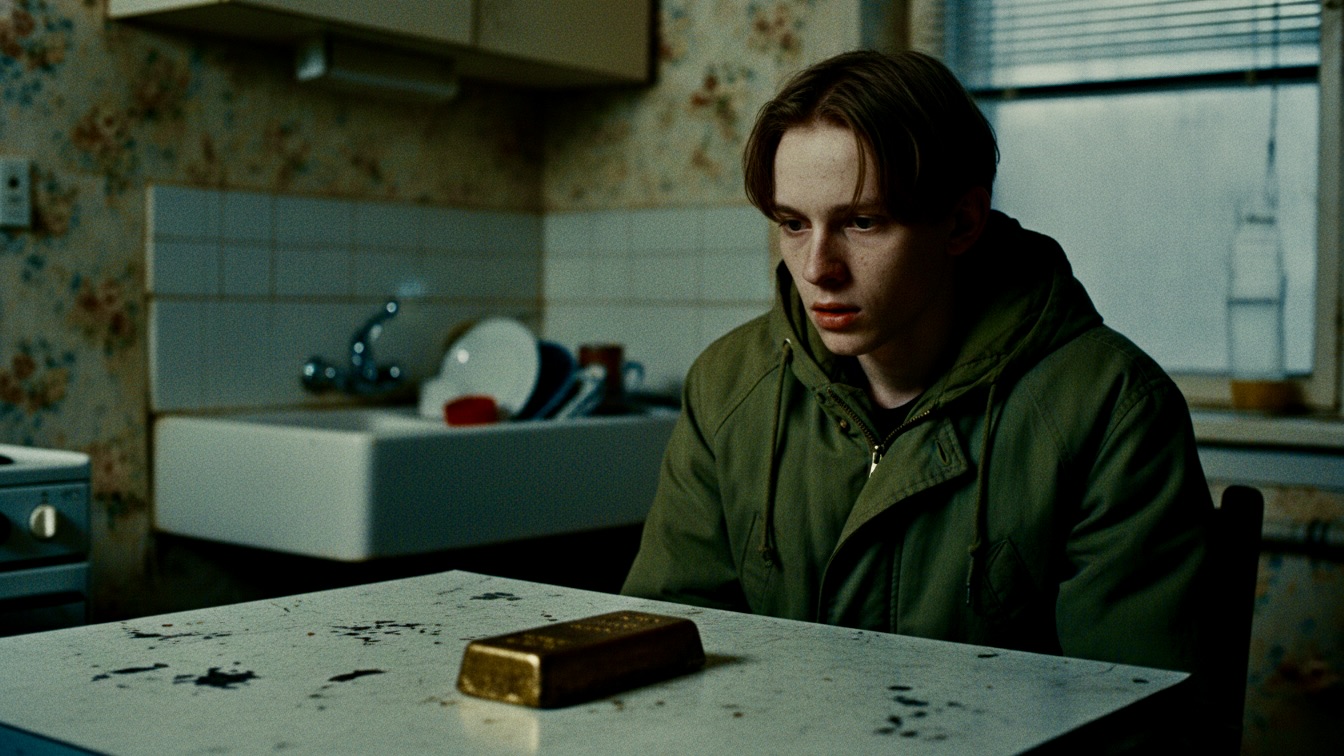
Leo finds a solid gold bar in the frozen mud of the Red River while the wind tries to kill him.
"Move your feet or they’ll freeze to the mud," Sam said. He didn’t look back. He kept walking, his boots crunching through the crust of dirty snow that lined the Red River. It was February in Winnipeg. The kind of cold that didn’t just bite; it took bites out of you. The air was minus forty with the wind chill. It felt like a physical weight pressing against Leo’s chest, making every breath a chore. Leo didn’t answer. He couldn’t. His jaw was locked tight, his teeth grinding together so hard he thought they might crack. He was focused on a patch of grey-brown ice near the water’s edge. Something was wrong with the color. It wasn't the dull silver of the river or the dead white of the snow.
Leo stopped. He crouched down, his knees popping like dry wood. His parka was thin, a hand-me-down with a broken zipper held together by a safety pin. He reached out with a gloved hand—the thumb was missing, exposing skin that had turned a waxy, dangerous white. He brushed away a layer of silt and frozen slush. Something hard hit his fingernails. It wasn't plastic. It wasn't a rock. It was a corner. A perfect, right-angled corner of something that caught the weak, filtered light of the overcast sun. It was yellow. Not the neon yellow of a discarded Gatorade bottle. This was deep. Dense. It looked heavy before he even touched it.
"Leo, come on. We’re late for the shift," Sam called out, turning around ten yards ahead. Sam’s face was wrapped in a greasy scarf, only his squinting eyes visible. He looked exhausted. They were both exhausted. They spent their mornings scavenging the banks for scrap metal—copper piping if they were lucky, crushed cans if they weren't. It was the only way to cover the difference in the rent after the landlord hiked it in January. "What are you doing? There’s nothing there. It’s just trash."
Leo didn't move. He dug his fingers into the frozen muck, prying at the object. It didn't budge at first. He had to chip away the ice with a jagged piece of rebar he’d been carrying. His heart started to thud against his ribs, a frantic, uneven rhythm. He felt a bead of sweat trickle down his spine, which was insane given the temperature. Finally, the earth gave way. He hauled it out. It was a brick. A small, incredibly heavy brick. He nearly dropped it because his brain wasn't prepared for the density. It was about the size of a smartphone but weighed as much as a bowling ball. He rubbed the mud off with his sleeve. The yellow was blinding now. It was soft-looking, almost oily in its luster.
"Sam," Leo whispered. His voice was a dry rasp. He tried again, louder this time, though his throat felt like it was lined with sandpaper. "Sam. Look."
Sam trudged back, his shoulders slumped. "Whatever it is, it’s too heavy to carry to the yard. Leave it." He stopped five feet away. His eyes drifted down to the thing in Leo’s hands. The silence that followed was louder than the wind. Sam pulled the scarf down from his mouth. His breath came out in a thick, white cloud. "Is that..."
"It’s heavy," Leo said. That was all he could manage. The physical reality of the weight was the only thing his mind could process. It wasn't a 'discovery.' It wasn't 'luck.' It was a problem. A massive, gold-colored problem that felt like it was burning a hole through his hands even through the wool. He looked at the river. The water was black and moving slow under the shelf of ice. Someone had put this here. Or someone had lost it. You don't just lose ten pounds of gold.
"Put it in the bag," Sam said. His voice was different now. The fatigue was gone, replaced by a sharp, jagged edge of panic. He scanned the top of the riverbank. The bridge was a few hundred yards away. A few cars crawled across it, their tires humming on the metal grate. To anyone up there, they were just two kids in dirty coats poking at the trash. "Leo. Put it in the bag. Now."
Leo shoved the bar into his nylon backpack. The straps groaned instantly. The weight hit the small of his back, dragging his posture down into a hunch. He felt a sudden, violent surge of nausea. This was the snap point. He could feel his pulse in his eyeballs. Every sound—the wind, the distant traffic, the cracking of the river ice—sounded like a threat. He stood up too fast and his head swam. "We need to go."
"Not the street," Sam said, grabbing Leo’s arm. His grip was tight, desperate. "We stay by the water. Under the bridge. If we go up to the road, people see us. They see you're carrying something heavy."
They started moving. The pace was faster now, a frantic scramble over the frozen rip-rap. Leo’s feet felt like blocks of lead. He kept thinking about the basement apartment. The mold in the corner of the ceiling. The way the heater kicked on and just blew cold air. This bar could fix it. Or it could get them killed. In Winnipeg, people got stabbed for a pack of cigarettes. For this? They wouldn't even find his body until the spring thaw. The thought made his stomach turn over. He looked at Sam. Sam was staring straight ahead, his jaw working. He was already spending it, or he was already mourning them. It was hard to tell.
"The yard?" Leo asked. He meant the scrap yard. Miller’s. Miller was a crook, but he was a crook they knew.
"No," Sam snapped. "Miller would call the cops or his cousins. Nobody knows. We go home. We hide it. We think."
"Hide it where? The floorboards are rotten. The landlord comes in whenever he wants."
"I said we think, Leo!" Sam’s voice cracked. He stopped and leaned against a concrete pylon under the bridge. The shadows here were deep and smelled of old urine and damp concrete. Sam was shaking. It wasn't the cold. "Do you have any idea what that is? If that's real? That’s not 'rent' money. That’s 'leave and never come back' money."
Leo leaned against the pylon too. He needed to take the weight off his shoulders for a second. His backpack felt like it was filled with lead shot. "It's real. The weight. Brass isn't that heavy. Lead is, but lead doesn't look like that when you scratch it." He had scratched it with the rebar. The gouge was bright, buttery yellow all the way through.
"We can't take the bus," Sam said, his eyes darting toward the stairs leading up to the street level. "The cameras. The driver. You're hunched over like you're carrying a dead body. It looks weird."
"We have to walk?" Leo looked at the sky. The light was already dying. In the winter, the sun didn't so much set as it just gave up. "It's three miles, Sam. I can't. My feet. I can't feel my toes anymore."
"Then you lose the toes," Sam said, his voice flat. "You want the gold or the toes? Decide."
Leo didn't answer. He adjusted the straps. The nylon was cutting into his shoulders, through the parka, through his hoodie. He felt a dull ache starting in his lower back that he knew would be a scream by the time they reached Osborne Street. They started walking. They stayed low, moving through the back lanes behind the industrial buildings that lined the river. Every time a car door slammed, Leo jumped. Every time a dog barked behind a chain-link fence, his heart skipped.
He felt the stress in his body like a physical fever. His mouth was bone dry. He kept licking his lips, which only made them chap and bleed. He could taste the copper in his mouth. He thought about his mom. She was at the hospital, cleaning floors. She’d be home at eight. If she saw this, she’d lose her mind. She’d want to take it to the police. She still believed in things like 'the right thing' and 'civic duty.' She didn't understand that the right thing didn't pay for heat.
"Someone's following us," Sam whispered.
Leo froze. He didn't turn around. He couldn't. His neck was too stiff. "You sure?"
"Don't look," Sam said, his pace quickening. "Behind the warehouse. A guy in a red jacket. He’s been there since the bridge."
Leo’s breath came in short, jagged gasps. The static in his brain was getting louder. He tried to think—was it just some guy? A regular person walking? Or had someone seen them at the river? The riverbank was supposed to be empty. But in this city, eyes were everywhere. People watched from windows. People lived in the bushes. "What do we do?"
"Cross the street. Go toward the lights. If he follows us into the light, we run."
They broke cover, scrambling up the embankment toward the road. The transition from the quiet, frozen river to the salt-stained reality of the street was jarring. The sound of a city bus screeching to a halt nearby made Leo jump nearly out of his skin. They crossed at the light, their boots slipping on the black ice that covered the asphalt. Leo looked back then.
There was a figure. A red jacket. Standing by the edge of the trees they had just left. The person wasn't moving. They were just standing there, a dark shape against the grey snow, watching. Leo felt a coldness that had nothing to do with the Winnipeg wind. It was a hollow, sinking feeling in the pit of his stomach. The gold wasn't heavy anymore; it was an anchor. It was pulling them down into something they weren't ready for.
"He’s just standing there," Leo said, his voice trembling.
"Keep moving," Sam urged, his hand on the back of Leo’s backpack, pushing him forward. "Don't look back again. Just move."
They turned the corner into a residential area, the houses small and hunched together like they were trying to keep each other warm. The streetlights flickered on, casting a sickly orange glow over the snow. Leo’s legs were burning. The lactic acid was building up, making his muscles twitch. He focused on the rhythm of his feet. Left, right, left, right. Don't think about the gold. Don't think about the man in the red jacket.
They reached the apartment building—a three-story walk-up with peeling brown paint and a front door that didn't lock properly. They ducked inside, the sudden warmth of the hallway hitting them like a physical blow. It smelled of boiled cabbage and old cigarettes. Leo leaned against the mailboxes, his chest heaving. He dropped the bag. It hit the floor with a heavy, metallic thud that seemed to echo up the stairwell.
"Shut up," Sam hissed. "Pick it up."
Leo grabbed the bag. They scrambled up the stairs to the second floor. Sam fumbled with the keys, his fingers shaking so badly he dropped them twice. Finally, the door clicked open. They burst inside and Sam slammed it shut, throwing the deadbolt and the chain.
Leo collapsed onto the linoleum floor of the kitchen. He ripped the backpack off and dumped the contents. The gold bar slid out, glowing under the single fluorescent bulb that hummed over the sink. It looked out of place. It was too clean, too perfect for this room with its stained counters and cracked linoleum. It was a piece of another world.
"We're rich," Leo said. He wanted it to sound like a celebration, but it sounded like a funeral.
Sam was at the window, peering through a gap in the blinds. He stood there for a long time, silent. The only sound was the clicking of the heater and the heavy, ragged breathing of two boys who had just realized their lives were over.
"Leo," Sam said softly.
"What?"
"The guy in the red jacket. He's across the street. Under the light."
Leo didn't get up. He just stared at the bar of gold. He realized then that the weight wasn't in the backpack. It was in the room. It was in the air. He reached out and touched the metal. It was still cold. It was the coldest thing he had ever felt.
He didn't hear the boots crunching on the ice outside his window, but he felt the sudden, sharp shift in the shadows of the room.
“He didn't hear the boots crunching on the ice outside his window, but he felt the sudden, sharp shift in the shadows of the room.”


