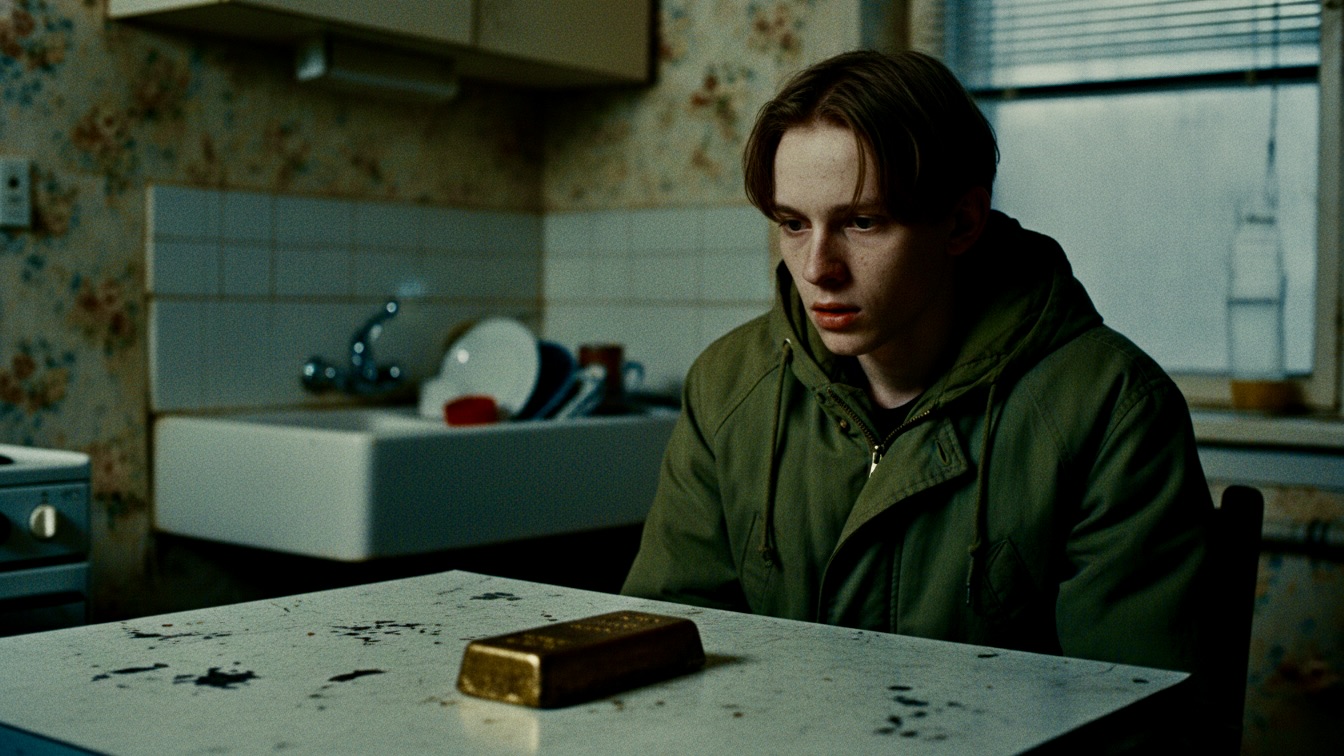
The story follows two brothers, Leo and Sam, who are scavenging for scrap metal in the brutal winter of Winnipeg. While searching the banks of the Red River, Leo discovers a dense, heavy brick of gold buried in the frozen mud. The discovery immediately transforms their desperate situation into a source of paralyzing terror. As they navigate the journey back to their dilapidated apartment, they are stalked by a mysterious figure in a red jacket. Once they reach the safety of their home, they realize the gold has not solved their problems but has instead brought a lethal threat to their doorstep, marking the end of their previous, albeit impoverished, lives.
The narrative functions as a grim exploration of the corrupting and isolating nature of sudden wealth. For Leo and Sam, the gold is not a symbol of opportunity but an immediate burden that strips away their agency and forces them into a state of constant paranoia. The story posits that in a world defined by extreme poverty, a windfall is more likely to be perceived as a death sentence than a salvation. The gold acts as an anchor, dragging the boys down into a reality where survival is no longer about finding copper pipes, but about evading a predator who has been alerted to their illicit fortune.
Furthermore, the environment of Winnipeg serves as a thematic mirror to the internal states of the characters. The relentless, sub-zero cold represents the indifference of the world toward the suffering of the impoverished. The transition from the frozen river to the suffocating warmth of their apartment highlights the irony that there is no true sanctuary for them. The gold, which should be the ultimate tool for liberation, ultimately functions as a catalyst for their inevitable entrapment, illustrating the theme that some burdens are too heavy for the soul to bear without fracturing.
Leo is the emotional center of the story, a young man whose exhaustion and physical deterioration make him vulnerable to the weight of his discovery. His psyche is defined by a deep-seated pragmatism born from years of deprivation, which is why he immediately views the gold as a problem rather than a gift. He is caught between a lingering, childish desire for security and the harsh, adult reality that this object will likely lead to his demise. His internal conflict is palpable as he fluctuates between the hope that the gold can fix his home and the paralyzing fear that it will result in his death.
Sam serves as the driving force of the duo, exhibiting a desperate, hardened edge that suggests he has already accepted the violent potential of their situation. He acts as the pragmatic, if frantic, leader who attempts to impose order on a chaotic event. His primary motivation is survival, yet he is clearly overwhelmed by the magnitude of their discovery. Sam’s decision-making reflects a psyche that is already mourning their lost innocence, as he realizes that the gold has irrevocably altered their trajectory and placed them in the crosshairs of a dangerous, unknown adversary.
The pacing of the narrative is expertly calibrated to mimic the physical and mental strain experienced by the protagonists. The author utilizes short, clipped sentences during moments of high tension to replicate the feeling of a racing pulse and shallow, freezing breaths. This rhythmic choice ensures that the reader feels the same claustrophobic urgency that consumes Leo as he carries the heavy burden back to his home. The shift from the expansive, desolate riverbank to the cramped, dark apartment reflects the narrowing of their options and the closing of their fate.
The sensory details are particularly evocative, grounding the abstract concept of wealth in the visceral reality of the cold. The author focuses on the biting wind, the smell of old urine, and the numbing pain in Leo’s extremities to emphasize that their environment is as much an antagonist as the man in the red jacket. The tone is relentlessly bleak, maintaining a sense of impending doom from the moment the gold is unearthed. By contrasting the blinding, oily luster of the gold with the dull, grey-brown misery of their lives, the narrative voice highlights the jarring, otherworldly nature of the discovery.


