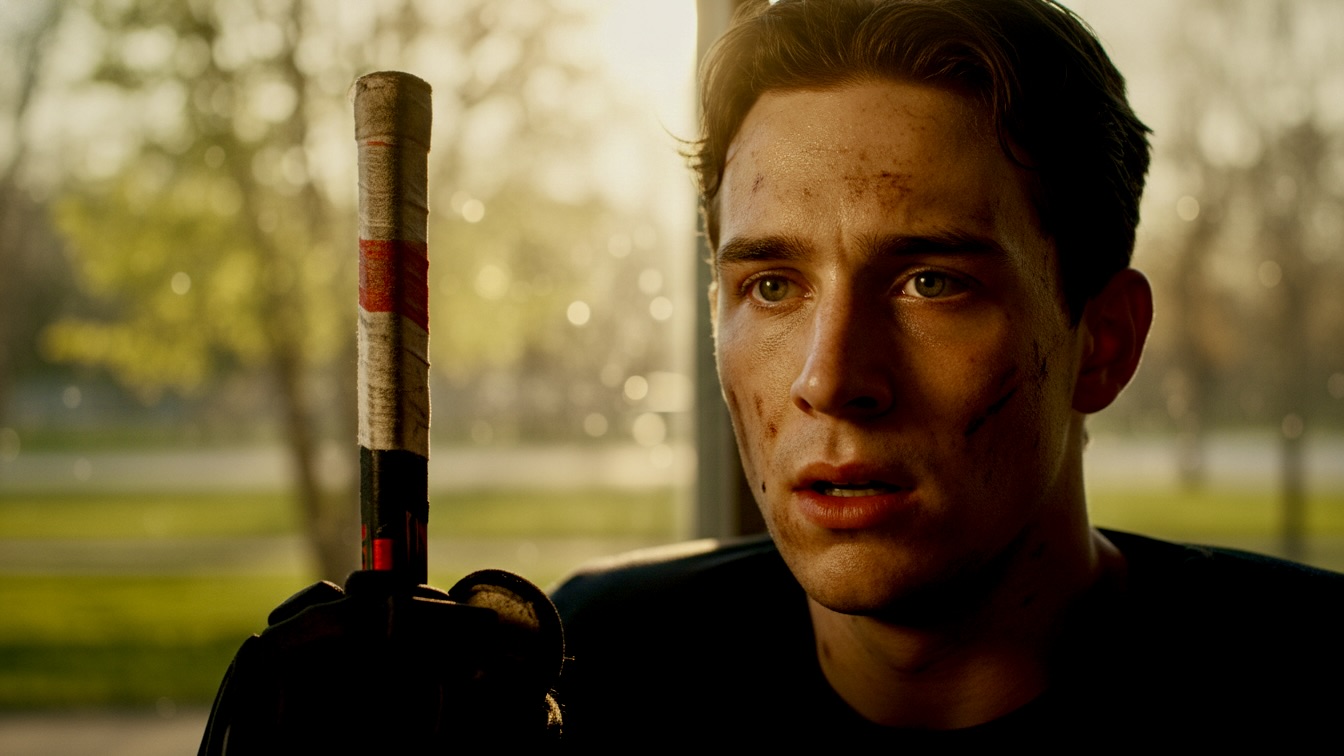
Spring rot turned the lake to slush, but it was the glowing thing beneath the ice that ended everything.
Willy stared at the slush. Spring in Northern Ontario was not a season of renewal. It was a season of rot. The snow did not melt cleanly. It collapsed into heavy, gray puddles that smelled like dead weeds and two-stroke exhaust. He stood near the edge of the ice-fishing derby, his boots sinking into the wet mess. The cold seeped through the cracked leather, biting at his toes. He hated this town. He hated the loud generators chugging near the ice huts. He hated that he was nineteen years old and spending his Saturday watching old men drink cheap beer on a dying lake.
His stomach felt heavy. It sat low and tight in his gut, like he had swallowed a handful of gravel. Twenty feet away, Stan and Nina sat on a plastic cooler. They were sharing a dented thermos. Willy watched them out of the corner of his eye. He had not texted either of them in eight months. Not since his father's funeral. He had just stopped replying. It was easier to disappear into his bedroom than to figure out how to talk to the only two people who actually knew him.
Nina laughed at something Stan said. The sound was sharp. It cut through the low rumble of the crowd. Willy looked down at his gloves. The fabric was frayed at the thumbs. He picked at a loose black thread. He wanted to go home. He wanted to lock his door and stare at the ceiling until Monday.
Then the shouting started.
A noise rose from the center of the lake. It was not a cheer. It was a panicked, jagged sound. Old man Longston was standing over his ice hole. He was pulling hard on his heavy gauge line. The ice around his boots was dark and thin. Water pooled over the surface. The crowd of men in bright orange hunting jackets stopped drinking. They turned. Willy took a step forward. His boots squelched in the slush.
The water in Longston's hole churned.
It was not a trout.
It came out of the dark water in a rush. It was thick, like a garden hose, but pale and translucent. A faint green light pulsed deep inside its segmented body. It whipped back and forth, shedding freezing water onto the ice.
Longston laughed. It was a nervous, confused bark. He reached out with a heavy gloved hand to grab the line.
The thing moved too fast. It snapped upward, uncoiling like a wet spring. It wrapped around Longston's wrist. The old man screamed. The sound tore through the quiet morning. It was a terrible, raw noise. The worm squeezed. Willy watched from thirty feet away as the thing burrowed. It did not bite. It just pushed its glowing green head directly into the flesh of Longston's forearm. The thick winter coat tore. Skin split. Dark blood hit the white ice in heavy drops.
Longston fell backward. His head cracked against the ice with a hollow thud. He convulsed. His heavy boots kicked violently against the slush, sending gray water flying in small arcs. The crowd froze. No one moved. The only sound was the chugging of the portable generators and the wet slapping of Longston's boots.
Then he stopped kicking.
He lay perfectly still for three seconds.
Willy felt the blood rush out of his face. His fingers went numb. He tried to swallow, but his throat was completely dry.
Longston stood up. The movement was wrong. It was too fast, too rigid. His eyes were wide open, but the pupils were gone. The irises were swallowed by milky white. The green glow from the worm now pushed through the skin of his neck, lighting up his veins like cheap neon tubes. He turned his head in a jerky, mechanical motion. He looked at the woman standing next to him. She was holding a plastic cup of coffee.
Longston lunged. He opened his mouth and bit down hard on her cheek. The plastic cup hit the ice. Dark coffee spilled over the white snow. The woman shrieked.
The crowd broke.
Panic is not organized. It is just noise and movement. People shoved each other. Men in heavy boots slipped on the wet ice, crashing down hard, scrambling on their hands and knees to get away. The infected woman stood up. Her eyes were already turning white. The green light pulsed in her neck. She grabbed a teenager by the coat and dragged him down.
Willy stood frozen. His legs refused to move. The cold in his boots was gone, replaced by a hot, rising terror in his chest.
"Move," Stan yelled.
Willy blinked. Stan was standing right in front of him. Nina was beside him, her face pale, her hands gripping the straps of her backpack so tight her knuckles were white.
"Run," Stan yelled again. "To the rink."
Willy nodded. It was a stupid, simple gesture, but it unlocked his legs. He turned and ran.
The shoreline was eighty yards away. The ice was slick and covered in water. Willy fell twice. The hard ice bruised his knees through his jeans. He tasted copper in the back of his mouth. He pushed himself up, his gloves soaking wet, and kept running. Behind him, the wet, slapping sounds of the infected chasing the crowd echoed over the lake. There were more screams now. Guttural, angry roars mixed with the terrified crying of the locals.
They hit the gravel parking lot. The tires of parked trucks were sinking into the mud. They sprinted past the bait shop, past the rusted snowplow, toward the massive gray metal building at the edge of town. The Oakhaven Community Arena.
Willy reached the heavy metal side doors first. He hit the crash bar with both hands. The door gave way with a loud clank. He spilled into the dark, cold hallway. Stan and Nina crashed in right behind him.
"Lock it," Nina gasped.
Willy shoved the door shut. He grabbed the heavy steel deadbolt and slid it into place. The metal scraped loudly. He leaned against the door, panting. His lungs burned. The air in the rink smelled like ammonia, stale popcorn, and old rubber.
It was dark. The main overhead lights were off. Only the dim yellow emergency bulbs in the hallway provided any illumination.
Stan bent over, hands on his knees, dry heaving. A thin string of spit hung from his mouth. He wiped it away with the back of his sleeve. "What was that? What the hell was that?"
"I do not know," Willy said. His voice cracked. He sounded like a child.
Nina backed away from the door. She looked down the long, shadowed hallway toward the main lobby. "We need to block the doors. The front glass doors. If they come this way, those locks will not hold."
They moved. The adrenaline was a physical pressure in Willy's head. It made his vision tunnel. They ran to the main lobby. The front of the building was a wall of reinforced glass looking out onto the street. Outside, the town was coming apart. A pickup truck smashed into a telephone pole down the road. The horn blared endlessly.
"The vending machines," Willy said.
There were three heavy machines against the lobby wall. Two for soda, one for snacks. Willy stepped behind the snack machine and unplugged the thick black cord. "Help me push."
Stan got on the other side. They shoved. The machine was incredibly heavy. The metal feet ground against the rubber floor mats with a horrible, shrieking noise. It smelled like burning dust. They forced it forward, inch by inch, until it slammed against the glass doors. Nina dragged a heavy wooden bench from the locker room hallway and jammed it behind the machine to wedge it in place.
They pushed the other two machines. Their muscles strained. Willy felt a sharp pain in his lower back, but he ignored it. Sweat dripped down his forehead, stinging his eyes. When all three machines were barricading the doors, they stepped back. They stood in the quiet lobby, breathing hard.
"Is it enough?" Nina asked.
"It has to be," Stan said.
Willy looked at Stan. Really looked at him for the first time in months. Stan had cut his hair. He looked older. The easy, arrogant smile he used to wear in high school was completely gone, replaced by a hard, tight line.
"You stopped returning my calls," Stan said. He did not look at Willy. He just stared at the vending machines.
"I know," Willy said.
"You just vanished."
"I know," Willy repeated. He looked down at his wet boots. "I am sorry."
Nina shook her head. "Not right now. Do not do this right now."
A heavy thud against the glass made them all jump.
Willy looked up. A man was pressing his face against the glass door, right between the gap in the vending machines. It was the guy who ran the hardware store. Mr. Ayers. But his eyes were pure white. The veins in his forehead were black. The green glow was pulsing under his jaw. He did not knock. He just pressed his face against the cold glass, leaving a smear of grease and blood.
Then another person appeared. Then a third. They began to press against the glass. They did not punch. They just pushed their bodies against the doors with mindless, relentless weight. The reinforced glass creaked.
"They are going to break it," Nina said. Her voice was flat. "Eventually, they are going to push right through."
Willy felt the cold gravel in his stomach twist. The coward in him screamed to run into the locker rooms, lock the door, and hide under a bench. Just close his eyes and disappear. That was what he was good at. Hiding.
But he looked at the glass bending under the weight of the infected. He looked at Nina's shaking hands. He looked at Stan.
"We need to go to the Zamboni bay," Willy said.
"Why?" Stan asked.
"Because hiding is not going to work this time. We need something to hit them with."
They walked down the side hallway, away from the lobby, toward the back of the arena. The air grew colder here. The ice surface was just beyond the boards. The Zamboni bay was a large, concrete room with a massive garage door at the back and a heavy steel door leading to the rink. It smelled strongly of gasoline, grease, and wet metal.
Willy found the light switch. Searing white fluorescent light flooded the room. Tools were scattered across a greasy workbench. Wrenches, screwdrivers, rolls of tape, spare parts for the ice resurfacer.
Willy walked over to a pile of broken hockey sticks in the corner. The arena manager kept them to use as stakes for the snow fences in the winter. Willy grabbed a composite stick. The blade was snapped off, leaving a hollow, jagged carbon-fiber shaft.
"Grab that scraper blade," Willy said, pointing to a heavy piece of steel on the bench.
Stan picked it up. It was a foot long, heavy and sharp on one edge. "This is heavy."
"Hold it against the stick," Willy said.
Willy grabbed a fresh roll of clear sock tape from the shelf. He pulled the end free. It made a loud, tearing sound. He pressed the heavy steel blade against the bottom of the broken stick. He started wrapping the tape around both pieces. He pulled the tape as tight as he could. The plastic stretched and dug into the carbon fiber. He wrapped it twenty times, moving down the shaft, binding the metal to the stick. His hands were slick with sweat, but he forced his grip to stay firm.
"Hold it tighter," Willy said.
Stan gripped the metal. "I am trying. It is covered in grease."
Willy ripped the tape and pressed it down. He grabbed the stick and swung it slowly. The weight was uneven, heavy at the bottom, but it was solid. It was a weapon.
He handed it to Stan. "Make two more."
Nina found a length of heavy iron pipe leaning against the wall. She weighed it in her hands. She did not need to tape anything to it. She just held it tight. She looked at Willy. "You think we can actually fight them?"
"We just need to keep them away if the glass breaks," Willy said.
They spent the next thirty minutes in silence, modifying the broken sports equipment. The physical act of working, of using their hands, pushed the terror down slightly. The repetitive sound of tearing tape was a strange comfort. It was something they could control in a world that had suddenly broken apart.
Then, the sound came.
It was thin. It echoed off the high corrugated tin roof of the arena. It was barely audible over the hum of the refrigerators keeping the ice frozen.
Willy stopped wrapping tape. He froze.
"Did you hear that?" Willy asked.
Stan looked up. "Hear what?"
There it was again. A high, reedy sound. A whimper.
Nina pointed toward the dark cavern of the ice rink. "It is coming from the bleachers. The upper section."
Willy dropped the roll of tape. He walked to the edge of the boards and looked out over the ice. The rink was dark, illuminated only by the light spilling from the Zamboni bay. Above the ice, the rows of wooden bleachers rose into the shadows.
The sound came again. It was a child crying.
"Morning practice," Stan said quietly. "The peewee league had a practice at seven this morning. Someone must have left their kid. A little brother or something."
"We cannot go up there," Nina said. Her voice trembled. "We locked the lobby doors. If we go out there, we are exposed."
Willy looked at the dark bleachers. The crying was getting louder. It sounded like a toddler. He pictured a small kid sitting alone in the dark, smelling the old popcorn, hearing the horrific sounds of the town dying outside, completely alone.
Willy looked at his hands. They were shaking again. He felt the overwhelming urge to close the steel door of the Zamboni bay and lock it. To pretend he heard nothing. To ghost the kid, just like he had ghosted his friends.
He gritted his teeth. He grabbed his makeshift weapon. A heavy steel wrench taped to a goalie stick shaft.
"I am going," Willy said.
"Are you crazy?" Stan grabbed his arm. "The glass at the front is cracking. If they break through while you are out there, you are dead."
"I am not leaving a kid in the dark," Willy said. He pulled his arm away. "Stay here. Lock the door behind me. If I am not back in ten minutes, do not open it."
Before Stan could argue, Willy stepped out of the bay and onto the rubber matting that circled the ice. He walked slowly. Every step felt incredibly loud. The arena was vast and empty. The cold air radiating from the ice chilled the sweat on his neck.
He reached the metal stairs leading up to the bleachers. He climbed them slowly. His boots clanged softly against the steel grates. The smell of old hotdogs and spilled soda grew stronger up here.
"Hey," Willy whispered into the dark. "Where are you?"
A sniffle came from the third row.
Willy moved down the narrow aisle. He saw a shape huddled under one of the wooden benches. It was a tiny boy wearing a bright red puffy jacket. He had his hands over his ears, his face buried in his knees.
Willy knelt down. "Hey, buddy. It is okay. I am going to get you out of here."
The kid looked up. His face was streaked with dirt and tears. He did not say anything. He just reached his small arms up.
Willy picked him up. The kid was heavier than he looked. Willy shifted him onto his left hip and held the heavy taped stick in his right hand. "Okay. Let's go."
Willy turned around to head back to the stairs.
A shadow stepped out from behind the press box at the top of the bleachers.
Willy stopped. His breath hitched.
It was Coach Peters. He was wearing his blue arena jacket. But the jacket was torn at the shoulder. The green glow illuminated his jawline in the dark. His mouth hung open loosely. Saliva dripped onto the concrete floor.
Coach Peters saw Willy. He let out a low, wet hiss.
Willy backed up, clutching the kid tighter. "Stay back."
Peters did not hesitate. He charged down the concrete steps. He moved with that same horrifying, jerky speed.
Willy shoved the kid behind him against the wooden seats. He gripped the hockey stick with both hands. His heart hammered in his chest like a trapped bird.
Peters lunged. He reached out with pale, gripping hands.
Willy swung the stick. He did not think about form. He did not aim. He just swung with every ounce of terror and anger in his body.
The heavy steel wrench connected with Peters's collarbone. The impact was violent. The shockwave traveled down the carbon-fiber shaft and vibrated painfully in Willy's hands. He heard bone snap with a loud, wet crunch. Peters stumbled backward, losing his footing on the stairs. He fell hard against the wooden benches.
Willy did not wait. He swung again. This was not a movie. It was clumsy and brutal. The steel struck Peters in the side of the head. The infected man went limp, sliding down the concrete steps into a heap.
Willy stood there, gasping for air. His arms felt weak. He looked at the heavy wrench taped to the stick. It was covered in dark blood.
He dropped the stick. He grabbed the kid by the red puffy jacket and scooped him up.
"Close your eyes," Willy told the kid. "Do not look."
Willy ran down the metal stairs. He did not care about the noise anymore. He sprinted across the rubber matting toward the Zamboni bay. He saw the heavy steel door open slightly. Stan was standing in the gap, holding his weapon, waiting.
Willy pushed through the door. Stan slammed it shut behind him and threw the deadbolt. The heavy metallic click echoed in the room.
Willy collapsed against the workbench. He set the kid down on a pile of clean towels. His entire body was shaking now. The adrenaline was leaving, replaced by a deep, hollow exhaustion.
Nina walked over. She crouched down and wrapped a blanket around the toddler. The kid just stared blankly at the floor.
Stan looked at Willy. "You got him."
"Yeah," Willy breathed out. "I got him."
They sat in the Zamboni bay for the rest of the night. Nobody slept. They sat on the cold concrete floor, listening. They heard the glass in the front lobby finally shatter around 3:00 AM. They heard the heavy, wet footsteps of the infected walking through the halls. They heard the mindless scratching at the heavy steel door of the bay. But the door held.
Willy sat next to the kid. He looked at Stan, sitting across the room in the dim light. Stan looked back.
"I am sorry I disappeared," Willy said quietly.
Stan nodded slowly. "You came back today. That is what matters."
Hours passed. The scratching at the door eventually stopped. The noise in the arena faded into an eerie silence.
Light began to push through the small, frosted window blocks near the high ceiling. It was morning. The bright, harsh light of spring cut through the gloom of the room.
Then, a new sound began.
It was distant at first. A low rumble. A rhythmic thumping that rattled the loose tools on the workbench. It grew louder, shaking the corrugated tin roof of the arena.
Helicopters. Military rotors.
Nina stood up. "They are here. Someone is here."
Stan smiled. A real, tired smile. "We made it."
Willy leaned back against the concrete wall. He closed his eyes. The tension drained out of his muscles, leaving him feeling like an empty shell. They had survived. They had stopped hiding, and they had survived.
He opened his eyes and looked down at the kid sleeping on the towels next to him. The toddler shifted in his sleep. His small hand came up and scratched the side of his neck.
Willy froze.
Beneath the collar of the red puffy jacket, a faint green light pulsed under the skin.
“Beneath the collar of the red puffy jacket, a faint green light pulsed under the skin.”


