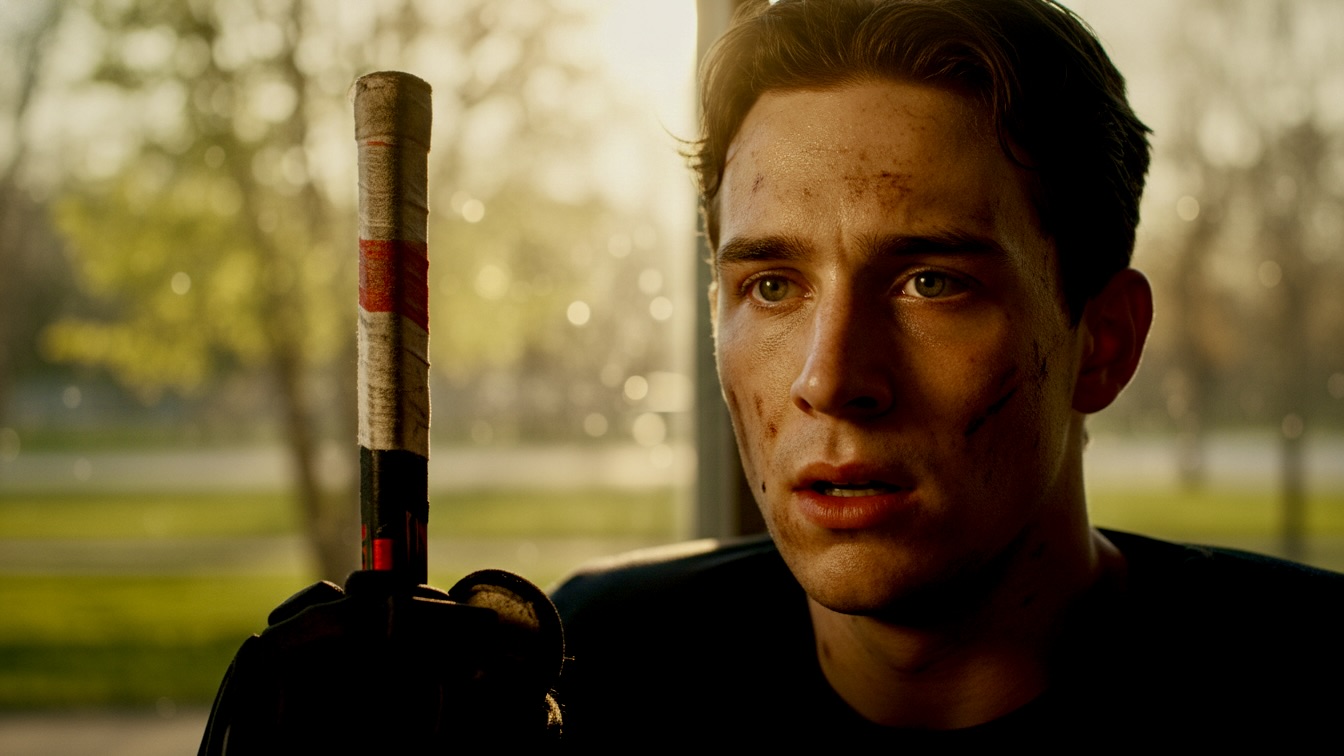
The narrative begins in the bleak, thawing landscape of Red Lake, Northern Ontario, where nineteen-year-old Willy observes a local ice-fishing derby with a sense of profound detachment and resentment. Having isolated himself from his friends Stan and Nina following his father’s death, Willy is trapped in a state of emotional stasis that mirrors the rotting, slushy environment around him. This mundane misery is shattered when a translucent, bioluminescent parasite emerges from an ice hole and infects a local fisherman, sparking a violent and rapid outbreak.
As the infected begin to attack the crowd with mechanical, predatory precision, Willy, Stan, and Nina flee to the Oakhaven Community Arena. Inside, they reinforce the glass entrance with heavy vending machines, creating a fragile sanctuary against the growing horde outside. During this period of high tension, the strained interpersonal dynamics between the three friends surface, highlighting Willy’s history of "ghosting" those who cared for him as a maladaptive coping mechanism for his grief.
The silence of the arena is eventually broken by the sound of a crying child hidden in the bleachers. Despite the immense risk and the growing breach at the front doors, Willy chooses to abandon his habit of hiding and ventures into the dark rink to save the toddler. He successfully fends off an infected coach in a brutal confrontation and brings the boy back to the safety of the Zamboni bay.
The story concludes with the arrival of military helicopters, signaling a potential rescue as the morning light breaks. However, the hard-won relief is instantly obliterated by a horrific discovery. As Willy watches the rescued child sleep, he notices the telltale green glow of the parasite pulsing beneath the boy's skin, suggesting that their sanctuary has been compromised from within and their struggle may have been in vain.
A central theme of the story is the concept of rot, both environmental and internal. The author opens with a vivid description of the Northern Ontario spring not as a time of rebirth, but as a season of decay where the snow collapses into "heavy, gray puddles." This physical setting serves as a powerful metaphor for Willy’s psychological state. He is mired in the aftermath of his father's death, unable to move forward, and his self-imposed isolation acts as a form of emotional rot that threatens to consume his youth and his relationships.
The narrative also explores the transition from passivity to agency. At the start of the chapter, Willy is a spectator of his own life, watching the world through a lens of hatred and exhaustion. The arrival of the parasite forces a literal and metaphorical "unfreezing" of his character. By choosing to save the child, he rejects the "coward" within him that desires to disappear. This shift from the person who ignores texts to the person who wields a weapon to protect others represents a desperate attempt at redemption and reconnection with the living world.
Finally, the story interrogates the futility of barricades. The characters spend a significant amount of time and physical effort securing the arena, believing that steel doors and heavy machinery can keep the horror at bay. However, the ending suggests that the most dangerous threats are those that are invited in through empathy or overlooked in the chaos. The "barricade" of the title refers not just to the vending machines at the door, but to the emotional walls Willy built around himself, both of which prove to be tragically porous.
Willy is a young man defined by avoidant attachment and complicated grief. The heavy "gravel" he feels in his stomach is a somatic manifestation of his repressed emotions, a weight he has carried since his father’s funeral. His decision to stop replying to his friends was not an act of malice, but a defensive retreat into the safety of invisibility. He finds it easier to exist in a vacuum than to navigate the vulnerability required to maintain human connections during a period of intense personal loss.
Psychologically, Willy’s journey in this chapter is one of forced re-engagement. The external threat of the parasite acts as a catalyst that overrides his internal paralysis. When he hears the child crying, he experiences a moment of profound moral clarity that outweighs his instinct for self-preservation. By stepping onto the ice, he is symbolically confronting the "cold" that has defined his life for the past eight months. His victory over Coach Peters is a visceral rejection of his former passivity, though the final twist serves as a cruel irony that punishes his first act of genuine selflessness.
Stan serves as the pragmatic and grounded foil to Willy’s internalised turmoil. He is described as having lost the "easy, arrogant smile" of his high school years, suggesting that the harsh realities of life in a dying town have already begun to harden him. Unlike Willy, who hides, Stan is proactive and vocal, taking charge of the immediate physical survival of the group. He represents the life Willy abandoned, and his confrontation with Willy about the ignored phone calls highlights the lingering hurt caused by Willy's isolation.
Despite his frustration with Willy’s disappearance, Stan’s willingness to wait at the door of the Zamboni bay shows a deep-seated loyalty. He is a character of action who values tangible presence over apologies. His "hard, tight line" of a mouth reflects a man who has accepted the grim nature of their reality and is prepared to do the heavy lifting required to survive. He provides the necessary physical support that allows Willy to find his own courage, acting as an anchor for the group’s collective effort.
Nina is characterized by her high level of situational awareness and her focus on long-term survival. She is the one who recognizes the inadequacy of the front door locks and suggests the move to the Zamboni bay. Her anxiety is visible through her "shaking hands" and "white knuckles," yet she remains functional, contributing to the construction of weapons and the fortification of their position. She acts as the emotional mediator between Stan and Willy, sensing that their current predicament is not the time for litigating past grievances.
Her reaction to the child’s presence is initially one of caution, reflecting a survivalist mindset that views any deviation from the plan as a threat. However, once the child is brought into their circle, her maternal or nurturing instincts take over as she wraps him in a blanket. She represents the fragile hope of the group, the part of them that still believes in a future worth protecting. Her presence rounds out the trio, providing a balance of strategic thinking and quiet empathy that keeps the group cohesive under pressure.
The pacing of the story is masterfully handled, beginning with a sluggish, atmospheric dread that mirrors the "rot" of the town before accelerating into a frantic, high-stakes survival horror. The author uses short, punchy sentences during the action sequences to convey the suddenness of the violence and the fragmentation of the characters' panic. This contrast between the slow, heavy descriptions of the slush and the "jagged sound" of the outbreak creates a sensory experience that keeps the reader off-balance.
Sensory details are used with clinical precision to ground the supernatural elements of the story in a gritty reality. The smell of "dead weeds and two-stroke exhaust" and the "ammonia, stale popcorn, and old rubber" of the rink provide a visceral backdrop that makes the pale, glowing parasites feel even more alien. The use of sound—the "wet slapping" of boots, the "chugging" of generators, and the "tearing sound" of sock tape—heightens the tension, turning a familiar community setting into a claustrophobic soundscape of terror.
The narrative voice is intimate yet bleak, filtered through Willy’s cynical and traumatized perspective. The author avoids flowery prose in favor of a raw, direct style that emphasizes the physical toll of the events. Descriptions of the infected are particularly effective because they focus on the "wrongness" of their movements and the "mechanical" nature of their transformation. This stylistic choice reinforces the theme of the loss of humanity, as the townspeople Willy once knew are reduced to biological vectors driven by a mindless, glowing force.


