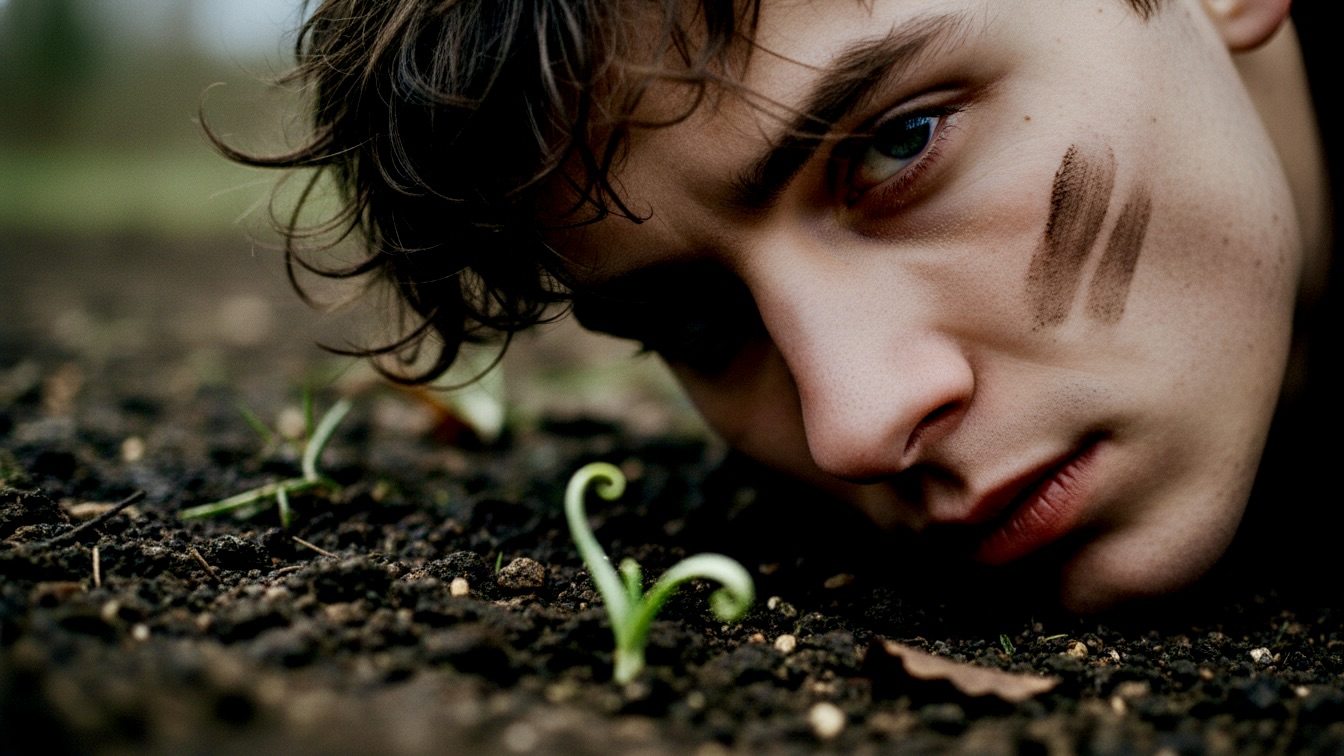
Jack faces the gray reality of a winter thaw, where growth is invisible and the screen still calls.
The phone was a warm brick in his palm. It had been four hours. Four hours of watching people in Los Angeles eat expensive toast and talk about their morning routines.
Jack’s own morning routine involved staring at a water stain on his ceiling until his eyes burned. He felt like a ghost haunting his own studio apartment. The air tasted like stale coffee and laundry he’d forgotten to move to the dryer two days ago. It was that specific kind of winter depression where the walls seem to move in an inch every time you blink. He looked at his thumb. It was hovering over a notification. Someone he hadn't spoken to since high school was getting married. Again.
He threw the phone onto the pile of gray hoodies on his bed. He needed to leave. If he stayed in this room for another twenty minutes, he was pretty sure he would actually dissolve into the mattress.
Outside, the world was a mess. A freak warm front had rolled in, turning the neat white snow into a toxic-looking gray slush. It wasn't spring. It was just a temporary lapse in the freeze, a wet, heavy pause that made everything look worse. The sky was the color of a wet sidewalk. Jack walked toward the community garden, his sneakers soaking through within three blocks. The cold water hit his socks and sent a sharp, electric jolt up his spine. It was the first thing he’d felt all day that wasn't filtered through a screen.
The garden looked like a crime scene. The straw they’d laid down a month ago was matted and dark, soaked with meltwater. There were no sprouts. No green. Just mud and the skeletal remains of last year’s failures. Jack stood by the gate, his hands shoved deep into his pockets. He felt a sudden, sharp wave of resentment. He’d done the work. He’d dug the holes. He’d felt that weird, brief moment of clarity in the cold. And for what? The ground looked exactly the same. It looked dead.
"You look like you're waiting for a bus that isn't coming," a voice rasped.
Mrs. Linder was by the tool shed. She was wearing a neon yellow rain slicker that made her look like a very small, very angry crossing guard. She was hacking at a pile of frozen compost with a pitchfork.
"It’s all mud," Jack said. He didn't mean to sound so whiny, but it came out that way. "The garlic. Nothing’s happening."
Mrs. Linder stopped hacking and leaned on the pitchfork. She looked at him with that same flat, unimpressed stare. "Did you expect it to throw a parade? It’s February, Jack. The sun is up for about eight minutes a day. Give it a rest."
"I just thought... I don't know. I thought I'd see something. A sign or whatever."
"A sign," she repeated. She let out a short, dry laugh. "You kids. You want a progress bar for everything. You want a little 'loading' icon to tell you you're not wasting your time. There’s no UI out here. There’s just the dirt."
Jack kicked at a lump of slush. "It feels like I’m just standing in a puddle. I could be at home. I have things to do."
"Like what? Checking your 'reach'?" She made air quotes with her free hand. "I saw you through the fence earlier. You were staring at that rectangle like it was the burning bush. You’ve been here five minutes and you’re already twitching."
Jack felt his face heat up. It wasn't just the cold. She was right. His pocket felt heavy. He could feel the phantom vibration of a text that probably wasn't even there. He was addicted to the noise. The garden was too quiet. The silence was a physical weight, a vacuum that his brain was trying to fill with digital junk.
"It’s hard," he muttered. "The quiet. It makes me think about stuff I don't want to think about."
"Good," Mrs. Linder said. She walked over to the row where they’d planted the garlic. She knelt down, her joints popping like bubble wrap. "Get down here."
Jack hesitated, looking at his wet sneakers. Then he sighed and knelt next to her. The mud soaked into his jeans instantly. It was cold and gross, but as he leaned forward, he caught a scent. It wasn't the smell of rot or exhaust. It was something sharp. Pungent. Earthy.
"Smell that?" she asked.
"Mud?"
"Life," she corrected. "The microbes are waking up. The thaw isn't for you, Jack. It’s for them. The water carries the nutrients down to the roots. It’s the delivery system. Just because you can’t see the green doesn’t mean the work isn’t being done."
She reached out and brushed away a layer of matted straw. The ground underneath was dark and glistening. She dug her fingers in, just an inch.
"Look."
Jack leaned in. He saw a tiny, pale nub. It wasn't green yet. It was a ghostly, yellowish white, barely the size of a fingernail. It looked incredibly fragile, surrounded by the heavy, oppressive weight of the wet earth.
"Is that it?" he whispered.
"That’s the push," she said. "It’s been working on that for three weeks. Fighting the frost. Pushing against the weight of the soil. It doesn't have an audience. It doesn't get a 'like' for effort. It just does it because that’s the only way to survive."
Jack stared at the tiny sprout. He felt a weird, tight sensation in his throat. It was so small. The world was so big and cold and loud, and this tiny, pale thing was just... existing. It was trying. It didn't care about the news cycle or the rent or the fact that Jack felt like a failure. It was just doing the one thing it was built to do.
"Don't touch it," Mrs. Linder warned. "It’s still soft. Just look."
Jack looked. He stayed there for a long time, kneeling in the mud, his wet jeans clinging to his skin. The
“He realized the silence wasn't empty anymore; it was full of the sound of something fighting to breathe.”