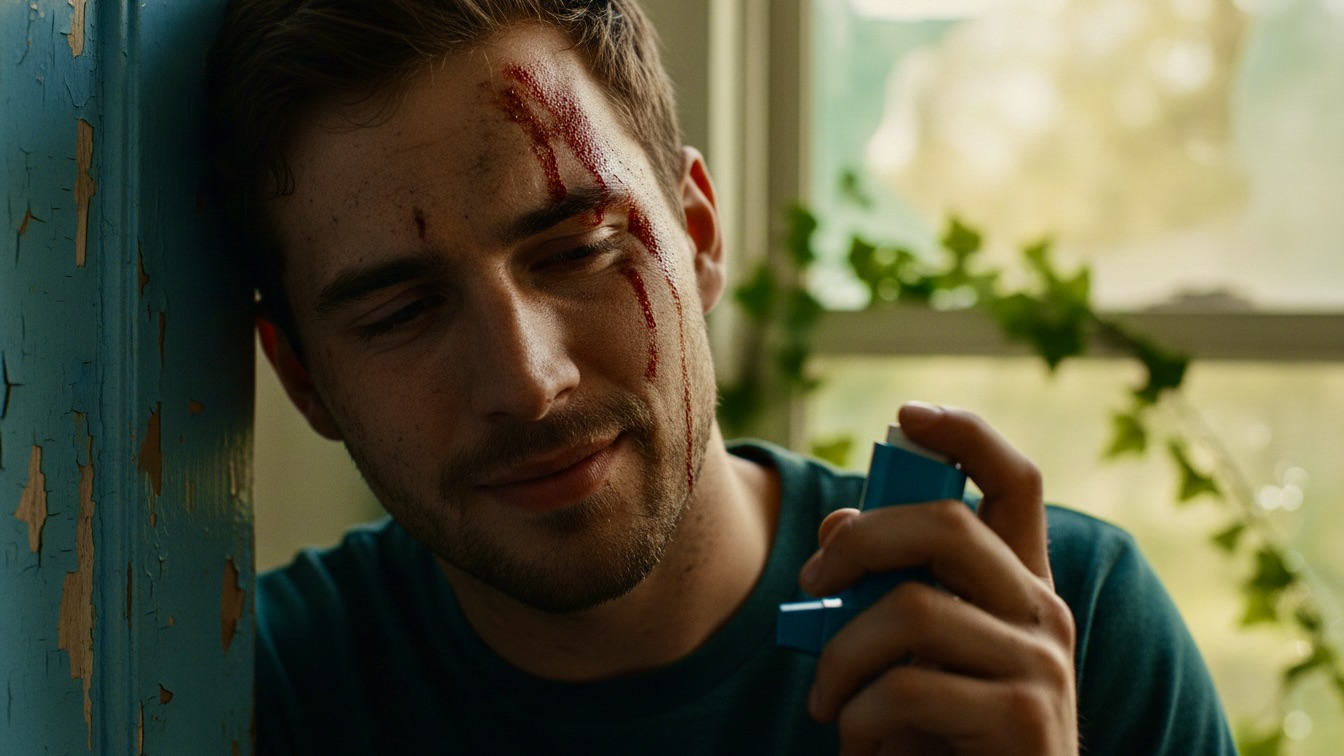
The narrative follows Kenny, a young man navigating a decaying post-apocalyptic city to secure life-saving medication for his younger brother, Tyler. In a world where spring has become a suffocating season of toxic pollen and overgrowth, Kenny visits an underground clinic to trade his last remaining valuables for three Albuterol inhalers. The journey back to his home is a gauntlet of lethal obstacles, beginning with a violent confrontation with desperate scavengers in an alleyway. After seizing a motorcycle, Kenny is pursued by a heavily armed patrol belonging to a local warlord named Silas.
The chase culminates in a high-stakes sequence through a ruined shopping mall, where Kenny suffers a traumatic crash that results in several broken ribs. Despite the agonizing pain and the pursuit of the patrol, he manages to scale a massive quarantine fence to reach his own derelict sector. He arrives at the apartment just as Tyler is succumbing to a severe asthma attack, successfully administering the medication. While the immediate crisis is averted, the story concludes with the grim realization that Kenny has traded all their food for a mere three days of breath.
The central theme of the story is the perversion of nature and the concept of "rebirth" as a destructive force. Typically, spring is associated with life and renewal, but in this broken urban landscape, it is described as a parasite and a "different kind of rot." The pollen acts as a biological weapon, turning the natural cycle of the earth into a death sentence for the vulnerable. This inversion suggests that when human infrastructure fails, nature does not simply return to a peaceful state; instead, it aggressively reclaims the world in a way that is hostile to human biology.
Another prominent theme is the mechanical failure of the human body and its dependence on dwindling technology. Kenny views Tyler’s asthma not as a medical condition, but as a "manufacturing error" and a "mechanical failure." This dehumanizing language reflects a world where life is no longer sacred, but is instead a series of resource-heavy systems that require specific "override codes" to function. The blue plastic of the inhaler represents the final, fragile tether between humanity and the industrial age that once protected it.
The narrative also explores the brutal mathematics of survival and the futility of sacrifice. Kenny undergoes immense physical and psychological trauma, trading his safety, his health, and his food supply for a very brief extension of his brother's life. The "simple, brutal equation" he mentions early on becomes a haunting reality by the end of the chapter. Every victory in this environment is pyrrhic, as solving one problem—suffocation—immediately triggers another—starvation. The story suggests that in a collapsed society, the cost of love is an unsustainable debt.
Kenny functions as a protector who has been forced to adopt a persona of emotional detachment to survive. He describes himself as a "ghost," a psychological defense mechanism that allows him to move through a violent world without the burden of fear or hesitation. When faced with a threat, he experiences "cognitive static," a state of hyper-arousal where rational thought is replaced by pure, lethal instinct. This suggests that Kenny has been deeply traumatized by the collapse, leading to a form of functional dissociation that keeps him alive but isolated.
His internal conflict is rooted in the "weight of consequence" he carries regarding his brother’s life. He views Tyler's survival as his sole mission, yet he is acutely aware of the impossibility of his task. His decision to trade food for medicine demonstrates a desperate, short-term focus necessitated by the immediate threat of Tyler’s death. Psychologically, Kenny is a man living on borrowed time, using his own body as a shield and a tool until it inevitably breaks under the pressure of the "brutal math" he constantly calculates.
Tyler represents the extreme vulnerability of the post-collapse generation. He is described as brave, yet his physical reality is one of constant, looming terror. His dependence on Kenny is absolute, creating a relationship where his very breath is a commodity provided by his older brother. Tyler’s perspective is limited by his illness, making his world small and focused entirely on the mechanical act of respiration.
Despite his physical weakness, Tyler possesses a keen sense of awareness regarding the cost of his survival. When he notices Kenny’s injuries and the empty food shelves, he immediately recognizes the sacrifice made on his behalf. This awareness likely contributes to a sense of guilt or burden, as he watches his protector slowly disintegrate to keep him breathing. He is the heartbeat of the story, but he is also the anchor that keeps Kenny tethered to a dying world.
The pacing of the chapter is masterfully handled, transitioning from the stagnant, claustrophobic atmosphere of the clinic to the frantic, high-octane energy of the chase. The author uses short, punchy sentences during the action sequences to mimic Kenny’s spiked heart rate and the "cognitive static" he feels. This creates a visceral experience for the reader, where the physical toll of the journey is felt through the rhythm of the prose. The shift back to a slow, agonizing crawl during the final ascent to the apartment emphasizes the exhaustion and the "cold, crushing" reality of the aftermath.
Sensory details are used to ground the post-apocalyptic setting in a repulsive, tangible reality. The "yellow, suffocating dust" of the pollen, the "wet, hard crunch" of the brick hitting bone, and the "sickening snap" of the broken rib provide a gritty texture to the narrative. These details move beyond mere world-building; they serve to highlight the fragility of the human form against the jagged edges of a ruined civilization. The contrast between the "violently blue" sky and the "cracked asphalt" beneath Kenny reinforces the theme of a world that has become indifferent to human suffering.
The narrative voice is a stark, first-person perspective that reflects Kenny’s pragmatic and fatalistic worldview. He speaks of blood, bullets, and medicine with the same clinical detachment, showing how the extremity of his environment has flattened his emotional range. This voice is effective because it avoids melodrama, allowing the inherent horror of the situation to speak for itself. The final image of the empty peach can serves as a powerful silent beat, punctuating the chapter with a sense of inevitable doom that no amount of bravery can overcome.


