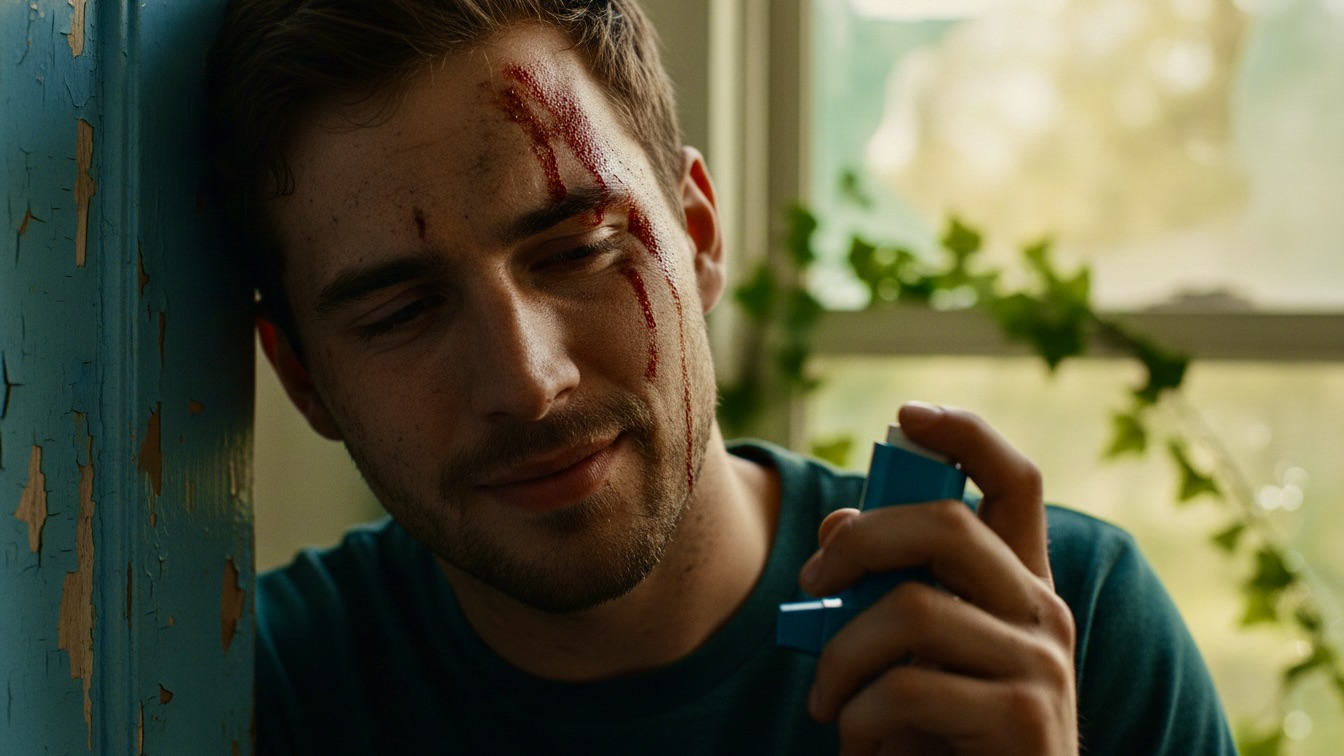
Format: Short Film / Anthology Episode | Est. Length: 10-12 minutes
Imagine this story as a visceral, high-tension installment of a prestige anthology series where the "quiet apocalypse" is rendered in suffocating detail. This episode serves as a standalone descent into a world where nature has become a predatory force, inviting the audience to experience the claustrophobic reality of a courier whose every breath is a calculated risk against a ticking clock.
"Burner Phone Runners" is an episode within The Overgrowth, an anthology series set in a post-service society where urban decay has been accelerated by hyper-aggressive flora. The series follows various "Runners"—specialized couriers who navigate the fractured territories of warlords to deliver pre-collapse relics and life-saving supplies. While each episode features a new protagonist, the overarching narrative explores the slow death of the city’s infrastructure and the rise of feudal "Wards" that control the remaining pockets of habitable space.
In a city where spring pollen has become a toxic death sentence, a lone courier must survive a gauntlet of paramilitary patrols and a catastrophic injury to deliver a single inhaler to his suffocating brother.
A desperate courier must cross three hostile territories to deliver life-saving medicine to his brother before the spring pollen shuts his lungs forever. With every breath a struggle and every step a target, he discovers that survival is a brutal mathematical equation with no margin for error.
The primary theme is the irony of nature; spring, traditionally a symbol of rebirth and life, is depicted as a parasitic rot that brings death to the vulnerable and chokes the remnants of civilization. It highlights the "Season of Overgrowth" as a period of extreme danger, where the beauty of blooming vines and yellow dust serves as a literal and metaphorical shroud for the dying city.
The second theme explores the "Cost of Care," focusing on the impossible trades—food for medicine, blood for time—that define family bonds in a lawless world. Kenny’s journey illustrates that in a post-collapse society, love is not expressed through words but through the physical endurance of agony and the willingness to sacrifice one's own safety for the survival of another.
The stakes are binary and immediate: the life or death of Kenny’s younger brother, Tyler. If Kenny fails to return with the unexpired Albuterol, Tyler will suffocate in their living room, leaving Kenny alone in a predatory world where family is the only remaining currency. Beyond the immediate threat, the loss of the inhalers would mean the loss of their last three days of stability, forcing an unprepared exodus into the even more dangerous wilderness beyond the city.
External conflict is driven by the Iron Ward’s paramilitary patrols, led by the warlord Silas, who view any unauthorized transit as a provocation punishable by death. Internal conflict stems from Kenny’s "cognitive static," a psychological state where his rational fear battles his primal survival instinct, forcing him to commit acts of sudden, jarring violence. These forces are compounded by the environment itself, as the broken geography of the city and the suffocating pollen act as constant, passive antagonists.
Kenny, a hardened courier in a post-collapse city, meets with a disgraced veterinarian to trade his final valuables—dented peaches and ammunition—for three unexpired inhalers. His younger brother, Tyler, suffers from a terminal respiratory condition exacerbated by the "yellow rot" of spring pollen, making the medicine a literal lifeline. Warned that the streets are "bleeding" with patrols from the Iron Ward, Kenny attempts a stealthy return to his quarantined sector, but he is quickly intercepted by desperate junkies and forced into a violent confrontation.
After hijacking a dirt bike and leading a high-speed chase through a hollowed-out shopping mall, Kenny suffers a catastrophic crash that leaves him with broken ribs and a punctured leg. He narrowly escapes a paramilitary patrol by scaling a razor-wire fence, limping through the silent, dead streets of his home sector in a race against Tyler’s failing lungs. He arrives just in time to administer the medicine, but the victory is hollow; he realizes they have traded their last food for three days of breath, necessitating a final, desperate flight from the city.
Kenny (Protagonist): A stoic survivor whose identity is entirely subsumed by his role as Tyler’s protector. He begins the story as a "ghost" attempting to move through the world without a footprint, but the journey forces him to transition into a wounded warrior who accepts the brutal, bloody math of survival. His psychological arc is one of grim realization, moving from the hope of a "safe transit" to the cold understanding that their time in the city has officially expired.
Tyler (Supporting): Kenny’s younger brother, whose physical fragility represents the last vestige of the pre-collapse world’s vulnerability. He is brave but physically failing, viewing his asthma as a "manufacturing error" rather than a death sentence to spare Kenny the guilt of his burden. His arc is passive but vital, serving as the emotional anchor that justifies Kenny’s descent into violence and his endurance of extreme physical pain.
The Trade: Kenny meets Dr. Hayes in a bleach-scented basement to exchange ammunition and food for three precious inhalers while the doctor warns him that the "streets are bleeding" today. He packs the medicine into a faulty backpack, acknowledging that any error in the upcoming journey will result in Tyler’s death. The scene establishes the high stakes and the "mechanical failure" of the human body that the blue plastic inhalers are designed to override.
The Alley Ambush: While navigating the yellow, pollen-thick ruins, Kenny is cornered by two desperate junkies who demand his bag as a "toll" for crossing their territory. He attempts to de-escalate but is forced into a brutal counter-attack, using a brick to shatter the jaw of one assailant before hijacking their dirt bike. The roar of the modified engine alerts every patrol in the area, turning his stealth mission into a loud, high-stakes flight through the Iron Ward.
The Galleria Chase: A paramilitary truck with a mounted machine gun spots Kenny and pursues him into the hollowed-out remains of a massive shopping mall. He weaves through the debris of consumerism while bullets tear through marble pillars, eventually attempting a desperate descent down a stalled escalator to lose his pursuers. The bike wipes out at the bottom, crashing into Kenny and snapping his ribs, leaving him pinned and bleeding while the patrol closes in on his position.
The Fence and the Final Mile: Despite the agony of his broken ribs, Kenny drags himself from the wreckage and limps toward the twelve-foot quarantine fence that separates him from his home. He scales the chainlink under fire, tearing his flesh on razor wire before dropping into the relative safety of his own dead, scavenger-picked sector. The final three blocks are a "death march" where he battles blacking out, driven solely by the rhythmic, distant sound of his brother’s wheezing echoing in his mind.
The Breath of Life: Kenny breaks into the darkened apartment to find Tyler blue-lipped and dying on the couch, his lungs completely clamped shut by the pollen. He fights a jammed zipper to retrieve the inhaler and administers the life-saving mist just as Tyler’s vision begins to fade. As the boy’s breathing stabilizes, Kenny looks at their empty pantry and realizes the medicine has only bought them three days of survival before they must flee the city forever.
The episode begins with a cold, clinical tension that explodes into frantic, high-octane terror during the mall chase. The climax shifts into a visceral, agonizing crawl, emphasizing the physical weight of Kenny’s injuries to create a sense of grueling endurance. The resolution offers a bittersweet note of relief that is immediately undercut by a sense of impending doom, leaving the audience with a feeling of "borrowed time."
If expanded, the season would follow Kenny and Tyler’s journey out of the city toward a rumored "Clean Zone" in the mountains where the pollen cannot reach. Each episode would focus on a different "Runner" or survivor they encounter, building a larger narrative about the collapse of the water systems and the rise of Silas as a regional dictator.
The thematic escalation would move from individual survival to the possibility of community, as Kenny is forced to decide whether to help other "defective" survivors or maintain his singular focus on Tyler. The season would conclude with the brothers reaching the edge of the city, only to realize that the "Overgrowth" is not a local phenomenon but a global shift that requires a new way of living.
The visual style is "Overgrown Industrial," utilizing high-contrast lighting to emphasize the bright, sickly yellow of the pollen against the dark, damp shadows of the ruins. The camera work should be handheld and intimate during the "static" moments of violence, shifting to wide, sweeping shots of the nature-reclaimed city to emphasize the scale of the environment.
Tonal influences include the visceral survivalism of Children of Men and the desolate, nature-reclaimed aesthetics of The Last of Us. The sound design is critical, featuring a constant, low-frequency hum (the cognitive static) and the rhythmic, terrifying sound of labored breathing to maintain a sense of physiological anxiety.
The target audience consists of adults and older teens (16+) who gravitate toward post-apocalyptic thrillers and character-driven survival dramas. It appeals to viewers who appreciate high-stakes, grounded science fiction that focuses on human endurance and the breakdown of social contracts rather than traditional "zombie" or "action" tropes.
The pacing follows a "pressure cooker" structure, starting with a slow, methodical trade before accelerating into a relentless, high-tempo chase through the mall. The final act slows down significantly to a "death march" pace, using long, agonizing takes to emphasize the physical toll on the protagonist. The 10-12 minute runtime ensures that the tension never dissipates, providing a lean, punchy narrative experience.
The motorcycle crash and escalator slide require a combination of practical stunt work and clever camera angles to maximize the impact without a massive budget. The "yellow pollen" effect can be achieved through a mix of practical dust/smoke and post-production color grading to make the environment feel truly suffocating and alien.
Special attention must be paid to the "Iron Ward" set design, using reclaimed materials and welded steel to differentiate it from the "Neutral Zone." The use of a real, abandoned mall or industrial site would be ideal to capture the scale of the "Galleria" sequence, providing the necessary architectural decay to ground the story in reality.


