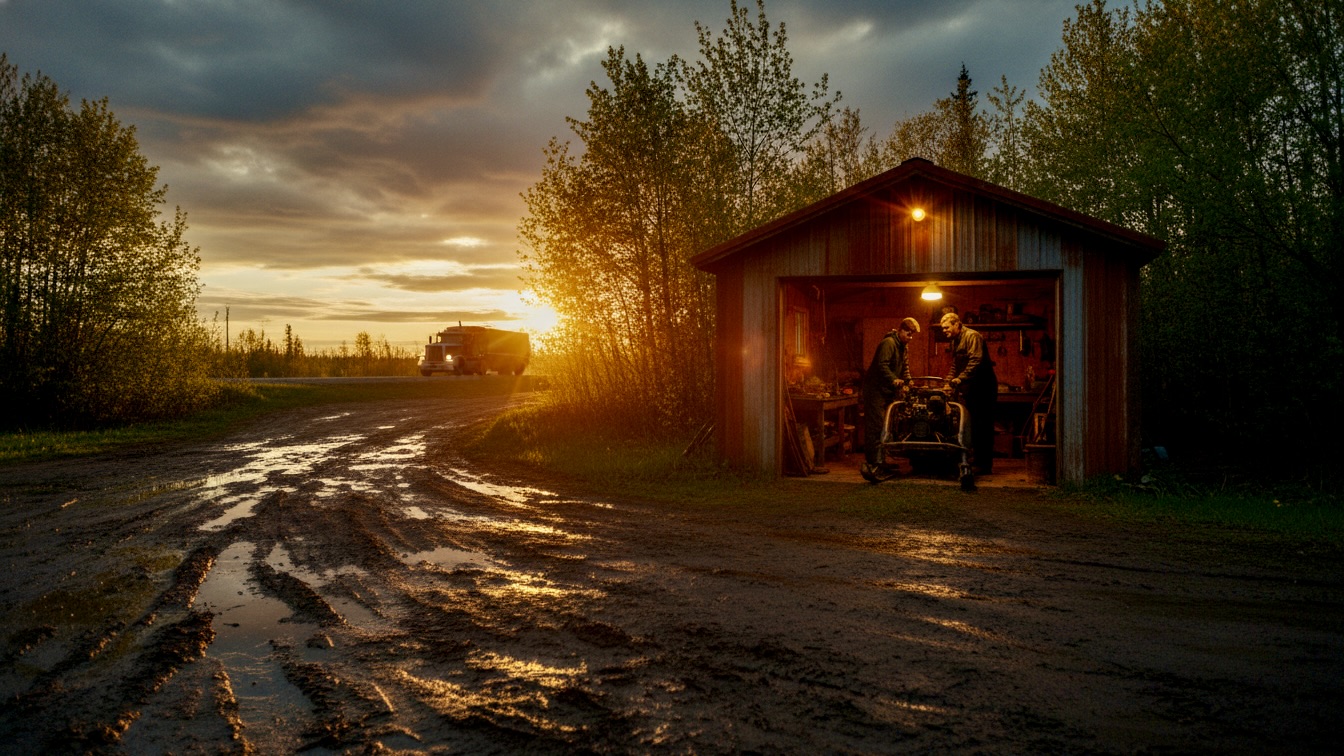
Sam and Uncle Miller debate the dangers of a nuclear waste repository while the spring mud swallows the town.
The light in the garage was dying, turning from a weak yellow to a flat, bruised grey. Outside, the spring thaw was doing its worst. The driveway was a soup of brown mud and bits of gravel that had been pushed aside by the plow months ago. Everything smelled like wet dirt and old gas. Uncle Miller was hunched over the engine of a 2018 Ski-Doo, his knuckles stained a permanent, oily black. He wasn't moving. He was just staring at a missing bolt. On the pegboard, there were several empty hooks where tools used to hang. The big pipe wrench was gone. The torque wrench was gone. Each empty space felt like a small hole in the room.
Sam sat on a plastic milk crate, swinging his legs. He was eleven, and his boots were still caked in the thick, clay-heavy mud from the walk over from Borups Corners. He held a glossy pamphlet he’d picked up at the post office. It had pictures of happy people in hard hats and very blue water. The words on the front were big and friendly. Sam didn't trust them. The world felt too big today, and the pamphlet felt too light, like it might blow away and take the truth with it.
"So, they’re burying the glowing trash?" Sam asked. He kicked a loose nut across the concrete. It skittered and hid under a workbench covered in rusted coffee cans.
Miller didn't look up. "It doesn't glow, Sam. That’s for movies. It’s just heavy. And hot. And it stays that way longer than you’ll be alive. Longer than this garage will be standing. Probably longer than the trees out back."
"The paper says it’s safe," Sam said, pointing at a bullet point. "It says they use 'international best practices.' That sounds like they’re the best at it, right?"
Miller finally stood up, his back popping with a sound like a dry branch snapping. He wiped his hands on a rag that was more grease than cloth. "'Best practices' is just corporate-speak for 'we’re doing what everyone else does so you can't sue us personally.' It’s fluff, kid. It’s like when your teacher says you have 'potential' instead of saying you’re failing math."
Sam flipped the page. The paper felt slick and expensive under his thumb. "It says here they use something called ALARA. As Low As Reasonably Achievable. What’s that? Is that like a grade?"
Miller let out a short, dry laugh. He leaned against the workbench, looking out the window at the darkening bush. The Revell site was out there, somewhere past the screen of birch and pine. "ALARA is a trick. It’s a word game. Imagine I tell you to clean this garage as well as 'reasonably' possible. You’d sweep the middle, maybe move a box or two. But if I told you to make it 'spotless,' you’d be here all night scrubbing the oil off the floor with a toothbrush."
"I wouldn't do that," Sam said, grinning.
"Exactly," Miller said, his voice sharpening. "The 'Reasonable' part is the escape hatch. If it costs too much money to keep the radiation out of the creek, they’ll just say it wasn't 'reasonable' to spend that much. They balance our water against their bank account. And guess who usually wins that fight?"
Sam looked at the pamphlet again. The blue water in the photo didn't look like the water in the creek. The creek was brown and fast right now, carrying sticks and dead grass. "But they have a 'Safety Case.' The man at the booth said it’s a total plan."
"A safety case isn't a conversation, Sam. It’s a lecture. They show up with a thousand pages of math and say, 'Look, we solved it.' But they didn't ask us what the problems were. They didn't ask about the snowmobile trails or the way the deer move through the Revell bush in the spring. They just decided what was a 'reasonable' risk for us from an office in Toronto. I don't know about you, but I don't like people in skyscrapers deciding how much 'extra' radiation my morning coffee should have."
"I want zero," Sam said firmly. "Why can't they just say 'Zero Discharge'? That’s a better word. Zero is easy to count."
"Zero is expensive," Miller replied. He picked up a screwdriver and started scraping at a chunk of dried mud on the engine block. "Zero means they have to be perfect. And nobody likes being told they have to be perfect. They’d rather have 'limits.' Limits are just permissions to leak a little bit."
Sam stood up and walked to the window. The light was almost gone now. The trees looked like jagged black teeth against the sky. "If they build the big fence, can we still go to the Dyment Recreation Hall? I like the pancakes there. And the air hockey table that only works if you kick the side."
Miller’s face softened, but only a little. The skin around his eyes crinkled. "The hall is going to be surrounded by trucks, kid. Big ones. Carrying stuff you don't want to get stuck behind in traffic. They talk about 'economic benefits,' but they don't talk about the noise. Or the dust. Or the fact that 'home' starts to feel like a construction zone. That hall is where we have birthdays and funerals. It’s not a 'socio-economic asset.' It’s just ours."
"We should tell them," Sam said. "We should tell them we need our own monitor. Like a scoreboard. Right in the middle of town. If the numbers go up, the scoreboard shows it. In red letters. Big ones."
"A community-led monitoring station," Miller nodded, sounding impressed. "That’s actually in the government report. The IAAC—those are the big bosses—they said the same thing. People don't trust the fox to guard the henhouse. If the nuclear program is doing the monitoring, they’re always going to say everything is fine. We need our own eyes on the ground. Right here in Dyment."
Sam felt a small spark of something. Not quite hope, but a sense that the world wasn't just happening to them. They could talk back. "And the trails? The ones where we saw the lynx last year?"
"They’ll try to close them," Miller said. "Safety zones. Exclusion areas. More fancy words for 'Stay Out.' We’d need a 'land-for-land' deal. If they take an acre of our bush, they better give us an acre somewhere else that’s just as good. No shortcuts."
"And they have to fix the air hockey table," Sam added.
"Naturally," Miller agreed. "That’s a non-negotiable."
They stood in silence for a moment. The only sound was the steady drip of snow melting off the roof and hitting the mud below. It sounded like a clock ticking. The garage felt smaller now, the shadows stretching from the corners to touch their boots. Sam looked at the empty tool hooks again. He realized they weren't just missing tools; they were missing the feeling that things were staying the same.
"Is it going to happen?" Sam asked softly. "The big hole in the ground?"
Miller put his hand on Sam’s shoulder. His palm was rough and cold. "The government just put out a big list of issues. A Summary of Issues. It means they’re finally hearing the noise we’re making. It’s not a 'done deal' yet, no matter what the glossy papers say. But we have to keep being loud. We have to point at the 'reasonable' parts and tell them they aren't good enough."
"I’m good at being loud," Sam said. "Ask Mom."
"I know you are," Miller said with a ghost of a smile. "That’s why I’m telling you this. You’re going to be the one living here when the trucks start rolling. You need to know the difference between a 'safety case' and actual safety."
Sam looked down at the pamphlet. He crumpled it slowly, the thick paper resisting before finally collapsing into a ball of blue and green. He tossed it toward the trash can. It missed, landing in a puddle of oily water on the floor. The water soaked into the paper, turning the 'international best practices' into a soggy, brown mess.
"Uncle Miller?" Sam asked.
"Yeah, kid?"
"What happens if the hole leaks? Like, a thousand years from now?"
Miller looked at the dark woods, his eyes focusing on something far beyond the trees. "They say they have 'natural analogues.' They look at rocks from a million years ago to guess what happens next. But rocks don't talk. And they don't care about us. If it leaks, it’s not their problem anymore. It’s ours. That’s why we don't accept 'reasonable.' We only accept 'perfect.'"
Sam nodded. He understood perfect. A perfect cast into the river. A perfect goal in road hockey. Perfect was hard, but it was the only thing that mattered when the stakes were this high.
Suddenly, the heavy thrum of a truck engine vibrated through the floor of the garage. It wasn't a pickup. It was something much larger, shifting gears as it climbed the hill toward the Revell site. The windows rattled in their frames. A glass jar of nails on the shelf hummed. Sam felt the vibration in his teeth.
"Is that them?" Sam whispered, his eyes wide.
Miller didn't answer right away. He walked over to the garage door and pulled the chain, lowering the heavy wood until it shut out the grey light of the spring evening. The vibration didn't stop. It just got deeper, a low-frequency growl that seemed to come from the earth itself.
"That’s just the beginning," Miller said, his voice barely audible over the rumble.
Sam reached out and grabbed the edge of the workbench. The world didn't feel giant anymore. It felt like it was closing in, pressing against the walls of the garage. He thought about the creek, the fish, and the air hockey table. He thought about the word 'reasonable' and how much he hated it.
In the corner of the garage, a single red light on a battery charger began to blink, casting a rhythmic, pulsing glow against the dark metal of the snowmobile.
“The vibration under Sam’s feet grew stronger, and for the first time, he realized the ground wasn't just shaking—it was shifting.”


