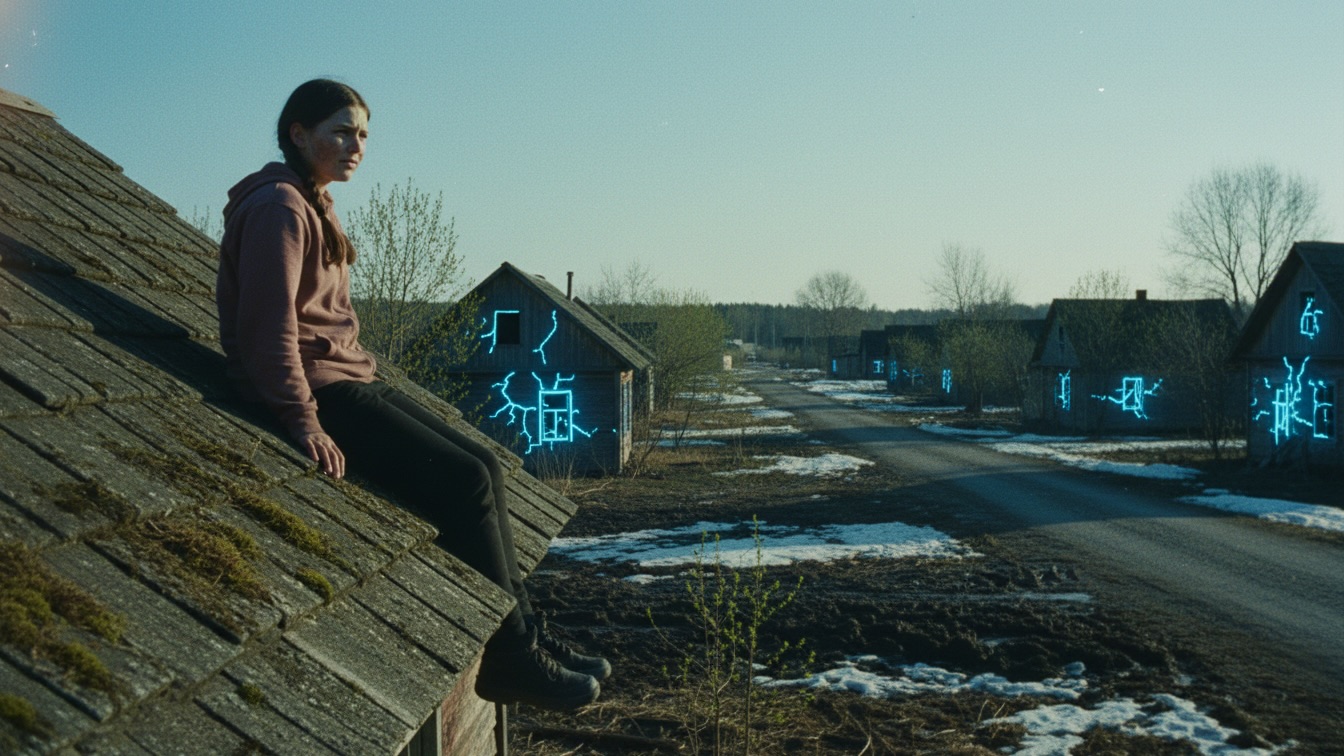
Stella discovers that the toxic black mold in her bedroom responds to the hyper-pop frequencies on her cracked smartphone.
The dampness doesn't just sit in the air. It lives in the floorboards. It eats the drywall. In Northwestern Ontario, spring isn't a postcard of blooming tulips. It’s a muddy, gray sludge that smells like wet dog and old rot. I sat on my bed, staring at the corner of my closet. The black mold was winning. It had grown three inches since Tuesday. It looked like a map of a country no one wanted to visit. My lungs felt heavy. That’s the vibe when you live in a house the government forgot about thirty years ago. I picked up my phone. The screen was a spiderweb of cracks. I had to tilt it forty-five degrees just to see the notifications. Zero bars. Again. The community's Wi-Fi was a joke, a ghost that showed up once a month and left without saying goodbye.
I swiped to my music app. I needed noise. Something loud. Something that sounded like glass breaking. I hit play on a hyper-pop track that was mostly distorted bass and high-pitched synths. The beat dropped, a jagged mess of sound. I saw it. The corner of the closet didn't just look wet. It pulsed. A faint, neon blue light flickered under the surface of the black sludge. I stopped the music. The light died. I played it again. The blue came back, brighter this time, vibrating with the kick drum. It wasn't a reflection. It was coming from inside the wall. My heart did a weird little skip. This wasn't supposed to happen. Mold is supposed to be gross and toxic, not a rave in a closet.
"Stella! Get out here!" Auntie Bev’s voice cut through the music. She sounded tired. She was always tired. It was a permanent state of being on the rez. I turned off the music and the closet went dark again. I walked into the kitchen. Auntie Bev was standing by the window, watching a white SUV crawl down the gravel road. It had a government seal on the door. My stomach turned over. I knew that SUV. It meant clipboards. It meant people in suits telling us our house was a hazard while offering zero solutions on where else to go.
"Inspectors," I said. I felt the irony in my throat. They show up to tell us we’re living in filth, like we don't already know. Like we chose the mold. "Urren is back," Bev sighed. She rubbed her temples. "He’s looking for a reason to condemn the whole block this time. Go tidy your room. Make it look like... I don't know. Just hide the worst of it."
I went back to my room. I looked at the closet. The mold was sitting there, dark and ugly again. But I knew what it could do. I grabbed a bag of charcoal dust from the shed. I’d been using it for a school art project I never finished. I smeared it over the moldy patches, masking the black-on-gray mess with a matte black layer. It looked like a shadow, nothing more. If I didn't play the music, it wouldn't glow. If it didn't glow, Urren wouldn't ask questions about bio-luminescent anomalies he didn't have a form for.
Inspector Urren didn't knock. He just kind of materialized in the doorway, smelling like peppermint and expensive laundry detergent. He had a digital tablet and a face that suggested he’d rather be anywhere else. "Miss Bev," he said, not looking at her. "We’re here for the follow-up. The air quality sensors triggered a red flag last night."
"The sensors always trigger," Bev said. She was leaning against the counter, her arms crossed. "The air has been bad since 1994. You’re late."
Urren walked past her and straight to my room. I stood in the doorway, blocking the view of the closet. He pushed past me anyway. He didn't care about personal space. To him, I was just a stat in a housing report. He scanned the walls with a handheld device. It beeped. A low, annoying sound. "High spore count," he muttered. "This wall is basically a sponge for toxins. Why is it painted black here?"
"Art," I said. My voice was flat. "It's a statement on the void of government assistance."
Urren looked at me for the first time. His eyes were cold. "It's a fire hazard and a health risk, Stella. This house is being flagged for immediate evacuation. We'll have the orders by Friday." He didn't wait for a response. He just walked out, his boots clicking on the linoleum. Bev followed him out, her voice rising in an argument I’d heard a thousand times. I stayed in my room. I felt a hot flash of anger. They wanted to kick us out. To move us to some modular units in the city where we’d be even more invisible.
I pulled out my phone. I connected it to a small, battery-powered speaker. I didn't play the hyper-pop. I started experimenting. I downloaded a frequency generator app. I started at 440Hz. Nothing. 528Hz. The mold shivered. I went higher. 880Hz. The charcoal dust started to crack as the mold underneath expanded. A bright, electric blue light bled through the black soot. It was beautiful. It was terrifying. I noticed something else. My phone, which usually had no signal, suddenly showed two bars. Then three. I looked at the mold. It wasn't just glowing. It was acting like an antenna. I touched the wall. It felt warm. A low hum resonated in my fingertips.
I spent the next two days in a fever dream. I wasn't just playing music; I was tuning a living circuit. I realized the mold followed specific patterns. If I pulsed a 1.2GHz frequency through it, the signal strength in the room doubled. It was a mesh. A biological, light-emitting mesh. I called some kids from the block. We met behind the community center, near the old satellite dish that hadn't worked since the blizzard of '22. "Look at this," I told them, showing them the blue patch I’d grown on a piece of scrap drywall. I played a tone from my phone. The drywall lit up. Their faces, usually tired and bored, widened with shock.
"What is that?" Leo asked. He was fourteen and spent most of his time trying to find enough signal to watch YouTube. "Is it radioactive?"
"It's the mold from the walls," I said. "It likes the noise. And it gives us bars. Real bars. If we grow it right, we don't need the tower in town. We can have our own net."
I taught them how to 'feed' it. It wasn't food; it was resonance. I gave them the frequency files. We went from house to house, stealthy like ghosts. We found the dampest spots—the basements, the closets, the crawlspaces. We 'tuned' them. Within forty-eight hours, the whole block was secretly humming. We hid the glow with charcoal and posters, but the signal was there. For the first time in years, everyone could call, text, and stream. We were a closed loop. We were sovereign.
Then the storm hit. It wasn't a spring shower. It was a late-season gale that tore through the pines and knocked the main power line three towns over. The entire community went dark. The official cell tower went down within ten minutes. The back-up generator failed because someone had siphoned the fuel months ago. Total blackout. Except for us.
In the darkness of my room, the closet was screaming blue. It was so bright I didn't need a flashlight. My phone pinged. A message from Leo: "Mrs. Miller is having chest pains. The landlines are dead. The radio is static. What do we do?"
I looked at the blue wall. I felt the pulse of the network. It was steady. It was alive. "Use the mold-net," I typed back. "I’m routing the emergency call through the mesh. Keep your phones close to the walls."
I sat on the floor, my fingers flying over the cracked screen. I was the server. I was the switchboard. I redirected the signal from house to house, jumping the gap across the muddy yards until I reached the clinic on the edge of the rez. The nurse picked up on the third ring. Her voice was thin with panic. "How are you calling? Everything is down."
"Doesn't matter," I said. "Mrs. Miller. House 42. Heart issues. Get the oxygen."
I heard the sirens ten minutes later. They were slow, struggling through the mud, but they were coming. I went to the kitchen. Auntie Bev was sitting at the table, a single candle burning. She looked at me, then at the blue light leaking from under my bedroom door. She didn't ask. She just nodded. She knew the world was changing, even if she didn't understand the science of the rot.
I climbed out my window and onto the roof. The rain was cold, stinging my skin, but I didn't care. I looked down the street. It was a sight I’ll never forget. Through the windows of the condemned houses, through the cracks in the siding and the gaps in the roofs, a soft, protective blue light was pulsing. It was rhythmic, like a collective heartbeat. Every house on the block was glowing. We weren't a hazard. We weren't a statistic. We were a beacon. I sat there on the wet shingles, watching the blue veins of our new world hum against the dark, waiting for the sun to rise on a place they couldn't ignore anymore.
“As the sirens faded, I noticed the blue light wasn't just in the houses anymore; it was starting to spread into the roots of the trees.”


