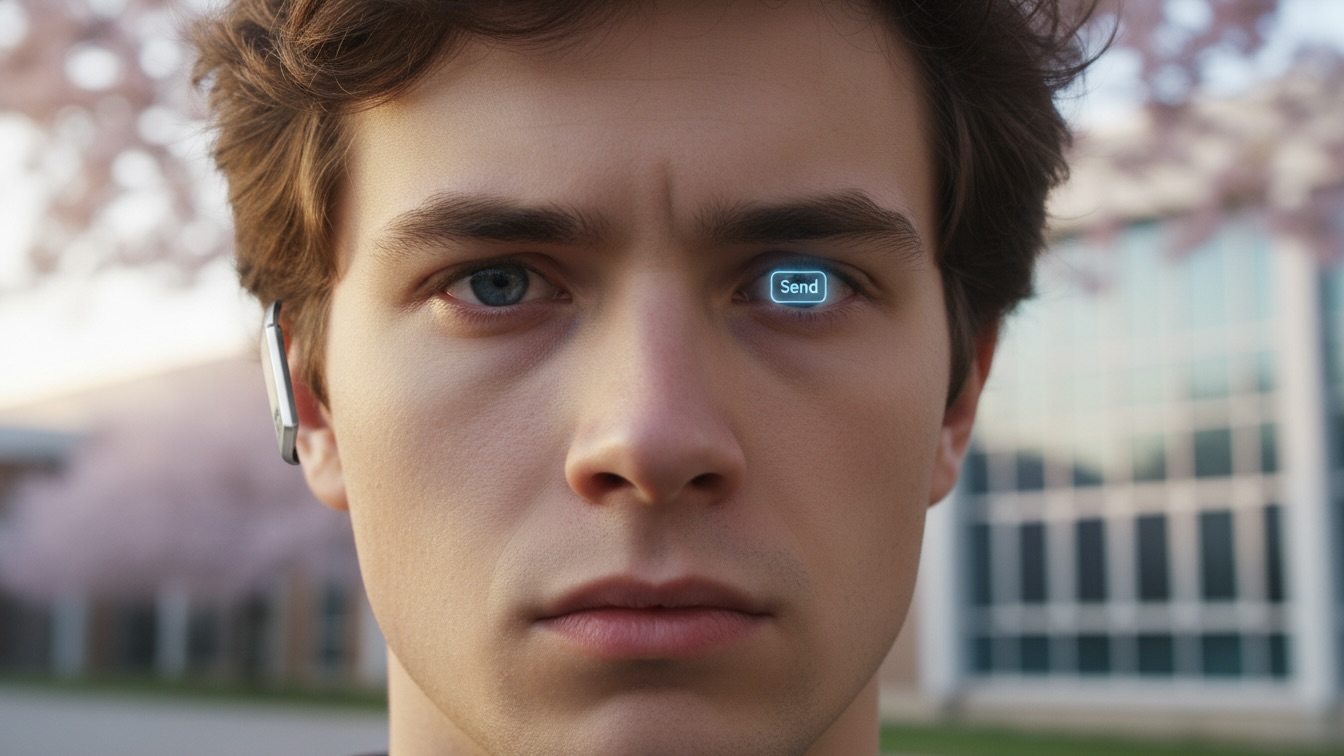
Jay faces social exile after a betrayal, discovering a dark way to reclaim his status at any cost.
The morning light did not feel like a blessing. It felt like an audit. Jay sat on the edge of his bed, the sheets tangled around his ankles like a trap. The air in the room was stale, smelling of old laundry and the metallic tang of the neural-link charger hummed on his nightstand. He reached for the interface, his thumb hovering over the cold plastic. Every morning was a gamble. You checked the numbers, and the numbers told you if you were allowed to exist. The link clicked into place behind his ear. A sharp, stinging sensation followed—the usual handshake between silicon and synapse. His vision blurred for a second, then the HUD flickered into life, overlaying the dirty beige walls of his bedroom with translucent data streams.
"Current Public Decency Score: 42.1," the system whispered into his auditory nerve. The voice was synthesized, calm, and utterly devoid of mercy. Jay felt his heart drop into his stomach. Yesterday he was an 82. He was safe. He was invited to the graduation gala at the Pier. Now, he was a ghost. A drop of forty points overnight was a death sentence. It meant he was flagged for 'Subversive Cognitive Patterns' or 'Malicious Intent.' The red notification icon pulsed in the corner of his eye, a rhythmic throb that matched the headache blooming behind his temples. He opened the logs. The search history was a nightmare of extremist manifestos and prohibited chemical formulas—none of it his. It was a plant. Someone had used a proximity ghosting tool to dump this trash onto his link while he slept.
He walked to the window. Outside, the cherry blossoms were in full bloom, pink petals drifting onto the cracked sidewalk. It was Spring, a season of renewal that Jay found deeply offensive. The world was pretending to be fresh while he was rotting from the inside out. He had to get to school. If he missed his first period, the algorithm would interpret his absence as 'Anti-Social Avoidance,' and his score would tank another ten points. He grabbed a jacket that had a tear in the sleeve he hadn't bothered to fix. In a world of perfect scores, a ripped seam was a loud statement of failure.
At the school gates, the scanners hummed. The green lights turned amber as Jay passed through. The security guard, a man whose skin looked like crumpled parchment, didn't even look up from his screen. He just tapped a baton against his thigh. Jay felt the weight of his 42.1 like a physical burden. He could see the scores of other students floating above their heads in the augmented reality layer. 94. 88. 91. They were the golden children, the ones whose thoughts were as clean as a sanitized hospital ward. Then he saw Kevin. Kevin was leaning against a locker, his score a bright, shimmering 96. He looked like he had never had a dark thought in his life.
"Explain this treachery at once," Jay said, stopping in front of him. His voice was tight, his hands balled into fists in his pockets. He didn't care about being subtle. The urgency was a fire in his throat.
Kevin looked up, a slow, lazy smile spreading across his face. "Your arrival is punctual, Jay. I expected you to be hiding under your bed, weeping over your shattered reputation."
"You did this," Jay hissed. "The ghosting tool. You dumped the manifestos into my index. Why? We were supposed to be a collective."
Kevin straightened up, his eyes cold and transactional. "A collective is only as strong as its weakest link, Jay. Your vibe was mid. Truly, it was an eyesore. I merely facilitated the inevitable decline of your social standing. Think of it as a mercy kill. You were never going to make the Tier-One cut. I just sped up the process so I wouldn't have to carry your corpse across the finish line."
"I am your friend," Jay said, the words feeling heavy and useless. He felt a bead of sweat roll down his spine. The hallway felt narrower. The air felt thinner.
"Friendship is a legacy system, Jay. It has no place in the current architecture of success," Kevin replied. He checked his watch, a sleek piece of tech that probably cost more than Jay’s entire neural-link. "Now, if you will excuse me, I have a gala to attend. You, however, have a date with the Zero-Tier outcasts in the basement. I suggest you get used to the smell of damp concrete."
Kevin walked away, his laughter a sharp, jagged sound that echoed in Jay's ears. Jay stood there, his vision swimming. He needed a way back in. He couldn't go to the basement. The Zero-Tiers were the un-people, the ones who cleaned the streets and lived in the shadows of the high-rises. He looked at his HUD. The red icon was still pulsing. He began to dig into the system settings, his fingers twitching in his pockets as he manipulated the virtual interface with his thoughts. He wasn't a coder, but desperation is a powerful teacher.
He found it in the overflow menu of his privacy settings. A backdoor exploit, left by some disgruntled developer years ago. It was a 'Data Corruption' protocol. It allowed a user to offload 'unstable data packets'—the very things lowering his score—onto any nearby node with an open handshake. Usually, schools were shielded. But Mr. Roden’s terminal was different. Mr. Roden, the history teacher who still talked about 'objective truth' and 'the beauty of the unrecorded mind.' He used an older model, a relic from the early 2020s. It was vulnerable.
Jay walked toward the history wing. The floorboards creaked under his feet. The school felt like a tomb, filled with the ghosts of children who were being measured every second of every day. He found Mr. Roden in his classroom, grading papers with a physical pen. The man looked exhausted. His eyes were red-rimmed, and his sweater was pilled at the elbows. He was the only person in the building who didn't look like a polished product.
"Jay," Mr. Roden said, looking up. "You look troubled. Is the weight of the world finally settling on your shoulders?"
"It is a heavy burden, sir," Jay said. He felt a pang of guilt, a sharp needle in his chest. Mr. Roden had been the only one to defend him when his score dipped last semester. He had called the PDS a 'tyranny of the mediocre.'
"Sit. Tell me of your woes," Mr. Roden gestured to a chair.
Jay sat, but his mind was elsewhere. He was looking at the terminal on Mr. Roden's desk. The handshake icon was green. It was open. Jay’s neural-link hummed, sensing the proximity. All he had to do was initiate the transfer. The manifestos, the chemical formulas, the 'subversive' thoughts—all of it would flow into Mr. Roden’s profile. Jay’s score would skyrocket back to an 82. Mr. Roden, however, would be flagged immediately. A man of his age, with those files? He wouldn't just be a Zero-Tier. He would be imprisoned.
"Sir, do you believe in sacrifice?" Jay asked. His voice was a whisper.
Mr. Roden leaned back, his chair groaning. "I believe that we are defined by what we refuse to give up. Integrity is the only currency that doesn't devalue, Jay. Even if the world tells you otherwise."
Jay looked at the man. He saw the kindness in his eyes, the genuine concern. Then he looked at the floating score in his vision. 42.1. It was dropping again. 42.0. 41.9. The algorithm was detecting his hesitation as 'Internal Conflict,' a sign of instability.
"I am sorry," Jay said.
"For what, my boy?"
Jay didn't answer. In the virtual space of his mind, he reached out and touched the 'Send' button. It was a bright, neon-blue icon that felt cold to the touch of his consciousness. He held it. His finger—the mental representation of it—trembled. He thought of the graduation party. He thought of the lights on the pier, the music, the feeling of belonging. Then he thought of the basement. The damp concrete. The smell of failure.
Kevin was right. Life was a transaction. You paid with your soul to keep your seat at the table.
Jay pressed the button.
There was a sudden surge of heat in his brain. A data-transfer progress bar appeared in his peripheral vision. 10%. 40%. 80%. He watched as the red files left his index and crawled like digital spiders toward Mr. Roden’s terminal. The teacher’s computer let out a soft, high-pitched beep. Mr. Roden frowned, turning toward the screen.
"That’s odd," the teacher muttered. "The system is reporting a massive influx of..."
He didn't finish the sentence. A siren began to wail from the hallway. Above Mr. Roden’s head, his score—which had been a respectable 75—began to tumble. It fell so fast the numbers were a blur. 60. 40. 20. 5.
"What is this?" Mr. Roden gasped, his hand going to his heart. "Jay, what is happening?"
Jay stood up. He felt lighter. His HUD was glowing green. "Current Public Decency Score: 85.4," the system whispered. "Welcome back, Citizen."
He looked at Mr. Roden one last time. The teacher looked small. Broken. The security guards were already at the door, their batons drawn. They didn't even look at Jay as he walked past them. He was an 85. He was invisible to the law. He was one of them again.
He walked out into the spring air. The cherry blossoms were still falling. They looked like confetti now. He reached into his pocket and felt the tear in his jacket. He would buy a new one tomorrow. He had the points for it. He saw Kevin across the courtyard. Kevin saw him, looked at the 85.4 floating over his head, and raised a hand in a mock salute. Jay didn't smile back, but he didn't look away either. He understood the rules now. He was a snake, and the world was a garden he intended to keep.
His neural-link chimed. A new notification appeared.
"Invitation Accepted: Graduation Gala at the Pier."
Jay closed his eyes for a second, feeling the sun on his face. It didn't feel like an audit anymore. It felt like a reward. He had survived the cull. He had traded a man’s life for a party invitation, and the most terrifying part was how easy it had been. He began to walk toward the gate, his mind already calculating the next move, the next transaction, the next person he would have to break to stay whole. He realized that the spring was not about renewal. It was about the things that survived the winter by eating everything else.
“He realized that the spring was not about renewal; it was about the things that survived the winter by eating everything else.”


