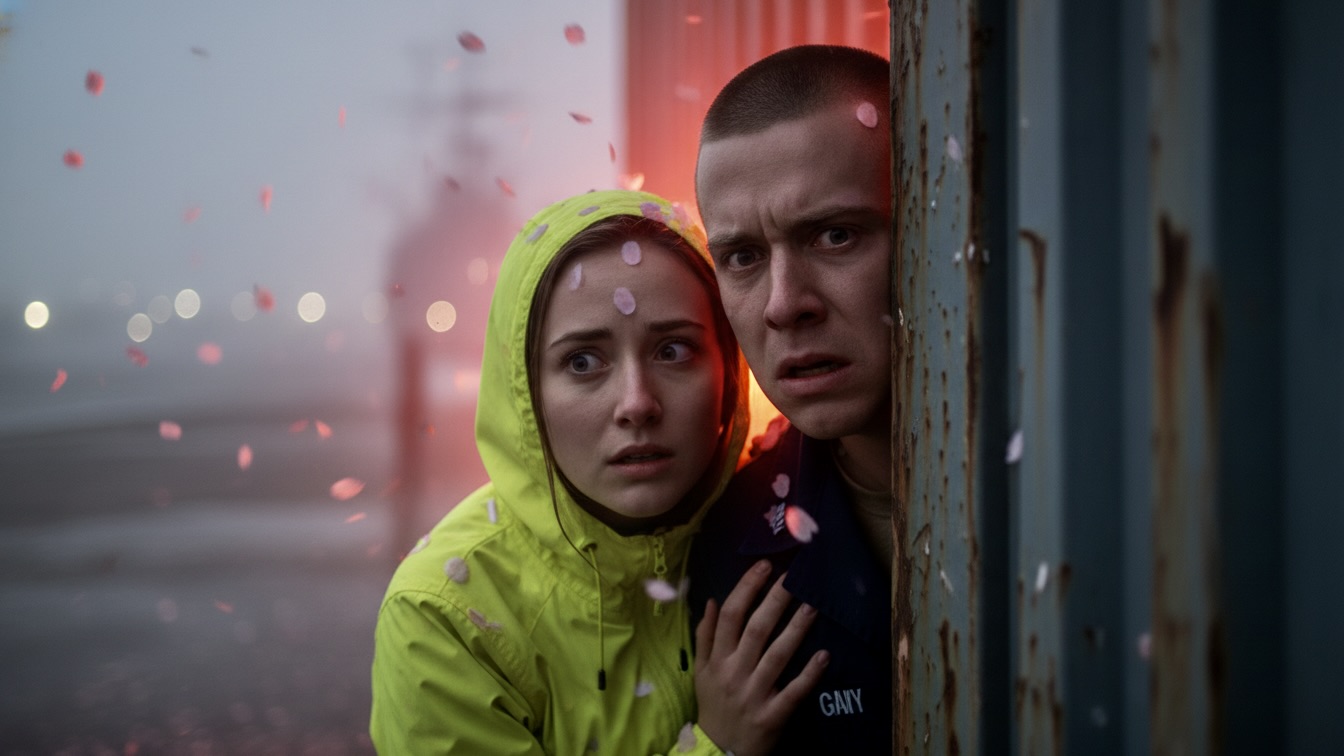
A Navy recruit discovers a migrant hiding in a crate as a global energy crisis freezes the harbor city.
The harbor was a graveyard of steel. Huge tankers sat motionless in the dark water, their hulls rusting in the spring damp. We’d been on the line for seventy-two hours. The blockade was absolute. Nothing moved in or out of the strait. The Admiral called it 'strategic containment.' The guys on the deck called it a slow death. Gas hit fifty dollars a gallon this morning. The city across the water was a grid of blackness, save for the flickering orange of trash fires. People were burning furniture to stay warm because the grid couldn't handle the load. Spring was supposed to be here, but the wind coming off the Atlantic felt like a razor blade. It was a wet, heavy cold that got into your marrow and stayed there.
I gripped my rifle. My knuckles were white. The polymer was cold against my skin. Commander Edwards paced the bridge above us. He looked like a man made of stone. He didn't care about the gas prices or the families freezing in the tenements. He cared about the line. 'Hold the perimeter,' he’d said. 'The first boat that breaks the line gets a warning. The second gets a hull breach.' We were twenty-year-olds holding the world’s breath in our lungs. I looked at the cherry blossoms lining the shore. They were blooming early, pink against the grey concrete of the pier. They looked like bruises. The wind tore them off the branches, swirling them into the oily water. It was beautiful in a way that made me want to vomit.
I was supposed to be checking the supply crates on the Port Side. We were taking on medical supplies for the fleet, but half the crates were empty. Shortages were everywhere. I kicked a wooden pallet. It splintered. I walked toward the stack of reinforced plastic containers near the crane. The silence out here was wrong. It wasn't just quiet; it was a physical weight. The Shadow Mass. That’s what the older guys called it. It’s when the fog gets so thick you can’t see your own hands, and the light from the buoy markers just disappears into the grey. It felt like the world was being erased, one foot at a time. I reached for the latch on a large crate marked 'Ventilator Parts.' The iron hinge was rusted, even though it was new. It groaned as I pulled it back.
She was there. Huddled between two foam-lined dividers. She looked small. Not just short, but compressed, like she was trying to take up zero space. Her jacket was a bright, neon yellow—the kind of thing you wear when you want to be seen on a bike, not when you’re hiding on a Navy vessel. She had dark hair matted with sweat and sea spray. Her eyes were wide, catching the dim glow of my flashlight. She didn't scream. She didn't even move. She just stared at me. My heart hammered against my ribs. My training said to yell. My training said to call it in. 'Intruder on deck.' 'Secure the perimeter.' But I didn't. I just stood there, the iron hinge still vibrating under my hand.
"Don't," she whispered. Her voice was thin, like paper.
"What are you doing here?" I asked. My voice sounded too loud in the unnatural silence.
"My sister," she said. She climbed out of the crate, her legs shaking. She almost fell. I reached out to steady her, then pulled my hand back like she was electrified. She looked at me, really looked at me. "She's in the ward. The hospital by the gate."
"The maternity ward?" I knew the place. It was a brick building just past the checkpoint.
"They’re raiding it," she said. "The immigration guys. They’re surrounding the block. No cap, they’re taking everyone. Even the new moms."
I looked back toward the bridge. Edwards was talking into a radio. The light from the control room hit the fog, creating a weird, shifting halo. "You shouldn't be here, Renee," I said. I didn't know her name, but I’d seen her before. She worked the coffee cart near the pier before the blockade went live. She’d given me an extra sugar once and told me I looked too young for the uniform.
"I'm Renee," she said, as if reading my mind. She stepped closer. I could smell the salt on her. "Jimmy, right? I saw your tag. Look, my sister... she just had the baby. Two hours ago. She’s undocumented. If they take her now, she won't make it. The baby won't make it. It’s freezing in there. They turned the heat off to save power."
"I have orders," I said. It felt like a lie as soon as it left my mouth.
"Orders don't keep babies warm," she said. She reached into the crate and pulled out a small bag. It clinked. "I got meds. Antibiotics. Some formula. I just need to get past the gate."
"The gate is locked down. There’s a spring storm coming in. The fog is already masking the harbor. You'll get shot before you hit the sidewalk."
"Then help me," she said. "Please."
I looked at the cherry blossoms. They were thick on the ground now, like pink snow. The fog was rolling in harder, a true Shadow Mass. You couldn't see five feet in front of you. It was the only chance she had. It was the only chance I had to feel like a human being instead of a gear in a machine that was grinding the world to a halt. I checked my watch. The patrol rotation was in ten minutes.
"Come on," I said.
We moved like ghosts. I knew the blind spots of the cameras. I’d spent months staring at the monitors when I was on night watch. We stayed low, hugging the shadow of the crane. The fog was our only friend. It swallowed the sound of our boots on the metal deck. We reached the gangplank. A guard was smoking a cigarette near the bottom. The tip glowed like a dying star.
"Stay here," I breathed.
I walked down. "Hey, Miller," I said.
Miller jumped. "Damn it, Jimmy. You scared the hell out of me. Can't see a thing in this soup."
"Command wants a headcount on the east crates," I said. "Go check the manifest in the office. I’ll cover your post."
Miller hesitated. He wanted to get out of the wind. "Bet. Don't let anyone steal the ship while I'm gone."
As soon as he disappeared into the small shack, I signaled Renee. She flew down the ramp, a yellow blur in the grey. We hit the pier and ran. The harbor was a maze of shipping containers and stacked lumber. The fog muffled everything. We could hear the sirens from the city—distant, mournful wails. The energy crisis had made the world feel small and dangerous. Every shadow looked like a soldier. Every gust of wind sounded like a footstep.
"This way," she whispered.
We ran through the cherry trees. The blossoms were wet, sticking to our clothes. The smell was cloying now, sweet and rotten. We were a mile from the hospital gates when the first flare went up. It was a brilliant, blinding red. It hung in the air, illuminating the fog from the inside out. It turned the Shadow Mass into a bloody cloud.
"They found the crate," I said. My stomach dropped.
"Keep going," Renee urged. She was breathing hard, her lungs whistling.
We reached the perimeter fence. The hospital was a dark monolith a hundred yards away. I could see the blue and red lights of the immigration vans. They were lined up like wolves at a campfire. Soldiers in tactical gear were moving toward the entrance.
"The side door," Renee said. "The laundry chute. It stays unlocked for the night shift."
We sprinted across the open asphalt. The fog was thinning. The wind was picking up, blowing the cover away. We were halfway there when a searchlight cut through the dark. It swept over the ground, catching the pink petals, then it hit us.
"HALT!" a voice boomed over a loudspeaker. It was Edwards. He was on the perimeter wall.
We didn't stop. We couldn't. Renee was leading now, her neon jacket a target. I stayed behind her, my rifle still slung, my hands empty. I wanted them to see I wasn't a threat. I wanted them to see we were just kids.
"STOP OR WE WILL FIRE!"
A shot rang out. A warning. It hit the pavement three feet to my left, sending sparks into the air. Renee didn't flinch. She reached the door and yanked it open.
"Get in!" she yelled.
I turned back. The gate guards were leveling their weapons. The red dots of their laser sights danced across the brick wall. One of them settled on my chest. I looked up at the wall. I couldn't see Edwards, but I knew he was watching. I knew he was counting the seconds. I stepped inside the doorway and slammed the heavy steel door shut just as another volley of shots peppered the exterior.
We were in. The hospital smelled like bleach and old soup. It was freezing. Renee didn't wait. She started climbing the stairs. I followed, my boots heavy. We reached the third floor. The maternity ward. It was a chaos of muffled cries and hushed voices. Nurses were moving in the dark with flashlights.
"Renee!"
A woman in a hospital gown was sitting in a plastic chair in the hallway. She was holding a bundle of blankets. She looked terrified.
"Maria," Renee gasped. She ran to her sister.
I stood by the window. Down below, the vans were closing in. They were breaching the main entrance. The Navy guys were at the perimeter fence, talking to the immigration officers. A standoff. My own people were out there. I was a deserter now. I was a traitor for a bag of antibiotics and a girl in a yellow jacket.
"We have to move her," I said. "They're inside."
Renee looked at the bag of meds. She looked at the baby. The infant was tiny, its face wrinkled like a dried plum. It wasn't even crying. It was too cold to cry.
"Where?" Renee asked. "There's nowhere to go."
I looked at the roof. "The helipad. There’s a maintenance bridge that connects to the parking garage. If we can get across, we can disappear into the tenements."
"Jimmy," Renee said. She touched my arm. Her hand was warm now. "You don't have to do this. You can go back. Tell them I forced you."
"I’m already in," I said. "No cap."
We made for the roof. The wind was screaming up there. The spring storm had finally arrived. Rain mixed with the cherry blossoms, turning the world into a slushy, pink mess. We reached the maintenance bridge—a narrow catwalk of rusted iron. It swayed in the wind. Below us, the drop was fifty feet to the concrete.
"Go," I said, ushering Maria and Renee onto the bridge.
I stayed at the door, watching the stairwell. I heard the heavy thud of tactical boots. They were coming. I looked out at the harbor. The blockade was still there, a wall of lights in the distance. The world was breaking, and we were the cracks.
I saw the first helmet peak over the landing. I raised my rifle, not to fire, but to hold.
"Drop it, Jimmy!" Edwards' voice echoed in the stairwell. He had followed us in. He stood ten feet away, his pistol aimed at my head. "Don't be a fool. It’s just a girl. It’s just a baby."
"It’s everything," I said.
Behind me, the bridge groaned as the girls reached the other side. They were safe for now. But the door was open, and the wind was blowing the blossoms into the hallway, carpeting the floor in a mock-celebration of a spring that felt like the end of the world.
Edwards took a step forward. His face was unreadable. "The blockade is for the greater good, son. We need order."
"Order is cold," I said.
I backed toward the edge of the roof. The wind caught my jacket, pulling me toward the void. I looked at the commander, a man I had once respected, and I saw the history of every bad decision humanity had ever made written in the lines of his face. He didn't see people. He saw units. He saw threats.
"Come back over the ledge," he commanded.
I looked at the parking garage. Renee was looking back. She raised a hand. A small gesture. A goodbye. Or a thank you. I couldn't tell.
I turned my attention back to Edwards. I lowered my rifle and let it clatter to the roof.
"I'm done," I said.
He didn't lower his gun. The red dot of a laser sight found its home right between my eyes.
“The red dot of a laser sight found its home right between my eyes.”


