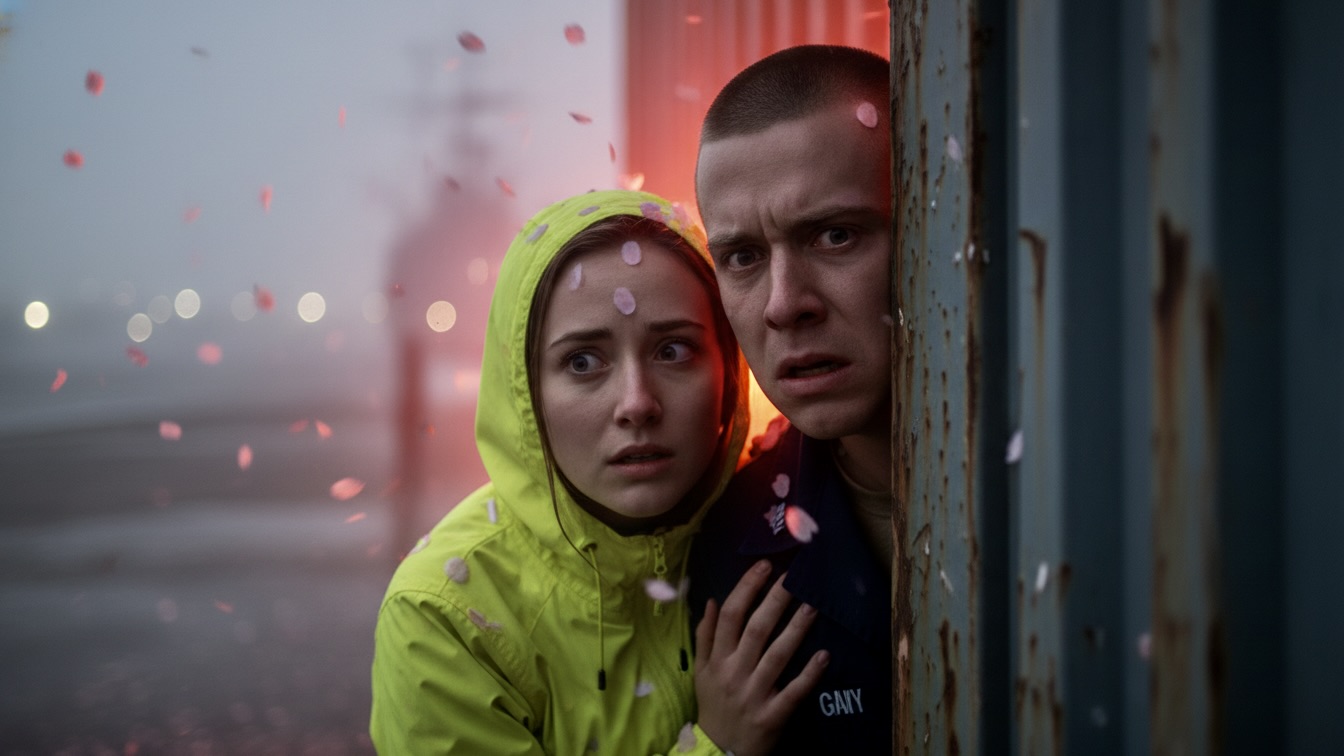
The narrative follows Jimmy, a young soldier stationed at a harbor blockade during a period of severe energy scarcity and political unrest. While patrolling a "graveyard" of rusting tankers, Jimmy discovers Renee, a civilian woman, hiding in a crate of medical supplies. She explains that her undocumented sister has just given birth at a nearby hospital currently being raided by immigration authorities. Despite the strict "strategic containment" orders enforced by his cold commander, Edwards, Jimmy decides to help her.
Under the cover of a thick fog known as the "Shadow Mass," Jimmy deserts his post and guides Renee to the hospital. They navigate a landscape of decaying infrastructure and freezing temperatures, eventually reaching the maternity ward to find Renee’s sister, Maria, and her newborn baby. As the authorities close in, Jimmy leads the women to the hospital roof to escape via a maintenance bridge. The story concludes with a tense standoff between Jimmy and Commander Edwards, where Jimmy chooses to abandon his weapon and his military identity to protect the fleeing family.
The central theme of the story is the tension between systemic order and individual morality. The blockade is presented as a clinical, "strategic" necessity by the military hierarchy, yet its actual impact is the "slow death" of the civilian population. Jimmy’s internal journey reflects the psychological awakening of a person who realizes that "the greater good" is often used as a rhetorical shield to justify state-sponsored cruelty. By choosing to help Renee, he rejects the abstract logic of the machine in favor of a tangible, human responsibility.
Another prominent theme is the fragility of civilization and the psychological toll of scarcity. The setting is defined by a failing power grid, fifty-dollar gas, and people burning furniture for warmth. This environmental desperation creates a "Shadow Mass," a metaphor for the moral and social erasure that occurs when survival becomes the only priority. The fog serves as a physical manifestation of this ambiguity, hiding both the crimes of the state and the desperate acts of those trying to subvert it.
Nature and its corruption also play a symbolic role throughout the text. The cherry blossoms, traditionally symbols of renewal and beauty, are described as "bruises" that look "beautiful in a way that makes me want to vomit." This imagery suggests that in a world defined by blockade and blockade-induced suffering, even beauty becomes a source of revulsion. The blossoms are eventually mixed with rain and slush, symbolizing the death of hope and the harsh reality of a spring that brings only cold and violence.
Jimmy is a protagonist caught in a state of cognitive dissonance, struggling to reconcile his training with his innate empathy. At the start of the chapter, he is a "gear in a machine," his knuckles white with the tension of maintaining a line he does not fully understand. He is only twenty years old, a detail that highlights his vulnerability and the tragedy of a youth spent enforcing a "slow death" on his own community. His psychological shift begins when he recognizes Renee, transforming her from a potential threat into a human being with a history.
As the narrative progresses, Jimmy’s internal conflict resolves into a firm rejection of his military identity. He uses the word "no cap" to mirror Renee’s language, signaling his defection from the formal, cold world of Commander Edwards to the visceral, honest world of the civilians. His decision to drop his rifle at the end is a symbolic act of disarmament, not just of his body, but of his soul. He accepts the label of a traitor because he realizes that maintaining "order" has become a form of moral suicide.
Renee serves as the catalyst for Jimmy’s transformation and the emotional heart of the story. She is characterized by her resilience and her refusal to be invisible, signaled by her "neon yellow jacket" which stands out against the grey fog. Unlike the soldiers who hide behind uniforms and orders, Renee is exposed and desperate, driven by a primal need to protect her family. She represents the "cracks" in the world that Jimmy mentions—the places where humanity still exists despite the blockade.
Psychologically, Renee is the mirror that reflects Jimmy’s lost humanity back to him. She remembers his name and his face from before the crisis, grounding him in a reality that predates his life as a soldier. Her plea for help is not just for medical supplies, but for Jimmy to remember that "orders don't keep babies warm." She is the one who leads him through the final stages of the escape, showing a strength that rivals the "stone" of the military commanders.
Commander Edwards is the personification of the state’s cold, utilitarian authority. Described as a "man made of stone," he lacks the capacity for empathy, viewing the world through the lens of "strategic containment" and "the greater good." To him, people are not individuals but units that either hold the line or break it. His psychological rigidity makes him a formidable antagonist, as he cannot conceive of a motivation higher than the maintenance of order.
In the final standoff, Edwards represents the history of human failure and the cyclical nature of violence. He aims his weapon at a young man he once mentored, unable to see the baby or the girl as anything other than a breach in security. His character illustrates the danger of a mind that has been completely subsumed by systemic logic. He is not necessarily evil in a traditional sense, but his absolute devotion to "order" makes him the primary source of the story’s cold, oppressive atmosphere.
The prose is characterized by a heavy, atmospheric quality that emphasizes sensory deprivation and physical discomfort. The author uses metaphors of cold and sharpness—such as the wind feeling like a "razor blade"—to create a setting that is hostile to life. This tactile imagery is essential for establishing the high stakes of the plot, as the reader can feel the "wet, heavy cold" that threatens the newborn baby. The pacing mirrors Jimmy’s rising anxiety, starting with the stagnant stillness of the harbor and accelerating into a frantic, breathless chase.
The narrative voice is first-person and introspective, allowing for a deep exploration of Jimmy’s psychological state. The use of modern slang like "no cap" and "bet" provides a sharp contrast to the formal military jargon used by Edwards, highlighting the generational and moral divide between the characters. This linguistic shift serves as a stylistic marker for Jimmy’s defection. The "Shadow Mass" fog acts as a recurring motif that blurs the lines between the physical environment and the characters' moral confusion, eventually clearing only when Jimmy makes his final choice.
The juxtaposition of industrial decay and natural beauty is a recurring stylistic device. The "graveyard of steel" and "oily water" are constantly interrupted by the "pink snow" of the cherry blossoms. This contrast creates a sense of "cloying" unease, as the beauty of the flowers feels misplaced and grotesque in the context of a blockade. This stylistic choice reinforces the theme that the world is "breaking," and that the traditional markers of spring and life have been corrupted by the political and energy crisis.


