The chapter introduces us to the bleak, slushy landscape of Thunder Bay in April, where a group of high school students is attempting to complete a "Tiny Home Bloom" project. Janice, the narrator, finds herself literally bonded to the structure after an accident with industrial-strength glue while trying to impress her crush, Lester. Lester, the perceived leader of the project, maintains an aura of competence that is quickly revealed to be a facade.
The situation descends into further absurdity when Sarah-Beth arrives with neon paint that reacts with pine pollen to create a bioluminescent, toxic-looking glow. As a sudden and violent northern storm hits the parking lot, the structural integrity of the tiny home is put to the test. Janice is forced to undergo a painful liberation from the wall to help Lester prevent the porch from collapsing under the weight of the sleet.
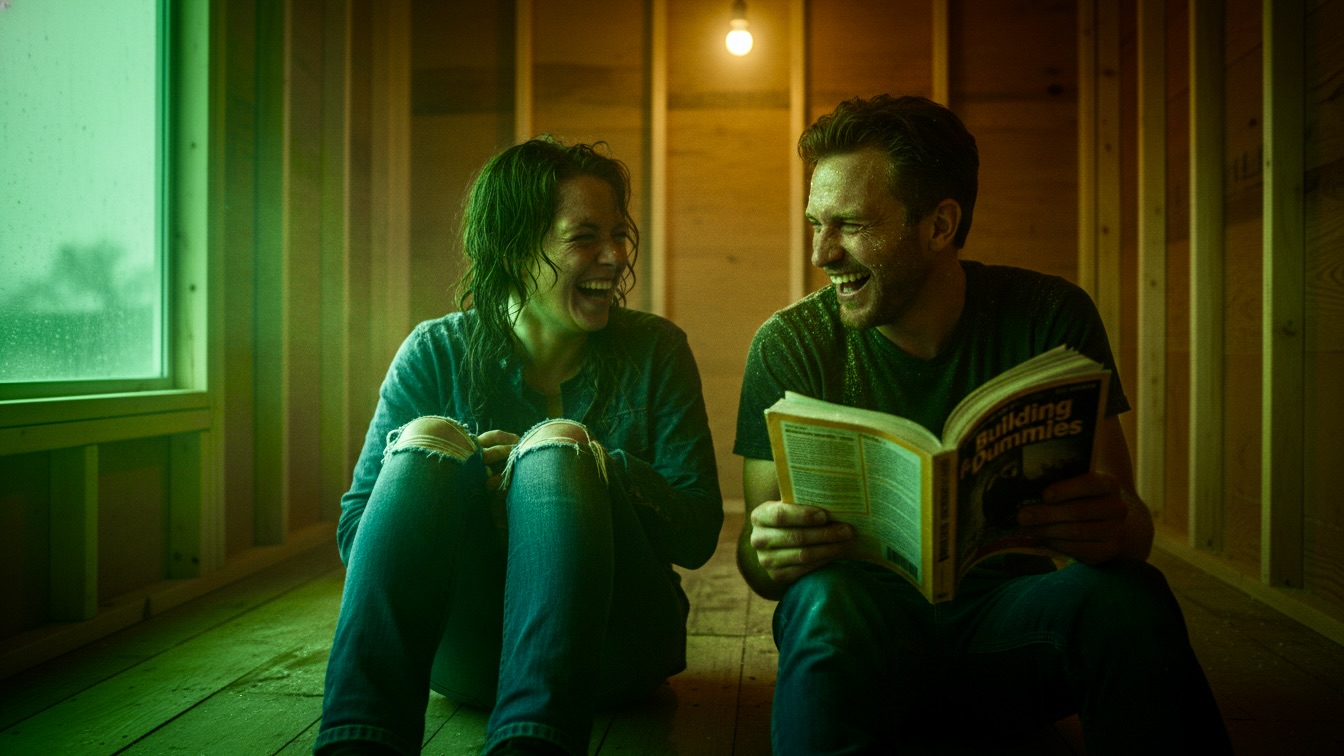
In the aftermath of the storm, the characters find a moment of quiet connection inside the glowing, vibrating house. Lester admits his lack of construction knowledge, revealing he has been relying on a "Building for Dummies" book. The chapter concludes with the trio bracing for the arrival of a news crew, finding a strange sense of accomplishment in their chaotic, radioactive-looking survival.
One of the central themes explored in this text is the tension between performance and reality. Every character is engaged in a form of masquerade, attempting to project an image of adulthood or competence that they do not truly possess. Janice tries to embody a "breezy" and "competent" persona to attract Lester, while Lester uses his physical appearance and clothing to signal a mastery of carpentry he lacks. This theme culminates in the literal "bonding" of Janice to the house, suggesting that the roles we play can often trap us in uncomfortable or dangerous positions.
The narrative also examines the concept of resilience through a lens of irony and absurdity. While the school project is intended to showcase "community resilience," the actual experience of the students is one of desperate, last-minute improvisation. Their resilience is not found in the sturdy construction of the house, but in their ability to laugh and share a soggy sandwich amidst a literal and metaphorical storm. The "Plywood Palace" becomes a symbol for the fragile, often haphazard structures of adolescent identity.
Finally, the story highlights the unpredictable and often hostile relationship between humanity and the environment. The setting of Thunder Bay is described not just as a location, but as an active psychological force that "attacks" the characters. The chemical reaction between the synthetic paint and the natural pollen creates a surreal, bioluminescent landscape that defies the students' control. This intersection of the man-made and the natural world serves as a catalyst for truth, stripping away the characters' pretenses and forcing them into a state of raw, honest cooperation.
Janice serves as a cynical yet deeply relatable protagonist whose internal monologue reveals a sharp awareness of her own insecurities. She is acutely self-conscious, measuring her worth through the eyes of Lester and the perceived "coolness" of her actions. Her decision to use industrial glue on a trim piece is a physical manifestation of her desire to be useful, which ironically results in her becoming a "structural element" of the very thing she is trying to build. This literal entrapment forces her to confront the absurdity of her situation and her feelings for Lester.
Psychologically, Janice exhibits a defensive wit that she uses to shield herself from the bleakness of her environment and her own perceived failures. She is quick to criticize her teacher, Mr. Schmidt, and her peer, Sarah-Beth, yet she remains trapped by her own romanticized version of Lester. By the end of the chapter, however, her focus shifts from self-preservation and image-management to genuine action. Her willingness to sacrifice her vintage denim and face the freezing storm marks a transition from a passive observer to an active participant in her own life.
Lester is a character defined by the "imposter syndrome" that often accompanies the transition into adulthood. He possesses the physical markers of a leader—the Carhartt jacket, the strong jawline, and the steady saw-hand—but he is internally navigating a sea of uncertainty. The revelation of his "Building for Dummies" book is a pivotal moment that humanizes him, stripping away the "lead builder" persona and revealing a teenager who is just as lost as his peers. This vulnerability makes him more accessible to Janice and the reader alike.
His reaction to the crisis reveals a core of genuine responsibility despite his lack of technical skill. When the storm hits, he does not abandon the project or his friends; instead, he uses whatever tools and knowledge he has to protect the structure. His laughter at Janice’s predicament is not malicious, but rather a recognition of the shared absurdity of their lives. By admitting he has been "winging it," he invites a level of honesty that allows for a deeper connection with Janice, moving their relationship past the superficiality of high school crushes.
Sarah-Beth acts as the narrative’s chaotic catalyst, representing the unbridled and often misguided enthusiasm of youth. She is less concerned with the technical requirements of "exterior grade" paint and more focused on the visual impact and the potential for viral fame. Her character highlights the disconnect between the digital world of social media "tags" and the physical reality of a collapsing porch. She is the bridge between the mundane school project and the surreal, bioluminescent spectacle that the house becomes.
Despite her clumsiness and lack of foresight, Sarah-Beth possesses an optimistic resilience that contrasts with Janice’s cynicism. She sees beauty in the "toxic waste spill" and immediately recognizes the artistic potential in their failure. Her presence ensures that the project remains a "deliberate artistic statement," even if that statement was entirely accidental. She represents the ability of the younger generation to find meaning and "vibes" in the wreckage of their own making.
The narrative voice of the chapter is characterized by a dry, self-deprecating humor that perfectly captures the "mood disorder" of a northern spring. The author uses vivid, often grotesque metaphors to describe the setting, such as the snow turning into a "salt-crusted slurry that hates your shoes." This personification of the environment establishes a tone of weary endurance. The pacing begins as a slow, observational comedy of errors and rapidly accelerates into a high-stakes survival drama, mirroring the suddenness of a Thunder Bay storm.
Sensory details are used effectively to create a sense of immersion and visceral discomfort. The smell of "wet asphalt and deep, damp rot," the "sickly, alien light" of the glowing paint, and the "metallic tang of the sleet" provide a rich texture to the scene. These details serve to ground the more absurd elements of the plot, making the bioluminescent house feel like a tangible, if bizarre, reality. The contrast between the "radioactive neon" and the "bruised purple" sky creates a striking visual palette that underscores the story's themes of artifice versus nature.
The dialogue is snappy and realistic, capturing the specific cadence of teenage interaction where profound admissions are often buried under layers of sarcasm. The use of the "Building for Dummies" book as a physical prop provides a comedic yet poignant payoff to the tension established early in the chapter. The narrative successfully balances the internal psychological state of the protagonist with external action, using the physical collapse of the house as a metaphor for the collapsing facades of the characters. This results in a story that feels both grounded in a specific place and universal in its exploration of the human condition.


