Format: Short Film / Anthology Episode | Est. Length: 10-12 minutes
Imagine a series titled Northern Exposure: Thunder Bay, an anthology exploring the gritty, darkly comedic coming-of-age stories in Northern Ontario. Each episode focuses on a different group of students at a struggling vocational high school, navigating the harsh climate and their own questionable life choices as they attempt to build a future out of scrap wood and sheer stubbornness. This story serves as a pilot for the series, establishing a world where the environment is an active antagonist and the characters must find warmth in the most absurd circumstances.
In the freezing slush of a Thunder Bay April, a teenage girl accidentally glues herself to a tiny home just as a freak chemical reaction turns the house into a glowing, radioactive neon beacon.
When a DIY tiny home project becomes a bioluminescent disaster during a sudden sleet storm, a self-conscious teen must choose between her dignity and saving the structure she’s literally bonded to. As the local news descends, she discovers that her "expert" crush is just as lost as she is.
The primary theme is the facade of competence versus the reality of amateurism. The story explores how teenagers—and adults like the absent Mr. Schmidt—perform expertise to mask deep-seated insecurities, using Carhartt jackets and "Building for Dummies" as shields against the harsh reality of their own ignorance. It questions the value of "looking the part" when structural integrity is on the line.
The secondary theme is resilience in the face of environmental and social absurdity. Set against the "mood disorder" of a Northern spring, the narrative highlights the bonding power of shared failure. It suggests that true connection is found not in perfection, but in the messy, glowing aftermath of a collective mistake, where vulnerability becomes more useful than a cool exterior.
For Janice, the stakes are primarily social and physical; she risks public humiliation on live television while being physically trapped in a potentially collapsing structure. For Lester, his reputation as a "capable man" and his academic standing are on the line. If the porch collapses or the news crew exposes the project as a dangerous fraud, the students face failing a critical vocational credit and the loss of their community's already fragile respect.
The primary external conflict is the brutal, unpredictable Thunder Bay weather and the chemical mishap that creates a literal "ticking clock" before the news crew arrives. Internally, Janice struggles with her crush-induced paralysis and her desire to appear "cool," while Lester battles the imposter syndrome of being a lead builder who doesn't know how to frame a roof. The antagonist is not a person, but the collective weight of neglect (from Mr. Schmidt) and the indifferent, violent force of a Northern spring storm.
In the bleak, slushy parking lot of a Thunder Bay high school, eighteen-year-old Janice tries to impress her crush, Lester, while they work on a "Tiny Home Bloom" project. A mishap with industrial-strength glue leaves Janice’s sleeve permanently bonded to the cedar siding just as their teammate, Sarah-Beth, accidentally douses the house in neon paint that reacts with pine pollen to become bioluminescent. The situation escalates when the local news announces an early arrival to cover what they believe is a deliberate artistic statement on "community resilience."
As a sudden, violent sleet storm threatens to topple the unanchored porch, Lester admits he has no idea what he’s doing, relying on a "For Dummies" book to survive. Janice manages to break free—losing part of her jacket in the process—to help Lester brace the structure against the wind. In the glowing, alien light of their failed project, the two share a soggy sub and a moment of genuine connection before the news van headlights appear, signaling their transition from students to accidental local legends.
Janice: A cynical but romantic eighteen-year-old who uses sarcasm to hide her lack of confidence. She starts the episode obsessed with her image and her crush on Lester, but ends it physically scarred (a ruined jacket) and emotionally grounded, realizing that shared vulnerability is more valuable than a "cool" facade. Her arc is one of shedding her pretenses to become a literal and figurative support for others.
Lester: The "lead builder" whose rugged exterior—jawline and Carhartt gear—belies a total lack of technical knowledge. He transitions from a posture of silent authority to a state of frantic, honest admission, eventually finding a more authentic confidence through his partnership with Janice during the storm. He represents the pressure of traditional masculinity being dismantled by the reality of a 2x4.
Sarah-Beth: An energetic, chaos-agent student who prioritizes aesthetic "pop" over structural integrity or safety. She serves as the catalyst for the episode's visual climax, remaining blissfully unaware of the danger as she chases viral fame through the bioluminescent disaster. Her character highlights the disconnect between digital perception and physical reality.
Mr. Schmidt: The quintessential "checked-out" educator who exists primarily as a looming shadow of administrative neglect. His absence forces the students into their leadership roles, highlighting the theme of "youthful vigor" born out of necessity rather than guidance. He is the personification of the system that has left these students to fend for themselves in the cold.
Beat 1 (The Setup): Janice watches Lester struggle with a circular saw in the freezing parking lot, establishing her crush and the bleak, slushy atmosphere of Thunder Bay in April. She attempts to look "effortless" while leaning against the house, only to realize her sleeve is bonded to the siding with industrial glue. This moment establishes the physical comedy and the immediate predicament of being a "structural element" of the house.
Beat 2 (The Chemical Reaction): Sarah-Beth arrives with "radioactive neon" paint and accidentally spills it, which reacts with a sudden cloud of yellow pine pollen to create a glowing, bioluminescent mess. The house transforms into a "haunted highlighter," and the news crew announces an early arrival to cover the "artistic" phenomenon. The tension ramps up as the aesthetic disaster meets a looming deadline, forcing the characters to choose between fixing the mess or leaning into the lie.
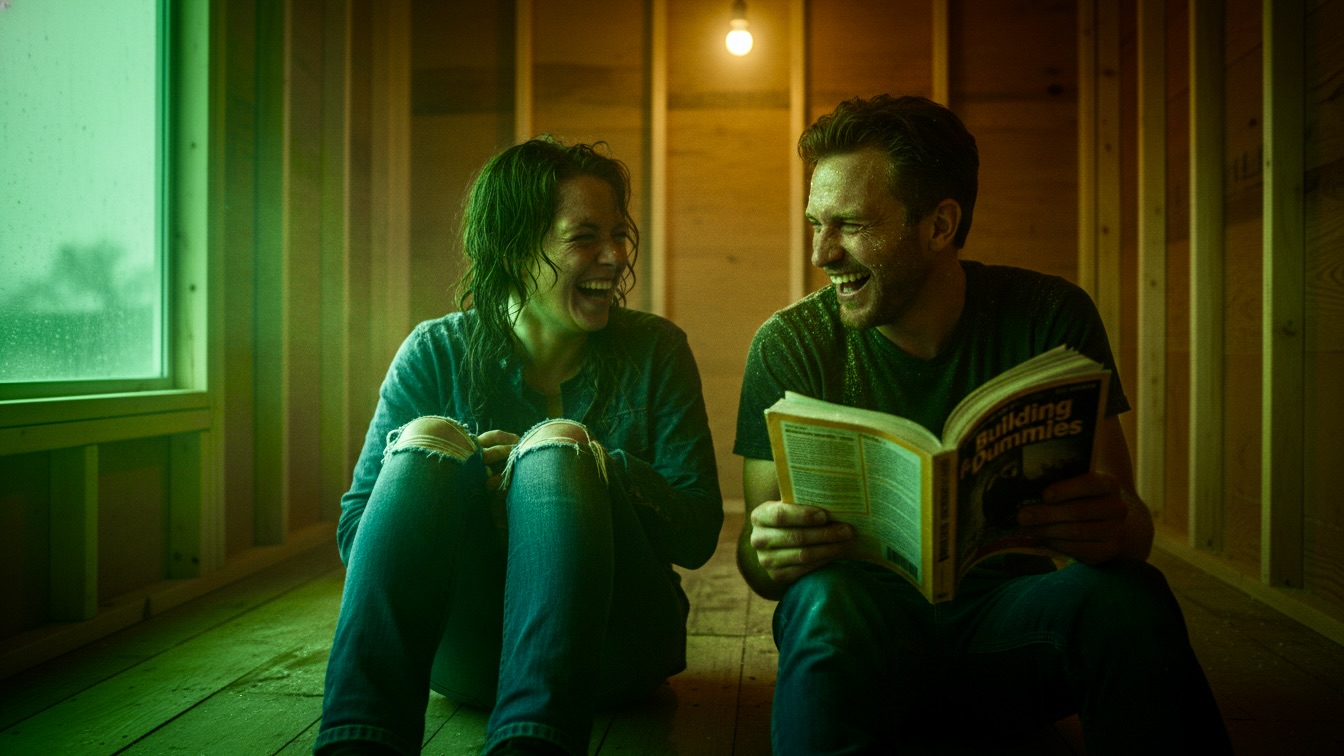
Beat 3 (The Admission): As the weather turns into a violent sleet storm, Lester pulls out a "Building for Dummies" book, admitting he has been winging the entire construction process. Janice realizes the loft and porch are death traps held together by "hope and long screws" rather than engineering. This midpoint shift moves the conflict from social embarrassment to physical survival as the structure begins to rock on its blocks.
Beat 4 (The Climax): Lester uses a screwdriver to pry Janice’s sleeve off the wall, tearing her jacket but freeing her to help save the structure. Together, they battle the freezing wind and mud to jam a 4x4 timber under the buckling porch just before the wind can lift it. The physical struggle solidifies their bond through shared labor rather than posturing, proving their "resilience" is real even if the house is a disaster.
Beat 5 (The Resolution): Soaked and covered in glowing slime, Janice and Lester retreat inside the vibrating, neon house to share a soggy Italian sub. They accept the absurdity of their situation and the impending media circus as the news van headlights appear in the distance. The episode ends on a note of quiet, mutual understanding amidst the chaos, with the "Plywood Palace" pulsing like a beacon in the dark.
The episode follows a trajectory from awkward, self-conscious adolescent posturing to high-stakes panic, finally settling into a warm, grounded sense of camaraderie. The audience experiences the "cringe" of Janice’s predicament, the surreal wonder of the glowing house, and the adrenaline of the storm. This concludes with a satisfying emotional "thaw" that mirrors the Northern spring—messy and cold, but ultimately hopeful.
If expanded, the season would follow the "Tiny Home Bloom" project as it travels to various competitions across Northern Ontario, with each stop presenting a new environmental or social hurdle. The glowing "Plywood Palace" becomes a local legend, forcing the trio to maintain the lie of their "artistic intent" while secretly learning actual carpentry to keep the house from falling apart. This creates a season-long tension between their public image as artistic prodigies and their private reality as desperate amateurs.
The overarching narrative would track Janice and Lester’s burgeoning relationship as they move from "faking it" to "making it," eventually confronting Mr. Schmidt’s neglect. The season would culminate in a regional showcase where the students must decide whether to reveal the house's structural flaws or risk it being sold to a vulnerable resident. This final reckoning with their integrity would serve as the ultimate test of their growth from children playing at construction to adults taking responsibility.
The visual style is "Industrial Surrealism," blending the gritty, desaturated grays and browns of a Northern winter with the jarring, hyper-saturated neon green of the bioluminescent paint. Handheld camerawork during the storm sequences should emphasize the chaotic, tactile nature of the environment, contrasting with static, wide shots that highlight the isolation of the parking lot. The lighting should transition from the flat, oppressive glare of an overcast day to the eerie, pulsing glow of the house at night.
The tone is a blend of Lady Bird’s adolescent yearning and the dark, environmental comedy of Fargo. It should feel cold and damp enough for the audience to want a jacket, yet warm enough in its character beats to feel like a classic indie coming-of-age story. The dialogue is fast-paced and dry, leaning into the specific regional dialect and the "gallows humor" common in isolated northern communities.
The target audience is Older Teens and Young Adults (16-25) who enjoy "disaster-lite" comedies and relatable coming-of-age narratives. It appeals to viewers who appreciate regional specificities—the "Northern" experience—and stories about the gap between internet-ready aesthetics and messy reality. The blend of physical comedy and emotional sincerity makes it suitable for streaming platforms focusing on high-quality, short-form anthology content.
The 12-minute runtime follows a rapid three-act structure: Act I (0-4m) establishes the glue predicament and the paint spill; Act II (4-9m) introduces the storm and Lester’s confession; Act III (9-12m) covers the porch rescue and the final "soggy sub" resolution. The pacing is frantic in the middle, mirroring the storm's intensity, but slows down significantly for the intimate final scene to allow the emotional resonance to land.
The "bioluminescent" effect should be achieved through a combination of UV-reactive paint and practical blacklights hidden in the set dressing, supplemented by minimal VFX in post-production to give the paint a pulsing, "living" quality. This ensures the actors are physically interacting with the light source, enhancing the surreal atmosphere. The "pollen cloud" can be simulated with non-toxic yellow powder dispersed via air cannons to create the necessary chemical-reaction visual.
The storm sequence requires high-powered wind machines and "sleet" (a crushed ice and water mix) to create a sense of genuine environmental hostility. Production must account for the "rip" of the denim sleeve, requiring multiple identical vintage jackets for retakes and a breakaway section of the cedar siding to ensure actor safety during the prying scene. The tiny home itself should be built on a gimbal or a vibrating platform to simulate the structural instability during the climax.


