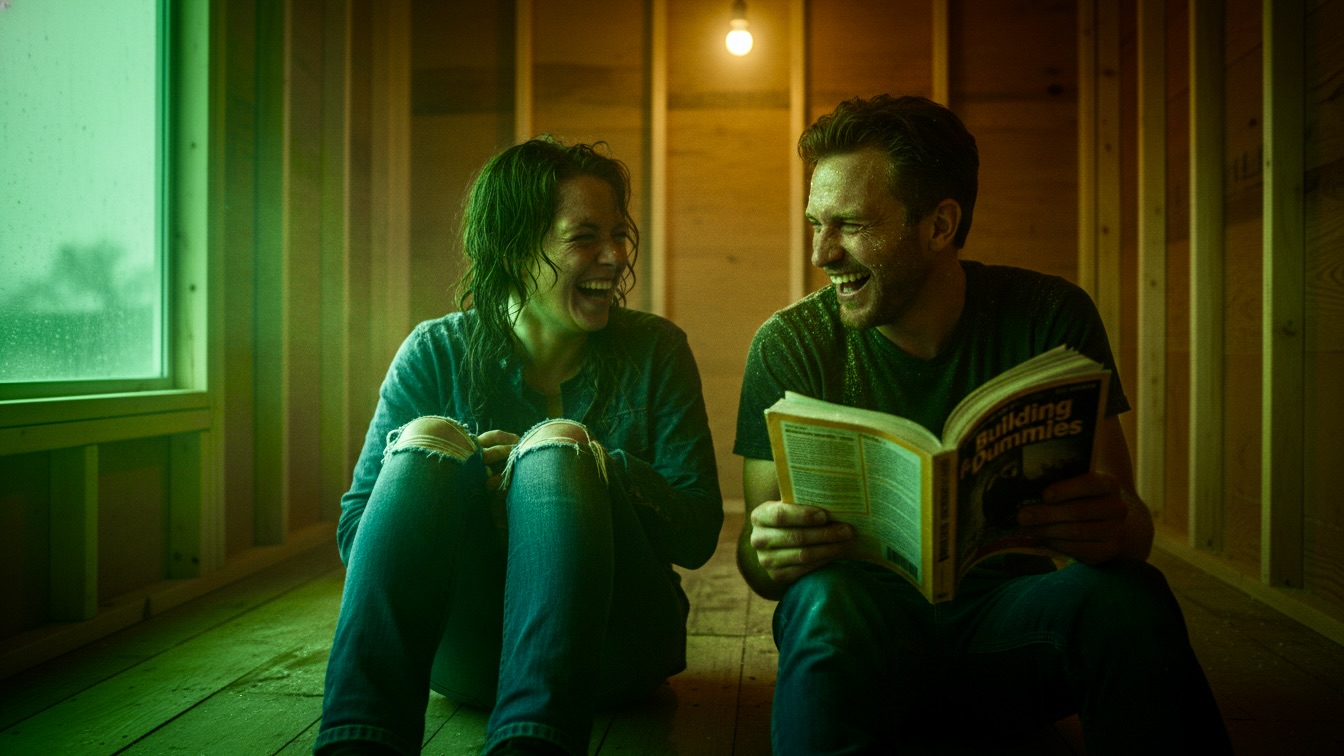
A high school tiny house project turns into a neon disaster as slush and super glue collide in Thunder Bay.
Thunder Bay in April is not a season. It is a mood disorder. The snow doesn't so much melt as it does turn into a grey, salt-crusted slurry that hates your shoes. I stood in the high school parking lot, squinting against a sun that had no warmth but plenty of glare, watching Lester try to use a circular saw. He looked like he was fighting a small, angry animal. He was the lead builder for our 'Tiny Home Bloom' project, mostly because he owned a Carhartt jacket and had a jawline that suggested he knew what a load-bearing wall was. He didn't. I knew he didn't, but I was eighteen and prone to making bad decisions based on how a guy looked in a beanie.
"Janice, hold the level," Lester shouted over the wind. The wind smelled like wet asphalt and the deep, damp rot of the forest waking up.
"It's already level, Lester. The ground is just crooked," I said. I was trying to lean against the window box of our half-finished tiny home. I wanted to look effortless. I wanted to look like the kind of girl who understood carpentry but was too cool to care about the splinters. I shifted my weight, trying to find a pose that said 'competent but breezy,' and that's when I felt the tug.
Earlier, I’d been trying to fix a loose trim piece with a tube of industrial-strength Cyanoacrylate. I’d been sloppy. A bead of the stuff had run down the cedar siding. Now, my vintage denim sleeve was bonded to the window box. Not just touching it. Bonded. I was part of the house now. I was a structural element.
"You okay?" Lester asked, wiping sawdust from his forehead. He left a brown streak across his skin. He looked at me, and I felt that familiar, stupid flip in my stomach.
"I'm great," I said, my voice an octave too high. "Just really vibing with the wood. Feeling the grain."
"Right," he said, looking skeptical. "Anyway, Sarah-Beth is bringing the paint. Mr. Schmidt wants the mural finished before the news crew shows up at four. Something about 'community resilience' and 'youthful vigor.'"
"Schmidt is a liar," I muttered. Schmidt was our shop teacher, a man who had clearly given up on life somewhere around the late nineties. He spent most of the day in his office eating ham sandwiches and staring at blueprints for boats he would never build.
Sarah-Beth appeared around the side of the tiny home, carrying two gallons of what was supposed to be 'Spring Meadow Green.' She looked like she was vibrating. "Guys, look! I found this stuff in the back of the supply closet. It's neon. Like, radioactive neon. It's going to pop on the news!"
"Is that exterior grade?" Lester asked, trying to sound professional.
"Who cares? It's bright," Sarah-Beth said. She tripped over a discarded 2x4. The lid of the first gallon popped off.
In slow motion, the paint didn't just spill. It launched. It hit the side of the house, narrowly missing my head, and then the wind caught it. At that exact moment, a gust of northern wind whipped through the parking lot, carrying a thick, yellow cloud of pine pollen from the trees behind the gym. The pollen hit the wet, neon paint.
There was a brief, silent moment of chemical interaction. The paint didn't just dry; it curdled. And then, it started to glow.
"What the hell?" Lester said, dropping his saw.
It wasn't just neon anymore. It was bioluminescent. The pollen, which was thick enough to choke a horse this year, had reacted with whatever questionable pigments were in Sarah-Beth's discount paint. Our tiny home now looked like a disco ball had vomited on a garden shed.
"It's beautiful," Sarah-Beth whispered, pulling out her phone. "This is going to go viral."
"It looks like a toxic waste spill," I said, still glued to the wall. "Lester, help me."
"With the paint?" he asked.
"No, with my arm. I'm stuck to the house."
He walked over, his boots crunching in the slush. He looked at my sleeve, then at the house, then back at me. A slow, confused grin spread across his face. "You used the super glue?"
"I was trying to be helpful!"
"You look like a human gargoyle," he said. He started laughing. It was a good laugh, deep and genuine, and if I weren't currently a permanent fixture of a 150-square-foot dwelling, I might have enjoyed it.
"Don't just stand there laughing at my misery," I snapped. "The news crew is going to be here in two hours and the house is currently glowing green."
"It's not just glowing," Sarah-Beth shouted, looking at her screen. "The local news saw my tag! They’re coming early! They think it's a deliberate artistic statement about environmental decay!"
"We are so dead," Lester said. He reached into his oversized jacket pocket and pulled out a worn, yellow book. I caught the title: 'Building for Dummies.'
I stared at it. "Are you serious?"
Lester went redder than the paint was green. "I didn't want to admit I didn't know how to frame the roof. Schmidt just told me I was the lead because I was the only one who didn't cry during the safety video."
"You've been winging this whole thing?" I asked. "The porch? The loft?"
"The loft is mostly held up by hope and some very long screws," he admitted.
Before I could process the fact that I was currently attached to a death trap, the sky turned a bruised purple. This is the thing about Thunder Bay: the weather doesn't change; it attacks. One minute it was sunny and slushy, and the next, a wall of sleet was screaming across the asphalt.
"The porch!" Lester yelled. "The supports aren't anchored yet!"
He was right. The porch was a cantilevered disaster waiting to happen. If the wind caught it, the whole structure would pivot like a seesaw.
"Lester, the glue!" I screamed.
He grabbed a flathead screwdriver from his belt. "Hold still. This is going to ruin your jacket."
"Just do it!"
He jammed the screwdriver between the wood and my sleeve, prying with a grunt. There was a sickening 'rip' sound. I was free, but I left a six-inch square of denim behind. I didn't care. The wind was howling now, and the tiny home was actually rocking on its concrete blocks.
"Sarah-Beth, get inside!" Lester ordered.
We scrambled into the small interior. It smelled like fresh pine and the damp, metallic tang of the sleet. The glowing paint outside was smeared across the windows by the rain, casting a sickly, alien light into the room. It was like being inside a haunted highlighter.
"The porch is going to go," Lester said, peering out the door. The sleet had turned into heavy, wet slush that was piling up on the flat roof of the porch. It was hundreds of pounds of weight we hadn't accounted for.
"We have to brace it," I said, my adrenaline finally overriding my embarrassment. "Where are the 4x4s?"
"Under the tarp!"
We lunged back out into the chaos. The slush was hitting my face like tiny, frozen rocks. My ruined sleeve flapped in the wind. We grabbed a heavy timber, slipping in the mud that had replaced the parking lot's ice. Lester grabbed one end, I grabbed the other. We were both covered in that glowing yellow-green slime now.
"On three!" he shouted. "One, two, three!"
We jammed the timber under the corner of the porch just as a massive gust threatened to lift the whole thing. The wood groaned. The house Shuddered. For a second, I thought we were going to be crushed. But the brace held.
We stood there, panting, soaked to the bone, staring at each other in the weird, radioactive light.
"We look ridiculous," I said. My hair was matted with glow-pollen and my arm was freezing.
"We look like we're in a low-budget sci-fi movie," Lester agreed. He reached out and wiped a glob of green paint off my cheek. His hand was rough and cold, but he didn't pull it away immediately.
"You're still holding the book," I pointed out, nodding toward his jacket pocket.
He pulled it out. It was soaked. "Chapter Ten: How to Not Die in a Storm. Too late for that, I guess."
"I have a sandwich in my bag," I said suddenly. My stomach had decided that despite the impending structural collapse and the media circus, it was time for lunch. "It's a sub from the Italian place. Probably soggy."
"I love soggy subs," Lester said.
We sat on the floor of the tiny, glowing house, the wind screaming outside, and shared a flattened turkey sub. The neon paint continued to pulse outside the window as the sun began to set, turning the slush into a glowing, frozen wasteland.
"You think Schmidt will give us an A?" Lester asked, his mouth full of bread.
"For the house? No," I said, looking at the crooked ceiling. "For the drama? Absolutely."
In the distance, I could see the headlights of the news van turning into the school driveway. They were in for a hell of a story.
“As the news cameras began to roll, the glowing porch let out a long, ominous creak that sounded like a final goodbye.”


