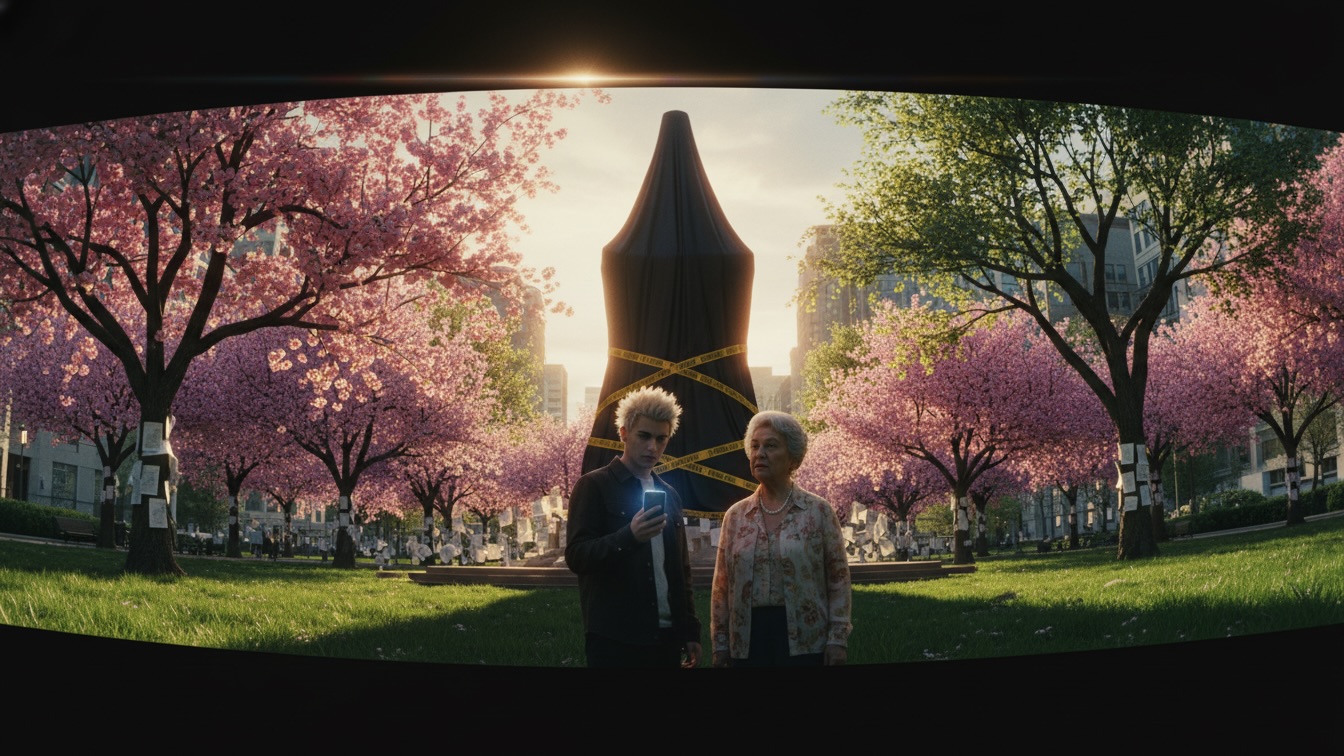
Ruth finds her grandson decorating a local park with caution tape while the spring sun burns through the haze.
The air in the park didn't feel like spring. Usually, April meant something light, but this year it felt like being trapped in a wet wool blanket. The heat was early and aggressive. It sat on the back of my neck, making my skin itch under my collar. My hip gave a sharp, metallic pop with every third step I took toward my usual bench. I didn't want a new bench. I wanted the one with the slightly splintered slat on the left side, the one that had held my weight for forty years.
I stopped ten feet away. The statue of the town founder, a man whose name I usually forgot until I looked at the plaque, was gone. Not gone-gone, but hidden. Someone had draped a heavy, black polyester cloth over him, tying it off at the base with thick industrial twine. It looked like a giant, mourning thumb sticking out of the grass. Surrounding it was a perimeter of bright yellow caution tape, the kind you see at construction sites where someone has definitely messed up.
Jake was there. He was wearing a hoodie despite the eighty-degree humidity, the hood pushed back to reveal his bleached hair. He was holding a can of neon orange spray paint, shaking it with a rhythmic, irritating clack-clack-clack. Three of his friends were with him. They looked like they’d been assembled from a pile of laundry—baggy pants, tiny sunglasses, and the kind of sneakers that looked like they belonged on a moon landing.
I didn't yell. Yelling is for people who think they still have control over the world. I just walked up to the edge of the tape and waited. Jake saw me. He didn't look guilty. He looked tired. That was the thing about his generation; they were born with the exhaustion of a thousand-year-old monk.
"Hey, Gran," he said. He didn't stop shaking the can. "You’re early. The vibe isn't fully set yet."
"The vibe looks like a crime scene, Jake," I said. I looked down at the pavement. They hadn't just taped things off. They were spray-painting giant numbers on the concrete. 1924. 1958. 2012. "Are we counting down to something?"
"We’re auditing," one of the girls said. I think her name was Mia. She was wearing wired headphones around her neck like a scarf. "The park is under review. We’re checking the receipts on the local history."
"Auditing?" I sat down on the bench. The caution tape was brushed against my shoulder, a cheap plastic reminder that I was technically in a restricted zone. "It’s a park. You play frisbee here. You don't audit it."
Jake stopped shaking the can. He walked over and sat on the edge of the fountain, which was dry and filled with dead leaves. "Everything is an asset, Gran. And this asset has been under-performing in the truth department. We’re just making the physical space match the digital reality. It’s an aesthetic correction."
I reached into my bag and pulled out the Tupperware container. I’d made egg salad. The smell of mustard and mayo wafted up, cutting through the chemical scent of the spray paint. It was a grounded, old-world smell. "I have sandwiches. Are you too busy being a revolutionary to eat, or can we pause the aesthetic correction for ten minutes?"
Jake looked at his friends. They looked at the container. For a second, the 'audit' didn't matter. They were just nineteen-year-olds who had forgotten to eat breakfast because they were too busy worrying about the end of the world.
"Egg salad?" Jake asked, his voice losing that flat, ironic edge.
"With the spicy mustard you like," I said.
They converged on the bench. I handed out the sandwiches on paper napkins. We sat there in the shadow of the draped statue, a group of kids in tech-wear and one old woman in a floral blouse, eating in a silence that was almost peaceful. The spring wind picked up, making the black cloth on the statue snap like a sail. It was a lonely sound.
"What happens when the audit is over?" I asked, watching Mia pick a piece of celery out of her sandwich.
"We update the firmware," Jake said. He saw my face and sighed. "It means we tell the actual story, Gran. Like, why this guy is in the park and why the people who lived across the street in the fifties were forced out. We’re just adding the context that got deleted."
"You make it sound like the world is a computer program," I said.
"Isn't it?" he shrugged. "Everything is just data. Some of it is just badly coded."
Before I could respond, a white city truck pulled up onto the grass. The tires crunched over the mulch. Officer Sampson stepped out. He was a man who took his uniform very seriously, even though the buttons always looked like they were under extreme structural stress. He was 'mid,' as Jake would say. Not a villain, just a guy who followed the rules because thinking for himself was too much work.
"Alright, move it," Sampson said, his hand resting on his belt. He didn't look at the kids; he looked at the tape. "Jake, I told you yesterday. You can't be out here defacing city property. And Ruth? You know better. You shouldn't be encouraging this."
I felt a spark of heat in my chest that had nothing to do with the weather. "I’m sitting on a bench, Bill. Unless they’ve passed a law against grandmothers having lunch, I think I’m okay."
"The park is closed for maintenance," Sampson said. He reached out to tear down a piece of the caution tape.
Jake was on his feet in a second. He didn't move toward the officer. He pulled out his phone. He held it at eye level, steady as a rock. "Go ahead, Officer Sampson. Tear down the audit. I’m live right now. Three hundred people are watching you interfere with a peaceful historical inquiry."
Sampson froze. It was a fascinating thing to watch. In my day, a badge was a wall. Now, a phone screen was a shield. Sampson knew that if he did the wrong thing, he’d be a meme by dinner time.
"Don't do this, kid," Sampson muttered. "I’m just doing my job."
"You’re giving off major main character energy, and not in a good way," Jake said, his voice cool and detached. "You’re acting like a legacy system trying to crash a new app. Just walk away. We aren't hurting anything. We’re just adding footnotes."
Sampson looked at me, pleading. I just took another bite of my sandwich. I wasn't going to help him. He represented the silence that had kept this park 'peaceful' for fifty years while the rest of the world burned.
"Ten minutes," Sampson growled. "Then I’m calling the tow truck for that statue cover."
He retreated to his truck, the door slamming with a hollow metallic thud. Jake didn't lower his phone until the truck was back on the paved road.
"That was intense," Mia whispered.
"It’s just content," Jake said, though I noticed his fingers were shaking slightly as he tucked the phone into his pocket.
I felt the weight of my bag. I’d brought a book from the library, a thick volume on the history of the county. I wanted to show Jake a photo of the park from 1910. I pulled it out, but as I opened the cover, the weight felt wrong. The book was light. Too light.
I flipped through the pages. Between page 142 and 180, there was nothing but jagged white stubs. The heart of the book had been surgically removed.
I looked at Jake. He didn't look away.
"The library is going to fine me for that," I said, my voice steady.
"I’ll pay the fine, Gran," Jake said. He pointed to the trees lining the edge of the plaza.
I looked. They weren't just spray-painting the ground. They had taped pages to the trunks of the oaks. My pages. The black-and-white photos of the old foundry, the hand-drawn maps of the district that didn't exist anymore, the census records of the families who had been 'relocated.' They were fluttering in the spring breeze, held down by heavy clear tape. They looked like leaves that the trees had grown in a fit of honesty.
"You stole the history because you didn't think I was using it?" I asked.
"I stole it because it was stuck in a building nobody visits," Jake said. "I’m making it open-source. Now everyone has to see it."
I looked at the jagged edges in my book. It hurt. I loved the physical weight of a complete story. But then I looked at the kids. They were standing by the trees, reading the pages. A group of teenagers who usually didn't look at anything that wasn't backlit by a lithium battery were squinting at 19th-century typography.
"You missed a page," I said.
Jake blinked. "What?"
"Page 164," I said, closing the ruined book. "The one about the strike in 1934. The one where they turned the fire hoses on the workers right here in this plaza. You didn't take that one. It must have torn when you pulled it out."
Jake checked his pockets. "I don't have it."
"It doesn't matter," I said. I stood up. My hip screamed, but I ignored it. I walked to the center of the plaza, right next to the black-draped statue. The sun was high now, casting a sharp, unforgiving light on everything.
A small crowd had started to gather. Not just Jake’s friends, but people walking their dogs, a couple on a date, even a guy in a suit who looked like he was lost. They were looking at the tape, the black cloth, and the pages on the trees. They were looking for an explanation.
Jake started filming again. I could see my own reflection in his lens—an old woman in a floral shirt, standing in a circle of orange spray paint.
"In 1934," I started, my voice cracking slightly before I found the strength in my diaphragm, "this park wasn't a park. It was a mud pit. And the men who stood where you’re standing weren't auditing anything. They were starving."
I told them about the strike. I told them about the way the water felt from the hoses, a detail I’d read in a diary years ago—how it didn't feel like water, but like being hit by a swinging lead pipe. I told them about the women who brought sandwiches, just like I had, and how they were arrested for 'obstructing the peace.'
I spoke for twenty minutes. The 'Grey Weight' of the afternoon seemed to lift, replaced by a sharp, electric tension. No one checked their phones. No one walked away. Even Officer Sampson stayed in his truck, his window rolled down, listening.
When I finished, the only sound was the rattle of the black cloth against the statue’s bronze head. The spring wind was getting colder, a reminder that the season was still in flux.
Jake lowered his phone. He looked at me, and for the first time in years, he didn't look like he was watching a simulation. He looked like he was actually there, standing on the same ground I was.
"That was... that was high-key fire, Gran," he whispered.
"It’s just the truth, Jake," I said. "It doesn't need a filter."
He looked at the black cloth. "We’re taking the cover off tonight. We’re going to paint the names of the strikers on the base. You want to help?"
I looked at my hands. They were spotted with age, the skin thin as parchment. They weren't meant for spray cans. But they were still good for holding things.
"I’ll bring the flashlights," I said. "And more sandwiches. I think we’re going to be here a while."
I looked up at the sky. The clouds were moving fast, breaking apart to let the raw, bright light of the season through. The audit wasn't over. It was just getting started. I turned to Jake, who was already typing something furiously on his screen.
"Jake," I said.
"Yeah?"
"Don't call me fire again. It’s weird."
He grinned, a real, messy human smile. "Bet."
I didn't know what that meant, but I knew we were finally speaking the same language. The park was still a mess, the statue was still a ghost, and my book was still ruined, but as I walked back toward my bench, the weight of the world felt a little more like something I could carry.
I sat down and watched the yellow tape dance in the wind, a bright, plastic boundary between the way things were and the way they were going to be. The heat didn't bother me anymore. I had a job to do. I had to remember the parts that hadn't been written down yet.
“As the sun dipped, I realized the pages Jake had stolen were only the beginning of the story we were about to rewrite.”


