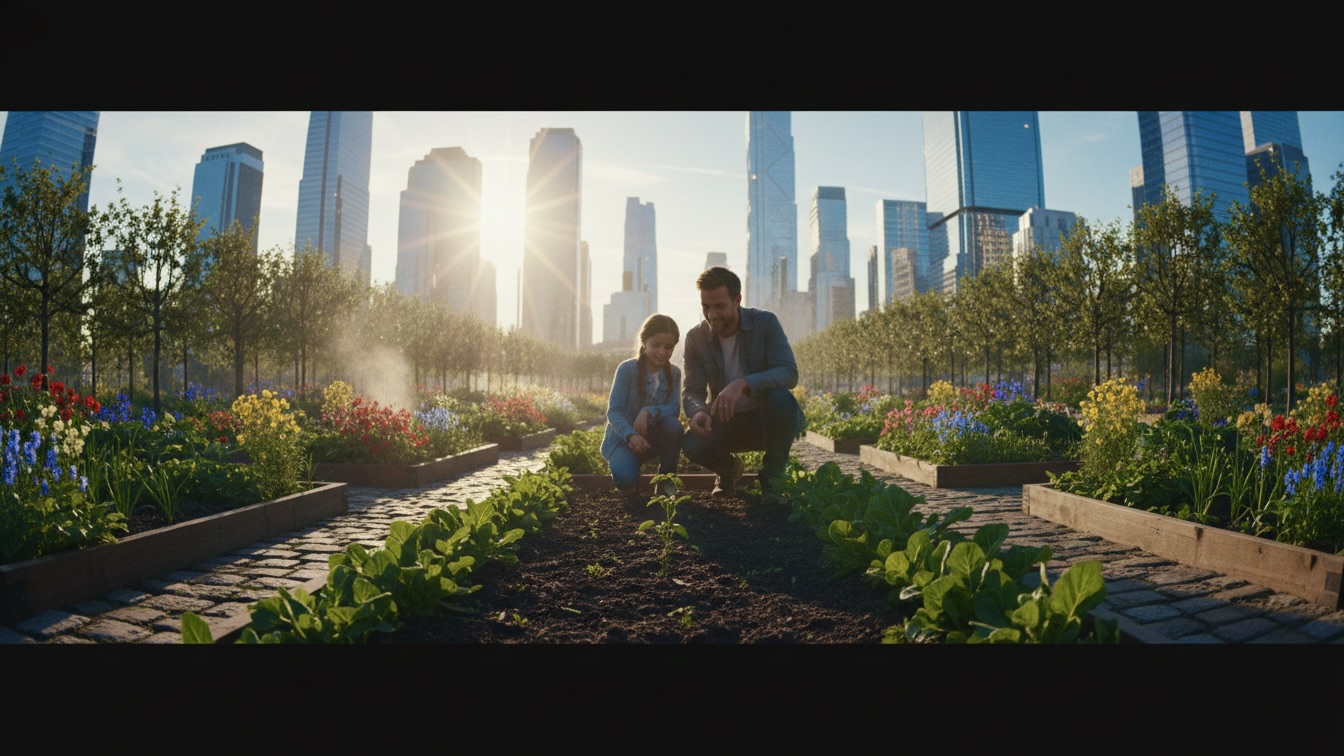
Mark hasn't spoken to Sophie in years until a community garden brings them together to fight city developers.
The silence in Mark’s apartment didn't sound like peace. It sounded like a dead battery. Five years of it. He sat at the kitchen table, the wood scarred from a decade of coffee mugs and dropped keys. Outside, the city hummed, a low-frequency vibration that made the windows rattle in their frames. It was March. The air was starting to lose its bite, replaced by that raw, damp smell of things trying to grow through concrete. He didn't grow things. He managed logistics for a shipping firm. He moved boxes from Point A to Point B. People were just boxes he didn't know how to carry.
His phone buzzed. A notification from a news app: 'Greenwood Commons Demolition Scheduled for Monday.' He closed the app. He didn't want to see it. He didn't want to think about the plot of land three blocks over where his wife, Elena, had spent her weekends covered in peat moss. Since she died, that garden was a ghost story he avoided. But ghosts have a way of finding the people who owe them the most.
A heavy knock thudded against his door. Not the polite rap of a neighbor. This was a challenge. Mark stood up, his knees popping—a reminder of fifty-something years of gravity. He opened the door and the oxygen in the hallway seemed to vanish. Sophie stood there. She looked like Elena, but sharper. Her hair was dyed a faded blue at the tips, and her eyes were tired in a way twenty-three-year-olds shouldn't be. She held a thick manila envelope like a weapon.
"You're still here," she said. No hello. No how are you.
"I live here, Sophie."
"Barely." She stepped past him, her boots leaving faint damp prints on his linoleum. She threw the envelope onto the table. "You need to sign this. It’s an affidavit for the injunction. We’re filing against the city to stop the bulldozers."
Mark didn't touch the paper. "It’s over, Soph. Edwards and the council already voted. They want the tech hub. It’s tax revenue."
Sophie laughed, a short, jagged sound. "Tax revenue. Right. Forget that Mom built that place from a literal trash heap. Forget that half the neighborhood gets their actual food from those beds. You’re just going to let them pave it because it’s easier than caring."
"I care," Mark said, his voice flat.
"No, you’re in your avoidance era. You’ve been in it for five years. You avoided her funeral, you avoided my graduation, and now you’re avoiding the only thing she left behind that actually breathes. Sign the paper, Mark. Or don't. But if you don't, don't ever call me again. Not that you do anyway."
She turned to leave, her hand on the knob. Mark looked at the envelope. He looked at her back—the rigid set of her shoulders, the way she was holding her breath. He felt the claustrophobia of his own life, the four walls of his apartment closing in like a shipping container.
"Wait," he said. He picked up a pen. "I’ll sign. But an affidavit won't win this. Edwards needs a reason to flinch. He needs the optics to be bad."
Sophie turned around, her expression skeptical. "The optics are already bad. They’re tearing down a garden."
"Not enough," Mark said. "We need to show them the garden isn't just dirt. We need to plant the spring harvest. Now. If the plants are in the ground—if there’s a crop people are waiting for—the legal stay is easier to argue. It’s about 'irreparable harm.'"
Sophie stared at him. For a second, the wall between them thinned. "You remember the legal terms from Mom’s old cases."
"I remember some things."
"Fine," she said, her voice softening by a fraction of a decibel. "Meet me there at six. Bring gloves. Real ones, not those thin ones you use for the car."
***
The garden was a mess. Winter had been cruel. Dead vines clung to the chain-link fence like skeletal fingers. The soil was gray and compacted. Sophie was already there, dragging two-cubic-foot bags of organic garden soil toward the center of the lot. She looked small against the backdrop of the rising glass towers that surrounded the park. The city was eating the sky, and this little patch of earth was the only thing left that wasn't made of steel.
Mark grabbed a bag. It was heavier than he expected. He felt the strain in his lower back immediately. "Where do you want this?"
"The heirloom beds," Sophie said, pointing to the raised wooden structures in the back. "The Brandywine seeds Mom saved. I’ve been starting them in my apartment under LEDs. They’re ready."
They worked in a rhythm of shared labor and jagged silence. Heave, rip, pour. Heave, rip, pour. The sun began to dip behind the skyscrapers, casting long, bruised shadows across the dirt. Mark’s hands were soon coated in a fine, dark dust. It felt strange—tangible. Not like the digital spreadsheets he stared at all day.
"You’re doing it wrong," Sophie said, watching him level the soil. "You’re packing it too tight. The roots need to breathe. They’re not bricks."
"I’m just trying to make it level."
"It doesn't need to be level. It needs to be alive."
She knelt in the dirt, her jeans instantly staining. She began to poke holes in the earth with a finger, her movements precise. Mark watched her. She had Elena’s hands. Long fingers, steady grip. He felt a sudden, sharp pang in his chest that had nothing to do with physical exertion. It was the realization that he had missed the moment she became an adult. He had been so busy protecting himself from the pain of the past that he’d locked out the person who shared it.
"I saw your car last week," Mark said, trying to find a thread of conversation. "In the shop on 4th?"
"The alternator died," she said without looking up. "I fixed it myself."
"You did?"
"YouTube. And I didn't have the money to pay a mechanic. I’m a freelance designer, Mark. I live on coffee and spite."
"I could have helped."
"You didn't answer my texts for three months after Christmas. I stopped asking."
The silence returned, heavier this time. A siren wailed a few blocks over. The smell of the fresh soil was thick now—sweet, metallic, and deep. It was the smell of oxygen. Mark realized he was breathing deeper than he had in years. The claustrophobia of his apartment felt like a different world.
They spent the next three hours hauling fifty bags of soil. By the end, Mark’s shirt was damp with sweat despite the cool spring breeze. They reached the heirloom section. Sophie pulled a tray of small, green starts from her bag. They were fragile, barely four inches tall, but their leaves were a vibrant, defiant green.
"These are the ones," she whispered. "If we get these in, we can call the press tomorrow. 'Community Plants Heritage Crop Amidst Demolition Threat.' It’s a headline."
As they tucked the last seedling into the ground, a black sedan pulled up to the curb. The engine didn't turn off. A man stepped out, wearing a suit that cost more than Mark’s car. It was Councilman Edwards. He looked at the dirt-stained pair with a mixture of pity and annoyance.
"Mark," Edwards said, nodding. "I heard you were down here. I thought you were a man of logic."
Mark stood up, wiping his hands on his thighs. "Logic changes when the variables do, Councilman."
Edwards walked to the fence, his polished shoes staying carefully on the sidewalk. "The developer, Aris Group, they’re not monsters. They want to revitalize this corridor. They told me to tell you that if you can get the neighborhood to drop the injunction, there’s a 'consulting fee' in it for you. Six figures. You could move out of that walk-up. You could set Sophie up in a real studio."
Sophie froze, a trowel halfway in the dirt. She looked at Mark. Her face was unreadable, but her eyes were narrowed, waiting for the inevitable betrayal. She had been conditioned to expect it.
Mark looked at the small green plant at his feet. He looked at the dirt under his fingernails. He felt the weight of the bribe, the 'easy way out' he had taken so many times before. Then he looked at Sophie. She looked like she was prepared to lose everything.
"The soil is already in the ground, Arthur," Mark said. "The seeds are in. We’re not selling."
Edwards sighed, a sound of corporate fatigue. "It’s a patch of weeds, Mark. Don't be a martyr for a dead woman's hobby."
"It’s not a hobby," Mark said, his voice gaining a sudden, sharp edge. "It’s a lung. This city is choking, and you want to pull the plug. Get off the property."
Edwards didn't argue. He just got back into his car and drove away. The red taillights faded into the city glow.
Sophie stood up slowly. She brushed a lock of hair behind her ear, leaving a streak of mud on her forehead. "You just turned down a lot of money."
"I’ve had money," Mark said. "It didn't help."
"Why now?" she asked. Her voice was small. The minimalist armor was cracking.
"Because I’m tired of being alone in a quiet room, Soph."
***
The following Saturday was the Renewal Festival. It was a gamble. They had forty-eight hours before the bulldozers were scheduled to arrive. The neighborhood had rallied—a chaotic, beautiful mess of people. There were folding tables with homemade cookies, a local band playing acoustic covers on the bed of a pickup truck, and hundreds of people wandering between the rows of newly planted vegetables.
Mark stood on a makeshift stage—two wooden pallets pushed together. He looked out at the crowd. He saw the families from the nearby projects, the tech workers who lived in the high-rises, and the older residents who remembered when this was a vacant lot filled with needles. He saw Sophie standing near the front, her arms crossed, her face tight with anxiety.
He took the microphone. The feedback squealed for a second before settling into a hum.
"I’m not a speaker," Mark started. His voice sounded strange to him—not the voice of a man who managed logistics, but the voice of a man who lived here. "I’m a guy who spent five years trying to forget this place existed. I thought if I stayed away, the things I lost wouldn't hurt as much. I was wrong."
He looked directly at Sophie. She didn't look away.
"We talk about 'revitalizing' things like they’re just blueprints and steel. But you can't revitalize something if you kill the heart first. This garden is the heart. My wife built it because she knew that people need to touch the earth to remember they’re human. I forgot that. I failed her, and I failed my daughter. I spent five years in a quiet apartment while she was out here doing the work. I’m not here to save the garden today. I’m here because the garden saved me."
He paused, the silence of the crowd different now. It wasn't the silence of his apartment. It was the silence of people listening.
"If the bulldozers come on Monday, they’ll have to go through us. Because we’ve already planted. And you don't tear up what’s growing."
He stepped down. The applause wasn't thunderous, but it was real—a wave of warmth that felt like the first true day of spring. Sophie met him at the edge of the pallets. She didn't say anything at first. She just reached out and gripped his forearm. Her hand was warm.
"That wasn't terrible," she said. High praise.
"I meant it."
"I know."
***
Monday morning came with the sun. Mark and Sophie sat on the edge of the heirloom tomato beds, drinking coffee from paper cups. The air was crisp, the sky a pale, hard blue. At 8:00 AM, the sound of heavy engines began to rumble down the street. Two yellow bulldozers appeared at the end of the block, followed by a city SUV.
Mark stood up. Sophie stood beside him. They weren't alone. Behind them, nearly a hundred neighbors had gathered, sitting on the ground, leaning against the fence, or standing with signs.
The lead bulldozer stopped twenty feet from the gate. Councilman Edwards got out of the SUV, looking tired. He didn't look at the crowd. He looked at his phone. He walked toward Mark, his steps hesitant.
"The judge signed it," Edwards said, his voice flat. "A stay of execution. Pending a full environmental impact study of the heirloom species you... conveniently discovered."
Sophie let out a breath she seemed to have been holding for five years. She leaned her head against Mark’s shoulder for a split second before pulling back, reclaiming her space.
"We win?" she asked.
"For now," Mark said. "But 'for now' is long enough to grow a lot of things."
Edwards turned back to the machines and signaled them to retreat. The rumble of the engines faded as they backed down the street, their yellow paint glaring in the spring sun. The crowd began to cheer, but Mark barely heard it. He was looking at the dirt on his boots. It was the same dirt that was on Sophie’s boots.
"The garden is going to need a lot of work this season," Sophie said, looking at the rows of seedlings. "The irrigation is shot, and the north fence is rotting."
"I have some tools in storage," Mark said. "I can be here after work. Every day, if you want."
Sophie looked at him, her expression guarded but the sharpness in her eyes replaced by something softer—clarity. The claustrophobia was gone. The air felt thin and clean.
"I’m making pasta tonight," she said, her voice terse but the offer clear. "At my place. 7:00 PM."
Mark nodded. "What should I bring?"
"Just yourself," she said. "And maybe don't be late. It’s my avoidance era, remember? I have zero patience for people who don't show up."
She walked away to join the group of volunteers, her movements quick and full of purpose. Mark stayed by the tomato plants for a moment longer. He reached down and touched the leaf of a Brandywine start. It was cool and slightly fuzzy. It felt like a beginning.
He walked out of the garden, the gate clicking shut behind him. He didn't go back to his apartment. He went to the hardware store to buy a new shovel, the weight of the past finally light enough to carry.
The city was still loud, the glass towers still loomed, but the ground beneath him felt solid. He checked his watch. He had ten hours until dinner. Ten hours to figure out how to be a father again. He started walking, his pace fast, his lungs full of the sudden, sharp oxygen of a world that was no longer a quiet room.
He saw a small purple flower pushing through a crack in the sidewalk. He didn't step on it.
He kept walking, the sun warming the back of his neck, the future no longer a box to be moved, but a seed that had finally, miraculously, found the light.
Sophie was waiting for him in the distance, waving him over to help with a heavy trellis, and for the first time in five years, Mark didn't look away.
“He reached for the door to her apartment, wondering if he was ready for the honesty that waited on the other side.”


