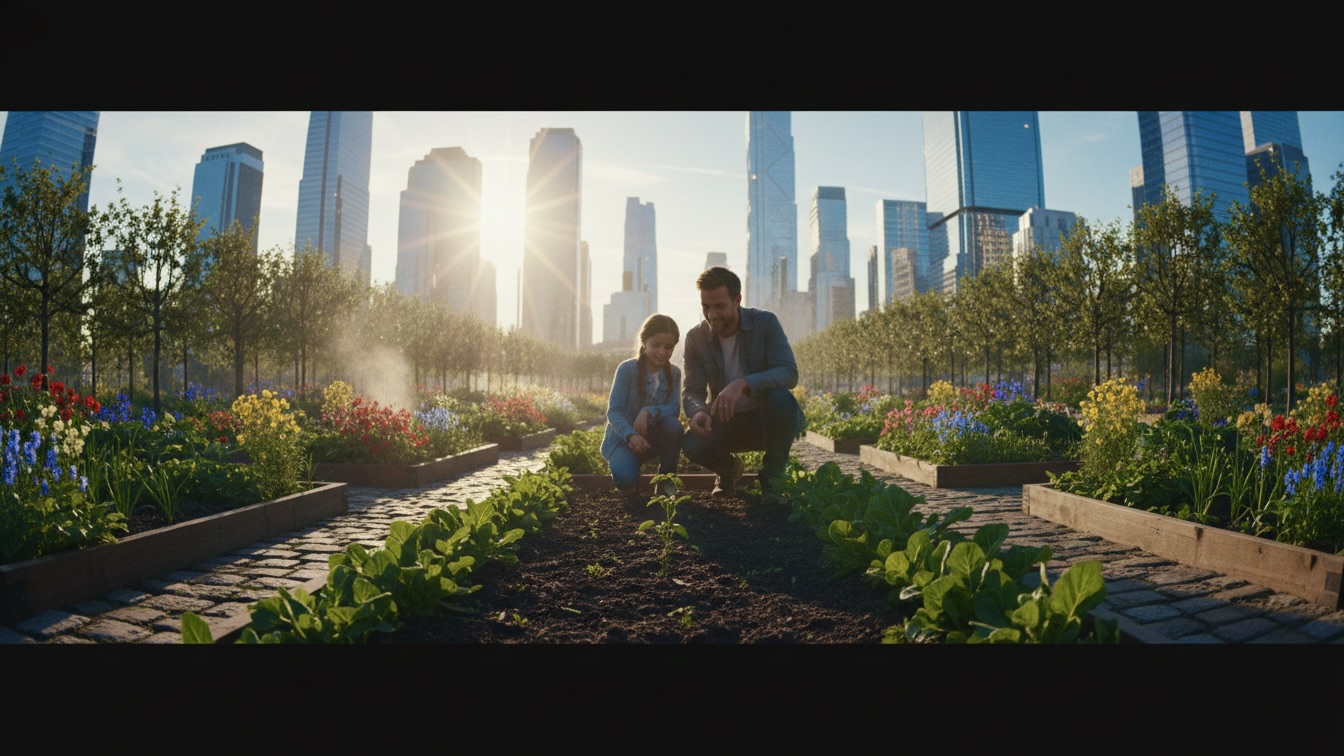
Mark is a man defined by his stagnation, living in an apartment that feels more like a storage unit than a home five years after his wife Elena’s passing. When his estranged daughter Sophie arrives with a legal plea to save their mother’s community garden from urban development, Mark is forced to confront the grief he has spent years avoiding. Rather than merely signing a document, he chooses to engage in the physical reclamation of the land, using his knowledge of his late wife’s legal background to devise a strategy centered on the concept of "irreparable harm."
Through the grueling labor of preparing the soil and planting heirloom seeds, Mark and Sophie navigate their fractured bond in the shadows of the city's glass towers. They resist a significant bribe from a local councilman, choosing instead to rally the neighborhood for a festival of resistance. The story concludes with a successful legal stay for the garden and the beginning of a tentative reconciliation between father and daughter. Mark finally steps out of his "avoidance era" and back into the world of the living, finding purpose in the dirt he once tried to forget.
The central theme of "Heirloom Soil" is the transformative power of grief when it is transitioned from passive avoidance to active cultivation. Mark’s initial state is one of emotional paralysis, where he views life through the lens of logistics—moving boxes without understanding the weight of the contents. The garden serves as a physical manifestation of the memories he has suppressed, and his return to it represents a psychological homecoming. By engaging with the earth, he stops merely managing his existence and starts participating in it.
Another significant theme is the conflict between organic human connection and the sterile encroachment of modernization. The glass towers and "tech hubs" represent a future that prioritizes profit and efficiency over the "lung" of the community. By choosing the soil over a six-figure bribe, Mark rejects the transactional nature of his current life. He acknowledges that some things, like the heritage of a family or the health of a neighborhood, possess a value that cannot be quantified by a corporate ledger.
The metaphor of "heirloom" growth also underscores the importance of generational continuity. The Brandywine tomatoes are not just plants; they are a genetic link to Elena and a bridge between Mark and Sophie. The act of planting these specific seeds suggests that while individuals die, the beauty and sustenance they provide can be preserved through intentional care. This theme highlights that legacy is not a static monument but a living thing that requires the labor of those left behind to survive.
Mark is a man suffering from prolonged, complicated grief that has manifested as a total withdrawal from his emotional responsibilities. His professional life in logistics mirrors his internal state, as he attempts to manage his world as a series of points and boxes rather than feelings and people. He uses his apartment as a fortress against the "vibration" of a world that reminds him of his loss. This avoidance has cost him his relationship with his daughter and his sense of self.
His psychological journey in the chapter is one of "re-earthing." When he touches the soil and feels the physical strain of labor, he is forced back into his body and out of his numbing routine. The rejection of the bribe is his most significant moment of growth, marking the point where he chooses integrity and his daughter over the "easy way out." By the end of the story, he has moved from a man who avoids funerals to a man who shows up for dinner, signaling a recovery of his paternal identity.
Sophie represents the "sharp" edge of grief, characterized by her anger and her refusal to let the past be paved over. Unlike her father, who retreated into silence, she has channeled her pain into activism and self-reliance. Her dyed hair and "minimalist armor" suggest a young woman who has had to create her own identity and protection in the absence of a present father. She carries the burden of her mother’s legacy with a fierce, almost desperate intensity.
Her arc in the story is focused on the cautious lowering of her defenses. While she begins the encounter with hostility and ultimatums, her willingness to invite Mark to dinner at the end shows a capacity for forgiveness. She tests him throughout the narrative, watching to see if he will fail her again. When he stands his ground against the councilman, she allows herself to lean on him, if only for a second, acknowledging that she no longer has to carry the weight of the garden alone.
The pacing of the narrative effectively mirrors Mark’s internal awakening, starting with a slow, claustrophobic atmosphere and transitioning into a more rhythmic, active tempo. The initial scenes in the apartment are heavy with silence and stagnation, emphasizing the "dead battery" of his life. As the action moves to the garden, the prose becomes more tactile and sensory, filled with the "heave, rip, pour" of manual labor. This shift in energy reflects the character’s movement from a state of stasis to one of purpose.
The author uses sensory details to ground the reader in the physical reality of the transformation. The "raw, damp smell" of spring and the "fine, dark dust" on Mark’s hands serve as a sharp contrast to the "digital spreadsheets" of his work life. These details emphasize the "tangible" nature of his new path. The sound of the city—the rattling windows and wailing sirens—acts as a constant pressure that makes the quiet moments in the garden feel more precious and hard-won.
The tone of the story is one of gritty hope, avoiding sentimentality in favor of a more realistic portrayal of healing. The dialogue between Mark and Sophie is "jagged" and "terse," reflecting the genuine difficulty of repairing a broken relationship. There are no grand declarations of love, only the practical offers of help and the shared silence of work. This stylistic choice makes the eventual victory and the dinner invitation feel earned rather than forced, grounding the emotional payoff in the reality of the characters' shared struggle.


