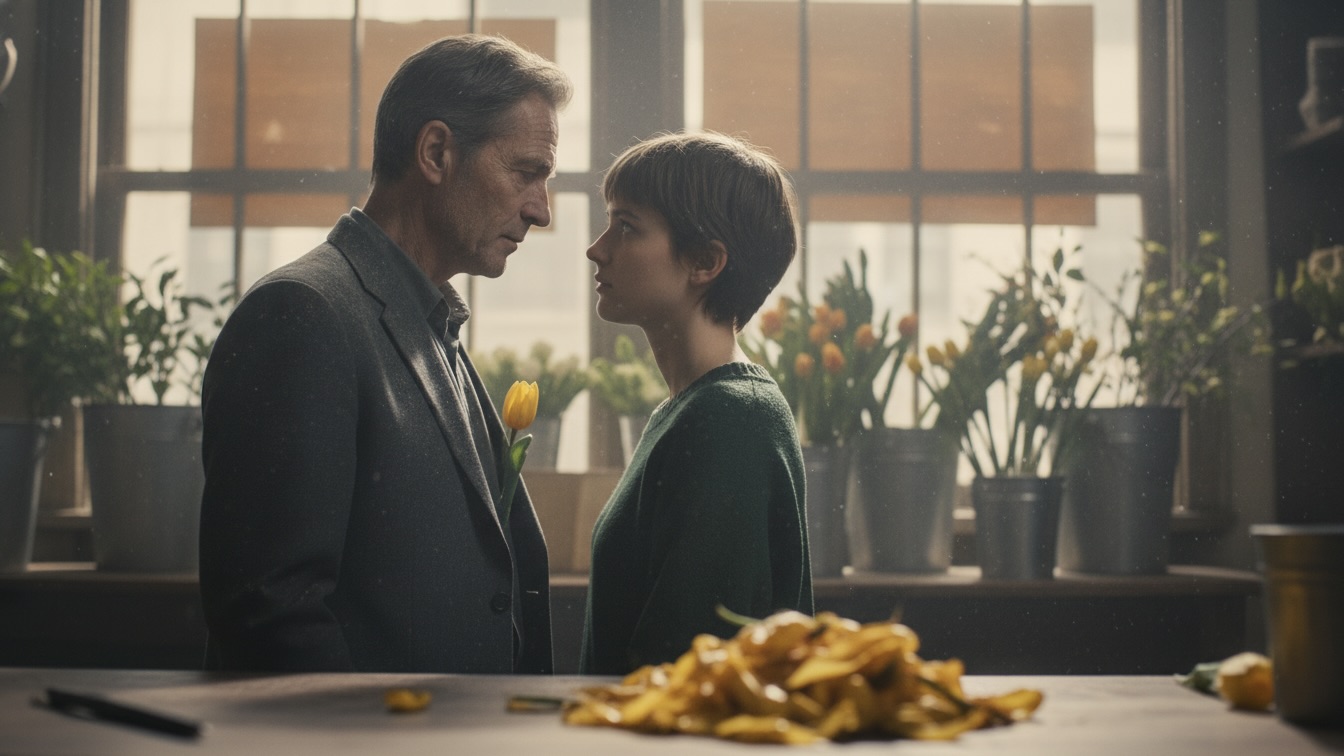
A retired judge and his activist daughter find shelter in a florist shop as the city erupts outside.
Robert sat on a concrete planter that had been painted a neon shade of yellow for the festival. It was too low for his knees. The stone was cold, leaching heat from his thighs despite the bright April sun. He looked at his watch. 12:15 PM.
Helene was fifteen minutes late, which meant she was actually on time in her own world. He adjusted his glasses. They were expensive, rimless things that felt like they were sliding off his face every time he sweated. Around him, the downtown plaza was a mess of sensory static. People in bright windbreakers held paper cups of overpriced coffee. The air smelled like fried dough and car exhaust. Somewhere nearby, a street performer was playing a steel drum. It was a rhythmic, hollow sound that made Robert’s head throb. He wondered if this was a mistake. Three years of silence was a long time to break over a lukewarm salad.
He pulled out his phone. The screen had a hairline fracture across the top right corner. He hadn’t fixed it because he liked the way it felt under his thumb—a reminder that things break even if you’re careful. He checked his messages. Nothing from her. He looked up and saw the crowd shifting. The casual flow of tourists was being interrupted by a denser, faster current. People in black hoodies. Backpacks. The energy in the plaza changed instantly, like the drop in pressure before a storm. He felt a familiar tightening in his chest. As a judge, he’d spent thirty years watching people try to explain why they’d broken things. He knew the look of a crowd that was about to stop talking and start hitting.
"You’re still wearing that suit," a voice said.
Robert turned. Helene was standing there. She looked older, or maybe just more tired. Her hair was chopped short, jagged at the ends as if she’d done it herself with kitchen shears. She smelled like stale cigarette smoke and something metallic—adrenaline, maybe. She didn't hug him. She didn't even sit down. She just stood there, looking at the suit he’d worn to his retirement party three years ago.
"It fits," Robert said. "You’re late."
"I was busy," Helene replied. She looked toward the gathering crowd at the edge of the fountain. Her eyes were sharp, scanning the movements of the police officers who were starting to line up near the bank entrance. "The world doesn't stop because you want lunch, Dad."
"I thought we were here to talk, not to monitor the revolution," Robert said. He tried to keep his voice level. He didn't want to start with a fight, but she made it so easy. She always carried her politics like a loaded weapon.
"Talking is a luxury," she said, her eyes still on the police. "You’d know. You spent decades talking in a room where everyone had to listen to you. That’s not how the street works."
"The street seems to be working itself into a frenzy," Robert noted. He stood up, his knees popping. "Let’s go inside. There’s a bistro around the corner. It’s quiet."
"I’m not going into a bistro," Helene said. She finally looked at him, and the intensity in her gaze made him want to look away. "I’m not sitting in some air-conditioned bubble while they’re out there. You’re so complicit, Robert. You think because you followed the rules, the rules were fair. They weren't. They were just your rules."
"I applied the law as it was written," he said. It was his standard defense, his armor.
"Exactly," she spat. "And that’s why we don't talk."
Before he could respond, a loud, percussive pop echoed through the plaza. It wasn't a gunshot. It was a flashbang. Then came the screaming. The polite festival atmosphere dissolved in seconds. The steel drum player stopped. The tourists began to run, their bright windbreakers becoming a blur of panicked color. A group of protesters surged forward, their voices rising into a singular, unintelligible roar.
"Helene, we have to go," Robert said, reaching for her arm.
She pulled away, her face lit with a terrifying sort of focus. "This is what happens when you ignore the rot!"
Suddenly, the front window of the bistro Robert had pointed to exploded. It didn't shatter; it disintegrated into a rain of heavy, jagged glass. A brick had gone through it, followed by a trash can. The sound was like a car crash that wouldn't end. The crowd pushed them back, a wave of bodies moving toward the narrow side street. Robert felt a shove from behind. He stumbled, his expensive glasses flying off his face and disappearing under a dozen hiking boots. The world turned into a smudge of gray and green.
"Dad!" Helene grabbed his jacket. Her hand was shaking, though her face remained a mask of defiance.
They were forced toward the doorway of a small shop tucked between two larger buildings. A heavy wooden door creaked open, and a hand reached out, pulling them inside just as a line of riot police swept past the window, shields clanking.
Inside, the air was suddenly still. It was cool and damp, and the smell was overwhelming—not smoke or sweat, but the thick, sweet scent of crushed stems and wet earth. They were in a florist's shop. Piles of yellow tulips, white lilies, and blue hydrangeas sat in galvanized buckets. The florist, a woman in her sixties with dirt under her fingernails, slammed the door and threw the bolt.
"Stay away from the front," she said. Her voice was steady, but she was clutching a pair of heavy garden shears like a dagger.
Robert leaned against a cooling unit, gasping for air. Without his glasses, the shop was a dreamscape of blurred colors. He felt like he was underwater. "Are you hurt?" he asked, squinting toward where he thought Helene was.
"I'm fine," she said. Her voice was different now. The edge was gone, replaced by a hollow vibration. He heard her slide down the wall. "They’re actually doing it. They’re actually breaking it."
"They’re breaking everything," Robert said. He felt for a chair and sat down, his heart hammering against his ribs. The claustrophobia of the last three years—the silence, the unread emails, the bitterness—seemed to have materialized into the stone walls of this shop.
Outside, the world was ending in screams and the rhythmic thud of batons against plastic. Inside, a petal from a yellow tulip drifted onto Robert’s shoe.
"Why did you stop calling, Helene?" he asked. The question felt heavy, dropping into the quiet of the shop like a stone into a well. "It wasn't just the sentencing guidelines. It wasn't just the politics. What was it?"
Helene didn't answer for a long time. He could hear her breathing—short, jagged inhalations. "Because you looked at me like a case file," she said finally. "I’d come home from a rally, or from jail, and you’d look at me with that... that judicial neutrality. You weren't worried about me. You were just waiting for me to finish my testimony so you could tell me why I was legally wrong."
"I was trying to keep you safe," Robert said. "The law is a structure. Without it, you’re just... you’re in the middle of that."
He gestured toward the window. A heavy object hit the glass. It didn't break, but a web of white cracks spread across the pane. The florist let out a small, sharp cry and retreated further into the back of the shop.
"I don't want your structure!" Helene yelled, her voice cracking. "Your structure is a cage! I’m scared, Dad. I’m scared all the time. I’m scared that by the time I’m your age, there won't be any trees left, or any clean water, or any hope. And you just sat there in your robes and watched it happen. You protected the people who are burning the world down."
Robert felt a coldness in his gut that had nothing to do with the air conditioning. "I’m scared too," he admitted. The words felt thin, fragile. "I’m scared of the world you want to build. You want to tear everything down, but you have no blueprint for what comes next. You think chaos is a cleansing fire, but it’s just fire. It burns the innocent too. It’s burning this flower shop right now."
"At least it’s honest," she whispered. He heard her move, the sound of her boots on the wet floor. She sat down next to him. He could feel the warmth of her shoulder against his arm. It was the first time they’d touched in years.
"I just wanted you to be a father," she said. "Not a judge. I needed you to say 'I'm glad you're alive,' not 'You've violated section four of the municipal code.'"
Robert reached out, his hand hovering in the blur before finding her hand. Her fingers were cold. He squeezed them. "I am glad you’re alive, Helene. Every day. Even when I’m angry. Especially when I’m angry."
A brick finally made it through the front window. The safety glass held for a second before collapsing inward, a cascade of crystalline cubes bouncing off the buckets of tulips. The florist screamed.
"We need to board this up," the woman said, coming forward. She was dragging a heavy piece of plywood from the back room. "If they see the window is open, they’ll come in. They’ll take everything."
Robert stood up. His knees ached, and his vision was a mess, but he felt a strange, sudden clarity. The oxygen in the room felt different—no longer heavy with the scent of dying flowers, but sharp and electric.
"Helene," he said. "Help her."
Helene stood. She wiped her eyes with the back of her hand. She looked at the plywood, then at the shattered window, then at her father. She didn't say anything about the status quo. She didn't mention complicity. She just grabbed one end of the board.
Robert grabbed the other. They were a strange trio—the retired judge in a tailored suit, the radical organizer in a smoke-stained hoodie, and the florist with her garden shears. Together, they lifted the heavy wood and pressed it against the frame.
"I need a hammer," Robert said. "And nails."
The florist handed him a heavy, rusted hammer. Robert held a nail against the wood. He couldn't see the head of the nail clearly, but he could feel it. He swung. The sound of metal hitting metal was loud and final.
"Hold it steady," he told Helene.
"I've got it," she said. She leaned her weight against the plywood, her shoulder pressing into his.
They worked in silence for twenty minutes. The world outside continued to scream, but inside, there was only the rhythm of the hammer. Each nail was a small act of defiance against the chaos. They weren't fixing the world. They weren't even fixing their relationship. But they were standing in the same room, breathing the same air, and holding the same board.
When the last nail was in, the shop was dark. The only light came from the small cracks between the boards. The smell of the tulips was even stronger now, trapped in the small space.
Robert leaned his head against the plywood. He was exhausted. His hands were shaking.
"What happens when we go out there?" Helene asked. She was looking at the door. The noise outside had faded to a low, ominous hum.
"We walk," Robert said. "We walk until we find a place that isn't on fire."
"And then?"
Robert looked toward her blurred shape. "And then we try to talk again. Without the suits. Without the slogans."
Helene was silent for a moment. Then, she reached into a nearby bucket and pulled out a single yellow tulip. The stem was broken, but the petals were still bright. She tucked it into the breast pocket of Robert’s expensive suit.
"Your suit is ruined anyway," she said, a hint of her old irony returning.
"It was getting too tight," Robert lied.
He turned toward the door, his hand on the bolt. He didn't know what was waiting for them on the other side—tear gas, police lines, or just a very long walk home. But for the first time in years, the air in his lungs didn't feel like it was being rationed.
“He turned the bolt on the heavy wooden door, bracing himself for whatever the city had become while they were hiding.”


