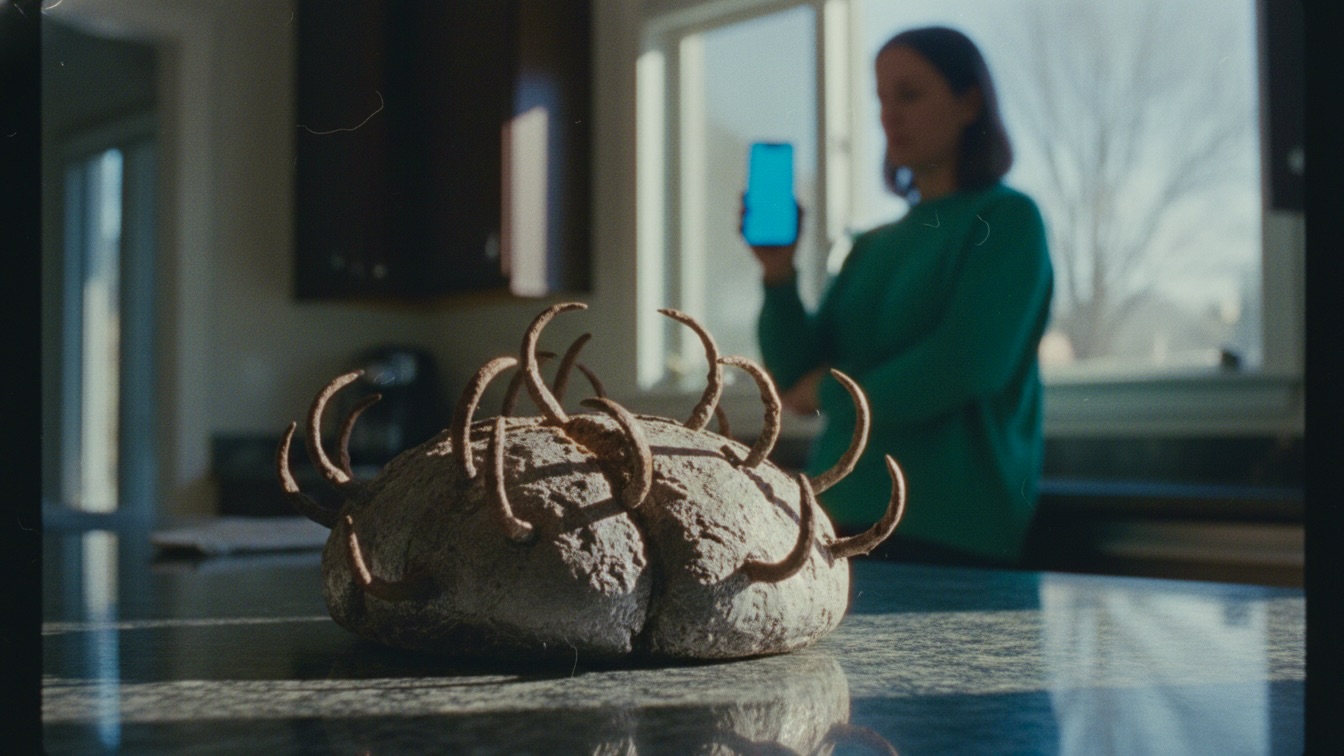
Deb aligns her baby's frequencies with a heavy, metal-laced dough blanket, unaware the wellness cure is actually eating him.
Lee was vibrating. That was the problem. Not the kind of vibration you could see with the naked eye, though Deb swore she could see his edges blurring against the crib sheets. It was a frequency issue. The house was full of bad air—WiFi signals, the hum of the smart fridge, the invisible grit of the 5G tower three blocks over. It was all noise. And Lee, poor six-month-old Lee, was soaking it up like a sponge. He wouldn't stop crying, a high, thin sound that felt like a needle tapping against the back of Deb's skull. It wasn't hunger. It wasn't a wet diaper. It was static.
She stood in the kitchen, the spring sunlight hitting the granite counters with a brightness that made her eyes ache. Outside, the world was aggressively green. New buds on the maples, tulips pushing through the mulch like blunt fingers. It was supposed to be the season of rebirth, but all Deb felt was a heavy, leaden exhaustion. She reached for the bowl of starter. This wasn't normal sourdough. This was the 'Gaia-Grounding Matrix' she’d ordered from a Telegram group for three hundred dollars. It arrived in a silver Mylar bag, smelling of wet pennies and old gym socks. The instructions were specific: mix with 'Iron-Rich Flour'—a heavy, greyish powder she’d found at a boutique health outlet in the city—and ferment for seventy-two hours under a UV lamp.
The dough was heavy. Heavier than it should have been. When she turned it out onto the counter, it didn't flop; it landed with a dull thud. It was a deep, bruised purple-grey, shot through with glints of something that looked like mica but felt like sand. She began to knead. The texture was strange, resisting her palms, then suddenly yielding with a wet, sucking sound. It felt like pushing her hands into warm, wet clay mixed with buckshot. Her wrists ached. Her skin started to tingle, a prickly sensation that crawled up her forearms. This was the grounding, she told herself. The toxins leaving her body. The frequency of the earth entering the grain.
She looked at her phone, mounted on a tripod by the sink. The ring light was already on, casting a flat, clinical glow over the dough. She tapped the screen. Go Live. The viewer count climbed instantly. Forty, eighty, two hundred. The comments started rolling in: 'Blessings, Deb!', 'Is that the new batch?', 'Look at that hydration!'.
"Hey guys," Deb said, her voice dropping into the practiced, breathy register of the online healer. She didn't look at the camera; she looked at the dough. "We’re doing the deep alignment today. Lee’s been so dysregulated. The atmospheric load is just too high this spring. You can feel it, right? That buzz in your teeth? That’s the grid. We’re going to ground him. This is the heavy blanket protocol. Fermented, bio-resonant, metal-dense. It pulls the static right out of the marrow."
She picked up the mass of dough. It felt like it had gained weight in the last five minutes. It was pulling on her shoulders. She carried it into the nursery, the phone following her on its gimbal. The room was dim, the air thick with the smell of lavender oil and something sharper—the smell of a hot iron left on too long. Lee was in his crib, his face a blotchy, frantic red. He wasn't even screaming anymore; he was just gasping, his little chest heaving in a rhythm that didn't match anything human.
"It’s okay, sweetie," Deb whispered, though she wasn't really talking to him. She was talking to the three hundred people watching on their phones. "We’re going to fix the signal."
She spread the dough. It was remarkably elastic. She pulled it thin, but it didn't tear. It stretched like a sheet of grey skin, wider and wider, until it was large enough to cover the infant from the neck down. As she lowered it onto him, Lee’s eyes went wide. He let out a choked sound as the weight hit him. It had to be forty pounds. The mattress sagged. The wooden slats of the crib groaned.
"See that?" Deb pointed at the screen. "The immediate stillness. That’s the grounding. The metal in the flour acts as a Faraday cage for his nervous system. He’s finally quiet."
Lee was quiet because he couldn't breathe. His ribcage was pinned. But Deb wasn't looking at his face; she was looking at the way the dough started to ripple. It was moving. Not from Lee’s breathing, but from within itself. Tiny, microscopic pulses traveled across the surface of the grey mass. A notification popped up on her phone, a red banner at the top of the screen: 'CONSUMER PRODUCT SAFETY COMMISSION: URGENT RECALL—IRON-RICH FLOUR BRAND.'
Deb swiped it away with a flick of her thumb. "The trolls are out today," she muttered to the camera. "The government doesn't want you to have the tools for your own sovereignty. They want us vibrating. They want us loud. Don't listen to the fear-mongering."
She sat in the rocker, watching the dough. The smell was getting worse. It wasn't just metal anymore; it was something sweet and rotting, like flowers left in a vase for a month. A tiny, sharp point broke through the surface of the dough near Lee’s shoulder. It was dark, almost black, and jagged. It looked like a splinter of rusted iron. Then another one appeared near his hip. Then three more.
"Look at the bloom," Deb whispered, leaning closer. The viewers were losing their minds. 'Is it growing?', 'What is that?', 'It looks like jewelry!'.
The splinters began to unfurl. They weren't wood; they were petals. Hard, metallic petals that shimmered with an oily, iridescent sheen. They grew with a faint, metallic clicking sound, like a clock winding up. As they opened, they revealed centers of soft, pulsing grey tissue. And then, the sound started. It wasn't a cry. It was a hum. A low, resonant frequency that vibrated the floorboards. It was perfectly in sync with the rhythm Lee’s heart had been three minutes ago.
"He’s singing," Deb said, her eyes welling with tears. "My baby is singing with the earth."
She didn't notice that the dough was no longer just sitting on top of Lee. It was merging with him. The grey mass was weeping a clear, viscous fluid that soaked into the baby’s pajamas, turning the cotton transparent. Where the fluid touched skin, the skin turned grey. The iron-petals were sprouting faster now, snagging on the mesh of the crib, tearing through the bumper pads. One petal, sharp as a razor, sliced into the wooden railing, leaving a deep, clean notch.
Deb stood up, her heart racing with a strange, frantic joy. She needed to prepare. She had the neighbors coming over. Pete and Sarah from down the street. They were skeptics—the kind of people who took their kids to doctors and ate processed sugar. She was going to show them. She was going to serve them the bread made from the same batch. She was going to save them too.
She left the nursery, the camera still running, capturing the crib as it became a riot of grey and silver. The humming grew louder, a harmonic chord that set the windows rattling in their frames.
In the kitchen, Deb began to bake. She took the remaining dough—the stuff that hadn't been used for the blanket—and shaped it into a boule. The oven was preheated to four hundred and fifty. When she slid the tray in, the smell changed instantly. It wasn't the smell of baking bread. It was the smell of a welding shop. A sharp, ozone tang that made her throat close up. She coughed, wiping sweat from her forehead with the back of a flour-dusted hand.
Her phone buzzed again. A text from an unknown number. 'Deb, this is Detective Rynds. I’m outside. We need to talk about the shipment you received from the industrial site in Ohio. Do not touch the material.'
Deb rolled her eyes. "They’re so desperate," she said to the empty kitchen. She went to the front window and peeked through the blinds. A black sedan was parked at the curb. A man in a suit was walking up her driveway, holding a clipboard. He looked tired. He looked like a man who spent his life vibrating at the wrong frequency.
She didn't open the door. Instead, she went back to the oven. Through the glass door, she saw the bread rising. It wasn't rounding out like a normal loaf. It was spiking. Long, thin needles of iron were shooting out of the crust, hitting the heating elements with a shower of sparks. The humming from the nursery was now a full-throated drone, a wall of sound that seemed to push against her skin.
The doorbell rang. Then a heavy knock.
"Deb? It’s Pete and Sarah. We’re a little early, but we brought wine!"
She wiped her hands on her apron and went to the door, a wide, fixed smile on her face. She opened it to find her neighbors standing there, clutching a bottle of cheap Pinot and looking confused.
"Do you guys hear that?" Sarah asked, squinting. "Is your plumbing okay? It sounds like a turbine."
"It’s the frequency of the house," Deb said, ushering them in. "We’ve achieved total alignment. Come in, come in. The bread is almost ready."
"Where’s Lee?" Pete asked, stepping over a stray iron-petal that had somehow migrated into the hallway. It was black and curved like a claw. He frowned, looking down at it. "Is that... wire?"
"He’s resting," Deb said. "He’s never been more peaceful. He’s part of the garden now."
She led them into the dining room. The table was set with her best linens, though the air was so thick with metallic dust that a fine grey film had already settled on the plates. The sound from the nursery was changing. The humming was breaking apart into individual notes—high, crystalline shrieks that sounded like metal being ground in a lathe.
"Deb, seriously," Sarah said, her voice trembling. "That sound. It’s coming from the baby’s room. Is he okay?"
"He’s perfect," Deb said. She went to the oven and pulled out the tray. The loaf was a monstrosity. It was a cluster of jagged, metallic shards, glowing a dull, angry red. It wasn't bread. It was a sculpture of fused slag and iron. She brought it to the table and set it down on a wooden trivet, which immediately began to smoke and char.
"What is that?" Pete backed away, his face pale.
"It’s the miracle," Deb said. She picked up a bread knife. The blade notched as soon as it touched the crust. She had to use a sawing motion, the screech of metal on metal drowning out the noise from the nursery. She hacked off a chunk and held it out to Sarah. "Eat. It’ll ground you. You’re so flighty, Sarah. You’re practically floating away."
From the nursery, a new sound emerged. A wet, tearing noise. Then, a voice. It wasn't Lee’s voice. It was a composite sound, thousands of tiny, vibrating petals working in unison to mimic speech. It was thin and mechanical.
"Mama," the house whispered. "Mama, I’m hungry."
Sarah dropped her wine glass. It shattered on the floor, the liquid pooling around her shoes. "That wasn't Lee. Deb, what did you do?"
"I aligned him!" Deb shouted, her voice cracking. She felt a sudden, sharp pain in her stomach. She looked down. A small, grey bump was forming under her apron. It throbbed in time with the sound from the nursery. "Can’t you feel it? The peace?"
The front door kicked open. Detective Rynds was there, a respirator mask pushed up onto his forehead. He took one look at the table, at the glowing, spiked bread, and then at the nursery door, which was now bowing outward as if something heavy was pressing against it from the other side.
"Out!" Rynds yelled at Pete and Sarah. "Get out of this house now! It’s a chemical byproduct! It’s self-assembling polymers!"
"It’s Gaia!" Deb screamed, clutching the bread to her chest. The iron needles pierced her palms, but she didn't feel the pain. She felt the connection. The grey fluid was leaking from the bread, staining her apron, sinking into her skin.
The nursery door groaned and then splintered. It didn't fall; it was pushed aside by a massive, roiling carpet of grey dough and iron flowers. It flowed into the hallway like lava, a sea of metallic tulips that clicked and sang. In the center of the mass, where the baby had been, was a tall, swaying column of fused metal and translucent flesh. It had no face, only a cluster of large, vibrant tulips that pulsed with a rhythmic, red light.
"Lee?" Sarah whispered, her back against the wall.
The thing that had been Lee tilted its head. The tulips opened wide, revealing rows of needle-thin iron teeth.
"Frequencies," the thing sang, the sound vibrating through the neighbors' teeth until their gums began to bleed. "All... aligned."
Rynds grabbed Deb by the arm, trying to pull her toward the door, but she was heavy. Impossibly heavy. Her feet seemed to be sinking into the floorboards, her shoes fusing with the wood. She looked at him with grey, clouded eyes.
"Don't you see, Detective?" she asked, her voice a chorus of metallic whispers. "The spring is finally here."
Outside, the spring sun continued to shine. The real tulips in the garden swayed in the breeze. But inside the house, the air was turning to lead. The humming grew until it was the only thing left, a single, perfect note that shattered every window in the neighborhood.
Deb reached out and took a bite of the glowing bread. It tasted like blood and batteries. It was the best thing she had ever eaten. She could feel the iron-petals starting to sprout in her lungs, opening up, blooming in the dark, preparing to sing to the morning.
The Detective scrambled back as the floor began to liquify. The grey mass was spreading, covering the furniture, climbing the walls. It wasn't just eating the house; it was converting it. The drywall was turning to slag; the carpet was becoming a field of razor-sharp grass.
"It’s beautiful," Deb whispered, as her jaw locked into place, fused by a sudden growth of silver ore.
She couldn't move her arms anymore. She was a statue, a monument to wellness, a perfect conductor for the earth’s most violent signals. She watched as the Lee-thing drifted toward Pete and Sarah, its iron-petals unfurling like reaching hands. They were screaming, but she couldn't hear them. All she could hear was the song.
The song of the bread. The song of the byproduct. The song of a world that was finally, mercifully, quiet.
As the sun began to set, casting long, orange shadows across the suburban lawn, the house fell silent. No more crying. No more static. Just the faint, rhythmic clicking of metal cooling in the dark, and the scent of a thousand iron tulips blooming in the spring air.
Deb felt a final, sharp tug in her chest. Her heart gave one last, leaden thump and then stopped. It didn't need to beat anymore. The frequency had taken over. She was grounded. She was deep. She was permanent.
In the nursery, the crib had completely vanished, replaced by a massive, pulsing mound of grey matter that sighed with the weight of its own growth. The windows were gone, replaced by thick sheets of translucent, biological plastic. The house was no longer a house. It was a hive. A nursery for the new spring.
And in the center of it all, Deb stood, her hand still frozen in the act of offering a piece of poisoned bread to a world that was no longer there to receive it.
The first of the iron-petals pushed through her eye socket, unfurling its jagged, silver wings toward the rising moon.
“As the neighbors screamed, Deb felt the first iron-petal tear through her throat, not to kill her, but to find its voice.”


