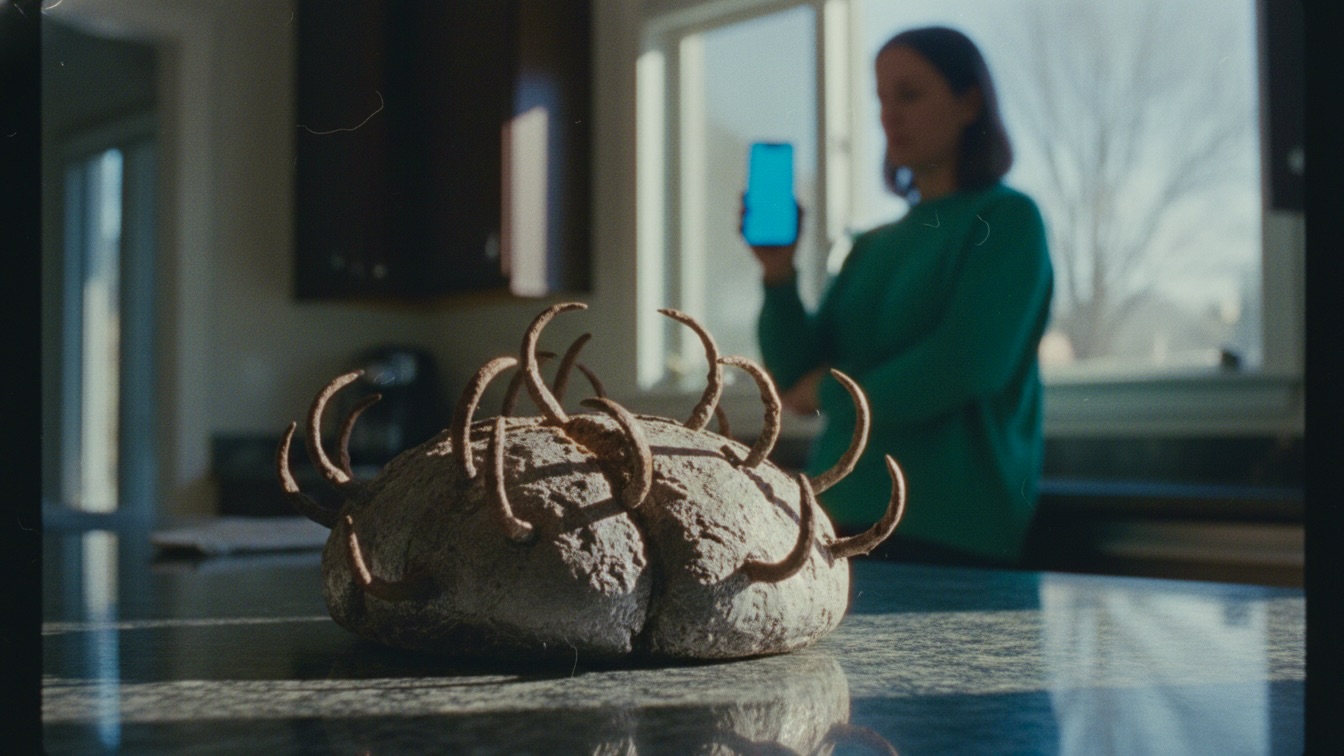
The story follows Deb, a mother overwhelmed by sensory input and the perceived "vibrations" of modern technology, which she believes are causing her infant son, Lee, to suffer. In an attempt to "ground" him and restore his frequency, she utilizes a specialized sourdough starter and iron-rich flour purchased from an extremist online wellness community. During a live-streamed event, she covers Lee with a massive, heavy blanket of this grey, metallic dough, ignoring a government recall notice and the baby’s clear physical distress. She views his resulting silence and lack of movement not as a sign of suffocation, but as the successful "alignment" of his nervous system.
As the narrative progresses, the dough reveals itself to be a self-assembling industrial polymer or biological byproduct that begins to consume and transform Lee. Jagged metallic flowers bloom from his body, and the house fills with a rhythmic, mechanical humming that Deb interprets as a spiritual breakthrough. When her neighbors, Pete and Sarah, arrive for a dinner party, they are met with the horrifying sight of the "miracle" bread and the sounds of a transformed creature mimicking human speech. Despite the intervention of a detective who warns her that the material is a dangerous chemical byproduct, Deb remains fully committed to her delusion. The story concludes with the total assimilation of the household, as Deb and her son become permanent, metallic fixtures in a biological hive, finally achieving the "peace" she so desperately sought.
The primary theme of the narrative is the dangerous intersection of maternal anxiety and digital misinformation. Deb’s descent into madness is fueled by a "Telegram group" and the echo chambers of online "healers" who weaponize pseudoscience to exploit vulnerable parents. Her fear of invisible threats like 5G and WiFi signals reflects a modern technophobia where the complexity of the world becomes a source of existential dread. By seeking "sovereignty" through unregulated products, she ironically surrenders her agency and her son’s life to a literal industrial waste product.
Another significant theme is the perversion of nature and the "wellness" aesthetic. The sourdough, traditionally a symbol of domesticity, nourishment, and slow living, is transformed into a vessel for body horror and industrial toxicity. The "Gaia-Grounding Matrix" represents the commodification of the earth-mother archetype, where the desire to return to a "natural" state leads to a grotesque, artificial evolution. The story suggests that the pursuit of purity and "alignment" can become a form of fundamentalism that blinds the individual to the visceral reality of suffering.
The concept of "grounding" serves as a central irony throughout the text. In the wellness community, grounding is intended to provide stability and health, but here it becomes a literal, leaden weight that anchors the characters into a state of permanent stasis. Deb’s desire to stop the "vibration" of life results in the total cessation of biological function. The "peace" she achieves is the silence of the grave, or rather, the silence of a machine, as she and Lee are converted into conductors for a frequency that is entirely inhuman.
Deb is a woman gripped by a profound psychological collapse, likely exacerbated by the isolation of new motherhood and the sensory overload of a digital world. Her internal state is characterized by a frantic need for control, which she masks with the "practiced, breathy register" of an online influencer. She views her son not as a sentient being with physical needs, but as a "dysregulated" object that must be tuned like a radio. This detachment allows her to ignore his gasping and the obvious signs of his death, as she is more concerned with the "viewer count" and the validation of her digital audience.
Her motivation is rooted in a desperate search for meaning in a world she perceives as "aggressive" and "loud." By adopting the persona of a healer, she compensates for her "leaden exhaustion" and feelings of inadequacy. Her refusal to listen to the detective or her neighbors highlights her total immersion in a conspiratorial mindset where any contradictory information is dismissed as "fear-mongering." Ultimately, her character represents the tragic end-point of radicalized self-optimization, where the ego is so consumed by its own narrative that it welcomes its own destruction as a form of enlightenment.
Lee serves as the silent, tragic pivot of the story, representing the ultimate victim of misguided parental protection. As a six-month-old infant, he is entirely dependent on a mother who has replaced intuition with ideology. His "vibration" and crying are likely normal infant responses to his environment or his mother’s own frantic energy, yet they are pathologized by Deb as "static." His transformation into the "Lee-thing" is a literal manifestation of how his identity and humanity are erased by the "heavy blanket" of his mother’s delusions.
Detective Rynds functions as the voice of the material world and the "vibrating" reality that Deb rejects. He represents the objective truth—that the "Gaia" matrix is actually a dangerous industrial byproduct from an Ohio site. His presence introduces a sense of urgency and grounded horror, contrasting sharply with Deb’s ethereal, detached perspective. Despite his efforts to save her, he is ultimately powerless against the speed of the biological conversion, serving as a witness to the finality of her choice to exit the human experience.
The pacing of the story is masterfully handled, beginning with a slow, domestic tension that gradually accelerates into a frantic, hallucinatory climax. The author uses the metaphor of "vibration" and "frequency" to build a sense of atmospheric dread, making the reader feel the same "needle tapping" against the skull that Deb describes. The transition from the mundane kitchen setting to the "riot of grey and silver" in the nursery mirrors Deb’s own loss of contact with reality. The narrative voice remains closely tied to Deb’s perspective, which creates a chilling contrast between her calm, spiritual descriptions and the visceral, metallic horror of the actual events.
Sensory details are used to create a "welding shop" atmosphere that subverts the typical warmth of a home. The smell of "wet pennies," "old gym socks," and "ozone" replaces the expected aroma of baking bread, signaling to the reader that something fundamentally wrong is occurring. The auditory descriptions, such as the "metallic clicking" of the petals and the "crystalline shrieks" of the house, reinforce the theme of biological life being overwritten by industrial machinery. These hard, sharp sounds contrast with Deb's "breathy" voice, emphasizing her delusion.
The imagery of the "iron tulips" and the "grey skin" of the dough provides a striking visual for the story's body horror elements. The author blends the organic and the inorganic, describing "pulsing grey tissue" and "needle-thin iron teeth" to evoke a sense of the uncanny. This fusion of the natural world with industrial waste highlights the perversion of the "spring" theme mentioned early in the text. Instead of a season of rebirth, the story presents a season of conversion, where the "miracle" is not life, but the cold, permanent stability of slag and ore.


