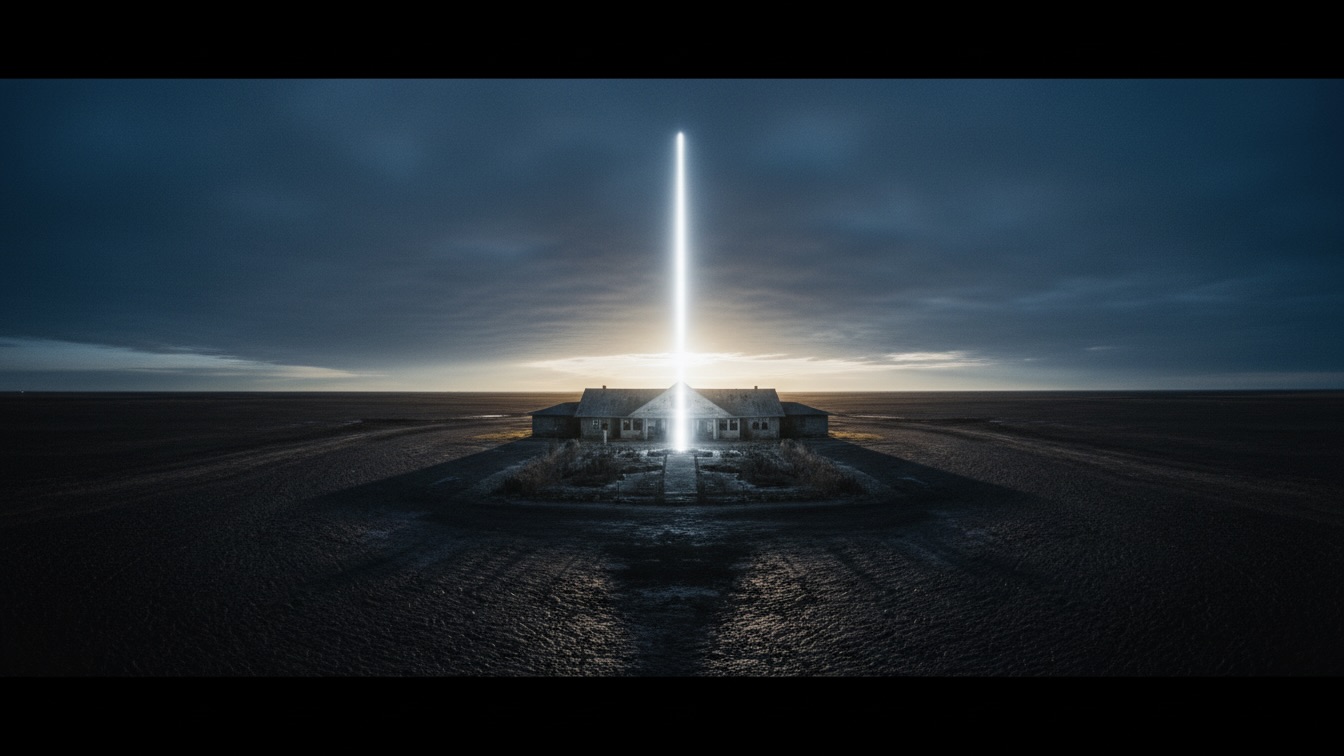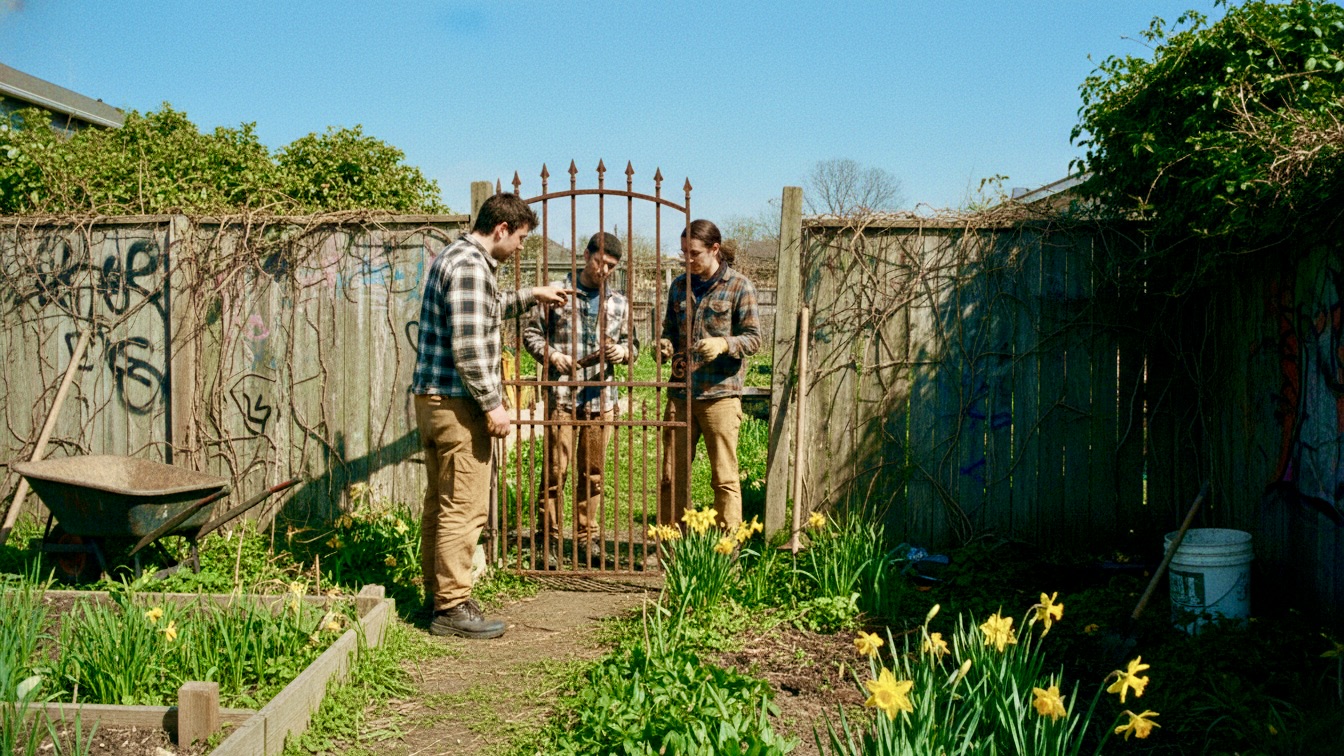
A group attempts to reclaim a cursed garden as winter shadows warp the reality of their local hall.
"The soil is dead, Mary. It is objectively void," I said. I tapped the blueprint. My finger left a smudge on the vellum. The paper felt like dried skin. Outside, the winter wind hit the side of the recreation hall with a sound like a wet sheet. It was four in the afternoon. It was already dark. The light in this room was failing, not because the bulbs were old, though they were, but because the shadows were getting heavy. They didn't just sit in the corners. They felt like they were leaning in to hear us.
Mary didn't look up. She was eighty, maybe older. Her hands were mapped with blue veins that looked like the very roots we were trying to pull out of the ground. "It is not dead, Devon. It is waiting. There is a distinction between a corpse and a sleeper. You would do well to learn it before you start digging."
Alex shifted in the plastic chair next to me. The chair screeched against the linoleum. The sound was too loud. It felt like it stayed in the air for a second too long. "The optics of this are bad if we fail," Alex said. He was looking at his phone, then at the map. "The community board gave us the grant because we promised a modern space. If we just end up with a pile of mud and some dead bushes, my reputation is cooked. I have a brand to maintain. 'Alex Rebuilds' doesn't work if Alex just ruins a parking lot."
"This was never a parking lot," Mary said. Her voice was theatrical. It had a vibrato that made my teeth ache. "It was a sanctuary. In 1968, we planted the lilies. In 1972, the roses. By 1975, the garden began to... change. The geometry stopped making sense. People stopped going in because the paths didn't lead where they were supposed to. You'd walk in for five minutes and come out three hours later. The hall board boarded it up. They thought if they ignored it, the earth would reclaim the mistake."
I looked out the window. The garden was a black mass behind the glass. In the winter moonlight, the overgrown vines looked like a tangle of frozen wires. There was a physical sense that something was out of place. A shadow moved across the snow, but there was nothing in the air to cast it. No clouds. No birds. Just a shifting, dark weight that seemed to swallow the light. My stomach turned over. It wasn't fear, exactly. It was the feeling you get when you realize a step is missing on a staircase.
"We need to modernize the layout," I said, trying to bring the conversation back to something I could control. "Circular beds. Drought-resistant perennials. We strip the topsoil. We start over. The 1960s vibe is aesthetic, sure, but the infrastructure is a mess. The drainage is non-existent. The water just... sits there."
"The water doesn't sit," Mary corrected. She leaned forward. Her eyes were sharp, reflecting the flickering LED overhead. "The water goes somewhere else. Have you not noticed the basement? The dampness doesn't smell like mold. It smells like ozone and old rain."
Alex rolled his eyes. "Mary, with all due respect, we're talking about landscaping, not a séance. We have the excavators coming on Monday. We need to finalize the zones tonight. Devon, what’s the play for the north corner? It’s the darkest spot."
I looked at the map. The north corner was where the 'Shadow Mass' felt the thickest. On the paper, it was just a blank square labeled 'The Grotto.'
"We clear it," I said. My voice sounded flat to my own ears. "We put in high-lumen solar lamps. We break the canopy. If we let the light in, the shadows go away. That's basic physics."
"Physics is a local law," Mary whispered. "It doesn't always apply to the dirt."
I ignored her. I stood up and walked to the window. The glass was cold. I pressed my forehead against it. The garden didn't look like a garden. It looked like a hole in the world. The silence out there was unnatural. No wind in the branches. No traffic noise from the road just fifty yards away. It was a pocket of absolute zero.
"The budget is tight," Alex said, his thumbs flying across his screen. "I can get the gravel for the paths at a discount if we buy the grey-scale mix. It’ll look clean. Very minimalist. Very 2026. We can tag the whole process. 'Restoring the Void.' People will eat it up."
"You talk as if you are decorating a room," Mary said. She stood up too. She was small, but she took up a lot of space. "You are not decorating. You are performing surgery. And the patient is not under anesthesia."
I turned away from the window. "What happened here, Mary? Really? Why did everyone just leave it to rot?"
Mary walked to the table and placed her hand over the north corner of the map. "We tried to change it. Just like you. We wanted it to be 'modern.' We brought in stones from the quarry that shouldn't have been moved. We planted things that didn't belong in this soil. We forced a shape onto the land that the land didn't want. The garden didn't die. It withdrew. And it took things with it."
"What things?" Alex asked, finally looking up from his phone. His irony was gone for a second. He looked small.
"Time," Mary said. "Perspective. A sense of north."
I felt a chill that had nothing to do with the drafty hall. I looked at the table. The shadows of our bodies were stretched out long across the floor, but they weren't following the light from the ceiling. They were all pointing toward the map. Toward the garden.
"We have a schedule," I said, my voice shaking. "Monday. The machines arrive. We're going to fix this. It’s just a plot of land, Mary. It’s just dirt and weeds."
"Then go out there," Mary challenged. Her voice was a theatrical dare. "Go out there right now. Stand in the center of the Grotto. If it is just dirt, you will be back in five minutes. If it is more, well... we will see you when the seasons shift."
Alex laughed, but it was a dry, nervous sound. "Okay, that’s creepy. Let’s just finish the zoning and go. I’m hungry."
"No," I said. I felt a sudden, sharp need to prove my own reality. "I'll go. I need to check the soil density anyway. I’ll take the probe."
I grabbed my jacket. The nylon hissed as I pulled it on. I picked up the metal soil probe from the corner. It felt heavy and real. I needed something real.
"Devon, don't be a hero," Alex said, though he didn't move to stop me. He was already back to his screen, his default defense against anything uncomfortable.
I walked to the back door. The handle was ice. I pushed it open. The air hit me like a wall. It wasn't just cold; it was dense. The silence I had seen through the glass was even more intense out here. It felt like cotton in my ears.
I stepped off the concrete porch and into the snow. The crust broke under my boots with a sharp 'crunch' that felt like breaking bone. I walked toward the gate of the garden. The wood was grey and splintered, held shut by a chain that had rusted into a single solid piece of iron.
I didn't use the gate. I climbed over the low stone wall.
Inside the perimeter, the air changed. The smell of winter—that clean, sharp scent—was gone. It smelled like wet earth and something metallic. Like copper. Like blood.
I walked toward the center. The shadows of the vines seemed to reach for my boots. I looked up. The stars were there, but they looked wrong. They were too bright, and they weren't where they should be. The Big Dipper was skewed, the handle bent at an impossible angle.
I reached the Grotto. It was a sunken area, surrounded by the skeletal remains of what might have been willow trees. The darkness here wasn't just a lack of light. It was a physical substance. It felt like walking through waist-deep water.
I knelt down. I pressed the soil probe into the ground.
It didn't go in. The ground wasn't frozen. It was hard like finished steel. I pushed harder. The metal probe bent.
Suddenly, the silence broke. It wasn't a sound, but a vibration. It came from beneath my feet. A low, rhythmic thrumming. Like a heart.
I looked back toward the recreation hall. The windows were glowing yellow, but they looked miles away. The building seemed to be shrinking, receding into a distance I couldn't bridge.
"Devon!"
It was Mary’s voice, but it sounded like it was coming from inside my own head.
I stood up. My heart was hammering against my ribs. I looked at the shadows on the snow. They were moving. Not with the wind—there was no wind. They were crawling toward me, weaving together to form a carpet of blackness that erased the white of the winter.
I turned to run, but the path was gone. Where there had been a straight line to the wall, there was now a wall of thorns. I turned left. More thorns. I turned right. The Grotto seemed to expand, the willow trees stretching upward like reaching fingers.
I looked at my hand. My skin looked grey in this light. I felt a sudden, terrifying disconnection from my own body. I wasn't Devon, the landscaper. I wasn't Devon, the guy with a plan. I was just a point of heat in a cold, hungry space.
I closed my eyes. I thought about the blueprint. The logic of it. The straight lines. The 90-degree angles. I forced myself to remember the feel of the smudge on the paper.
"It's just a garden," I whispered. My voice was a tiny spark in the dark. "It's just a project. I have a grant. I have a deadline."
I opened my eyes and lunged forward, straight through the thorns. They tore at my jacket, the sound of ripping fabric loud in the dead air. I didn't feel the pain, only the resistance. I pushed. I kicked.
Suddenly, I was over the wall. I tumbled into the snow on the other side, gasping. The air was normal again. Cold. Sharp. Clear.
I scrambled to my feet and ran for the door. I burst into the hall, slamming the door behind me and throwing the bolt.
Alex and Mary were staring at me. Alex looked confused. Mary looked... satisfied.
"You were gone for twenty minutes," Alex said. "I was about to come look for you. Did you get the sample?"
I looked down at my hands. I was still holding the soil probe. It was twisted into a perfect spiral. My jacket was shredded.
"The soil is... dense," I panted. My chest felt tight. "We can't use the excavators."
"What? why?" Alex stood up, frustrated. "The rental is non-refundable, Devon. We have a timeline."
"The machines will break," I said. I looked at Mary. She was smiling, a small, knowing thinness of the lips. "The ground isn't earth. Not anymore. It's something else."
"It is the Mass," Mary said. "It has been growing since we left it. It has its own architecture now."
Alex looked between us. "You guys are losing it. It's winter. The ground is frozen. That's why your probe bent. We'll use the heavy-duty blades. It’s fine."
"No," I said, my voice finding a new, harder edge. "It’s not fine. We aren't just rebuilding a garden, Alex. We're opening a door. And I think we need to know what's on the other side before we kick it down."
I walked back to the table. I looked at the 1960s blueprints. I noticed something I hadn't seen before. In the very center of the Grotto, there was a tiny, handwritten note in the margin. It wasn't a measurement. It was a name.
'The Anchor.'
"Who is the anchor, Mary?" I asked.
Mary’s smile faded. She looked old again. Tired. "Not a who, Devon. A what. The original gardener didn't want the world to change. He wanted to keep a piece of it exactly as it was. But you can't freeze time without freezing the space it occupies. The Anchor is what keeps this place... elsewhere."
I looked at the twisted metal in my hand. I thought about the rhythm under the snow. The heartbeat.
"We need to find it," I said.
Alex sighed, throwing his hands up. "Find what? A rock? A statue?"
"The center," I said. "The thing that’s making the shadows heavy. If we want to build something new, we have to unmake what’s already there. And we can't do that with machines."
I looked at the map. The north corner didn't look like a square anymore. It looked like an eye.
"We start tomorrow," I said. "But not with the excavators. We start with the records. I want to know who that gardener was. I want to know why he was so afraid of the world changing."
Alex looked at me, then at the shredded nylon of my sleeve. He seemed to realize, for the first time, that the irony wouldn't save him here. "Fine. I’ll check the digital archives. But if this takes more than a week, the funding pulls."
"The funding is irrelevant if the land won't let us stand on it," I said.
I turned back to the window. The shadow mass in the garden seemed to have shifted. It was closer to the building now. The glass was beginning to frost, but the frost was forming patterns—geometric, sharp, like the roots on the map.
We weren't just a community group anymore. We were an extraction team. And the garden knew we were coming.
I felt a strange, cold excitement. The burnout I’d been feeling for months—the boredom of 'modern' life, the endless scrolling, the meaningless 'optics'—it was gone. This was real. This had weight.
"Mary," I said, my voice formal, almost theatrical. "Prepare the keys. We are going into the archive tonight."
Mary nodded. "The vault is in the basement. It hasn't been opened since the year you were born."
I looked at Alex. "You coming?"
Alex looked at his phone, then shoved it into his pocket. "Yeah. I’m coming. But I’m keeping my flashlight on."
We left the main room, our footsteps echoing in the hollow hall. As I reached for the light switch, I glanced one last time at the garden.
In the center of the dark, a single, pale light flickered. It wasn't a lamp. It was a flower. A white lily, blooming in the dead of winter, its petals glowing with a light that didn't belong to the sun.
It was a signal. A warning. Or an invitation.
I flipped the switch. The hall went dark, but the garden stayed bright in my mind, a map of a place that shouldn't exist, waiting to be rediscovered.
The quest for the Anchor had begun.
“I flipped the switch, but the image of that impossible, glowing lily remained burned into my retinas, a white star in a black sea.”