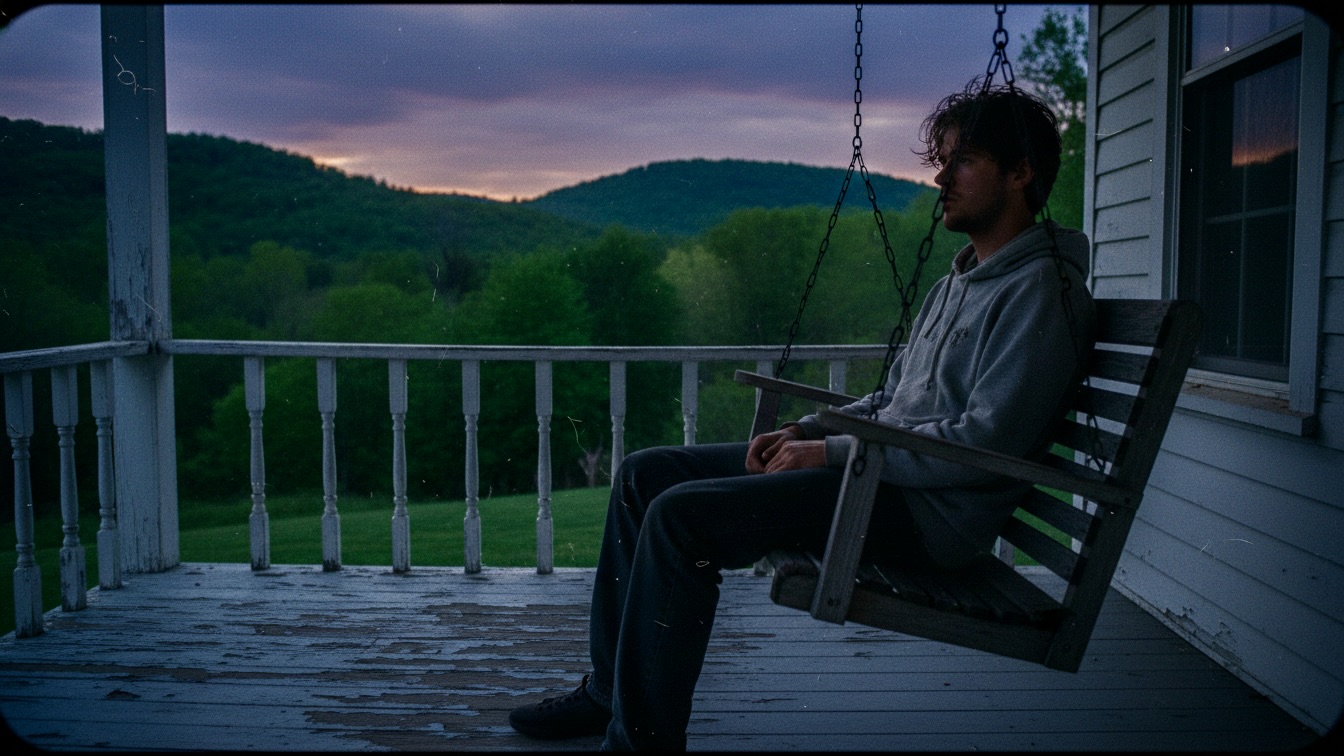
Ben stares at the empty wall where a television used to be, feeling the weight of the silence.
Ben ran his thumb over the plastic rectangle in the wall. It was a dead charger port. It hadn’t seen a current in ten years, maybe more. It was just a hole now. A little plastic grave for a cord that didn’t exist anymore. He remembered his dad talking about how they used to fight over these. Who got to plug in first. Whose battery was lower. Now, the wall was just a wall. The house was quiet. Not the peaceful kind of quiet they promised in the brochures when the Restoration started. It was the kind of quiet that felt like a pressure in his ears.
He moved to the kitchen. The fridge didn’t hum. It didn’t have to. The cooling tech was silent, passive, perfect. He opened it and grabbed a glass of water. The water was clean. It was always clean. He missed the taste of chlorine sometimes. It sounds stupid, he knew that, but the chlorine tasted like effort. It tasted like someone was trying to keep you from dying. This water just tasted like nothing.
He looked at the counter. There was a ring of dust where a microwave used to sit. They’d recycled the old appliances three years ago. 'Source reduction,' the council called it. Now they had a communal kitchen three blocks away where the heat was shared and the waste was managed. It was better. Everyone said it was better. Ben just looked at the empty space on the counter and felt a weird twitch in his chest.
He stepped out onto the porch. The air was cool, smelling of damp soil and the sharp, sweet scent of crushed jasmine. It was spring. The hills were an aggressive, vibrating green during the day, but now they were just dark shapes against a sky that was getting too big. That was the thing about the Restoration—they took away the smog, and suddenly the universe was right there, staring you down.
"You’re late," Sarah said.
She was sitting on the top step, her boots muddy. She was wearing a thick wool sweater that looked like she’d knitted it herself, which she probably had. Everyone was into 'making' now. It was the only way to kill the time.
"The door stuck," Ben lied. He sat down next to her, leaving a few inches of space.
"The door didn't stick. You were staring at the walls again."
"I wasn't staring."
"You were. I can see it in your face. You have that look. Like you're trying to remember a password you forgot."
Ben looked at his hands. His nails were dirty. He’d spent the afternoon in the garden, planting heirloom tomatoes that would probably taste amazing and make him feel absolutely nothing. "It’s just quiet, Sarah."
"It’s supposed to be quiet. That’s the point. We won, remember? No noise pollution. No light pollution. Just us and the trees."
"Is that enough?"
Sarah shifted, her sweater scratching against the wood. "It has to be. Come on. The satellites are crossing in ten minutes."
They started the walk up the ridge. The path was narrow, lined with wild grass that brushed against Ben’s shins. The ground was soft, still holding the rain from two days ago. He could feel his heels sinking into the earth with every step. It felt heavy. The whole world felt heavy, like it was saturated with too much peace.
"Do you ever think about the old photos?" Ben asked. He was breathing a little harder now as the incline sharpened.
"The digital ones?"
"Yeah. Like, the billions of them. Just sitting on servers that don't have power anymore. All those people's faces. Gone."
"They aren't gone," Sarah said, not looking back. "They're just... archived. In the dark."
"That’s the same thing as gone."
"No, it’s not. It's just sleeping. Watch your step, the root is still there."
Ben hopped over a thick oak root. He remembered when this hill was covered in trash. His grandfather told him stories about finding soda cans and plastic bags buried three feet deep. Now, it was pristine. It was so clean it felt sterile. Like a museum of a hill.
They reached the top. The ridge overlooked the valley. Below them, the village was a cluster of dim, warm lights. No streetlamps. No neon. Just the glow of candles and low-wattage LEDs powered by the wind farm on the north peak. It looked like a painting from the eighteen-hundreds.
"There," Sarah pointed.
Ben looked up. The sky was a deep, bruised indigo. And then, a tiny prick of light began to move. It was slow, steady. Then another. And another.
"The old communication net," Ben whispered.
"Dead hardware," Sarah said. "Just orbiting. Forever. Like ghosts."
"They used to send signals through those. Thousands a second. People talking, arguing, buying things. All of it went through those little dots."
"Now they're just shiny rocks."
Ben lay back on the grass. The blades were cool and damp against the back of his neck. He stared at the stars. They didn’t twinkle as much as he thought they would. They were just hard, bright points.
"My dad said he used to stay up all night on his phone," Ben said. "Just scrolling. Seeing things from the other side of the world."
"Sounds exhausting," Sarah said. She lay down next to him. Her shoulder brushed his. He didn’t move away.
"He said he felt connected."
"He was lonely, Ben. Everyone was lonely then. That's why they built all this. So we wouldn't have to be."
"I feel lonely now," Ben said. The words came out smaller than he intended.
Sarah didn't answer for a long time. The only sound was the wind moving through the new leaves in the valley below. It sounded like a long, slow exhale.
"It’s a different kind of lonely," she finally said. "It’s the lonely you feel when you’re the only person in a big room. The room is nice. It’s got everything you need. But it’s still just you."
"Do you think we messed up?"
"Who?"
"Us. The humans. By fixing it."
Sarah turned her head to look at him. In the starlight, her eyes looked like dark holes. "We didn't have a choice. It was this or the end. You prefer the end?"
"I don't know. At least the end was interesting. This is just... Tuesday. Every day is Tuesday."
"You're just bored. Go volunteer at the mill tomorrow. Or help with the irrigation."
"I don't want to help with the irrigation. I want to feel like something matters. Not just because I need to eat, but because it actually matters."
Sarah reached out and grabbed his hand. Her palm was rough, calloused from the looms. Her grip was tight, almost desperate.
"This matters," she said.
"Does it?"
"We're alive. The air doesn't taste like ash. That has to matter."
Ben looked back at the sky. One of the satellites was fading, slipping into the shadow of the earth. He thought about the dead charger ports in his kitchen. He thought about the billions of photos of people who were long dead, trapped in cold silicon under a mountain somewhere. He wondered if they were happy. He wondered if they knew that one day, their descendants would sit on a hill in a perfect world and wish for a little bit of their chaos back.
"I saw a bird today," Ben said. "A hawk. It killed a rabbit right in the middle of the common green."
"Nature is brutal," Sarah said, closing her eyes.
"It was the most real thing I’ve seen in months," Ben said. "The blood was so bright on the grass. It wasn't clean. It was a mess. I couldn't stop looking at it."
"You're weird, Ben."
"Maybe."
He felt the warmth of her hand. It was the only thing that felt solid. The hill, the stars, the perfect valley—it all felt like a projection. Like if he reached out too far, his hand would go through the sky and find a brick wall.
"Sarah?"
"Yeah?"
"Do you ever want to just... leave?"
"Where would you go? It's the same everywhere. That was the whole point of the Global Accord. We all did it together."
"I don't know. Somewhere that hasn't been restored. Somewhere they still have the old mess."
"Those places are dead, Ben. Nothing grows there. It's just dust and plastic."
"At least it's real dust."
Sarah let go of his hand and sat up. She looked frustrated. "You're romanticizing a nightmare. People died. Millions of them. Because they couldn't stop consuming. We stopped. We saved the world. Why can't you just be okay with that?"
"I am okay with it. I just... I think I'm missing something I never had."
"You're missing struggle. You want to be hungry so the food tastes better. You want to be cold so the fire feels warmer. It’s a glitch in your brain. Evolution didn't prepare us for being safe."
Ben sat up too. He brushed the grass off his jeans. "Maybe it’s not a glitch. Maybe it’s just who we are."
They sat in silence for a while, watching the last of the satellites pass over. The spring air was getting colder. The jasmine smell was fading, replaced by the scent of pine and old woodsmoke.
"We should go back," Sarah said. "The meeting is early tomorrow. They’re discussing the new planting cycle."
"Right. The planting cycle."
They walked back down the hill in the dark. They didn't use torches. Their eyes had adjusted, and the starlight was enough. That was another thing they’d regained—the ability to see in the dark. It felt like a superpower, except everyone had it, so it was just another chore.
When they reached Ben’s porch, Sarah stopped.
"Are you going to be okay?" she asked.
"Yeah. I'm fine. Just tired."
"Don't stare at the walls too long. It doesn't help."
"I won't."
She leaned in and kissed his cheek. Her skin was cool. Then she turned and walked toward her own house, her silhouette disappearing into the shadows of the trees.
Ben went inside. He didn't turn on the lights. He walked back to the kitchen and stood in front of the dead charger port. He reached out and touched it again. It was cold. It was empty. It was a monument to a world that had too much of everything and didn't know what to do with it.
He went to his bedroom and lay down. Through the window, he could see a single star, bright and unwavering. He wondered if someone, somewhere, was looking back at him, wondering the same thing. Wondering if the peace was worth the price.
He closed his eyes and tried to imagine the sound of a city. The honking, the shouting, the electronic hum of a billion lives colliding. He couldn't do it. The silence was too thick. It filled the room, pressing down on him like a heavy blanket.
In the distance, a coyote howled. It was a raw, lonely sound. Ben listened to it until it stopped, leaving the night even emptier than before.
“He reached into the back of the drawer, his fingers brushing against something cold and metallic that shouldn't have been there.”


