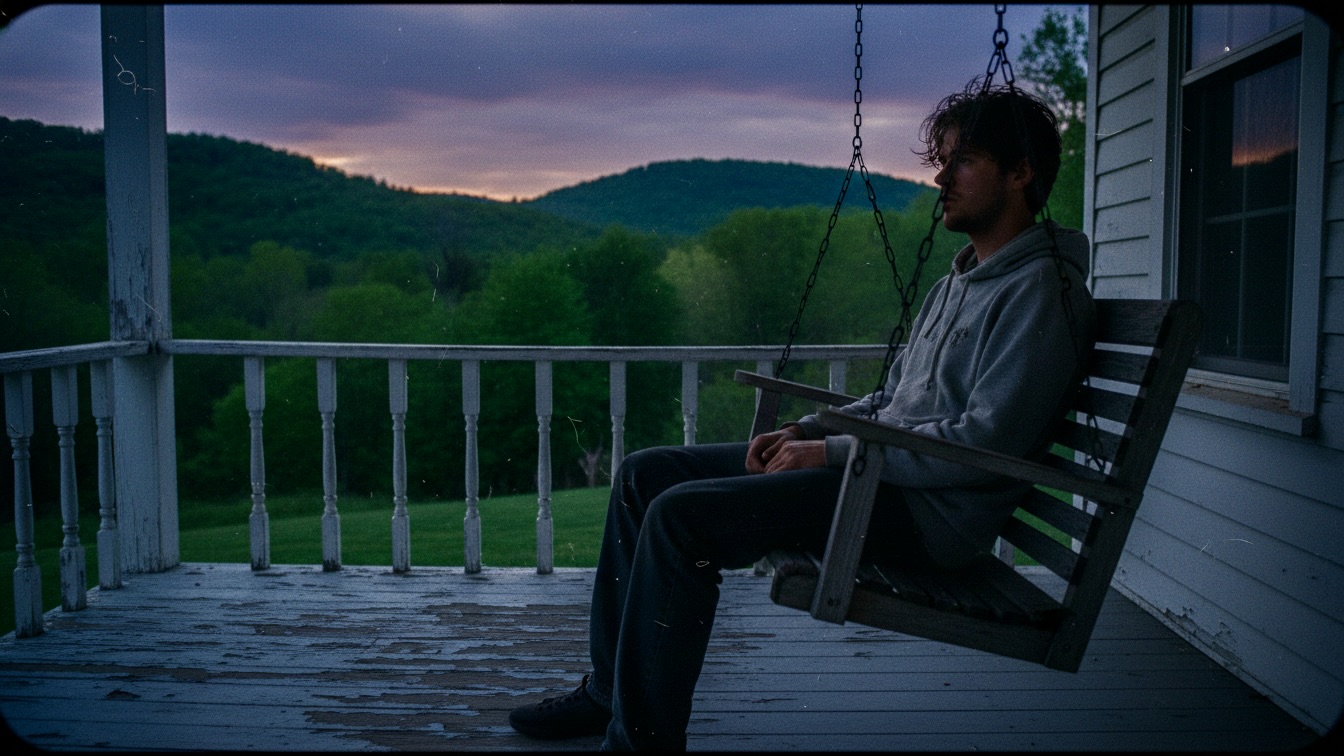
The story follows a man named Ben as he navigates the quiet, sterile reality of a post-technological society known as the Restoration. In this world, the chaotic remnants of the digital age have been replaced by communal living, passive technology, and environmental purity. Ben begins his evening by contemplating a dead charger port in his wall, which serves as a symbolic grave for a forgotten era of connectivity and consumption. He experiences a profound sense of disconnection from his surroundings, even as he consumes perfectly clean water and looks at the empty spaces where modern appliances once sat.
Ben meets his friend Sarah, and together they hike up a ridge to observe the passage of old communication satellites. These "shiny rocks" are the only remaining evidence of a world that was once loud, crowded, and digitally interconnected. During their walk and subsequent conversation, Ben expresses a deep-seated malaise and a longing for the "mess" of the past. He struggles to find meaning in a world where survival is guaranteed and the struggle for existence has been engineered away.
Sarah serves as a pragmatic counterpoint to Ben’s melancholy, reminding him of the ecological collapse that necessitated the Restoration. She views their current life as a victory for humanity, while Ben sees it as a beautiful but hollow museum. Their disagreement highlights a fundamental tension between the need for safety and the human desire for visceral experience. The chapter concludes with Ben returning to his silent home, still haunted by the void left by a world he never truly knew but deeply misses.
One of the primary themes explored in this text is the psychological toll of a sterile utopia. The Restoration has achieved what many modern environmentalists dream of: clean air, pure water, and a sustainable lifestyle. However, for Ben, this perfection results in a sensory and emotional vacuum. He misses the taste of chlorine because it represented human effort and the fight against death. In this new world, the lack of struggle has led to a lack of perceived meaning, suggesting that human satisfaction is inextricably linked to overcoming adversity.
The narrative also examines the concept of technological haunting and the weight of history. The dead charger ports and the orbiting satellites act as ghosts of a hyper-connected past. These objects are no longer functional, yet they exert a gravitational pull on Ben’s psyche. He is caught between a dead world he cannot return to and a living world that feels artificial. This theme highlights the difficulty of moving forward when the architecture of the past still litters the physical and mental landscape.
Furthermore, the story delves into the conflict between biological evolution and modern stability. Sarah astutely points out that the human brain is not prepared for total safety. This suggests that the "glitch" Ben feels is actually a fundamental part of the human condition that requires friction to feel alive. The mention of the hawk killing the rabbit serves as a powerful symbol for this theme. Ben finds the brutality of nature more "real" than the peaceful valley because it contains the raw, unpolished truth of existence that the Restoration has attempted to sanitize.
Finally, the theme of loneliness in the absence of noise is central to Ben's experience. In the old world, people were lonely despite being connected; in the Restoration, they are lonely because the silence forces them to confront themselves. The "pressure" Ben feels in his ears is the weight of a universe that is no longer obscured by smog or digital distraction. This theme suggests that while humanity saved the planet, they may have inadvertently created a world that is too vast and too quiet for the human soul to inhabit comfortably.
Ben is a man suffering from a profound sense of anemoia, which is a nostalgic longing for a time he never personally experienced. He is psychologically out of step with his environment, viewing the achievements of his society not as progress, but as a form of erasure. His habit of "staring at walls" indicates a dissociative tendency, as he searches for meaning in the literal gaps left by the previous civilization. He is a seeker who finds himself in a world that claims to have already found all the answers, leaving him with nowhere to direct his internal energy.
His fixation on the dead charger port reveals his desire for the "current" of the old world, both literally and metaphorically. He craves the chaos and the "mess" because those elements represent a time when human actions had visible, albeit destructive, consequences. To Ben, the current world feels like a projection or a museum display rather than a lived reality. This leads to a deep existential dread, as he fears that his life is merely a "Tuesday" that repeats forever without any genuine stakes or transformative potential.
Ben’s reaction to the hawk killing the rabbit is the most telling aspect of his psychological state. He is not repulsed by the violence; instead, he is captivated by its authenticity. The brightness of the blood on the grass provides a visual and emotional contrast to the "vibrating green" of the restored hills, which he finds aggressive and overwhelming. This reveals that Ben is starving for something that is not "perfect." He is a character defined by his inability to reconcile his biological need for struggle with the artificial peace of his era.
Sarah represents the voice of the collective and the success of the Restoration. She is grounded, practical, and seemingly well-adjusted to the new way of life. Her calloused hands and her commitment to "making" through knitting and gardening show that she has channeled her energy into the sanctioned activities of their society. Unlike Ben, she views the silence not as a vacuum, but as a hard-won victory. She serves as a psychological anchor, attempting to pull Ben back from his abstract longings into the tangible reality of their survival.
However, Sarah’s defensiveness suggests that she may be more affected by the quiet than she admits. Her insistence that Ben is "weird" and her frustration with his romanticization of the past could be interpreted as a defense mechanism. She understands the stakes of the Global Accord and fears that Ben’s dissatisfaction is a threat to the stability they have built. She views his malaise as a "glitch," a biological error that must be managed through labor and community involvement.
Her grip on Ben’s hand at the end of their walk is described as "almost desperate," which betrays her own underlying anxiety. While she advocates for the beauty of their clean world, she relies on Ben’s physical presence to feel solid. Sarah chooses to focus on the fact that they are alive and the air is clear because the alternative—acknowledging the emptiness Ben feels—is too dangerous to contemplate. She is a character who has chosen to believe in the utopia because the "nightmare" of the past is the only other option.
The pacing of the story is slow and meditative, mirroring the heavy, silent atmosphere of the Restoration. The narrative moves at a walking pace, lingering on small details like the texture of a wool sweater or the smell of crushed jasmine. This deliberate speed forces the reader to inhabit Ben’s headspace, where every small observation is magnified by the lack of external distraction. The transition from the interior of the house to the ridge provides a natural progression that mirrors Ben’s internal journey from isolation to a failed attempt at connection.
The tone is one of quiet melancholy and sterile beauty. The author uses sensory details to create a sharp contrast between the "perfect" present and the "messy" past. Descriptions like "bruised indigo" for the sky and "aggressive, vibrating green" for the hills suggest a world that is almost too vibrant to be natural. These choices convey a sense of hyper-reality, where the environment feels like a high-definition screen rather than a physical place. This contributes to the overall feeling of unease that permeates the chapter.
Narrative voice is third-person limited, staying close to Ben’s internal perceptions. This allows for a deep exploration of his psychological discomfort without the need for heavy-handed exposition. The dialogue between Ben and Sarah is sparse and laden with subtext, reflecting a relationship where much is understood but little is resolved. The use of the "dead charger port" as a recurring motif provides a strong symbolic framework, grounding the abstract themes of the story in a concrete, everyday object.
The imagery of the satellites as "ghosts" or "shiny rocks" effectively bridges the gap between the celestial and the mundane. It strips the technology of its former power, reducing the pinnacle of human achievement to mere orbital debris. This stylistic choice reinforces the theme of entropy and the fleeting nature of human endeavor. The final image of the coyote’s howl provides a haunting auditory conclusion, emphasizing that while the human world has been hushed, the raw and lonely voice of nature remains the only thing that is truly "real."


