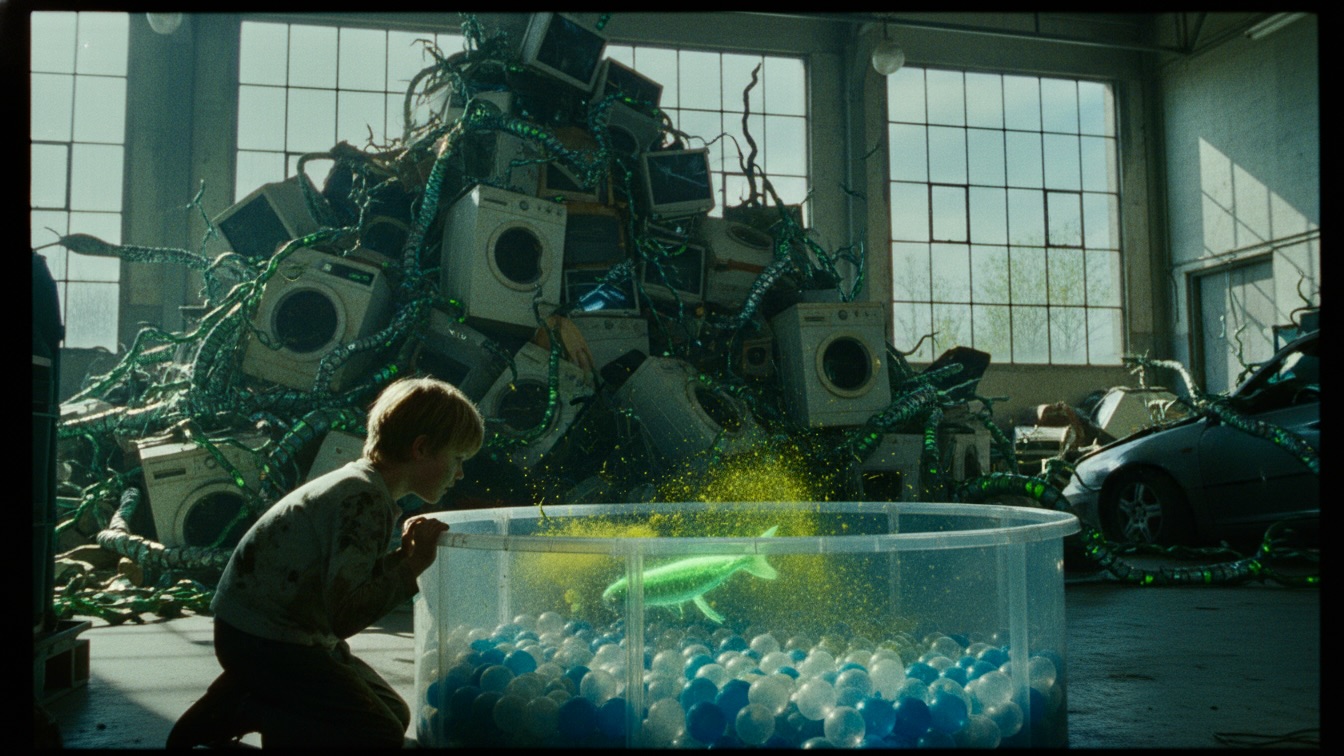
Max and Karen's argument over family debt is interrupted when glowing fish and discarded toys begin a terrifying synchronized performance.
The air inside the depot tasted like old pennies and the sour breath of a thousand unwashed soda cans. Karen felt the familiar vibration in her jaw, the precursor to a migraine that usually arrived exactly when she couldn’t afford it. Her right foot tapped a frantic, staccato rhythm against the oil-stained concrete. She clutched the tablet to her chest like a shield, the screen displaying a sea of red numbers that represented their father’s legacy of bad bets and unpaid loans. Outside, the spring sun was blindingly bright, casting harsh, unforgiving light through the high, cracked windows of the warehouse. It was the kind of morning that promised new beginnings but only delivered more of the same rot.
"The Treiner check cleared, Karen. Can you please, for the love of everything holy, stop being a total buzzkill for five minutes?" Max didn't look at her. He was too busy balancing a stack of neon-colored paper plates while trying to look effortless in a moth-eaten tuxedo vest he’d found in the textile bin. He kicked a stray aluminum can toward the bottle return chute. "We are hosting a gala. We are professionals. We are the premier event space for the discerning eight-year-old."
"We are a scrap yard with a bounce house, Max," Karen snapped. Her jaw tightened another notch. "And that check is already gone. It went to the interest on the equipment lease. If we don’t make another three thousand by Friday, the city is going to pull our permit for the drainage violation. Speaking of which, the smell coming from the bottle chute is absolutely abhorrent. It smells like a mass grave in a swamp."
Max waved a hand dismissively, his fingers stained with grease and cheap frosting. "The smell is atmospheric. It is the scent of progress. It is the smell of a lake that is finally waking up after a long winter. Do not allow your fixation on the ledger to poison the festivities. Look at Birthday-Boy Sam. He is having the time of his life."
Karen looked. Sam Treiner was currently attempting to submerge his younger cousin in the ball pit, a sprawling plastic enclosure filled with primary-colored spheres and, Karen suspected, several years' worth of bacteria. Mrs. Treiner stood nearby, her face a mask of polite horror as she surveyed the mountain of crushed appliances that served as the party’s backdrop. The depot wasn't just a business; it was a graveyard for the twentieth century. Washing machines, CRT monitors, and refrigerators were piled twenty feet high, held together by rust and gravity.
"It isn't just a smell, Max," Karen said, her voice dropping to a low, theatrical hiss. "It is a literal health hazard. I told you the drainage system was backing up. The water from the Great Lake is pushing back into our pipes. It’s the spring surge, but it’s wrong this year. It’s oily. It’s thick."
Max finally turned to face her, his eyes wide with a manic kind of optimism. "Then we will call it an immersive ecological experience. We will charge extra for the education. Now, go. Be a hostess. Ensure the cake table does not collapse under the weight of Mrs. Treiner’s expectations."
He pushed past her, heading toward the sound of a popping balloon. Karen took a shallow breath, trying to settle the churning in her stomach. She walked toward the drainage grate near the center of the floor. The sound was the first thing that struck her—a wet, rhythmic slapping. It sounded like a heartbeat, or a lung struggling for air. She looked down through the metal slats.
In the dark water below, something was moving. It wasn't just the oily sludge of the lake. It was silver. It was flashes of neon. The fish were coming up through the pipes. They weren't swimming; they were being pushed by some invisible pressure, their bodies thin and translucent, almost like wafers of glass. They were coated in a thick, glowing yellow dust—spring pollen that had mixed with the lake’s toxicity to create a bioluminescent sludge.
"Karen! Look!" Sam Treiner’s voice pierced the roar of the warehouse. He was standing by the edge of the ball pit, holding something up.
Karen’s heart skipped. She moved toward him, her boots clicking sharply on the concrete. "Sam, put that down. Whatever it is, it’s dirty."
But the boy didn't listen. He was staring at the object in his hands with a look of pure, unadulterated wonder. It was a trout, but it looked like it had been pressed in a book for a century. It was flat, its ribs visible through skin that shimmered with a sickly, neon green light. The pollen on its scales pulsed in time with its gasping mouth. It was a zombie fish, a relic of the Great Lake’s dying ecosystem, and it was alive in a way that defied biology.
"It’s pretty," Sam whispered. "It’s glowing."
"It’s a biohazard," Karen said, reaching for it. As she got closer, she realized the fish wasn't alone. Beneath the plastic balls, the pit was teeming with them. Hundreds of wafer-thin trout were weaving through the plastic spheres, their movements perfectly synchronized. They were forming a shape—a geometric circle that mirrored the drainage grate in the center of the room.
Suddenly, a low hum began to vibrate through the floor. It wasn't the sound of the scrap press or the wind outside. It was a digital chirp.
High above the party, on a shelf where the 'vintage' inventory was stored, the Furby mountain began to stir. There were nearly a hundred of them—discarded, battery-corroded toys from a bygone era, their synthetic fur matted with dust. One by one, their plastic eyelids clicked open. Their mechanical gears ground together with the sound of a rusted clock.
"Doo-dah!" one chirped.
"Me love you," another followed.
Then, they all began to speak at once. The sound was a jagged, sonic feedback loop that seemed to resonate with the rhythmic gasping of the fish in the ball pit. The Furbys weren't just making noise; they were echoing the frequency of the trout’s gills. The sound was theatrical, a chorus of the damned staged in a recycling center.
"Max!" Karen screamed over the rising din.
Max was frozen by the cake table. Mrs. Treiner had pulled Sam away from the ball pit, her face pale. The mountain of crushed appliances behind them groaned. The metal shifted, a slow, grinding movement as if the very foundations of the depot were being reshaped. Vines of silver-green scales began to creep out from the gaps in the scrap metal, growing at an impossible, visible speed. They looked like ivy made of fish skin, slick and iridescent, weaving through the legs of the cake table.
"What is this?" Max shouted, his bravado finally fracturing. "Karen, what did you do to the pipes?"
"I didn't do anything!" she yelled back. She was watching the fish. They had completed the circle now, their bodies overlapping to form a perfect, glowing ring in the ball pit. The light they emitted was so bright it cast long, distorted shadows against the walls. The Furby mountain was in a frenzy, their voices merging into a single, high-pitched scream that made Karen’s teeth ache.
The scrap pile heaved. A washing machine from the 1990s slid forward, its door swinging open like a hungry mouth. It narrowly missed the cake table, smashing into the concrete with a bone-shaking thud. The fish-scale vines lashed out, anchoring the fallen appliance to the floor.
Karen felt a sudden, cold clarity. She remembered the news reports from the previous night—the 'Exorcism Tournament' at the Great Lake. The local authorities had hired a group of fringe scientists and spiritualists to 'cleanse' the water of its heavy metal toxicity using experimental sonic frequencies. They had called it a purification ritual.
"They didn't clean it," Karen whispered, the realization hitting her like a physical blow. Her jaw was so tight she could barely speak. "They just drove it out."
She looked at the fish. They weren't attacking. They were huddling. The geometric circle wasn't a ritual; it was a formation of defense. The gasping, the synchronized chatter of the Furbys—it was a broadcast.
"Max, look at them!" Karen pointed to the ball pit. "They aren't just dying. They’re trying to tell us something. The tournament... the exorcism... they’ve stirred up something at the bottom of the lake that was never meant to see the light."
Max stared at the glowing trout, his mouth hanging open. The irony of their situation—fighting over debts while the world literalized its own decay—wasn't lost on him. He looked at the mountain of scrap, then at the fish, then back at Karen. For the first time in years, he looked like her brother again, not just a business partner failing at a dream.
"The lake is purging," Karen said, her voice steady despite the chaos. "And we’re the first stop on the way out."
Outside, the bright spring sky began to bruise into a deep, sickly purple, even though it was only noon. The sound of the Furbys reached a fever pitch, a wall of electronic noise that seemed to hold the very air in place. The fish in the ball pit began to vibrate, their thin bodies blurring until they were nothing but a ring of pure, neon light.
Karen reached out and grabbed Max’s hand. Her palm was sweaty, her grip desperate. She didn't look at the debt spreadsheet on her phone. She didn't think about the city permits or the Treiner check. She only thought about the water pushing through the pipes, and the heavy, cold presence that was following the fish into the light of the spring sun.
“As the warehouse floor began to crack, a massive, dark shadow rose within the drainage pipe, blocking out the last of the glowing neon light.”


