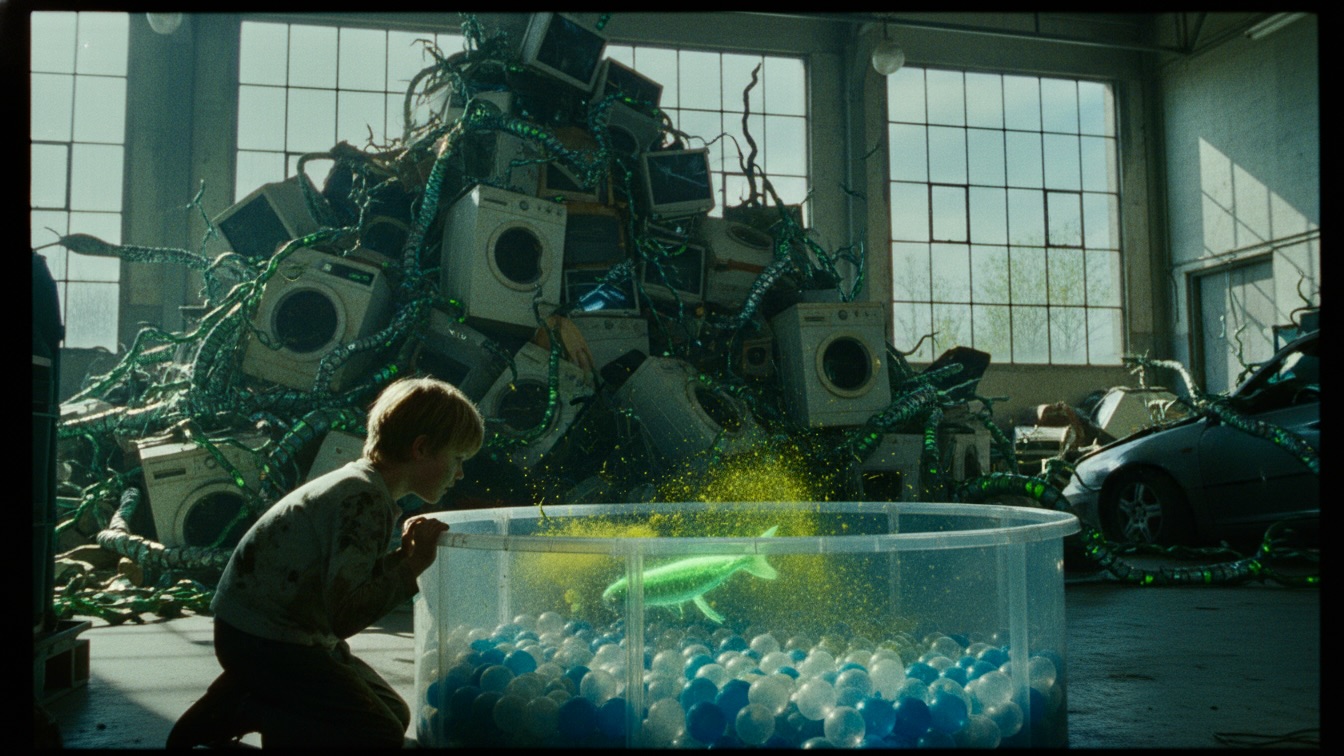
The story unfolds within the claustrophobic and decaying environment of a scrap yard converted into a makeshift children’s event space. Karen, burdened by her father’s legacy of debt and a looming migraine, struggles to maintain order while her brother, Max, indulges in a delusional performance of professional success. As they host a birthday party for a young boy named Sam Treiner, the physical reality of their failing business begins to manifest in disturbing ways. The drainage system, overwhelmed by the spring surge of the nearby Great Lake, begins to spew oily sludge and strange, bioluminescent fish into the facility.
The narrative takes a surreal turn when these translucent, glowing trout infiltrate the children's ball pit, creating a rhythmic, geometric formation. Simultaneously, a massive pile of discarded Furby toys spontaneously activates, their electronic chatter synchronizing with the movements of the fish. Karen realizes that a recent attempt by authorities to "purify" the lake has instead displaced a toxic and perhaps sentient force. The chapter concludes with the scrap yard being physically reshaped by organic, metallic growth as the siblings face the reality that the lake is purging its horrors directly into their lives.
The central theme of the narrative is the inescapable nature of systemic rot, both literal and metaphorical. The scrap yard serves as a "graveyard for the twentieth century," where the physical debris of past consumerism mirrors the financial ruin Karen and Max inherited from their father. This rot is not just a backdrop but an active force that permeates the air and the water, eventually manifesting as a biological threat. The story suggests that the past cannot be simply discarded or ignored; it remains beneath the surface, waiting for a catalyst to return to the light.
The text also explores the hubris of human intervention in the natural world. The "Exorcism Tournament" mentioned by Karen represents a misguided attempt to solve ecological toxicity through spiritual and technological theater. By attempting to "cleanse" the lake through fringe science and sonic frequencies, the authorities have merely agitated a deeper, more ancient corruption. This highlights the theme of displacement, where society’s refusal to truly address its waste leads to a violent and unpredictable return of the repressed.
Finally, the story examines the tension between denial and reality. Max represents a desperate form of escapism, using "manic optimism" and flimsy costumes to mask a crumbling existence. Karen, conversely, is hyper-aware of the physical and financial decay, yet she is equally trapped by it. The intrusion of the glowing fish and the screaming Furbys forces a collapse of these two perspectives. The siblings are forced to confront a reality where their mundane failures are eclipsed by a larger, more terrifying ecological reckoning.
Karen functions as the pragmatic and sensory anchor of the story, her internal state defined by physical tension and hyper-vigilance. She experiences the world through the "vibration in her jaw" and the "sour breath" of the depot, indicating a psychological state that is constantly braced for impact. Her identity is tied to the burden of responsibility, as she carries the "sea of red numbers" like a shield against her brother’s whims. She is the only character who truly sees the "mass grave" for what it is, refusing to participate in the charade of the gala.
From a psychological perspective, Karen exhibits signs of chronic stress and perhaps a mild form of trauma-induced hyper-awareness. She is obsessed with the "drainage violation" and the "literal health hazard," which are manifestations of her need to control an environment that is spiraling out of her reach. Her clarity at the end of the chapter suggests that she is more equipped for crisis than for the slow grind of poverty. When the supernatural occurs, her focus shifts from the debt to survival, showing a resilience that was previously buried under administrative dread.
Max is the antithesis of Karen, embodying a defense mechanism characterized by performative denial and grandiosity. He wears a "moth-eaten tuxedo vest" and uses flowery language to describe a "scrap yard with a bounce house," attempting to curate a reality that does not exist. His refusal to acknowledge the "abhorrent" smell or the financial ruin is a psychological tactic to avoid the crushing weight of their father’s failure. He views the world through the lens of marketing, even attempting to rebrand an ecological disaster as an "immersive experience."
His character arc in this chapter is defined by the fracturing of this bravado. When the "mountain of crushed appliances" begins to move and the fish-scale vines appear, Max’s persona as a "professional" host evaporates. He is forced to drop the act and look at Karen not as a "buzzkill," but as a partner in a genuine catastrophe. His transformation from a manic dreamer back into a vulnerable brother highlights the fragility of his constructed identity when faced with the raw power of the lake’s purge.
Sam Treiner represents the intersection of childhood innocence and the grotesque reality of the environment. While the adults see a "biohazard," Sam sees wonder, describing the dying, glowing fish as "pretty." He is the first to interact with the anomaly, bridging the gap between the mundane world of the party and the surreal intrusion of the lake’s toxicity. His lack of fear serves as a foil to Karen’s horror, suggesting that the next generation may be forced to find beauty or meaning within the ruins of the previous one.
The narrative employs a gritty, sensory-heavy prose style that emphasizes the physical discomfort of the setting. Descriptions like "old pennies," "oil-stained concrete," and "sour breath" create a visceral atmosphere of decay that grounds the later supernatural elements. This sensory grounding is crucial because it makes the transition into the surreal—the glowing trout and the screaming Furbys—feel like a natural extension of the environment's sickness. The author uses harsh, unforgiving light to strip away any romanticism, exposing the "rot" of the spring morning.
The pacing of the chapter is expertly handled, starting as a domestic drama about financial stress and slowly accelerating into ecological horror. The soundscape of the story is particularly effective, moving from the "staccato rhythm" of Karen’s foot to the "wet, rhythmic slapping" of the water, and finally to the "jagged, sonic feedback loop" of the toys. This auditory escalation mirrors the rising stakes and the characters' increasing loss of control. The use of the Furbys as a chorus for the fish adds a layer of uncanny, technological horror to the organic threat.
The narrative voice is third-person limited, closely following Karen’s internal monologue and physical sensations. This perspective allows the reader to feel the weight of her anxiety while still observing Max’s eccentricities from a distance. The tone is one of mounting dread, flavored with a dark irony that highlights the absurdity of their situation. The final shift in the sky’s color to a "sickly purple" signals a departure from the mundane world, leaving the reader with a haunting image of a world being reshaped by its own neglected waste.


