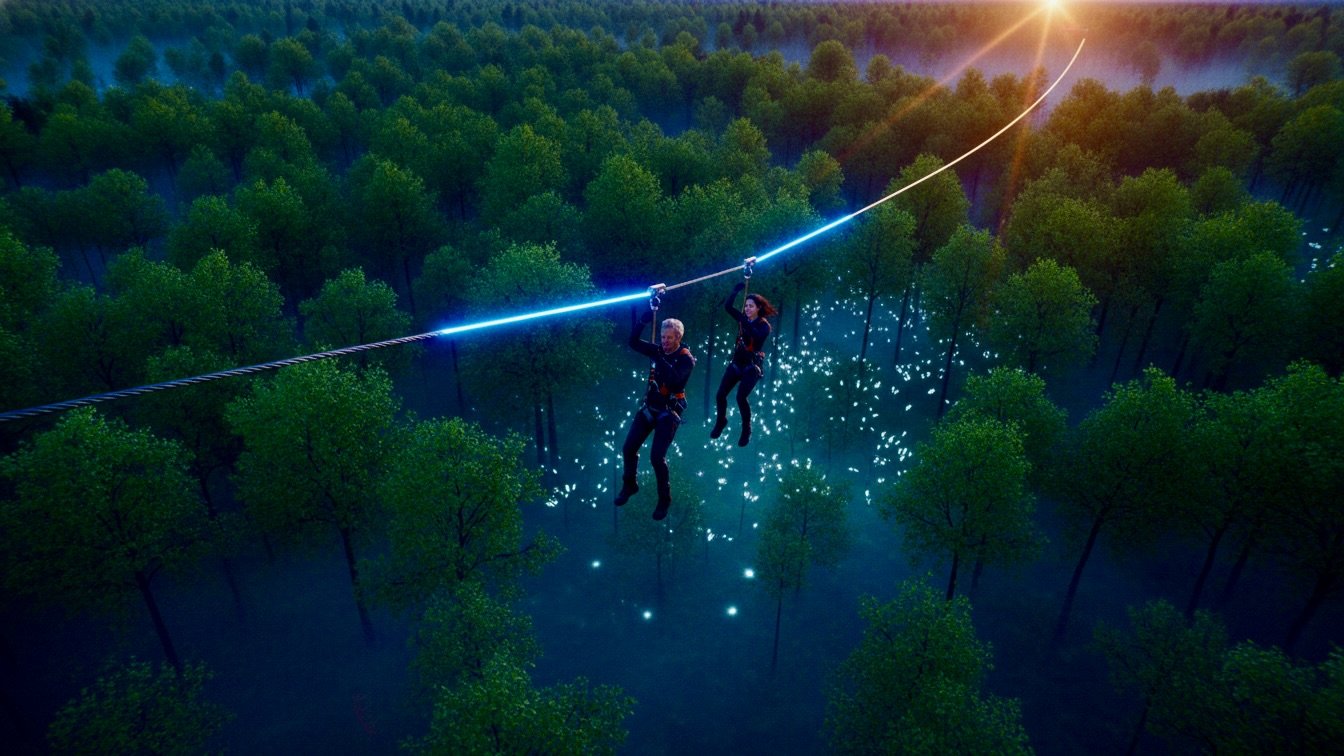
Ed sneaks out at midnight to bypass a city lock, only for his granddaughter to demand a piece of the action.
The hum started in my teeth. It wasn't a sound you heard with your ears. It was a vibration that traveled up through the floorboards of the porch and settled into my jaw. 40Hz. Maybe 42. The maple trees were waking up. It was mid-April, the ground was soft with thaw, and the trees were screaming in a key humans weren't supposed to touch.
I sat on the edge of my bed and pulled on my boots. My knuckles creaked. They felt like they were full of gravel. I grabbed the bypass key I’d spent three weeks soldering in the garage. It was a small, ugly piece of hardware, a mess of wires and a hacked chip, but it was the only thing that would talk to the city’s safety locks. The city didn't want us on the ziplines after dark. They said it was for our protection. They said the cables were unstable when the trees started the Spring Hum. They were lying. They just didn't want us to see what was happening to the sap.
I stepped out the back door. The air smelled like wet dirt and ozone. The town was dark, except for the faint green glow of the miracle tulips lining the sidewalks. Those things were a genetic mess, designed to look pretty in the dark, but they were a symptom of whatever was happening to the soil. Everything was changing. The ground was becoming a battery.
I reached the base of Station 4. It was a steel pylon that looked out of place against the ancient wood of the maples. The zipline network was supposed to be the future of green transit—clean, gravity-fed, quiet. But when the trees started humming, the cables started singing. I climbed the ladder. My lungs burned. The air felt thick, like I was breathing through a wet cloth. Claustrophobia usually hits me in the woods at night, the way the branches lean in, but tonight was different. The hum was a weight on my chest.
I reached the platform and fumbled with my harness. The safety lock was a red LED eye staring at me. I slotted my bypass key into the port. The light flickered, turned amber, then went dark. The lock clicked open. I was in.
"That’s a felony, Grandpa."
I jumped, my heart slamming against my ribs. Rita was standing in the shadows of the platform, her face lit by the cold blue screen of her phone. She was wearing a technical shell jacket and had her gimbal stabilized camera already gripped in her hand. She looked like she’d been waiting for an hour.
"Go home, Rita," I said. I tried to make my voice steady. It didn't work.
"Not happening," she said. She stepped into the light. She had her own harness on. It was an old model, probably something she’d scavenged from the high school's gym. "I saw you building the key. I’ve been tracking the frequency spikes on my app. This is peak content. The stream is going to lose it."
"This isn't for your followers," I said. "The trees are hitting resonance. If we don't bleed the pressure, the cables will snap. The whole grid could go."
"Sure, Ed. You're a hero," she said, her voice dripping with that irony she used as a shield. "But look at the sap buckets. They’re pulsing. You want to tell me that’s just pressure?"
She pointed toward the primary trunk. We’d hung the extraction taps three days ago. The plastic buckets weren't just full; they were glowing. A soft, rhythmic neon blue light was radiating from the syrup. It matched the pulse of the tulips on the ground. It was the same bioluminescence. The trees were drinking the same tainted ground water, but they were concentrating it into something else.
"It’s beautiful," I whispered.
"It’s five million views," she corrected. "Let’s go. Before the drone patrols catch us."
I didn't argue. I couldn't. The hum was getting louder, a physical pressure that made it hard to think. I hooked my trolley to the main cable. The steel wire was vibrating so hard it felt blurry to the touch. I stepped off the ledge.
Gravity took us. The wind was cold and sharp against my face, stripping away the stagnant feeling of the bedroom. We slid through the canopy, the maple leaves brushing against my boots. The sound changed. Out here, suspended between the trees, the hum turned into a chord. It was deep, resonant, and terrifyingly loud. It felt like the forest was a giant cello and we were the bow.
We reached the first extraction point. I braked hard, the smell of burning rubber filling the air. We swung there, fifty feet above the forest floor. Rita pulled out a collection vial. She didn't even look at the drop. She was focused on the frame of her shot.
"The color is insane," she said. She dipped the vial into the bucket. The syrup was thick, like molten glass. When it hit the glass, it sparked. Not a fire spark, but a static discharge. "It’s alive, Ed. Look."
I looked. The syrup wasn't just glowing; it was moving in tiny, synchronized waves. It was reacting to the frequency of the cable. I touched the bucket. My fingers tingled. The pressure in my chest started to lift. It was the weirdest sensation—like I’d been holding my breath for ten years and finally found an oxygen tank.
"We need to get more," I said. "If this is what I think it is, it’s not just sugar. It’s a liquid conductor."
Suddenly, a spotlight cut through the branches. It was harsh, white, and clinical.
"This is Office Polits," a voice boomed from a megaphone. It was thin and distorted. "You are in violation of City Ordinance 402. Disengage from the cable and descend immediately."
I looked down. A small electric cart was racing along the access path below us. Polits, the city planner, was leaning out the side. He was a man who loved rules more than people. He saw the world as a series of spreadsheets that needed to be balanced. He didn't hear the music. He just saw an unauthorized use of municipal infrastructure.
"He’s got a remote kill-switch for the stations," Rita hissed. "If he locks the next tower, we’re stuck over the ravine."
"Not if we move fast," I said.
I kicked off. We flew. The next section of the line was a steep drop. The wind screamed in my ears. Behind us, I could hear Polits shouting, the sound of his cart struggling over the roots. He wasn't going to give up. He’d spent the last year trying to shut down the zipline rebels. He thought we were just bored seniors and restless kids. He didn't understand that we were the only ones listening to what the town was trying to say.
We zipped past Station 5. I didn't stop. I used the momentum to swing into the next transition. Rita was laughing now, a genuine, sharp sound that cut through the bass of the trees. She was holding her camera out, capturing the blur of green and the trails of blue light we left behind.
"He’s gaining!" she shouted.
Polits had reached a maintenance hub. He was punching codes into a handheld terminal. Ahead of us, the safety lights on Station 6 began to flash red. The magnetic brakes were engaging.
"We’re going to hit the wall!" Rita screamed.
"Hold onto me!" I yelled back.
I didn't reach for the brake. Instead, I reached for the bypass key still hanging from my belt. I leaned forward, my body horizontal against the wind. As we approached the station, I jammed the key into the overhead trolley’s sensor.
The magnets screamed. Sparks showered down on us like New Year’s Eve. For a second, the world turned into friction and heat. Then, the lock snapped. We shot through the station like a stone from a sling.
We were over the deep woods now. The maples here were older, their trunks thick as houses. The hum was so intense it was making the air shimmer. I could see the sound—ripples in the atmosphere, like heat rising off a highway.
"Ed, look at the cable!" Rita pointed up.
The steel wire was glowing. It was turning the same neon blue as the syrup. The friction of our passage, combined with the frequency of the trees, had turned the entire zipline into a giant tuning fork.
I looked back. Polits was gone, hidden by the density of the forest, but I could see his spotlight searching the canopy like a lost star. He couldn't follow us here. The terrain was too rough.
We were approaching the Great Maple, the center of the grove. The zipline didn't go through it; it circled it. This was the high point. The cable here was stretched tighter than anywhere else in the town.
I felt a sudden, overwhelming sense of clarity. The claustrophobia of the last few months—the feeling of being trapped in a dying town, in a dying body—it all evaporated. I wasn't an old man with bad knees. I was a component in a circuit.
"Rita, give me the vial," I said.
"What? Why?"
"Just give it to me!"
She handed it over. I held the glowing syrup in my hand. We were nearing the apex of the curve. The cable was screaming now, a high-pitched metallic wail that harmonized with the low thrum of the roots.
I poured the syrup onto the cable.
It didn't drip. It coated the steel instantly, spreading like a silver film. The effect was immediate. The blue light didn't just glow; it ignited. The hum stopped being a sound and became a physical force.
I reached out and plucked the cable with my gloved hand.
It was the perfect note. It was a sound that didn't belong in this world. It was pure, crystalline, and impossibly loud.
Everything stopped. The wind died. Rita’s camera went dead. The forest held its breath.
Then, the Great Maple pulsed.
A wave of blinding white light erupted from the center of the grove. It wasn't an explosion; it was a release. It washed over us, warm and smelling of sugar and rain. I felt every cell in my body vibrate. The gravel in my knuckles vanished. The weight in my lungs was gone.
The light expanded, rolling through the canopy, hitting the town, illuminating every dark corner of Main Street. For a split second, the world was nothing but white. It was the cleanest thing I had ever seen. It was sudden oxygen. It was a fresh start.
As the light faded, we were still sliding, but the cable was silent. The trees had stopped humming. The air was still. We glided slowly toward the final station, the momentum carrying us home in the dark.
Rita looked at her dead phone, then at me. Her eyes were wide. She didn't have a witty comeback. She didn't have a caption.
"Did you see that?" she whispered.
"I felt it," I said.
We touched down on the final platform. My feet hit the wood, and for the first time in years, they didn't hurt. I unhooked my harness and looked out over the town. The streetlights were flickering back on, but they looked dim compared to what we’d just seen. The miracle tulips were dark. The maples were just trees again.
But I could still feel the note. It was a tiny spark at the base of my spine.
"We’re going to be in so much trouble," Rita said, her voice small. She was looking at the town hall, where Polits’ cart was likely already parked.
"Maybe," I said. I looked at my hands. They were steady. "But the windows are still intact."
She leaned against the railing. The spring air was cooling down. The adrenaline was leaving us, replaced by a deep, quiet peace.
"Was it worth it?" she asked.
I thought about the light. I thought about the way the forest felt when it finally got to speak. I looked at the empty vial in my hand.
"Every bit of it," I said.
We sat there on the high platform, two ghosts in the dark, watching the town wake up to a world that had been tuned to a brand new frequency.
“I looked down at my hands, which were still glowing faintly, and wondered if the light had changed more than just the forest.”


