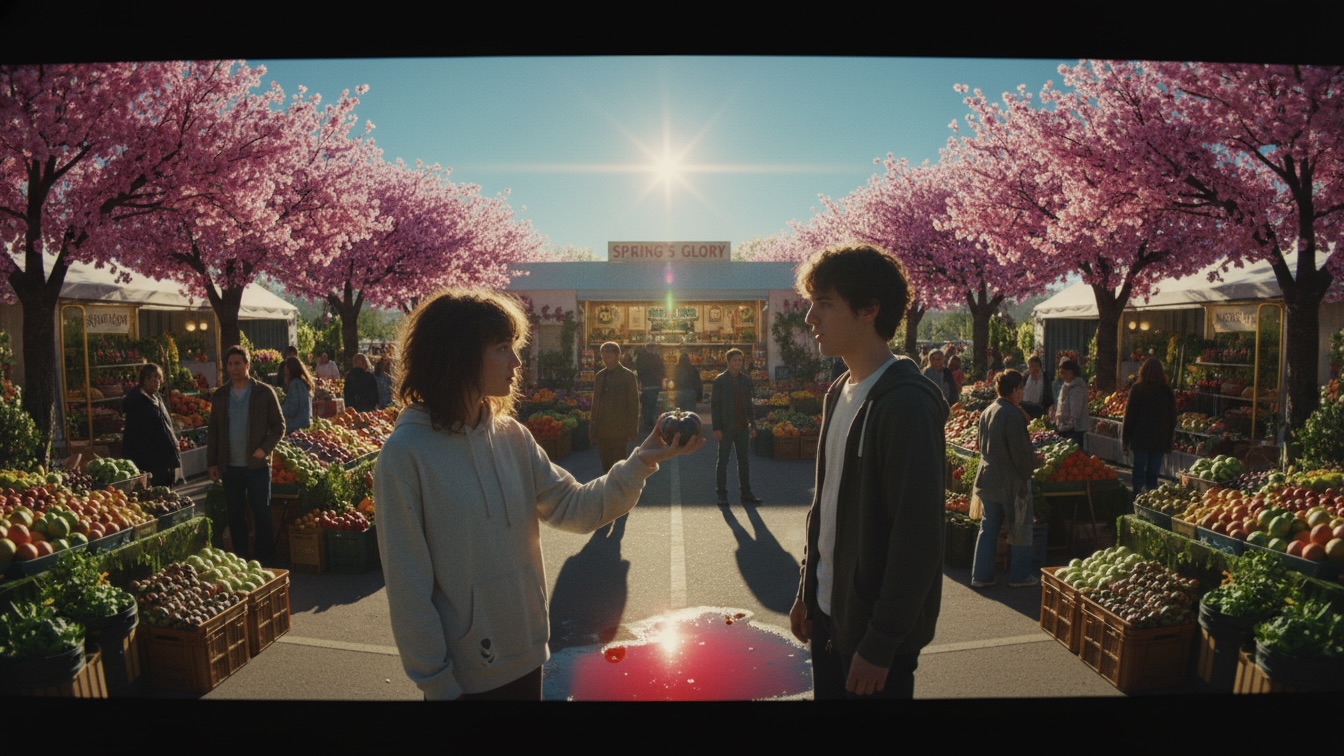
Leo and Sloane navigate a hyper-saturated farmer's market where the sparks are real but the reality feels thin.
"You're staring again."
Sloane didn't look up from the crate of heirloom tomatoes. She was wearing a washed-out hoodie that looked like it had been through a shredder. Her hair was a mess of dark knots. She looked perfect. I looked at my shoes. They were covered in city dust. The pavement was hot for April. The sun was doing that thing where it turned everything into a high-contrast photograph. The greens were too green. The sky was a flat, aggressive blue. It felt like someone had turned the saturation slider to a hundred and then broke the handle off.
"I'm not staring," I said. "I'm observing. There’s a difference."
"There really isn't."
She picked up a tomato. It was lumpy and purple-black. She held it like it was a grenade. Around us, the farmer's market hummed with that specific weekend energy. People in expensive athleisure. Dogs on short leashes. The smell of roasting coffee and damp earth. It was supposed to be wholesome. It felt like a stage set. My brain was throwing error codes. Too much light. Too many faces.
"Look at this," she said, holding the tomato toward my face. "It’s ugly. I love it."
"It looks like a bruised kidney."
"Exactly. It’s real. Everything else here is too shiny."
She was right. The digital price tags on the stalls were flickering. They were E-ink, supposed to be stable, but they were jumping between numbers. $4.00. $40.00. $0.00. No one else seemed to notice. They were too busy buying artisanal sourdough. I felt a buzz in my pocket. My phone. My dad. Again. I ignored it. My thumb hovered over the screen, then I shoved the device deeper into my jeans. My palm was sweaty.
"Your phone is vibrating," Sloane said. She finally looked at me. Her eyes were sharp. They saw too much.
"It's fine. Just spam."
"You don't get spam that makes your eye twitch, Leo."
"My eye isn't twitching."
"It is. Left one. Bottom lid. Fast. Like a heartbeat."
I rubbed my face. The air felt heavy. Not humid, just dense. Like I was walking through invisible gelatin. We moved to the next booth. It was an art stall. Hand-pressed prints. Mostly minimalist stuff. Blocks of color. Lines that didn't quite meet. I liked it. It felt honest. The artist was a kid, maybe twenty, with a nose ring and a look of profound boredom.
Sloane leaned in close to me. Her shoulder brushed mine. It was a small contact, but it felt like a static shock. My skin buzzed. Everything narrowed down to that one square inch of fabric touching fabric. I could smell her. Not perfume. Just soap and something like ozone. Like the air right before a storm.
"You're doing it again," she whispered.
"What?"
"Thinking. Stop it. It’s a Saturday. We’re at a market. We’re being normal."
"Is this normal?" I asked. I gestured to the crowd. A woman was trying to feed a piece of kale to a golden retriever. The dog looked confused. The sunlight hit a puddle of spilled juice on the ground, and for a second, the reflection didn't match the sky. It was red. Then it was gone.
"Normal is a construct," Sloane said. She picked up a print. It was a single black circle on an off-white background. "This is twenty dollars. For a circle."
"It’s a nice circle."
"It’s a lie. Circles don't exist in nature. Not perfect ones."
She put it back. Her hand lingered near mine on the table. My heart was a drum in my throat. I wanted to grab her hand. I wanted to run out of here. Both felt equally impossible. The
“Then the digital display on the nearest stall didn't just flicker—it screamed a bright, blinding white, and Sloane’s face went completely blank as she turned toward the sound.”


