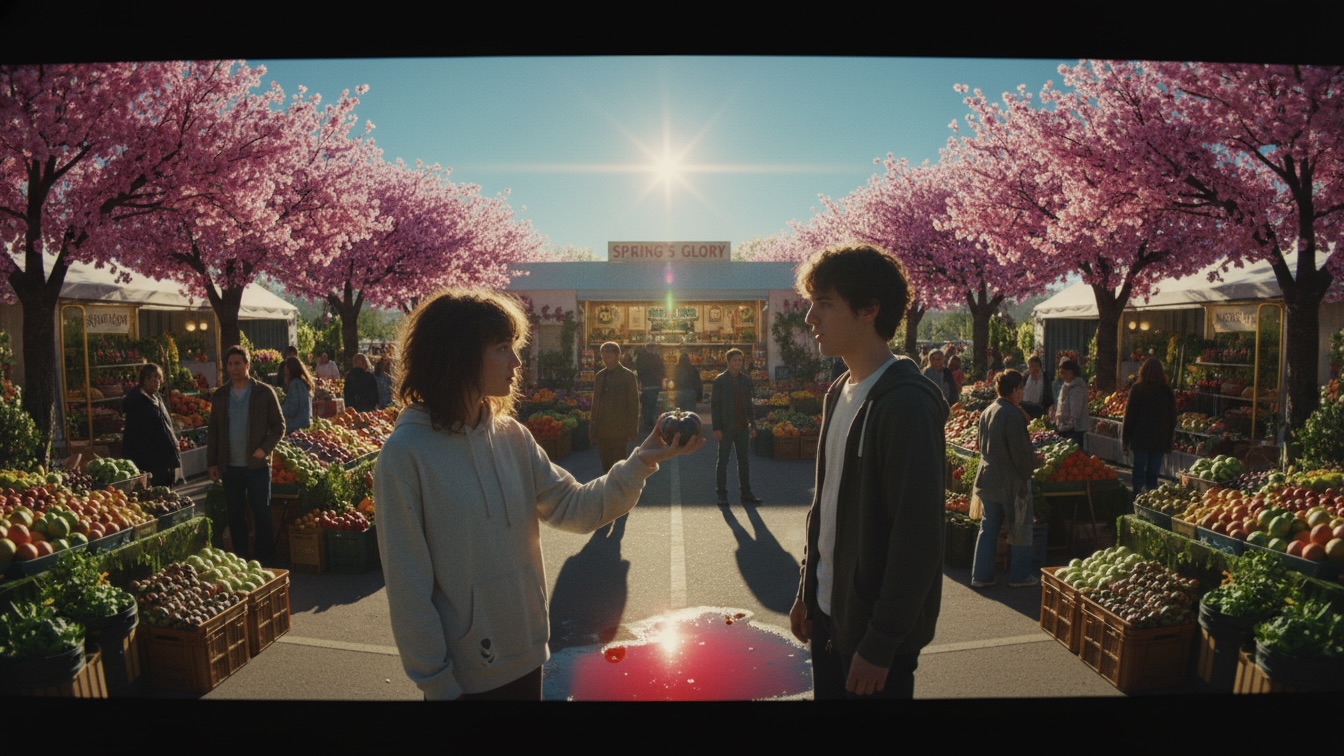
The chapter follows Leo and Sloane as they navigate a local farmer's market on an unseasonably warm April Saturday. Leo is visibly struggling with a sense of sensory overload, perceiving his surroundings as hyper-saturated and unnervingly artificial. While Sloane engages with the environment by appreciating the "ugly" and "real" aspects of the produce, Leo remains trapped in a state of hyper-vigilance.
As they move between stalls, Leo’s internal tension is exacerbated by persistent, ignored calls from his father and his own physical reactions to the crowd. A brief moment of physical contact with Sloane heightens his awareness of his surroundings, yet he remains deeply unsettled by perceived glitches in reality. The narrative concludes with a philosophical exchange regarding the artificiality of "normal" life and the non-existence of perfection in nature.
A primary theme explored in this text is the conflict between perceived reality and internal psychological states. Leo experiences the world through a lens of sensory distortion, where the sun is "aggressive" and the colors are dialed to an impossible intensity. This suggests a state of dissociation or a sensory processing disorder that makes the mundane feel hostile. The farmer's market, usually a symbol of wholesomeness, is recontextualized as a "stage set," highlighting the theme of existential inauthenticity.
The contrast between the organic and the synthetic further underscores the narrative's depth. Sloane’s preference for the lumpy, "ugly" tomato serves as a rejection of the polished, commercialized version of nature that the other patrons consume. Meanwhile, the flickering E-ink tags and the mismatched reflection in the juice puddle introduce a subtle element of the surreal. These details suggest that either the world itself is fraying at the edges or Leo’s mental grip on his environment is beginning to slip.
Finally, the theme of avoidance and the weight of familial expectation permeates the scene. Leo’s physical reaction to his father’s phone calls—the sweaty palms and the twitching eye—reveals a deep-seated anxiety that he is unable to articulate. His refusal to engage with the device creates a silent, mounting pressure that contrasts with Sloane’s blunt, grounding presence. This tension suggests that Leo is running from a personal reality that is far more daunting than the distorted physical world he inhabits.
Leo presents as a character in the throes of a significant psychological crisis, likely manifesting as high-functioning anxiety or a dissociative episode. He utilizes "observation" as a defense mechanism, a way to distance himself from the overwhelming stimuli of his environment. By categorizing his surroundings with clinical precision, he attempts to exert control over a world that feels increasingly unstable. His physical symptoms, such as the involuntary eye twitch and the sensation of walking through "invisible gelatin," indicate that his stress is being somatized.
His relationship with his father is a clear source of unspoken trauma or conflict, acting as the catalyst for his current state of hyper-arousal. He views himself as an outsider in a world of "normal" people, feeling a profound sense of alienation from the crowd. This isolation is only bridged by his proximity to Sloane, whose presence provides both a painful intensity and a necessary anchor. Leo is a man trapped between the desire to escape his own mind and the fear of what happens when he stops running.
Sloane serves as the narrative’s grounding force, possessing a keen emotional intelligence that allows her to see past Leo’s defensive posturing. She is characterized by her authenticity and her refusal to adhere to social pretenses, as evidenced by her disheveled appearance and her appreciation for the "ugly" tomato. Her dialogue is sharp and perceptive, acting as a mirror that reflects Leo’s internal state back to him. She does not coddle him; instead, she challenges his perceptions and forces him to confront his physical reality.
Her cynicism regarding "normalcy" and "perfect circles" suggests a philosophical depth and a possible history of her own struggles with societal expectations. She occupies the space comfortably, moving through the market with a confidence that Leo lacks. Despite her bluntness, there is an underlying sense of care in her observations of his physical tics. She acts as a catalyst for Leo, pushing him to stop "thinking" and simply exist in the moment, even if that existence is uncomfortable.
The narrative voice is characterized by a sharp, minimalist prose style that mirrors the protagonist’s fractured mental state. The author uses vivid, often violent imagery—such as a hoodie looking like it went through a "shredder" or a tomato resembling a "bruised kidney"—to establish a tone of underlying grit. The pacing is deliberate and claustrophobic, focusing heavily on small movements and internal sensations. This creates a sense of intimacy that makes the reader feel as trapped within Leo’s perspective as he is.
Sensory details are used effectively to heighten the sense of unease. The description of the sky as "aggressive blue" and the air as "dense" serves to externalize Leo’s internal pressure. The contrast between the mundane activities of the market and the surreal "glitches" provides a compelling narrative tension. By focusing on the minute details of fabric touching fabric or the smell of ozone, the author anchors the reader in a hyper-realistic world that feels perpetually on the verge of collapse.
The dialogue is sparse but heavy with subtext, revealing the power dynamic between the two characters without the need for extensive exposition. The use of short, punchy sentences contributes to the frantic energy of Leo’s internal monologue. Overall, the stylistic choices emphasize the theme of perception versus reality. The writing successfully captures the feeling of a panic attack in slow motion, where every detail is magnified and every interaction is fraught with hidden meaning.


