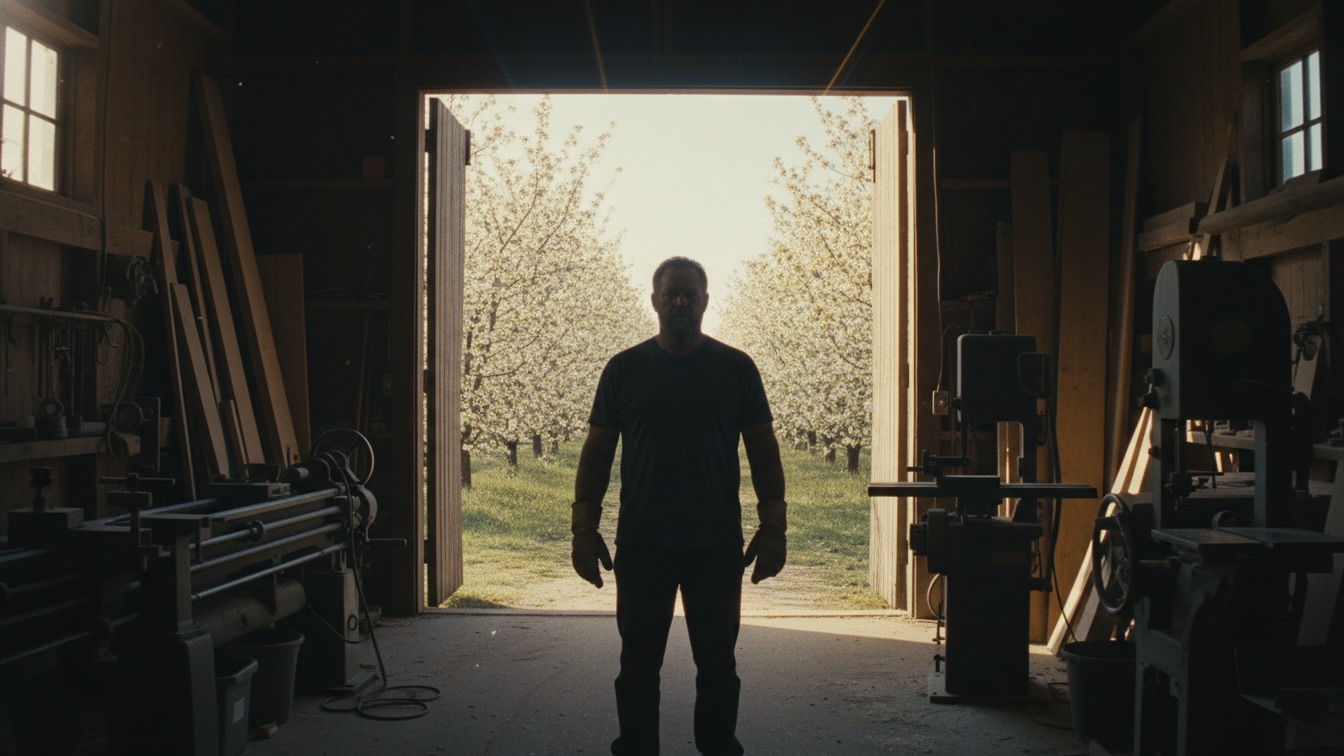
Ed watches his legacy crumble as trade wars turn the promise of spring into a cold, fiscal winter.
Ed stood at the center of the workshop, his palms resting on the rough surface of a half-finished dining table. The wood was white oak, sourced from a mill three hundred miles north, but the finish he needed—a specific, oil-based resin that brought out the honeyed depth of the grain—was currently sitting in a shipping container three thousand miles away.
The air in the shop was thick with the scent of sawdust and the aggressive sweetness of the cherry blossoms drifting in through the open clerestory windows. It was spring. The earth was waking up, shoving green shoots through the thawing mud, promising growth and abundance. But inside the shop, the atmosphere was curdling. The light didn't hit the floor the way it usually did. It felt heavy, a grey mass that seemed to pool in the corners, ignoring the laws of physics. Ed blinked, rubbing his eyes. The shadow stayed. It was a physical presence, a thickness in the air that made his lungs feel small.
He checked his watch. It was four in the afternoon. Usually, the hum of the lathes and the scream of the table saw filled the space, a productive cacophony that meant money was being made. Today, the machines were silent. The power bill had tripled in a month, and the cost of the imported steel fasteners had spiked so high that every screw he turned felt like a drop of blood leaving his veins. He looked at the white oak. It was supposed to be the centerpiece of a set for a family in the city. They wanted it by May. They had paid a deposit, a sum that had already been swallowed by the rising cost of keeping the lights on. Now, the rest of the materials were locked behind a new wall of tariffs and trade disputes that Ed didn't fully understand, but felt in his gut like a slow-moving landslide.
Paul walked in through the side door, his boots dragging against the concrete. The younger man was wearing a faded hoodie, his face illuminated by the blue glow of his phone. He didn't look up until he reached the workbench. He moved with the jittery energy of a generation that expected the world to end every Tuesday. Paul was twenty-four, Ed’s nephew, and the only employee left. He was supposed to be the future of this place, the one who would take the chisels and the planes when Ed’s hands finally grew too stiff to hold them. But looking at him now, framed by the dying light and the strange, shifting shadows of the shop, Ed saw only a ghost of a plan.
“Ports are jammed,” Paul said. He didn't say hello. He didn't need to. The news was always the same now. “They’re holding the resin. Customs says the new tax applies retroactively. We owe six grand just to get the drums on a truck. Then there’s the fuel surcharge. It’s cooked, Ed. Totally cooked.”
Ed straightened his back. He felt the familiar ache in his lumbar, a sharp reminder of thirty years spent hunched over wood. He tried to summon the formal weight of his father’s voice, the theatrical gravitas that had always commanded respect in this town. “We do not use the word ‘cooked’ in this establishment, Paul. We are craftsmen. We deal in solutions, not in the vernacular of the defeated. The state may demand its tribute, and the oceans may boil with the friction of trade, but the wood remains. The grain does not change its path because a politician signs a decree.”
Paul looked at him, his thumb scrolling rapidly. “Bruh, the grain doesn’t pay the rent. Landlord’s out front. He’s not doing the ‘craftsman’ vibe. He wants the check. Shipping company sent an automated text. If we don’t pay the tariff by midnight, they’re auctioning the lot. That’s our resin. That’s the finish for the next six months of orders. We lose that, we’re just sanding sticks in the dark.”
Ed turned away, his fingers tracing a knot in the oak. It felt like a blemish, a hard, unyielding eye staring back at him. “The arrogance of it,” Ed whispered, his voice echoing in the rafters. “To think that they can stifle the natural flow of commerce with a stroke of a pen. They see numbers on a spreadsheet. They do not see the sap. They do not see the years of growth required to produce a single plank of this quality. We are being bled dry by men who have never had a splinter in their lives.”
“Whatever,” Paul said, leaning against a stack of plywood. “It’s just math. Costs go up, we go down. I’m gonna go check the mail. Maybe someone sent us a miracle. Or a lawsuit. Probably a lawsuit.” He shuffled out, his phone still glued to his palm. Ed watched him go, feeling a profound sense of isolation. The shadow in the corner seemed to grow, a dark mass that didn't just block the light but consumed it. It was the Shadow Mass—the physical manifestation of the debt, the stress, and the fragility of his existence. It felt like a cold draft on the back of his neck, though the spring air outside was warm and fragrant.
He walked to the window. Outside, the apple trees were in full bloom. White and pink petals drifted through the air like slow-motion snow. It was a scene of perfect, unbothered beauty. Nature didn't care about supply chains. The trees didn't ask for permission to blossom. They simply did. They followed a logic that was older and more robust than the global economy. For a moment, Ed felt a surge of jealousy. He wished he were a tree. He wished his roots were deep enough to ignore the fluctuations of the dollar and the whims of the maritime unions. But he was a man, and a man was a creature of contracts and currencies.
He heard a sound from the back of the shop. A soft, wet thud. He turned, but saw nothing. The Shadow Mass had shifted. It was closer now, hovering near the rack where he kept his specialized Japanese saws. These tools were his pride. He had spent years learning how to use them, how to pull instead of push, how to trust the thin, razor-sharp steel. If he lost the shop, he would lose the tools. They would be sold at an estate auction, picked over by hobbyists who didn't know the difference between a crosscut and a rip. The thought made his stomach turn over. It was a physical nausea, a sour heat rising from his gut.
He reached out and grabbed a hand plane. The cold metal felt grounding. He needed to work. He needed to feel the wood resisting him, to hear the curl of a shaving as it left the surface. He set the blade and began to stroke the oak. Zip. Zip. Zip. The sound was rhythmic, a heartbeat for the room. But the wood felt different today. It felt brittle. It felt like it knew it was never going to be finished. It was as if the economic shock had vibrated through the very atoms of the workshop, poisoning the materials themselves.
Paul came back in, holding a stack of envelopes. He tossed them onto the workbench. They slid across the oak, leaving faint trails in the dust. “Tax man. Electric. And a letter from the bank. It’s got that ‘final notice’ red ink on the front. Very aesthetic. Very doomed.”
Ed stopped planing. He didn't look at the letters. “Paul, your generation finds a strange comfort in the apocalypse. You wear it like a garment. You find ‘aesthetic’ in the ruins of a life’s work. Tell me, do you have no desire to see this continue? Does the smell of the shop mean nothing to you?”
Paul sighed, picking at a hangnail. “It smells like work, Ed. It smells like being tired. I like the wood, sure. But I also like eating. I like having a phone that works. We’re out of wood. We’re out of oil. We’re out of money. You’re talking about the ‘soul of the craft’ while the ship is literally sinking. Look at the light, man. It’s weird in here. It feels like... I don't know. Like the air is broken.”
Ed looked at the light. Paul was right. It did feel broken. The Shadow Mass was no longer just in the corners; it was weaving between them, a grey veil that made the tools look distant, as if they were already part of a museum exhibit from a forgotten era. “The air is not broken, Paul. Our systems are broken. We have built a world of glass and expected it not to shatter when the wind blew. We are seeing the fragility of our own making.”
“Cool,” Paul said. “So, do I call the shipping company or just let them have the resin? Because if we don’t pay, I’m out. I can’t work for ‘legacy.’ Legacy doesn’t buy gas.”
Ed felt a flash of anger, a sharp, hot spark that cleared the fog of the Shadow Mass for a second. “You will call them. You will tell them that Ed Thomas does not abandon his cargo. You will tell them we are negotiating with the bank. We will find a way. We have survived droughts and recessions before. We will survive a tariff.”
“It’s not just a tariff,” Paul snapped, his theatricality matching Ed’s for a brief, ugly moment. “It’s everything. The wood is more expensive. The glue is more expensive. The customers are canceling because they’re scared too. It’s a chain reaction, Ed. We’re at the end of the chain. We’re the ones who get snapped off.”
Paul turned and walked out, his boots loud on the concrete. The door slammed, and the sound echoed through the silent shop, a final, percussive note. Ed stood alone. The Shadow Mass moved in, filling the space Paul had occupied. It felt cold. It felt like the late frost that killed the blossoms. He looked out the window again. The sun was dipping below the horizon, casting long, distorted shadows across the orchard. The pink of the blossoms was turning to a bruised purple. The spring abundance was a mask. Underneath, the same old struggle for survival remained, cold and indifferent.
He picked up the bank letter. The red ink was bright, almost glowing in the dim light. It was a demand for payment, a cold calculation of his worth. He thought about his father, who had built this shop with his own hands after the war. His father had faced different shadows—rationing, scarcity, the slow rebuild of a shattered world. But there had been a sense of shared purpose then. Now, it felt like everyone was on their own, a billion tiny islands drifting apart in a rising sea of debt.
Ed walked to the back of the shop, where the oldest lumber was stored. These were planks he had saved for years, special pieces of walnut and maple with figuring so beautiful it looked like liquid. He had planned to use them for something truly special, a masterpiece that would define his career. He ran his hand over the walnut. It was dusty. It was waiting. But even this wood was a liability now. If he couldn't afford the finish, if he couldn't afford the electricity to run the saws, it was just fuel for a fire.
He felt a sudden, sharp pain in his chest. It wasn't a heart attack—he knew the difference—but a tightening of the muscles, a physical reaction to the weight of the air. He leaned against the lumber rack, his breath coming in short, shallow gasps. The Shadow Mass was pressing against him. It felt like wool, thick and suffocating. He realized then that the mass wasn't something outside of him. It was the accumulation of every choice he had made, every debt he had taken, every dream he had pinned to the stability of a world that was fundamentally unstable.
He looked at his hands. They were covered in fine white dust. They were the hands of a man who created things. But in a world of tariffs and supply chain fractures, the act of creation was a luxury. The world didn't want tables. It wanted liquidity. It wanted margins. It wanted the friction of trade to produce heat, even if that heat burned down the house.
He walked back to the white oak table. In the center of the wood, right where the honeyed grain was supposed to shine, he saw a crack. It was small, a hairline fracture that hadn't been there an hour ago. He leaned in, his eyes widening. It wasn't a natural check in the wood. It was a stress fracture. The wood was reacting to the environment. The humidity in the shop had dropped because he had turned off the climate control to save money. The spring air was too dry, too volatile. The wood was splitting.
He touched the crack. It felt like a wound. He had failed the wood. He had failed the craft. The legacy he had fought so hard to protect was literally coming apart under his fingers. He heard the sound of a car pulling into the gravel driveway. It wasn't Paul. Paul’s car had a hole in the muffler that sounded like a machine gun. This was a smooth, heavy engine. A luxury SUV. The landlord. Or the bank’s appraiser. Or a customer coming to demand their deposit back.
Ed didn't move. He watched the crack in the white oak. It seemed to grow as he watched, a tiny, jagged canyon opening up in the heart of his work. Outside, the wind picked up, blowing a cloud of cherry blossom petals into the shop. They settled on the dusty floor like confetti at a funeral. The Shadow Mass was everywhere now, a total eclipse of the spirit. He felt a strange sense of peace. The struggle was reaching its end. The frost had arrived, and the tender shoots of his life were turning black.
He looked at the door. The handle turned. The metal groaned, a long, theatrical sound that seemed to last forever. Ed braced himself. He didn't know who was on the other side, but he knew what they represented. They were the personification of the trade shock, the human face of the economic winter. He stood tall, smoothing his apron, trying to find one last shred of the man he used to be. But his hands were shaking. He couldn't hide the tremor. He was a craftsman with no materials, a builder with no foundation, a man standing in a forest of blooming trees that were all about to die.
The door swung open, and the light from the setting sun flooded the room, blinding him for a second. The Shadow Mass retreated, but only for a moment, hovering just out of sight like a predator waiting for the light to fail. A figure stood in the doorway, a silhouette against the vibrant, cruel colors of the spring evening. Ed squinted, his heart hammering against his ribs. The figure didn't speak. It just stood there, a dark shape holding a briefcase, the finality of the situation settled into the very air of the room.
“The silhouette stepped forward into the sawdust, and Ed realized with a jolt of terror that the visitor wasn't there to collect a debt, but to deliver a notice of seizure for the very land beneath his feet.”


